Listen to this Post
Introduction:
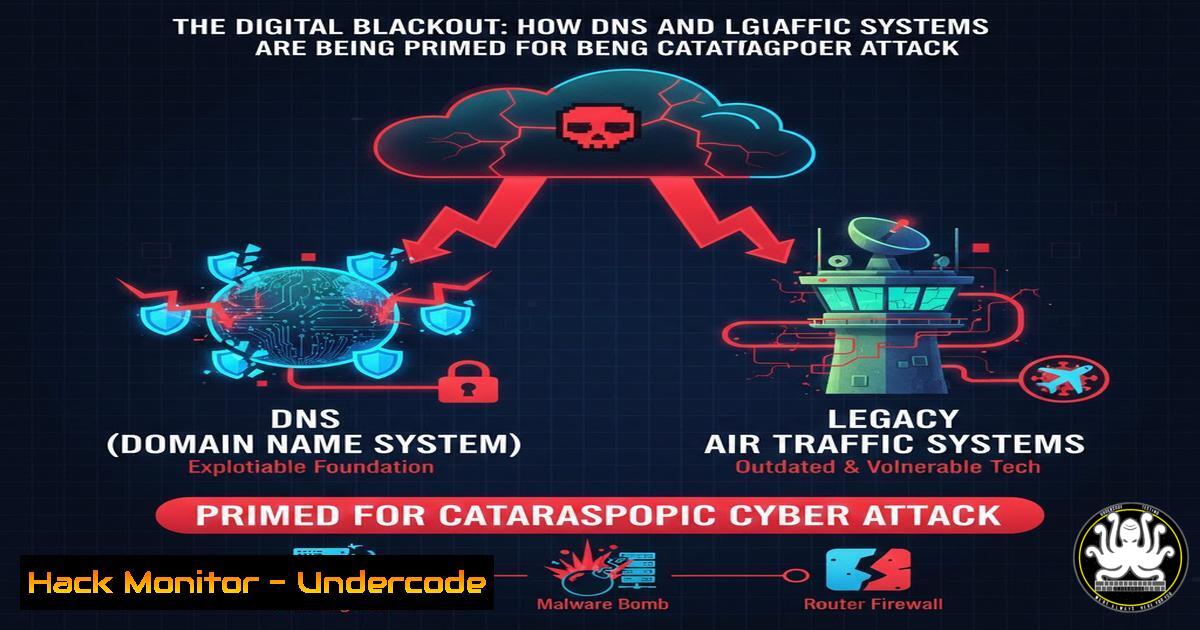
Recent airspace closures in Greece, the UK, and the US are not mere technical glitches but potential indicators of systemic vulnerabilities in aviation’s critical IT infrastructure. These events highlight a terrifying reality: foundational systems like DNS (Domain Name System) and unsecured legacy networks form a perfect, reusable attack template for state and non-state actors seeking to cause mass disruption without kinetic conflict. This article deconstructs the exposed weaknesses and provides a technical blueprint for hardening these vital systems.
Learning Objectives:
- Understand the critical role of DNS and DNSSEC in aviation infrastructure and how misconfigurations can lead to national-level outages.
- Learn to identify and secure misconfigured and illegitimate infrastructure within critical operational technology (OT) and IT networks.
- Implement proactive hardening measures for cloud and on-premises systems supporting air traffic management.
You Should Know:
- DNSSEC Is Just the First Lock on a Shattered Door
The post reveals a staggering fact: the UK’s NATS only implemented DNSSEC after a catastrophic outage in August 2023. DNSSEC (Domain Name System Security Extensions) prevents DNS cache poisoning by cryptographically signing DNS data. However, as the post astutely notes, this alone is insufficient. It secures the directory but not the myriad applications, databases, and APIs that rely on it.
Step‑by‑step guide:
First, verify if your organization’s critical domains use DNSSEC:
 Linux/macOS using dig
dig @8.8.8.8 example.com +dnssec +short
 Look for "RRSIG" records in the output. No RRSIG means no DNSSEC.

Using the `ldns` package for validation
dnskey-verify -v example.com
On Windows, use PowerShell:
Resolve-DnsName example.com -Server 8.8.8.8 -DnssecOk
 Check for "Signature" property in the output.
But don’t stop there. Conduct a full DNS audit:
– Subdomain Enumeration: Use tools like `amass` or `sublist3r` to discover all assets. `amass enum -d example.com -passive`
– Check for NS/DNS Delegation Hijacking: Ensure authoritative name servers are correctly configured and not pointing to illegitimate infrastructure. `dig ns example.com`
– API and Service Discovery: Use `nmap` to scan for exposed services on discovered IPs. `nmap -sV –script ssl-cert,http-title -iL discovered_ips.txt`
2. Hunting Misconfigured and Illegitimate Infrastructure
The “misconfigured and illegitimate infrastructure embedded deep within systems” is a hallmark of supply chain compromises and inadequate change management. This can be rogue VMs, shadow IT cloud instances, or unauthorized devices on the operational network.
Step‑by‑step guide:
- Cloud Asset Inventory: In AWS, use AWS Config rules `required-tags` to flag untagged resources. Use the CLI to list all EC2 instances and S3 buckets:
aws ec2 describe-instances --query 'Reservations[].Instances[].{ID:InstanceId,State:State.Name,IP:PublicIpAddress,Tags:Tags}' aws s3 ls - Network Traffic Baselining: Use Zeek (formerly Bro) to create a baseline of legitimate network flows. Anomalies can indicate C2 traffic.
Sample Zeek startup for monitoring
zeek -i eth0 local
Review the generated conn.log for unexpected external connections.
- Windows Command for Suspicious Services: On critical Windows servers (common in ATC backend systems), audit services:
Get-WmiObject win32_service | Select-Object Name, State, PathName, StartName | Where-Object {$_.PathName -notlike "C:\Windows"} | Format-List
Investigate any service binaries not in standard Windows paths.
3. Hardening Aviation API Security
Modern Air Traffic Management (ATM) systems rely on APIs for data exchange between flight planning, weather, and surveillance systems. These are prime targets.
Step‑by‑step guide:
- Implement API Gateway Security: Use a gateway (e.g., AWS API Gateway, Kong) to enforce rate limiting, authentication, and schema validation.
- OAuth 2.0 and Mutual TLS (mTLS): Never use API keys alone. For system-to-system communication in critical infrastructure, enforce mTLS.
Example OpenSSL command to verify a server certificate and present a client certificate
openssl s_client -connect api.critical-aviation.local:443 -cert client.crt -key client.key -CAfile ca.crt
- Static Application Security Testing (SAST): Integrate SAST tools like Semgrep or Checkmarx into the CI/CD pipeline for API source code. A sample Semgrep rule to find hard-coded secrets:
rules:</li>
<li>id: hardcoded-secret
patterns:</li>
<li>pattern-regex: "(?i)(api_key|apikey|secret|password|token).=['\"]\w{10,}['\"]"
message: "Hard-coded secret detected"
severity: ERROR
4. Vulnerability Exploitation & Mitigation in OT Environments
Aviation OT networks (e.g., for radar, communications) often run legacy Windows or real-time OS. The EternalBlue exploit (MS17-010) is a known threat.
Step‑by‑step guide (Mitigation):
- Network Segmentation: Firewall rules must separate OT from corporate IT. Use industrial DMZs.
- Patch Management For Legacy Systems: Where patching is impossible, deploy virtual patching via Intrusion Prevention Systems (IPS). A Snort rule to detect EternalBlue scanning:
alert tcp any any -> $OT_NETWORKS 445 (msg:"ET SCAN SMB EternalBlue Echo"; flow:established,to_server; content:"|00 00 00 31 ff|SMB|2e|"; depth:5; metadata:policy max-detect-ips drop; reference:url,blog.talosintelligence.com/2017/05/eternalblue.html; sid:2023496; rev:2;)
- Windows Hardening Command: Disable SMBv1 on Windows servers in the environment:
Set-SmbServerConfiguration -EnableSMB1Protocol $false -Force
5. Incident Response for a “Technical Glitch”
When an outage occurs, the first assumption must be “assume breach.” Have an IR playbook specific to aviation systems.
Step‑by‑step guide:
- Isolate Critical Systems: Have network segmentation plans ready to logically isolate ATM subsystems without causing cascading failures.
- Preserve Logs: Immediately collect logs from DNS servers, firewalls, and critical workstations. On Linux:
tar czf ir_logs_$(date +%s).tar.gz /var/log/. On Windows, use `wevtutil` to export System and Security logs. - Analyze for Persistence: Check for anomalous scheduled tasks (
schtasks /query /fo LIST /von Windows, `crontab -l` and `/etc/cron` on Linux) and new privileged accounts (net localgroup administratorson Windows, `grep ‘^sudo’ /etc/group` on Linux).
What Undercode Say:
- Key Takeaway 1: Aviation’s systemic risk is not just about unpatched software; it’s a failure of architectural security fundamentals. Implementing DNSSEC years late is a symptom of a broader culture that treats cybersecurity as a compliance checkbox rather than a core engineering discipline.
- Key Takeaway 2: The “reusable template” is real. Adversaries study these outages. The documented technical details from the FAA and NATS incidents provide a free playbook for attacking similar systems globally. The lack of public attribution is strategically meaningless; the exploit vector has been demonstrated.
The analysis is clear: These outages are stress tests of our collective cyber resilience. Each “glitch” publicly validates an attack method. The aviation sector, built on fail-safe engineering, is applying a dangerously reactive, fail-open mindset to its digital infrastructure. The convergence of IT and OT has created a vast, uncharted attack surface where a single compromised API or a spoofed DNS response can have the physical impact of a traditional weapon. Treating these closures as unrelated incidents is a profound failure of threat intelligence and strategic foresight.
Prediction:
Within the next 18-24 months, a major airspace closure will be publicly attributed to a state-sponsored cyberattack. This will trigger a global regulatory scramble, leading to mandatory, standardized cybersecurity frameworks for aviation OT akin to NIST 800-53 or IEC 62443, enforced by national aviation authorities. Simultaneously, we will see the emergence of specialized cyber insurance products for air navigation service providers, with premiums directly tied to demonstrated security postures like DNSSEC implementation, network segmentation, and red team exercise results. The age of plausible deniability for aviation cyber incidents is ending.
▶️ Related Video (74% Match):
🎯Let’s Practice For Free:
IT/Security Reporter URL:
Reported By: Andy Jenkinson – Hackers Feeds
Extra Hub: Undercode MoN
Basic Verification: Pass ✅


