Listen to this Post
Introduction:
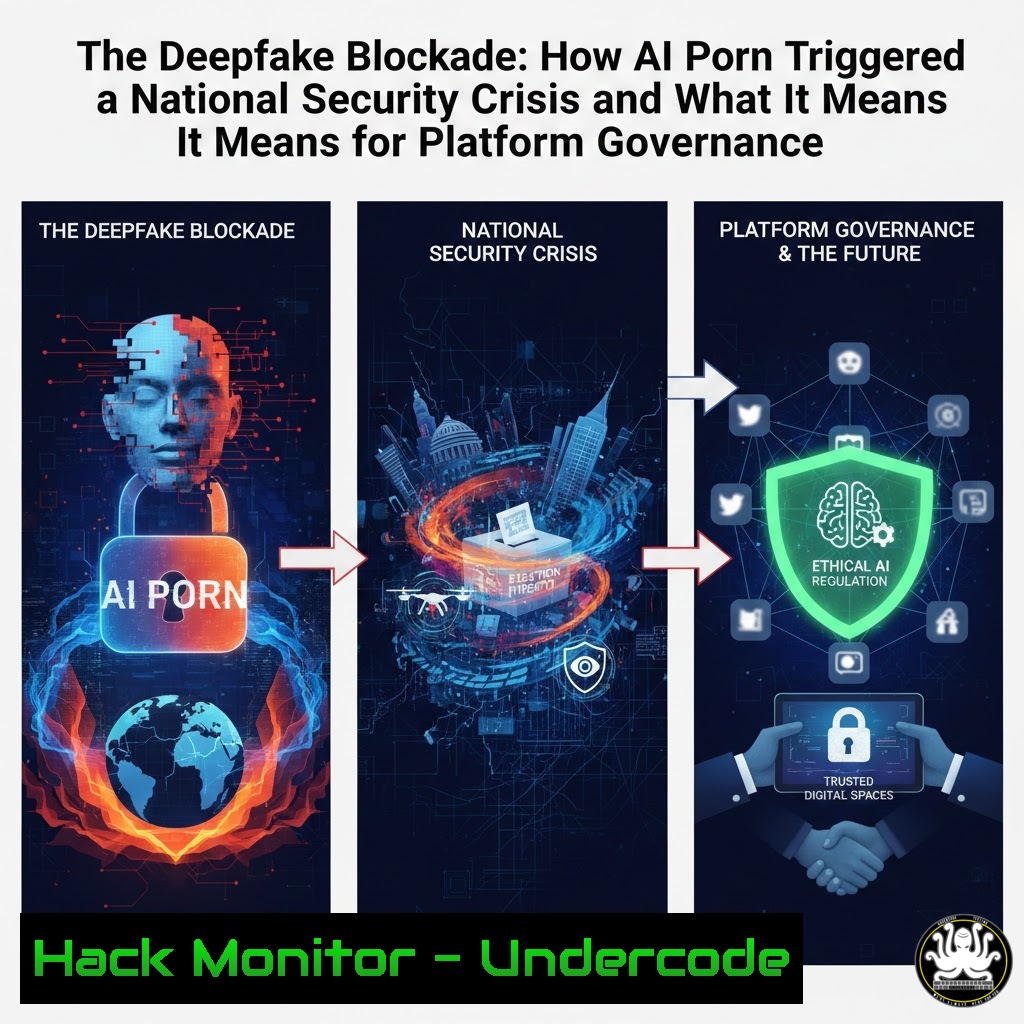
The recent blockade of social media platform X by Malaysia and Indonesia over its failure to curb AI-generated non-consensual intimate imagery represents a watershed moment in digital governance. This action transcends typical content moderation disputes, highlighting a critical collision between rapidly evolving generative AI capabilities, sovereign law, and platform accountability. Governments are now treating unmitigated deepfake proliferation not merely as a policy violation, but as a national security and public order threat demanding drastic intervention.
Learning Objectives:
- Understand the technical mechanisms behind deepfake generation and the corresponding detection/mitigation strategies available to platform engineers.
- Analyze the incident through a cybersecurity governance lens, focusing on “duty of care” failures and foreseeable systemic harm.
- Develop a proactive technical and policy framework for AI-powered social platforms to comply with emerging global regulatory expectations.
You Should Know:
1. The Technical Anatomy of a Deepfake Attack
The core issue prompting the blockade is the automated creation of non-consensual sexual imagery using generative AI models. These models, often accessible via API, can be weaponized by malicious actors.
Step-by-step guide explaining what this does and how to use it.
How It’s Done (Offensive Perspective): Attackers typically use open-source frameworks like DeepFaceLab or Autoencoders. A common pipeline involves:
1. Data Harvesting: Scraping target images from social media using tools like `selenium` or scrapy.
 Example using gallery-dl (Linux/macOS)
gallery-dl "https://www.instagram.com/target_profile/"
2. Model Training: Using a machine learning framework to train a face-swap model on the harvested data.
 Pseudocode for training loop (simplified)
from deepface import DeepFace
 This is illustrative; actual tools are often misused.
model = DeepFace.build_model("Facenet")
 Training would occur on a dataset of source and target faces.
3. Content Generation: Producing the final manipulated media, often blending the target’s face onto a source body.
How to Defend (Platform Responsibility): Platforms must implement detection at upload and via active crawling.
1. Implement Proven Detection APIs: Integrate services like Microsoft Video Authenticator or Facebook’s Deepfake Detection Challenge models.
2. Metadata & Hashing Analysis: Use tools like `exiftool` to check for AI-generation signatures and match known deepfake hashes.
 Check file metadata for anomalies
exiftool suspicious_video.mp4 | grep -i "generator|software"
3. Network Traffic Analysis: Monitor for patterns of bulk image downloads from single IPs, potentially indicating data harvesting for model training.
- Content Moderation at Scale: APIs, Heuristics, and Automation
For a global platform, manual review is impossible. Effective moderation requires automated systems flagging content for human review.
Step‑by‑step guide explaining what this does and how to use it.
1. Pre‑upload Filtering: Implement client-side hashing (like PhotoDNA) to screen known CSAM and banned deepfake hashes before the file is fully uploaded.
2. AI‑Powered Classification: Use fine-tuned convolutional neural networks (CNNs) to analyze uploaded images/videos for explicit content and facial manipulation artifacts.
 Example pseudocode for using a TensorFlow-based classifier
import tensorflow as tf
model = tf.keras.models.load_model('deepfake_detector_v2.h5')
prediction = model.predict(preprocessed_image)
if prediction[bash] > THRESHOLD:
send_to_human_review(queue)
3. User‑Behavior Heuristics: Flag users based on behavior patterns: e.g., accounts that upload multiple images of different individuals followed by rapid tagging. This can be tracked via backend logs and analyzed with SIEM rules.
3. Implementing Geographic Compliance via Network Enforcement
When a legal order is issued, platforms must technically enforce geographic blocks, often via IP-based geofencing.
Step‑by‑step guide explaining what this does and how to use it.
1. IP Geolocation Database Integration: Use a service like MaxMind GeoIP2 to map user IP addresses to countries.
2. Web Server Configuration: Block traffic at the edge. For example, in Nginx:
 In nginx.conf or a site configuration
geo $block_country {
default 0;
MM, ID 1;  Malaysia, Indonesia
}
server {
if ($block_country) {
return 451;  HTTP status for legal obstruction
}
}
3. Cloud Provider Firewall Rules: In AWS, use Network ACLs or Security Groups in conjunction with AWS WAF to block IP ranges originating from a country.
 Example AWS CLI to update a WAF IP set (conceptual)
aws wafv2 update-ip-set --scope=CLOUDFRONT --name=BlockRegion --addresses 203.0.113.0/24 192.0.2.0/24 --lock-token <token>
4. API Security Hardening for Generative AI Models
The post mentions Grok AI. Platforms offering AI models must secure their APIs against misuse for generating harmful content.
Step‑by‑step guide explaining what this does and how to use it.
1. Strict Rate Limiting: Prevent bulk generation via aggressive quotas using API gateway tools.
 Example Kong API Gateway rate-limiting plugin config
- name: rate-limiting
config:
minute: 5
policy: local
2. Prompt Filtering and Classification: Analyze all input prompts for violations before the AI model processes them. Use a secondary NLP model to classify prompts as potentially harmful.
3. Mandatory Watermarking & Logging: All AI-generated media must carry an invisible, cryptographic watermark (e.g., using the Imatag or Steg.ai SDK). Log all generation requests with user ID, prompt hash, and output hash for audit trails.
- Building a Cybersecurity Governance Framework for AI Duty of Care
The comment by Jamil Al Thani correctly identifies this as a governance failure. A proactive framework is needed.
Step‑by‑step guide explaining what this does and how to use it.
1. Risk Assessment: Conduct a formal assessment identifying how platform features (e.g., AI APIs, image sharing) can be abused to cause “systemic and foreseeable” harm (non-consensual imagery, misinformation).
2. Implement Controls: Map controls from standards like NIST AI RMF to the risks. For example:
MAP (Measure): Deploy the deepfake detection tools from Section 1.
MANAGE (Govern): Appoint a senior accountable officer for AI safety.
GOVERN (Culture): Establish a clear, transparent policy for handling government takedown requests.
3. Audit and Remediate: Continuously audit the effectiveness of controls through red teaming—hiring ethical hackers to attempt to bypass deepfake filters and generate harmful content on your platform.
What Undercode Say:
- Sovereignty Overrides Platform Policy. The incident proves that when a platform is perceived as an “active risk amplifier,” sovereign states will exercise their ultimate control over internet infrastructure within their borders. Technical compliance (geoblocking) becomes a non-negotiable operational requirement.
- The “Duty of Care” is Now Technical. Legal and ethical duty of care must be translated into executable technical controls—real-time detection, secure API design, and enforceable geographic restrictions. Governance gaps directly lead to service termination.
Analysis: This blockade is not an isolated content dispute but a precedent. It signals that governments are moving beyond negotiating content moderation policies to imposing direct consequences for a lack of effective technical safeguards against AI-amplified harms. For cybersecurity and IT leaders, the mandate is clear: AI product development must be inseparable from AI safety engineering. The technical architectures—from model design and API security to content filtering and compliance enforcement—must be designed with “prevention, traceability, and rapid remediation” as first principles. Platforms that fail to architect for this new reality face not just PR crises, but existential geopolitical blockages.
Prediction:
In the next 2-3 years, we will see the formalization of an “AI Safety Technical Compliance” regime, akin to GDPR for data privacy. Nations will require independent audits of a platform’s AI content generation and moderation systems as a condition for market access. Platforms will need to obtain and renew “AI Trust” certifications, demonstrating verifiable technical controls like watermarking, real-time deepfake detection rates, and abuse rate transparency. This will birth a new cybersecurity subspecialty focused on AI safety auditing and compliance engineering, while platforms resisting this shift will face increasing fragmentation of the global internet along sovereign digital borders.
▶️ Related Video (72% Match):
🎯Let’s Practice For Free:
IT/Security Reporter URL:
Reported By: Michael Tchuindjang – Hackers Feeds
Extra Hub: Undercode MoN
Basic Verification: Pass ✅


