Listen to this Post
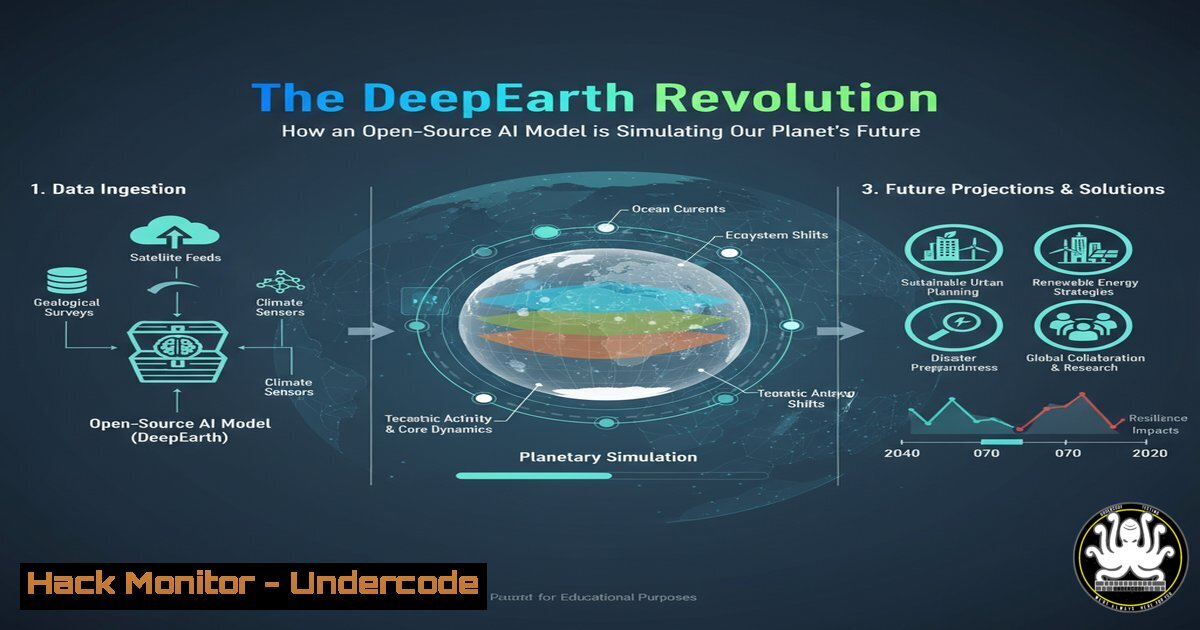
Introduction:
The convergence of artificial intelligence and environmental science has reached a pivotal moment with the emergence of DeepEarth, a foundational model for Ecological Intelligence. This open-source project, developed by leading institutions, represents a paradigm shift in our ability to model, understand, and predict complex planetary systems, offering unprecedented tools for cybersecurity professionals, IT architects, and data scientists to build resilient environmental monitoring and prediction systems.
Learning Objectives:
- Understand the core architecture and data integration capabilities of the DeepEarth AI model for cybersecurity and IT applications.
- Master the technical implementation of DeepEarth for local environmental threat modeling and climate risk assessment.
- Develop secure deployment strategies for large-scale AI models in sensitive research and governmental environments.
You Should Know:
1. Secure GitHub Repository Cloning and Verification
git clone https://github.com/deepearth-ai/core-model.git
cd core-model
git verify-commit HEAD
gpg --verify SHA256SUMS.asc
sha256sum -c SHA256SUMS.asc
This sequence ensures secure acquisition of the DeepEarth codebase. The `git verify-commit` command checks cryptographic signatures on the latest commit, while GPG verification and SHA256 checksum validation protect against repository compromise. Always perform these steps before deploying any open-source AI model in production environments.
2. Containerized DeepEarth Deployment with Security Hardening
docker build -t deepearth:secured .
docker run -d --name deepearth-container \
--security-opt=no-new-privileges:true \
--cap-drop=ALL \
--read-only \
-v /etc/deepearth/config:/config:ro \
-p 8080:8080 \
deepearth:secured
This Docker deployment implements principle of least privilege security. The `–cap-drop=ALL` removes all Linux capabilities, `–read-only` creates an immutable filesystem, and the volume mount provides read-only configuration access. This containment strategy is crucial for AI models processing sensitive environmental data.
3. API Security Configuration for DeepEarth Inference Endpoints
from fastapi import FastAPI, Security
from fastapi.security import APIKeyHeader
import ssl

app = FastAPI()
api_key_header = APIKeyHeader(name="X-API-Key")

ssl_context = ssl.SSLContext(ssl.PROTOCOL_TLS_SERVER)
ssl_context.load_cert_chain('/path/to/cert.pem', '/path/to/key.pem')

@app.post("/predict")
async def climate_prediction(api_key: str = Security(api_key_header)):
 Implementation for environmental modeling
return {"prediction": "climate_impact_data"}
This Python FastAPI configuration establishes secure REST endpoints for DeepEarth predictions. The SSL context enforces encrypted communications, while API key authentication controls access to sensitive climate modeling capabilities. Always implement rate limiting and request validation in production deployments.
4. Data Pipeline Security for Environmental IoT Integration
 Secure MQTT configuration for IoT sensor data
mosquitto_sub -t "sensors/+/climate" \
--cafile /etc/ssl/ca.crt \
--cert /etc/ssl/client.crt \
--key /etc/ssl/client.key \
-h mqtt.deepearth.local \
-p 8883

Data integrity verification
openssl dgst -sha256 -verify public.key -signature data.sig sensor_data.json
This MQTT subscription command with TLS encryption securely collects environmental sensor data for DeepEarth processing. The OpenSSL verification step ensures data integrity before ingestion into AI models, preventing tampering with critical climate monitoring information.
5. Network Security Hardening for Research Infrastructure
 Configure firewall rules for DeepEarth cluster
ufw allow from 10.0.1.0/24 to any port 5432  PostgreSQL
ufw allow from 10.0.1.0/24 to any port 6379  Redis
ufw allow from 192.168.1.100 to any port 22  SSH from management station
ufw deny out from 10.0.1.0/24 to any  Default deny egress
iptables -A FORWARD -p tcp --dport 8080 -m limit --limit 10/min -j ACCEPT
These UFW and iptables rules create a segmented network architecture for DeepEarth deployments. Limiting database access to specific subnets and implementing egress filtering prevents lateral movement in case of container compromise, essential for protecting sensitive environmental models.
6. Vulnerability Scanning for AI Dependencies
 Security scanning for Python dependencies
pip-audit
safety check --json
grype deepearth:latest
trivy image deepearth:secured

Container vulnerability assessment
docker scan deepearth:secured
hadolint Dockerfile
Regular vulnerability scanning is critical for AI research infrastructure. These commands identify CVEs in Python packages, container images, and Dockerfile configurations, helping maintain secure DeepEarth deployments against emerging threats in the AI/ML supply chain.
7. Incident Response for Compromised Environmental Models
 Forensic data collection
sudo journalctl -u docker.service --since "1 hour ago" > docker_logs.txt
docker export deepearth-container > compromised_container.tar
docker exec deepearth-container netstat -tulnp > network_connections.txt

Isolation and remediation
docker pause deepearth-container
docker network disconnect deepearth-network deepearth-container
docker commit deepearth-container forensic-image:investigation
This incident response protocol documents evidence and contains potential compromises of DeepEarth instances. The network isolation and forensic image creation preserve evidence while preventing exfiltration of sensitive climate prediction data or model weights.
What Undercode Say:
- The democratization of planetary-scale AI through open-source models like DeepEarth creates both unprecedented opportunities and significant security responsibilities for research institutions and governments.
- Environmental AI infrastructure must be treated as critical infrastructure, requiring the same security rigor as financial or defense systems due to its potential impact on public policy and resource management.
The DeepEarth model represents a fundamental shift in how we approach planetary security—both cybersecurity and environmental security. As these models become more sophisticated and widely deployed, they will inevitably become targets for nation-state actors seeking to manipulate climate predictions for economic or strategic advantage. The open-source nature, while accelerating innovation, also exposes the underlying architecture to detailed vulnerability analysis by malicious actors. Organizations implementing these systems must prioritize secure software development practices, robust access controls, and comprehensive monitoring to prevent manipulation of environmental predictions that could influence critical infrastructure planning or public policy decisions.
Prediction:
Within three years, we will witness the first major cybersecurity incident targeting environmental AI systems, potentially manipulating climate predictions to influence agricultural markets, water resource allocation, or disaster response planning. This will trigger a global regulatory response, establishing new security frameworks for planetary-scale AI models and creating specialized cybersecurity roles focused exclusively on protecting environmental intelligence infrastructure. The convergence of AI and climate science will become the next frontier in cyber-defense, with nation-states developing specialized capabilities to both protect and potentially compromise these critical systems.
🎯Let’s Practice For Free:
IT/Security Reporter URL:
Reported By: Abfadhly Deepearth – Hackers Feeds
Extra Hub: Undercode MoN
Basic Verification: Pass ✅


