Listen to this Post
Introduction
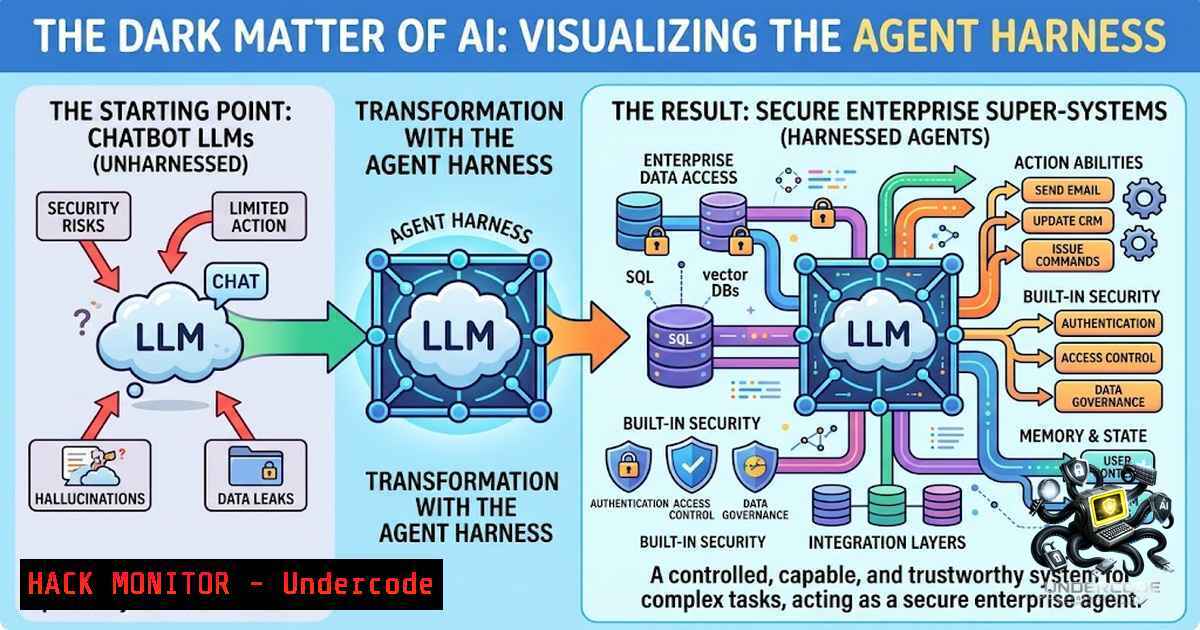
In the rush to deploy generative AI, many organizations mistakenly believe that a powerful Large Language Model (LLM) is the sole ingredient needed to build an autonomous agent. This misconception overlooks the critical orchestration layer—the Agent Harness—which transforms a raw reasoning engine into a secure, context-aware, and operationally safe system. Just as an operating system manages hardware resources and enforces security policies, the harness governs memory, validates actions, and ensures that every interaction adheres to strict enterprise guardrails, turning a simple query like “Where is my order?” into a securely executed workflow.
Learning Objectives
- Understand the architectural distinction between an LLM and a full AI agent system, focusing on the harness as the operating environment.
- Learn how context engineering, prompt assembly, and bounded execution loops enforce security, cost controls, and tenant isolation.
- Gain practical insights into implementing guardrails, validating tool calls, and managing state across a lifecycle-wide agent deployment.
- Context Engineering: The Shift from Raw Data to Curated Memory
The harness begins its work long before the LLM processes a single token. Instead of blindly stuffing the context window with every scrap of available data, it performs sophisticated context engineering. This involves curating three distinct memory types: semantic memory (factual knowledge about the business and its products), episodic memory (the history of the current user interaction), and procedural memory (the defined workflows and policies). The harness dynamically selects and structures this information, ensuring the LLM receives only the most relevant context to make a reasoned decision.
Step‑by‑Step Guide:
- Define Memory Schemas: In your agent configuration, specify the data sources for each memory type (e.g., a product catalog for semantic, session logs for episodic, and policy documents for procedural).
- Implement Retrieval Logic: Use vector databases (e.g., Pinecone, Weaviate) for semantic search and a key-value store (e.g., Redis) for quick session lookups.
- Curate the Input: The harness queries these sources, filters by user permissions, and compiles a JSON structure containing only the necessary data.
Linux Command Example (Inspecting a Vector Database Index):
curl -X GET "http://localhost:8080/indexes/product_catalog/stats" \
-H "Authorization: Bearer $PINECONE_API_KEY" | jq '.totalRecordCount'
This command verifies that your semantic memory is populated correctly, ensuring the harness has data to draw from.
2. Deterministic Prompt Assembly: Moving Beyond Ad-Hoc Text
A common pitfall in agent development is the use of ad‑hoc, non‑versioned prompt construction. The harness addresses this by deterministically assembling the prompt. It compiles static system instructions, dynamic variable substitutions (like the current user ID and order number), and tool definitions into a versioned template. This ensures repeatability and allows for rigorous testing and rollback.
Step‑by‑Step Guide:
- Create a Prompt Template: Store your system prompt as a Jinja2 or Mustache template, with placeholders for dynamic variables.
- Define Tool Schemas: Use JSON Schema to define every function the agent can call (e.g.,
get_order_status,update_shipping_address). - Assemble and Version: The harness reads the template, injects live data, and appends the tool schemas, producing a final prompt that is hashed and logged for traceability.
Code Snippet (Python Prompt Assembly):
from jinja2 import Template

template = Template("""
System: You are a secure assistant for user {{ user_id }}.
Current Date: {{ current_date }}
Instructions: {{ instructions }}
Tools available:
{{ tools_schema }}
""")
final_prompt = template.render(user_id="u_1234",
current_date="2026-07-26",
instructions="Use get_order_status first",
tools_schema="[{'name':'get_order_status', 'parameters':...}]")
print(final_prompt)
3. The Bounded Agent Loop: Validation Before Execution
The LLM may propose an action, but the harness governs its execution. In the bounded loop, the harness intercepts the proposed tool call, validates it against strict security policies, checks token consumption, and evaluates cost implications before allowing the action to proceed. This prevents runaway loops, unauthorized actions, and cost overruns.
Step‑by‑Step Guide:
- Implement an Interceptor: Before executing any tool, the harness validates the call against an allowlist.
- Check Budget and Limits: Query the current session cost and compare it against the per‑request or per‑day limit.
- Execute or Reject: If valid, execute the tool; if not, return a graceful error to the LLM and user.
Linux Command (Monitoring Token Usage with an LLM Gateway):
tail -f /var/log/agent_gateway/requests.log | grep "token_count"
This real-time monitoring helps track that the bounded loop is effectively throttling token usage, preventing an expensive response from going over budget.
4. Lifecycle-Wide Guardrails: From Input to Output
Security in agent systems must be pervasive, not an afterthought. The harness enforces guardrails at every stage of the lifecycle: input validation prevents injection attacks, tenant isolation ensures user A cannot access user B’s data, and output filtering sanitizes the final response before it reaches the user. This is enforced through a combination of middleware, policy-as-code, and runtime verification.
Step‑by‑Step Guide:
- Input Validation: Use a schema to validate all incoming user messages and parameters.
- Tenant Isolation: Attach a tenant ID to every log, metric, and state object.
- Output Filtering: After the LLM generates a response, the harness scans it for sensitive data (PII, secrets) using regex or an LLM-based filter, redacting or blocking as needed.
Windows PowerShell Command (Validating JSON Input against a Schema):
$inputJson = Get-Content -Raw -Path "user_request.json" | ConvertFrom-Json
$schema = Get-Content -Raw -Path "request_schema.json" | ConvertFrom-Json
if (-1ot (Test-Json -Json (ConvertTo-Json $inputJson) -Schema (ConvertTo-Json $schema))) {
Write-Host "Input validation failed!" -ForegroundColor Red
}
5. Core Design Principle: LLM Reasons, Harness Operates
The foundational philosophy of the agent harness is to separate reasoning from operation. The LLM is the brain that determines what to do, but the harness is the body that enacts those decisions safely. This separation allows for modular upgrades: you can swap out the underlying model (e.g., from GPT‑4 to Claude 3.5) without rewriting your security logic, and you can evolve your harness policies independently of model updates.
Step‑by‑Step Guide to Enforce This Principle:
- Decouple Components: Expose a standard API for the harness to communicate with the LLM, using OpenTelemetry for tracing the reasoning vs. execution steps.
- Implement Fallback Logic: If the harness detects suspicious behavior (e.g., the LLM tries to call a tool out of context), it can override the action and log the event.
- Audit and Log: Record every “reasoning” step and “operation” step in separate logs to provide a clear audit trail.
Linux Command (Splitting Logs for Analysis):
grep "reasoning" /var/log/agent.log > reasoning_events.csv
grep "operation" /var/log/agent.log > operations_events.csv
This allows security analysts to review what the model intended versus what the system actually executed, identifying potential behavioral anomalies.
6. Architectural Visualization: The Request-State Lifecycle
To truly grasp the harness, one must visualize the full request-state lifecycle. From the moment a user sends a message, the harness enters a state machine: Initial → Context Retrieval → Prompt Assembly → Validation & Execution → Output Post-processing → Completion. At each state, the harness may pause, rollback, or escalate to a human agent if thresholds are exceeded.
Step‑by‑Step Guide to Visualize:
- Model Your State Machine: Use a tool like Mermaid or PlantUML to diagram the lifecycle.
- Instrument with Metrics: Add Prometheus counters to track how many requests enter each state.
- Monitor with a Dashboard: Create a Grafana dashboard showing the flow of requests across the lifecycle, highlighting bottlenecks or failures.
Mermaid State Diagram (Conceptual):
stateDiagram-v2
[] --> ContextRetrieval
ContextRetrieval --> PromptAssembly: Data available
PromptAssembly --> ValidationLoop: Prompt compiled
ValidationLoop --> ExecuteTool: Validation pass
ValidationLoop --> ErrorHandler: Validation fail
ExecuteTool --> PostProcess: Tool success
ExecuteTool --> ErrorHandler: Tool failure
PostProcess --> []: Response sent
ErrorHandler --> []: Error logged & user notified
7. Security Hardening: Secrets, Tools, and Injection
A critical aspect of the harness is how it manages secrets and prevents prompt injection. Tool definitions must never expose raw API keys; instead, the harness should use a secrets manager (e.g., HashiCorp Vault) to inject credentials at runtime. Similarly, prompt injection attacks—where a user attempts to override system instructions—are mitigated by escaping user input and using separate system and user message roles in the chat API.
Step‑by‑Step Guide:
- Integrate a Secrets Manager: Use the Vault API to fetch credentials per tenant.
- Escape User Input: Strip or encode any tokens that resemble system instructions.
- Use Roles: When calling the LLM API, set the system message as a separate parameter, never allowing user messages to override it.
Linux Command (Retrieving a Secret for a Tool):
vault kv get -field=api_key secret/tools/get_order_status/prod
This ensures the harness securely fetches the credential only when needed and never logs it.
What Undercode Say
- Key Takeaway 1: The Agent Harness is not a luxury but a necessity for any enterprise deploying LLMs, transforming a generic reasoning engine into a secure, accountable, and cost-controlled system.
- Key Takeaway 2: The separation of “reasoning” (LLM) from “operation” (harness) provides a decoupled architecture that allows for independent evolution of the model and the security policies, significantly reducing risk and operational overhead.
Analysis: Naveed Munsif’s deep dive highlights a critical oversight in the current AI hype cycle: the allure of the model itself overshadows the operational glue that makes it enterprise-ready. By focusing on the harness, developers can mitigate common failure modes like token blowouts, unauthorized tool execution, and data leakage. The state-machine approach to lifecycle management is especially powerful, as it provides a clear, auditable trail of every decision and action, turning the “black box” of AI into a transparent, governable workflow. This architectural shift is reminiscent of the move from monolithic databases to microservices—it introduces complexity in design but pays off exponentially in resilience and security. As organizations scale their AI investments, those who neglect the harness will find themselves with brittle, expensive, and insecure systems, while those who embrace it will build durable foundations for autonomous business operations.
Prediction
- +1 The mainstreaming of Agent Harness architectures will lead to a new class of AI governance platforms, making it easier for regulated industries (finance, healthcare) to adopt AI agents without fear of compliance breaches.
- -1 Organizations that skip implementing a robust harness will face severe cost overruns due to uncontrolled token usage and may become prime targets for prompt injection attacks, leading to data exfiltration and reputational damage.
- +1 The market will see a surge in “harness-as-a-service” offerings, akin to cloud providers, allowing smaller companies to leverage enterprise-grade agent security without building it in-house.
- +1 Over the next two years, we’ll see the emergence of standard open-source harnesses that become the industry baseline, much like Kubernetes for container orchestration, fostering interoperability and security best practices.
- -1 The increased complexity of harnessed systems will create a skills gap, as traditional software engineers and data scientists must learn new paradigms of stateful, secure AI orchestration, potentially slowing adoption in resource-constrained organizations.
▶️ Related Video (74% Match):
🎯Let’s Practice For Free:
🎓 Live Courses & Certifications:
Join Undercode Academy for Verified Certifications
🚀 Request a Custom Project:
Secure, high-velocity infrastructure and disruptive technological engineering. Contact our engineering team for high-tier development and proprietary systems:
[email protected]
💎 Smart Architecture | 🛡️ Secure by Design | ⭐ Trusted by Thousands
IT/Security Reporter URL:
Reported By: Naveed Munsif – Hackers Feeds
Extra Hub: Undercode MoN
Basic Verification: Pass ✅


