Listen to this Post
Introduction
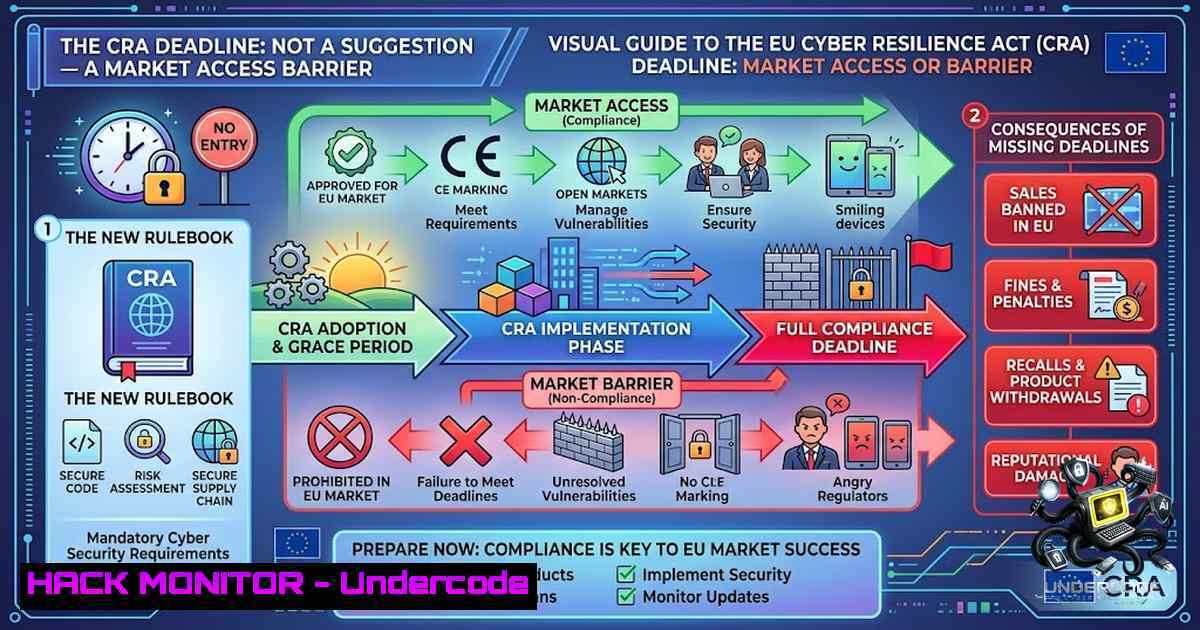
The European Union has fundamentally rewritten the rules of market access for any product with digital elements. The Cyber Resilience Act (CRA) transforms cybersecurity from a voluntary differentiator into a mandatory condition of sale within the EU single market – mirroring the CE marking framework for physical safety. With reporting obligations activating on 11 September 2026 and full product compliance required by 11 December 2027, organisations that treat this as mere bureaucracy are already behind. The recently published Commission guidance C(2026) 5252 provides 67 practical examples and detailed use cases to help manufacturers and developers navigate these requirements, but the clock is ticking.
Learning Objectives
- Understand the CRA’s mandatory reporting timelines and distinguish between vulnerability reporting (24/72-hour windows) and full product conformity (December 2027)
- Identify which products fall within scope, including remote data processing solutions and free/open-source software
- Build incident detection and reporting infrastructure capable of meeting the 24-hour notification requirement
- Implement risk assessment and technical documentation processes aligned with CRA 26 and ENISA’s Single Reporting Platform
You Should Know
1. The Two-Phase Compliance Timeline: Reporting vs. Conformity
The most critical misunderstanding surrounding the CRA is treating all deadlines as equal. They are not. The regulation operates on two distinct tracks with separate activation dates.
Phase One – Reporting Obligations (11 September 2026): From this date, manufacturers must report actively exploited vulnerabilities and serious incidents through ENISA’s Single Reporting Platform. The notification windows are unforgiving: 24 hours for the initial alert, 72 hours for the complete notification, and a final report within 14 days for vulnerabilities or one month for serious incidents. Critically, this obligation applies retroactively to products already on the market – not just future releases.
Phase Two – Full Product Conformity (11 December 2027): This is when products must bear CE marking and be accompanied by complete technical documentation demonstrating compliance with the CRA’s essential cybersecurity requirements.
Step‑by‑step guide for timeline readiness:
- Conduct a product inventory audit – Catalogue every product with digital elements currently in your portfolio, including legacy products still in circulation.
- Map reporting pathways – Establish internal escalation procedures that can trigger a report within 4 hours of vulnerability discovery to allow buffer for the 24-hour window.
- Implement continuous monitoring – Deploy vulnerability scanning and threat intelligence feeds across all product lines.
- Develop incident response playbooks – Create pre-approved templates for the 24-hour initial alert and 72-hour complete notification.
- Train reporting personnel – Ensure designated staff understand ENISA’s Single Reporting Platform submission process.
Linux command for continuous vulnerability monitoring (CVSS scoring and CVE tracking):
 Install and configure vulnerability scanning for product components
sudo apt-get install nmap vulscan
nmap -sV --script vulscan/vulscan.nse target_host

Monitor for new CVEs affecting your product dependencies
curl -s "https://cve.circl.lu/api/last" | jq '.results[] | {id: .id, summary: .summary, cvss: .cvss}'

Set up automated CVE alerting for your software bill of materials
sbom-tool scan -b . -o sbom.json
cve-bin-tool --input-file sbom.json --format json --output cve_report.json
Windows PowerShell for asset inventory and vulnerability baseline:
 Inventory all network-connected devices with digital elements
Get-1etNeighbor | Select-Object IPAddress, LinkLayerAddress, State

Check for missing security updates on Windows-based products
Get-WUList | Where-Object {$_.IsInstalled -eq $false} | Select-Object , KB

Establish baseline of installed software versions for SBOM generation
Get-WmiObject -Class Win32_Product | Select-Object Name, Version, Vendor | Export-Csv -Path product_inventory.csv
2. Scope Definition: What Products Are Actually Covered?
The CRA’s scope is deliberately broad, covering “products with digital elements” – from baby monitors and smartwatches to enterprise software and cloud-based applications. The new Commission guidance clarifies several ambiguous areas that have troubled compliance teams.
Key scope clarifications from the guidance:
- Remote data processing solutions are explicitly included when they are integral to the product’s functionality
- Free and open-source software falls within scope if placed on the market commercially, though the guidance provides proportionality measures for non-commercial distribution
- “Substantial modification” – defined as changes that affect the product’s cybersecurity compliance – triggers re-assessment obligations
Step‑by‑step guide for scope determination:
- Review product categories against the CRA’s definitions – does your product connect to a network or process digital data?
- Assess indirect digital elements – even hardware components with embedded firmware are covered.
- Evaluate open‑source components – if you distribute software (even free) as part of a commercial offering, compliance applies.
- Document scope decisions – maintain a formal scope determination document for each product line.
- Reassess after substantial modifications – implement a change management process that flags modifications requiring re‑evaluation.
Dependency scanning for open‑source components:
 Generate SBOM for all open‑source dependencies
cd /path/to/product/repo
syft dir:. -o json > sbom.json

Check for known vulnerabilities in open‑source components
grype sbom.json

Monitor for new vulnerabilities in dependencies over time
trivy fs --format table --severity CRITICAL,HIGH .
3. Building the 24‑Hour Reporting Infrastructure
The 24‑hour reporting window is the CRA’s most operationally demanding requirement. Organisations cannot improvise this capability; it requires pre‑existing monitoring, detection, and escalation infrastructure.
Essential infrastructure components:
- Continuous monitoring – SIEM or equivalent logging across all product environments
- Vulnerability intelligence – real‑time feeds from NVD, CISA, and industry‑specific sources
- Incident triage – dedicated team capable of assessing exploitability within hours
- Reporting templates – pre‑filled forms aligned with ENISA’s reporting schema
- Legal/GRC review – streamlined approval process that doesn’t delay the 24‑hour clock
Step‑by‑step guide for infrastructure setup:
- Deploy centralized logging – aggregate logs from all product instances (cloud, on‑prem, edge).
- Implement threat detection rules – create alerts for indicators of compromise specific to your product architecture.
- Establish severity classification – map findings to CRA’s “actively exploited” and “serious incident” definitions.
- Create reporting workflows – automate data collection for the Single Reporting Platform submission.
- Conduct dry runs – simulate incidents and measure time‑to‑report against the 24‑hour target.
ELK stack configuration for real‑time monitoring:
 Filebeat configuration for product log aggregation
filebeat.inputs:
- type: log
enabled: true
paths:
- /var/log/product/.log
fields:
product_id: "product_name_v1"
environment: "production"

Logstash pipeline for vulnerability event detection
filter {
if [bash] =~ /exploit|vulnerability|CVE/ {
mutate { add_tag => ["security_event"] }
date { match => [ "timestamp", "ISO8601" ] }
}
}

Kibana alert for 24‑hour reporting trigger
- name: CRA-24hr-Reporting-Trigger
index: product-logs-
threshold: 1
timeframe: 1h
condition: tags:security_event AND severity:("CRITICAL" OR "HIGH")
4. Technical Documentation and CE Marking Requirements
By December 2027, all covered products must bear CE marking and be accompanied by comprehensive technical documentation demonstrating conformity with the CRA’s essential requirements.
Documentation must include:
- Product architecture and design specifications
- Risk assessment methodology and results
- Vulnerability handling procedures
- Support period commitments (minimum 5 years for most products)
- Software Bill of Materials (SBOM) with version tracking
- Testing and validation reports
Step‑by‑step guide for documentation preparation:
- Adopt a risk‑based approach – follow the guidance’s 67 practical examples for proportionate documentation.
- Implement secure development lifecycle (SDLC) – document security requirements at each phase.
- Maintain living documentation – update with each product release or substantial modification.
- Prepare for notified body assessment – for products in higher criticality classes.
- Retain documentation for 10 years – post‑market surveillance obligations extend well beyond product lifecycle.
Automated SBOM generation and verification:
 Generate comprehensive SBOM with dependency relationships
cd /path/to/product/repo
syft dir:. -o cyclonedx-json > sbom_cyclonedx.json

Verify SBOM against known vulnerability databases
dependency-check --scan . --format HTML --out report.html

Automate SBOM generation in CI/CD pipeline
 Jenkins pipeline snippet:
stage('SBOM Generation') {
sh 'syft dir:. -o spdx-json > sbom_spdx.json'
sh 'grype sbom_spdx.json --fail-on critical'
}
5. Retroactive Application and Legacy Product Compliance
Perhaps the most overlooked aspect of the CRA is its retroactive effect on products already in circulation. Manufacturers cannot simply focus on new products and ignore their existing portfolio.
Implications for legacy products:
- All products on the market after September 2026 are subject to reporting obligations
- Vulnerabilities discovered in older products must be reported through the same 24‑hour framework
- Support periods must be defined and communicated for all products, including legacy lines
- End‑of‑life planning must consider CRA obligations
Step‑by‑step guide for legacy product compliance:
- Prioritize legacy products – focus on those with largest user bases or most critical functions.
- Establish support period definitions – communicate clearly to customers.
- Implement backporting capabilities – ensure security patches can be delivered to older versions.
- Retrospective vulnerability assessment – review known vulnerabilities in legacy codebases.
- Plan phased retirement – where compliance is infeasible, develop end‑of‑life timelines.
Legacy system vulnerability scanning:
 Scan legacy products for known vulnerabilities
nmap -sV -p- --script=vulners legacy_product_ip

Check for end‑of‑life dependencies
npm outdated --depth=0  For Node.js products
pip list --outdated  For Python products

Cross‑reference legacy components against CVE database
cve-search -p openssl-1.0.2  Check specific version
6. The NIS2 and CRA Intersection
The CRA does not exist in isolation. It forms part of a broader European cybersecurity framework alongside NIS2 and the Digital Omnibus proposal. Organisations subject to both must understand how requirements interact.
Key intersections:
- NIS2 focuses on operator obligations and national competent authorities; CRA focuses on product conformity
- Reporting obligations may overlap – CRA reports to ENISA, NIS2 reports to national CSIRTs
- Security requirements in NIS2 influence product design under CRA
- Supply chain security under NIS2 parallels CRA’s value chain obligations
Unified compliance approach:
- Map requirements – identify overlapping and unique requirements across both regulations.
- Establish single reporting interface – coordinate between ENISA and national CSIRT reporting.
- Integrate security management systems – align CRA product security with NIS2 organisational security.
- Conduct joint gap assessments – evaluate compliance posture holistically.
7. What This Means for SMEs and Microenterprises
The Commission guidance explicitly addresses the needs of smaller organisations with proportionality measures and simplified approaches. However, “simplified” does not mean “exempt” – microenterprises must still comply.
Practical considerations for SMEs:
- Leverage the 67 practical examples and use cases in the guidance for proportionality arguments
- Consider outsourcing monitoring and reporting to managed security service providers
- Use open‑source tooling to minimise compliance costs
- Document risk‑based decisions justifying proportionate security measures
What Undercode Say
Key Takeaway 1: The CRA fundamentally changes the cybersecurity game from voluntary best practice to mandatory market access requirement. Waiting until December 2027 to begin compliance work is not an option – the reporting infrastructure required for September 2026 cannot be built overnight.
Key Takeaway 2: The retroactive application of reporting obligations to existing products is the sleeper issue that will catch most manufacturers unprepared. Legacy portfolios represent significant compliance exposure that must be addressed proactively.
Analysis: The Commission’s guidance, while non‑binding, provides essential clarity on scope definitions and proportionality. The inclusion of 67 practical examples reflects genuine engagement with stakeholder concerns. However, the 24‑hour reporting window remains the most challenging operational requirement – most organisations do not currently have the monitoring infrastructure to detect and report an exploited vulnerability within a single business day. This will drive significant investment in security operations capabilities, particularly for SMEs that lack dedicated security teams. The Digital Omnibus proposal suggests the Commission recognises the compliance burden and may offer further simplification, but organisations should not rely on regulatory relief. The trajectory is clear: cybersecurity is now a condition of market access, and the window for preparation is closing rapidly.
Prediction
+1 The CRA will accelerate the consolidation of the European cybersecurity market, with managed security service providers developing specialised CRA compliance offerings that bundle monitoring, reporting, and documentation services.
+1 Open‑source software foundations and communities will establish formal vulnerability disclosure and reporting processes to help commercial distributors meet CRA obligations, strengthening the overall open‑source security ecosystem.
-1 The 24‑hour reporting window will result in a wave of “defensive reporting” – organisations filing notifications prematurely to avoid missing deadlines, creating noise in ENISA’s Single Reporting Platform that may obscure genuine critical incidents.
-1 Smaller manufacturers without existing security operations will struggle to implement the required monitoring infrastructure, potentially leading to market exits or acquisitions by larger players with compliance capabilities, reducing market diversity.
+1 The CRA’s requirement for SBOMs and dependency tracking will drive widespread adoption of software composition analysis tools, significantly improving supply chain security across the European software industry.
-1 The retroactive application to legacy products will create significant compliance liabilities for manufacturers with extensive installed bases, potentially diverting resources from innovation to remediation and reporting.
▶️ Related Video (78% Match):
🎯Let’s Practice For Free:
🎓 Live Courses & Certifications:
Join Undercode Academy for Verified Certifications
🚀 Request a Custom Project:
Secure, high-velocity infrastructure and disruptive technological engineering. Contact our engineering team for high-tier development and proprietary systems:
[email protected]
💎 Smart Architecture | 🛡️ Secure by Design | ⭐ Trusted by Thousands
IT/Security Reporter URL:
Reported By: Rpiazzese L11 – Hackers Feeds
Extra Hub: Undercode MoN
Basic Verification: Pass ✅


