Listen to this Post
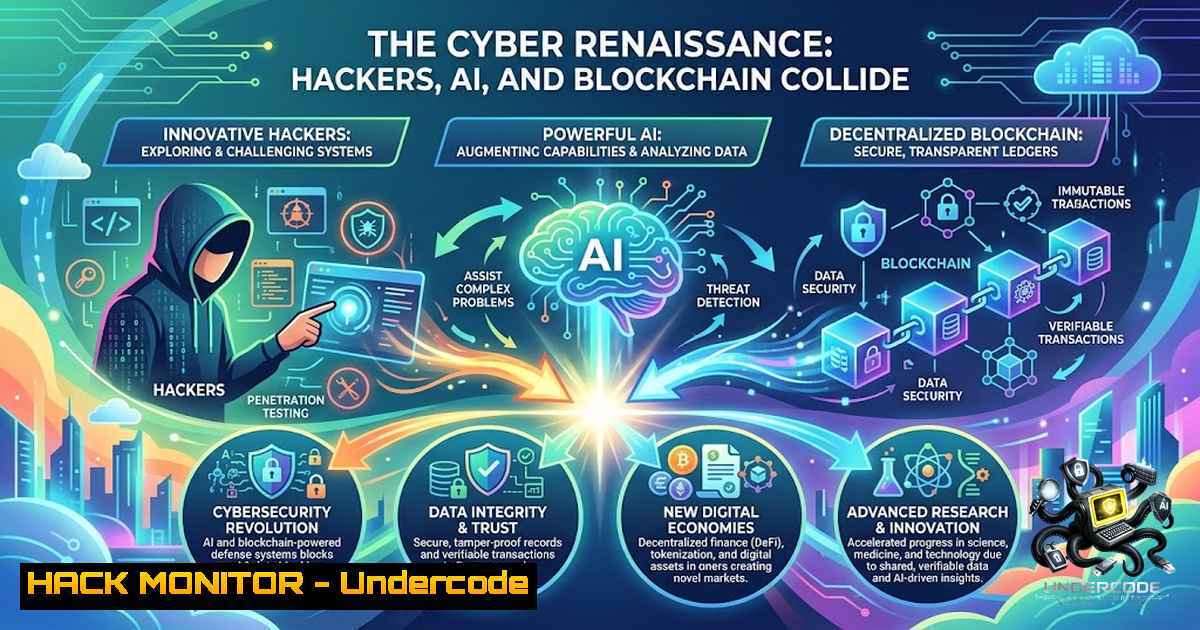
Introduction:
The line between notorious cybercriminals and ethical security researchers has never been thinner. As artificial intelligence accelerates both attack and defense capabilities, the modern cybersecurity professional must embody a paradoxical identity—part hacker, part protector, part entrepreneur. The convergence of blockchain technology, AI-driven threat landscapes, and the hacker mindset is reshaping not only how we defend digital assets but also how we define the very nature of cyber warfare in 2026.
Learning Objectives:
- Understand the evolving threat landscape where AI-assisted hacking outpaces traditional security measures
- Master essential Linux and Windows commands for penetration testing and system hardening
- Learn blockchain security fundamentals, including smart contract vulnerability identification and mitigation
- Develop a comprehensive approach to API security and cloud infrastructure hardening
- Apply Zero Trust principles in AI-enhanced security architectures
You Should Know:
- The AI Acceleration: Redefining Cyber Threats and Defenses
In 2026, artificial intelligence has fundamentally transformed the cybersecurity battlefield. The Five-Eyes Alliance, comprising intelligence agencies from the US, UK, Canada, Australia, and New Zealand, has identified Zero Trust architecture as the primary defense against agentic AI threats. This shift reflects a sobering reality: AI is shortening the time between vulnerability discovery and exploitation, with delays in patching directly increasing organizational risk.
The statistics are alarming. Traditional security appliances now intercept only about 80% of AI-driven attacks, while AI-1ative security tools can boost protection rates to 97-99%. CERT-In has documented AI-generated phishing campaigns producing highly convincing multilingual social engineering content, alongside autonomous multi-stage attack orchestration capable of privilege escalation and lateral movement planning.
For security professionals, this means adopting AI-enabled defensive tools for automated vulnerability detection, attack surface analysis, and threat detection. The modern defender must think like an attacker—anticipating how AI could weaponize vulnerabilities before they’re exploited.
Linux Commands for AI-Assisted Threat Detection:
 Monitor for suspicious processes that may indicate AI-driven malware
ps aux --sort=-%mem | head -20

Check for unusual network connections (potential C2 traffic)
netstat -tunap | grep ESTABLISHED

Analyze system logs for anomalies using AI/ML tools
sudo journalctl -f -1 100

Scan for open ports and services that could be entry points
nmap -sV -p- localhost

Monitor file system changes in real-time
inotifywait -m -r /etc /var/www /home
Windows PowerShell Commands for Security Monitoring:
 Get running processes with network connections
Get-1etTCPConnection | Where-Object {$_.State -eq "Established"}

Check for scheduled tasks that may indicate persistence
Get-ScheduledTask | Where-Object {$_.State -1e "Disabled"}

Audit Windows Event Logs for security events
Get-WinEvent -LogName Security -MaxEvents 50 | Format-List

Monitor registry changes (common persistence mechanism)
reg query HKLM\Software\Microsoft\Windows\CurrentVersion\Run

List all firewall rules
New-1etFirewallRule -DisplayName "Block All" -Direction Inbound -Action Block
2. Blockchain Security: The $1.32 Billion Wake-Up Call
The first half of 2026 witnessed a staggering $1.32 billion lost to DeFi hacks, representing a 50% increase in blockchain security incidents compared to the same period in 2025. Unverified smart contracts have emerged as a favored target, with attackers stealing $36.7 million across just four exploits between December 2025 and June 2026. The largest single incident occurred on January 8, 2026, when Truebit lost $26.2 million due to an integer overflow vulnerability in its bonding curve mechanism.
The situation is compounded by AI’s impact on security auditing. According to NEAR co-founder Polosukhin, AI-assisted hacking is outpacing traditional code reviews, making formal verification not just beneficial but necessary. AI has dramatically accelerated mathematical proof-generation, cutting work that once took years down to weeks. However, this same capability enables attackers to identify vulnerabilities faster than ever.
Vitalik Buterin has suggested that AI formal verification could actually make crypto significantly more secure, creating a potential arms race between AI-powered attackers and AI-powered defenders. The coalition of over 40 Bitcoin and crypto firms demanding early access to advanced AI security models reflects this urgency.
Step-by-Step Guide: Smart Contract Vulnerability Assessment
- Verify contract source code on blockchain explorers like Etherscan—unverified contracts were responsible for $36.7 million in losses
2. Use static analysis tools:
 Install Slither for Solidity analysis
pip3 install slither-analyzer
slither contract.sol --print human-summary
3. Perform fuzz testing:
 Using Echidna for property-based testing
echidna test contract.sol --config config.yaml
4. Audit for common vulnerabilities:
- Integer overflow/underflow (Truebit lost $26.2M to this)
- Reentrancy attacks
- Access control issues
- Front-running vulnerabilities
- Deploy on testnet first and monitor for unusual patterns before mainnet deployment
3. API Security: The Invisible Attack Surface
Modern full-stack applications increasingly rely on APIs that bridge blockchain, AI services, and traditional infrastructure. A Lead Full Stack Developer role now demands expertise in post-quantum cryptography (PQC) and AI integration to deliver high-security communication across global ecosystems.
API Security Hardening Checklist:
- Implement OAuth 2.0 with PKCE for mobile and SPA clients
- Use API keys with least-privilege permissions
- Rate limiting to prevent brute force and DoS attacks
- Input validation and sanitization for all parameters
- Encrypt sensitive data in transit (TLS 1.3+) and at rest
- Implement proper CORS policies
- Log all API access for audit trails
- Regular security scanning using tools like OWASP ZAP
Linux Command for API Endpoint Discovery:
 Discover subdomains that may expose APIs
subfinder -d example.com -o subdomains.txt

Enumerate API endpoints
ffuf -u https://example.com/FUZZ -w /usr/share/wordlists/dirbuster/directory-list-2.3-medium.txt

Test for common API vulnerabilities
nuclei -target https://api.example.com -t ~/nuclei-templates/
Windows API Security Testing:
 Test API endpoints with Invoke-WebRequest
$headers = @{"Authorization"="Bearer <token>"; "Content-Type"="application/json"}
Invoke-WebRequest -Uri "https://api.example.com/v1/users" -Headers $headers -Method GET

Check for exposed Swagger/OpenAPI documentation
Invoke-WebRequest -Uri "https://api.example.com/swagger/v1/swagger.json"
4. Cloud Infrastructure Hardening in the AI Era
The shift to cloud-1ative architectures has expanded the attack surface exponentially. Securing non-human identities and eliminating silos has become critical as AI accelerates attacks while identity defenses struggle to keep up.
Cloud Security Best Practices:
- Identity and Access Management (IAM) : Implement least-privilege access, use temporary credentials, and regularly audit permissions
-
Network Segmentation: Apply microsegmentation to limit lateral movement—modern microsegmentation provides vital defense against LLM threats
-
Encryption: Encrypt data at rest and in transit; prepare for post-quantum cryptography standards
-
Continuous Monitoring: Deploy ML-based discovery tools to map “shadow AI” and unmanaged assets
-
Incident Response: Develop and regularly test AI-assisted incident response playbooks
Linux Commands for Cloud Security Auditing:
 Check for exposed cloud credentials in code
grep -r "AWS_SECRET_ACCESS_KEY" /path/to/project
grep -r "AZURE_CLIENT_SECRET" /path/to/project

Scan for open S3 buckets (using AWS CLI)
aws s3 ls --recursive | grep -i "public"

Audit Kubernetes cluster security
kubectl auth can-i --list
kubectl get pods --all-1amespaces -o json | jq '.items[] | .spec.containers[].securityContext'
Windows Cloud Security Commands:
 Check Azure resource permissions
Get-AzRoleAssignment | Where-Object {$_.RoleDefinitionName -eq "Contributor"}

Audit Azure Key Vault access
Get-AzKeyVault -ResourceGroupName "production" | ForEach-Object {Get-AzKeyVaultCertificate -VaultName $_.VaultName}
5. Penetration Testing: The Ethical Hacker’s Arsenal
The OSCP (Offensive Security Certified Professional) certification through the PEN-200 course remains the gold standard for penetration testing. Modern ethical hacking courses cover reconnaissance, OSINT, password attacks, and vulnerability management through hands-on projects.
Step-by-Step Penetration Testing Methodology:
- Reconnaissance: Gather information about the target using OSINT techniques
- Scanning: Identify open ports, services, and potential vulnerabilities
3. Vulnerability Analysis: Assess identified vulnerabilities for exploitability
- Exploitation: Attempt to exploit vulnerabilities (with proper authorization)
- Post-Exploitation: Assess the impact and potential for lateral movement
6. Reporting: Document findings and remediation recommendations
Essential Penetration Testing Commands:
 Network reconnaissance
nmap -sS -sV -O -A target.com

Web application scanning
nikto -h https://target.com

Vulnerability scanning
openvas --target target.com

Password cracking
hashcat -m 0 -a 0 hash.txt rockyou.txt

Exploit framework
msfconsole
msf6 > use exploit/windows/smb/ms17_010_eternalblue
msf6 > set RHOSTS target.com
msf6 > exploit
6. Zero Trust Architecture: The New Security Paradigm
Zero Trust principles—least privilege, deny-by-default security, application containment, segmentation, and continuous verification—have become the cornerstone of modern cybersecurity strategy. The proliferation of autonomous AI agents and shadow AI requires new governance models, as traditional IAM controls struggle to manage the “agency” and tool access of nondeterministic AI systems.
Implementing Zero Trust:
- Verify explicitly: Always authenticate and authorize based on all available data points
- Use least privilege: Limit access with just-in-time and just-enough-access policies
- Assume breach: Design systems assuming compromise has already occurred
- Micro-segmentation: Divide the network into small, isolated zones
- Continuous monitoring: Monitor and validate all traffic, regardless of source
Linux Zero Trust Configuration:
 Implement application whitelisting
auditctl -w /usr/bin/ -p wa -k binary-change

Restrict sudo access to specific commands
visudo
 Add: username ALL=(ALL) NOPASSWD: /usr/bin/systemctl, /usr/bin/journalctl

Configure firewall with deny-by-default
sudo ufw default deny incoming
sudo ufw default allow outgoing
sudo ufw allow ssh
sudo ufw enable
Windows Zero Trust Configuration:
 Enable Windows Defender Application Control
Set-AppLockerPolicy -Policy "C:\policies\applocker.xml"

Configure Windows Firewall with deny-by-default
Set-1etFirewallProfile -Profile Domain,Public,Private -DefaultInboundAction Block

Implement LAPS for local admin password rotation
Install-AdmPwdPsextension
Update-AdmPwdADSchema
What Undercode Say:
- The Hacker Mindset is Invaluable: Understanding how attackers think—anticipating their moves, their creativity, their persistence—is the foundation of effective defense. The “electronic terrorist” label often obscures the technical brilliance that, when channeled ethically, becomes our greatest security asset.
-
AI is a Double-Edged Sword: The same AI capabilities that accelerate cyberattacks can be harnessed for defense. The organizations that thrive will be those that embrace AI-1ative security tools while maintaining human oversight and ethical boundaries.
The modern cybersecurity professional operates at the intersection of multiple disciplines: full-stack development, blockchain engineering, AI integration, and ethical hacking. The post references beating Magnus Carlsen—the chess legend—on a robot/game, symbolizing the strategic thinking required in cybersecurity. Chess teaches pattern recognition, forward-thinking, and the ability to anticipate opponent moves—skills directly transferable to cyber defense.
The story of the hacker who reportedly “wasn’t even allowed to watch TV during three years of probation, and only had to pay back around $4,000” highlights the sometimes disproportionate consequences in cybercrime prosecution. Yet it also underscores a deeper truth: the line between celebrated innovator and convicted criminal can be frighteningly thin.
Blockchain developers must now contend with AI agents capable of identifying $4.6 million worth of exploitable vulnerabilities in smart contracts. The same AI that powers Claude Opus 4.8 can discover four-year-old bugs in Zcash’s Orchard shielded pool. This democratization of hacking capability means that security can no longer be an afterthought—it must be baked into every line of code.
The 2026 landscape demands professionals who can navigate Linux terminals, configure Windows security policies, audit smart contracts, and understand AI threat vectors—all while maintaining the ethical framework that distinguishes security researcher from cybercriminal.
Prediction:
+1 The convergence of AI and blockchain security will create a new class of “AI security engineers” by 2027, with demand outpacing supply by 300%, driving salaries to unprecedented levels.
+1 Formal verification powered by AI will become standard practice for smart contract deployment, reducing DeFi hack losses by 60% within 18 months.
-1 AI-assisted hacking will outpace human-led defense by 2027, forcing organizations to rely entirely on AI-1ative security tools or face inevitable breaches.
+1 The democratization of penetration testing tools through AI will lower the barrier to entry for ethical hacking, expanding the cybersecurity workforce by 40%.
-1 The rise of autonomous AI agents will create new attack vectors that traditional security frameworks cannot address, leading to a “wild west” period of exploitation before new standards emerge.
+1 Post-quantum cryptography integration will become mandatory for all blockchain projects by 2028, creating a multi-billion dollar security upgrade market.
-1 Unverified smart contracts will continue to be exploited at increasing rates until regulatory frameworks mandate source code verification and third-party auditing.
+1 The cybersecurity industry will undergo a renaissance where “hacker” becomes a respected career path, with ethical hacking programs integrated into standard computer science curricula worldwide.
▶️ Related Video (90% Match):
🎯Let’s Practice For Free:
🎓 Live Courses & Certifications:
Join Undercode Academy for Verified Certifications
🚀 Request a Custom Project:
Secure, high-velocity infrastructure and disruptive technological engineering. Contact our engineering team for high-tier development and proprietary systems:
[email protected]
💎 Smart Architecture | 🛡️ Secure by Design | ⭐ Trusted by Thousands
IT/Security Reporter URL:
Reported By: https://lnkd.in/p/e7ENcTwW – Hackers Feeds
Extra Hub: Undercode MoN
Basic Verification: Pass ✅


