Listen to this Post
Introduction:
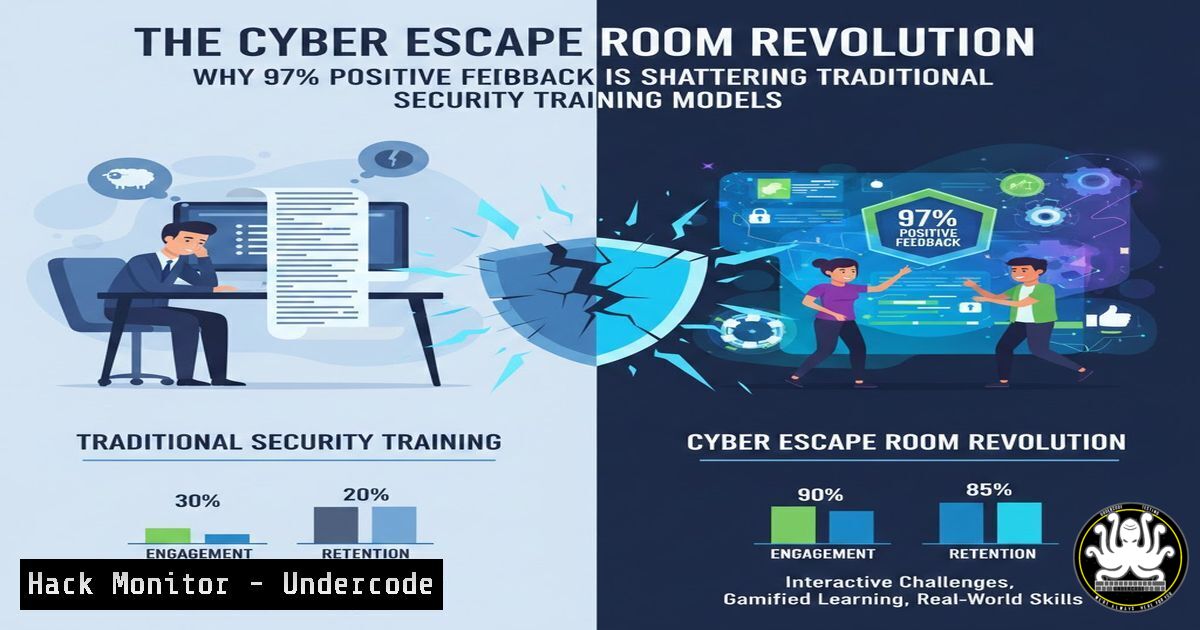
Traditional cybersecurity awareness training is failing. The paradigm is shifting from mandatory, forgettable click-through modules to immersive, hands-on learning experiences. The recent success of The Cyber Escape Room Co. ® at Telegraph Media Group, resulting in 97% positive feedback, demonstrates that engagement is the new frontier in building a human firewall. This article deconstructs the methodology and provides a technical and strategic blueprint for implementing gamified security awareness.
Learning Objectives:
- Understand the core components and psychological principles behind effective cyber escape rooms.
- Learn how to design and deploy your own tabletop or digital escape room scenarios for security awareness.
- Measure the ROI and long-term impact of gamified training on your organization’s security posture.
You Should Know:
- The Psychology of Engagement: Why Escape Rooms Beat CBTs
Computer-Based Training (CBT) often triggers passive learning, where information is consumed but not retained. Escape rooms, however, leverage active learning, problem-solving, and immediate feedback loops. The neurological principles of dopamine release upon solving a puzzle reinforce the learning objective, making the lesson memorable. The feedback from The Telegraph, such as “The cryptic puzzle and the props made the training come to life,” highlights the power of tactile and collaborative engagement. This approach moves knowledge from short-term to long-term memory by associating it with a positive, high-stakes experience.
- Blueprinting Your First Scenario: The Phishing Email Decryption
A common and highly effective scenario involves decrypting a suspect phishing email to find a “key” to escape the (virtual) room.
Step-by-step guide:
Objective: Teams are “locked” in a simulated email client. They must analyze a phishing email to find a hidden code.
The Clue: An email from “[email protected]” contains a link. The visible text says “Click Here to Secure Your Account,” but the underlying URL points to `http://malicious-site.tk/login`.
The Tools: Provide a “Security Toolkit” with links to URL expanders, WHOIS lookup tools, and header analyzers.
The Execution: Participants are taught to view email headers. A command-line tool can be introduced for more technical groups.
Linux/Windows (PowerShell) Command to Analyze Headers (Example):
 For a saved .eml file
cat phishing_email.eml | grep -i 'received|from|by|subject'
 In PowerShell, for a Message object
Get-Content C:\phishing_email.eml | Select-String -Pattern "Received|From|By"
The “Aha!” Moment: The team discovers a base64-encoded string in the email’s `X-Priority` header. Decoding it reveals the code to “escape.”
Decoding Command:
echo "SGVscCFUaGVZVGh1bmRlckRvbWFpbg==" | base64 --decode
 Output: Help!TheThunderDomain
3. Building a Physical “Office Espionage” Puzzle
Not all scenarios require a computer. A tabletop puzzle can effectively teach physical security and social engineering concepts.
Step-by-step guide:
Objective: Find a hidden Wi-Fi password that an “attacker” planted in the office.
The Setup: Scatter clues around a room: a sticky note with a QR code, a “password policy” on a whiteboard, and a locked box.
The Clues:
- The QR code leads to a riddle about the company’s founding year.
- The password policy on the whiteboard states: “Password = [Company Name]
[Special Char]".</li>
<li>A "forgotten" ID badge for a fake employee is left on a desk, with the company name "OmniCorp" on it.
The Solution: Teams must deduce that "OmniCorp" is the company name, use the riddle to find the founding year (e.g., 1984), and follow the policy to create the password <code>OmniCorp1984!</code>. This password opens the locked box, containing a final message about the dangers of password reuse and physical tailgating.</li>
</ol>

<h2 style="color: yellow;">4. The Ransomware Incident Response Simulation</h2>

This scenario tests a team's ability to respond to an active threat, moving from identification to containment.

<h2 style="color: yellow;">Step-by-step guide:</h2>

Objective: Isolate an infected machine and recover data from backups under a time constraint.
 The Trigger: A simulated alert: "Ransomware detected on PC-ENG-04. Files with .crypt extension found."

<h2 style="color: yellow;"> The Steps:</h2>

<ol>
<li>Identification: Use a network diagram to identify what PC-ENG-04 is connected to.</li>
<li>Containment: The team must "disconnect" the machine by physically unplugging a network cable (or clicking a "disconnect" button in a simulation).</li>
<li>Eradication & Recovery: Teams are given a list of backup files. They must find the most recent, clean backup before the ransomware timestamp.</li>
</ol>

<h2 style="color: yellow;"> Linux Command to Find Latest Backup:</h2>

[bash]
ls -la /mnt/backup/ | grep $(date +%Y-%m-%d) | sort -r | head -1
4. The Lesson: Reinforces the importance of segmented networks and verified, frequent backups.
5. API Key Exposure: The Cloud Hunter Scenario
This teaches developers and cloud engineers about the dangers of exposed secrets in public repositories.
Step-by-step guide:
Objective: Find a publicly exposed API key in a simulated GitHub repository and use it to “secure” a fictional cloud storage bucket.
The Setup: Provide a link to a dummy Git repo you’ve created with a file namedconfig.json.The Vulnerability: The `config.json` file contains:
{
"aws_access_key_id": "AKIAIOSFODNN7EXAMPLE",
"aws_secret_access_key": "wJalrXUtnFEMI/K7MDENG/bPxRfiCYEXAMPLEKEY"
}
The Hunt: Teams must use `grep` or a simple script to find the word “key” in the codebase.
Command:
grep -r "aws_secret_access_key" .
The Mitigation: The final step is to use the AWS CLI (or a simulated version) to “rotate” the key, teaching immediate incident response.
AWS CLI Command (Conceptual):
aws iam create-access-key --user-name TestUser
aws iam delete-access-key --user-name TestUser --access-key-id AKIAIOSFODNN7EXAMPLE
What Undercode Say:
- Engagement is a Security Control. A bored employee is a vulnerable employee. Gamification isn’t a gimmick; it’s a strategic tool to drastically increase knowledge retention and foster a proactive security culture.
- The Technical is Accessible. The feedback from The Telegraph, “many thought it was going to be too technical which it isn’t,” is crucial. Effective training abstracts complex topics into solvable puzzles, lowering the barrier to entry while still teaching foundational principles.
The 97% positive feedback is not an anomaly; it’s a data point proving a broken model is being fixed. Traditional training measures completion; gamified training measures competence and confidence. The corridor conversations and waiting lists mentioned by the CISO are qualitative metrics that are often more valuable than a 100% compliance report. The future of security awareness lies in creating experiences that employees seek out, not are forced to complete. This transforms security from an IT policy into a shared, company-wide value.
Prediction:
Within two years, gamified, scenario-based training will become the industry standard, relegating passive CBTs to a minor, compliance-only role. We will see the rise of AI-driven dynamic escape rooms that adapt puzzle difficulty in real-time based on team performance, and VR/AR escape rooms for immersive physical security and social engineering drills. This will create a measurable divide between organizations with a truly engaged human firewall and those relying on outdated, check-the-box training, directly impacting their resilience against social engineering attacks.
🎯Let’s Practice For Free:
IT/Security Reporter URL:
Reported By: Amystokeswaters Amazing – Hackers Feeds
Extra Hub: Undercode MoN
Basic Verification: Pass ✅🔐JOIN OUR CYBER WORLD [ CVE News • HackMonitor • UndercodeNews ]
📢 Follow UndercodeTesting & Stay Tuned:


