Listen to this Post
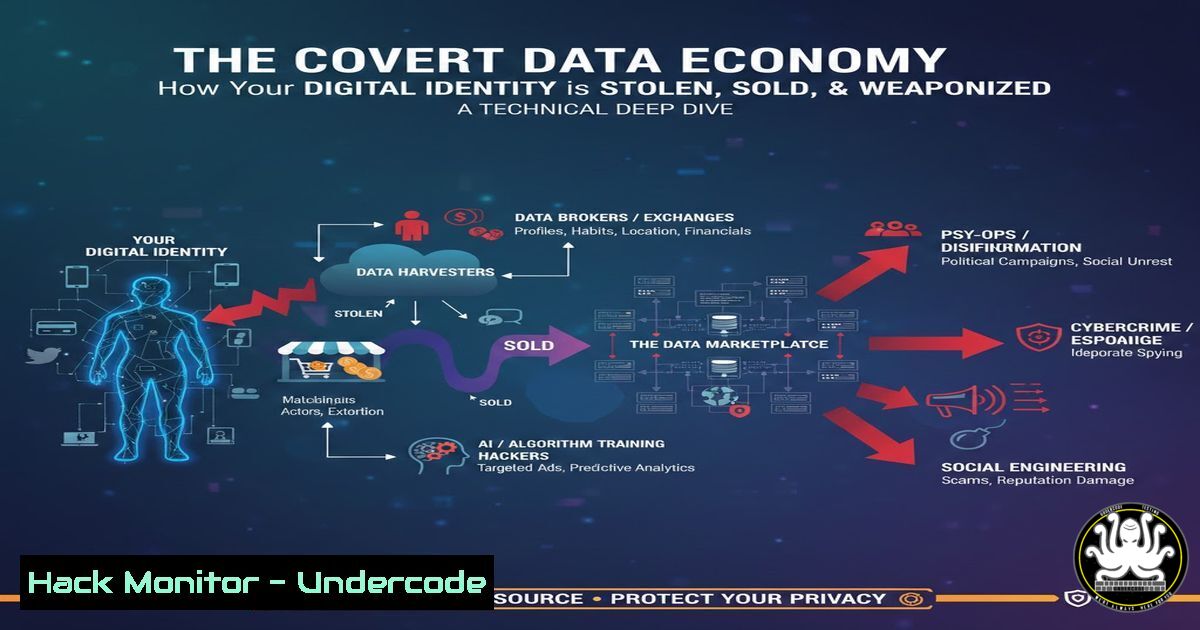
Introduction:
The personal data economy, a shadowy market valued at hundreds of billions, operates on the systematic collection, aggregation, and sale of your digital footprint. This isn’t just about targeted ads; it’s a foundational cybersecurity threat where data brokers, app developers, and corporate entities compile detailed dossiers that fuel identity theft, sophisticated phishing, and large-scale breaches. Understanding this pipeline is the first step in reclaiming your digital sovereignty and hardening your personal and organizational attack surface.
Learning Objectives:
- Decipher the data broker ecosystem and execute technical opt-out procedures.
- Implement device-level hardening to thwart covert data exfiltration from smartphones.
- Utilize Open-Source Intelligence (OSINT) and dark web monitoring tools to audit your exposed data.
You Should Know:
- Smartphone as a Covert Data Exfiltrator: Forensic Analysis and Hardening
Your smartphone is a primary data collection node. Apps often request permissions beyond their function, logging location, contacts, and device identifiers (IMEI, ADID) which are bundled and sold.
Step‑by‑step guide:
Audit Permissions (Android via ADB): For a deeper view than the settings menu offers, use Android Debug Bridge (ADB). This reveals permissions requested by apps that aren’t explicitly granted.
 Connect your device and run:
adb shell dumpsys package [package.name] | grep -A 50 "requested permissions:"
Network Traffic Analysis: Use a local VPN-based firewall like NetGuard (no-root) or PCAPdroid to monitor outbound connections. Block traffic to known ad-tech and analytics domains (e.g., graph.facebook.com, www.google-analytics.com).
Hardening: Disable advertising IDs. On Android: Settings > Google > Ads > Delete advertising ID. On iOS: Settings > Privacy & Security > Tracking > Disable “Allow Apps to Request to Track.” Use privacy-focused ROMs (GrapheneOS for Pixel) or configuration profiles (Lockdown Mode on iOS) for extreme hardening.
- Data Brokers: The Invisible Aggregators and How to Opt-Out
Data brokers like Acxiom, Experian, and Epsilon compile profiles from public records, purchase histories, and online tracking. These databases are lucrative targets for attackers.
Step‑by‑step guide:
Identification: Start with the top brokers. Lists are maintained by the SimpleOptOut project or the Yaelwrites GitHub repository.
Systematic Opt-Out: The process is manual and tedious. Create a dedicated email alias and use a password manager.
1. Visit the broker’s privacy page (e.g., `acxiom.com/about-us/privacy/`).
2. Find the “Your Choices” or “Opt-Out” link.
- Submit required information, often including full name, address, date of birth, and sometimes a copy of your driver’s license or utility bill (watermark it “For Opt-Out Only”).
Automation Script (Conceptual): While fully automated opt-out is complex due to CAPTCHAs and varying forms, you can use browser automation (Selenium) to navigate to opt-out pages. A more feasible approach is using a service like DeleteMe (paid) or running self-hosted scripts that manage your request queue. -
OSINT on Data Giants: Investigating Entities Like IQVIA
IQVIA aggregates healthcare and prescription data, a highly sensitive subset. Understanding what they hold involves technical reconnaissance.
Step‑by‑step guide:
Corporate Intelligence: Use `whois` and DNS enumeration to map their digital footprint.
whois iqvia.com
dig a iqvia.com +short
nslookup -type=MX iqvia.com
Data Flow Inference: Search for SDKs and APIs. On GitHub, search for `”IQVIA” + “SDK”` or `”IQVIA” + “API key”` to uncover integration methods and potential data points collected.
Regulatory Recon: Search the European Data Protection Board (EDPB) or CNIL (FR) public register for the company’s GDPR 30 Records of Processing Activities (ROPA) submissions, which may detail data categories and purposes.
- Dark Web Data Leak Monitoring: Setting Up Alerts
When data brokers are breached, your aggregated profile is sold on dark web markets. Proactive monitoring is crucial.
Step‑by‑step guide:
Use Breach Alert Services: Employ Have I Been Pwned (HIBP) API with monitored email addresses. For organizational use, integrate the API.
 Example using PowerShell to check HIBP (requires API key)
$apiKey = "your-hibp-api-key"
$email = "[email protected]"
$header = @{"hibp-api-key" = $apiKey}
Invoke-RestMethod -Uri "https://haveibeenpwned.com/api/v3/breachedaccount/$email" -Headers $header
Deploy a Dark Web Crawler (Conceptual): For advanced users, use Tor with Python libraries (stem, requests) to scrape paste sites (though many are blocked). A more practical method is subscribing to commercial threat intelligence feeds that include curated dark web data.
- Securing Health Data: Understanding and Mitigating Health Data Hub Risks
Centralized health repositories like France’s Health Data Hub are high-value targets. The principle applies to any centralized sensitive database.
Step‑by‑step guide:
Encryption at Rest & in Transit: Ensure any health data you handle uses AES-256 encryption at rest and TLS 1.3+ in transit. For cloud storage (e.g., AWS S3), enforce bucket encryption and disable public access.
 AWS CLI example to enforce encryption on an S3 bucket
aws s3api put-bucket-encryption --bucket my-health-data-bucket --server-side-encryption-configuration '{"Rules": [{"ApplyServerSideEncryptionByDefault": {"SSEAlgorithm": "AES256"}}]}'
Pseudonymization vs. Anonymization: True anonymization of health data is nearly impossible. Implement strict pseudonymization where a key links data to an identity, storing that key in a separate, hardened system.
Access Control & Audit: Implement Role-Based Access Control (RBAC) and mandatory logging. Use a SIEM to monitor all queries.
-- Example PostgreSQL audit trigger log entry
CREATE TABLE health_data_audit_log (
user_id text,
query_text text,
accessed_at timestamp DEFAULT CURRENT_TIMESTAMP
);
What Undercode Say:
- Your Data is a Persistent Asset: Once collected, your data lives indefinitely in broker databases, constantly resold and reaggregated after breaches. Technical opt-out and continuous monitoring are not one-time tasks but required lifecycle management.
- The Attack Surface is Amplified: The data broker ecosystem doesn’t just invade privacy; it directly enables more potent cyberattacks. A detailed profile allows for hyper-targeted spear-phishing (vishing), credential stuffing, and security question bypass.
The analysis is stark: the covert data economy has outsourced the risk of data collection to individuals while privatizing the profit. Each data point seems harmless, but when aggregated across brokers, it creates a master key to your digital—and often physical—identity. This market operates in legal gray areas, leveraging terms of service and opaque data flows. The technical countermeasures are a game of whack-a-mole, emphasizing the need for legislative action like GDPR and technical paradigms like data minimization. For cybersecurity professionals, this expands the threat model: defending the organization now includes defending the digital personas of its executives and employees from these external aggregation engines.
Prediction:
The future will see the convergence of AI-driven data aggregation and automated social engineering attacks. Data brokers will employ ML to infer sensitive attributes (e.g., health conditions, financial stress) from seemingly benign data, creating even more valuable—and dangerous—profiles. This will lead to fully automated, personalized phishing campaigns at scale. Conversely, growing regulatory pressure will spark the development of standardized, automated opt-out protocols (perhaps an “HTTP Opt-Out” header or API standard) and the rise of personal data vaults using zero-knowledge proofs, where you can prove attributes (e.g., age over 18) without exposing the underlying data, fundamentally disrupting the current broker model.
▶️ Related Video (72% Match):
🎯Let’s Practice For Free:
IT/Security Reporter URL:
Reported By: Cyber It – Hackers Feeds
Extra Hub: Undercode MoN
Basic Verification: Pass ✅


