Listen to this Post
Introduction:
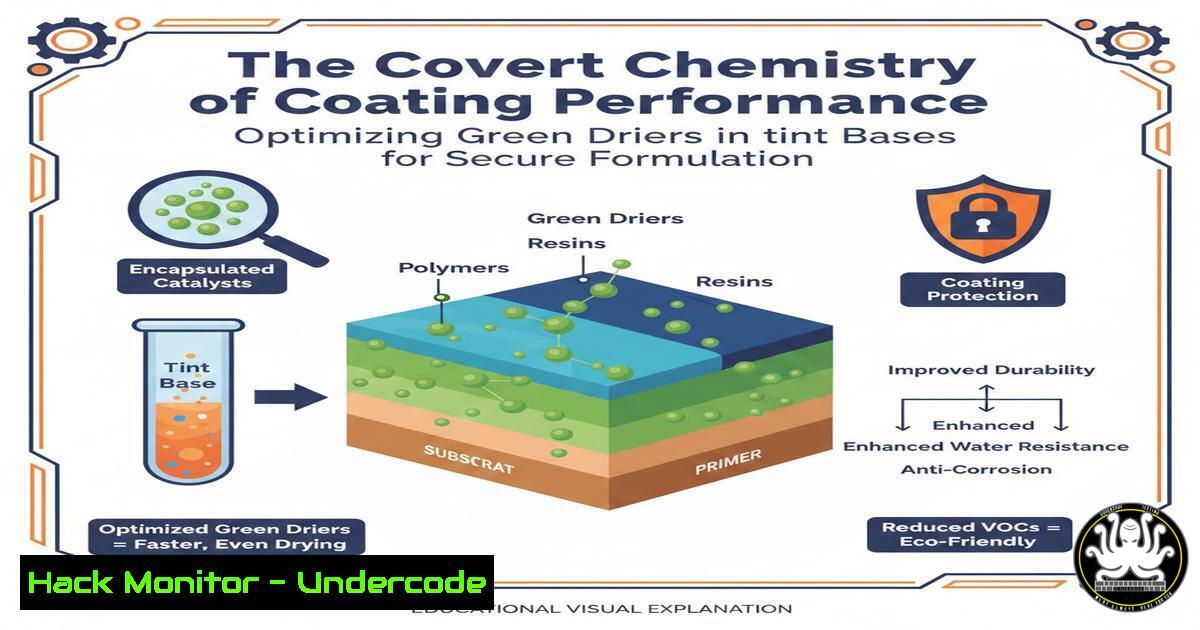
In the specialized world of paint formulation, achieving the perfect balance between drying performance and color fidelity is a precise science akin to securing a complex IT system. The introduction of “green driers” – active, eco-friendly catalysts based on metals like zirconium or potassium – into tint bases represents a powerful tool that, if misconfigured, can lead to product failure, manifesting as color shift, wrinkling, or uneven cure. This article translates the practical art of chemical formulation into a framework of systematic hardening, testing, and controlled deployment that any technical professional can appreciate.
Learning Objectives:
- Understand the role of green driers as supportive catalysts and the critical risks of overdosing.
- Learn the procedural best practices for integrating additives at the correct stage to ensure stability.
- Develop a methodology for real-world, environment-based testing that goes beyond lab conditions.
You Should Know:
- Principle of Least Privilege: Starting Small and Scaling with Control
Just as you would never grant a new application `root` or `Administrator` access by default, a green drier should be introduced with minimal permissions. Their high catalytic activity means a small miscalculation in concentration can lead to system-wide failure (e.g., wrinkling, yellowing).
Step‑by‑step guide:
Baseline Assessment: Begin with a thoroughly documented “secure baseline” – your standard tint base formula without the green drier. Note its drying time, color coordinates (e.g., CIELAB values), and hardness.
Initial Integration: Introduce the green drier at the lowest recommended threshold (0.01% metal content). Treat this like a controlled deployment to a staging server.
Incremental Scaling: If drying performance is insufficient, increase the dosage in minimal, controlled increments (e.g., 0.005%). Document the change log for every iteration. The command-line mindset is key: precise, logged, and reversible.
Verification: After each increment, run a full suite of tests (drying, color, hardness). Do not proceed until the results from the previous increment are fully analyzed.
- Architectural Role Definition: They Are Support Players, Not The Main Drier
A common architectural flaw is replacing the primary drier system (e.g., cobalt) entirely with green driers. This is akin to trying to use a monitoring tool as your primary firewall. Their role is to enhance through-dry and reduce surface tack, especially in shades where primary driers are inhibited by pigments.
Step‑by‑step guide:
Define the Stack: Document your “application stack.” Primary driers (Co, Mn) are your core logic. Green driers (Zr, K) are your auxiliary support libraries.
Configure Interaction: Ensure your primary drier system is optimized and stable first. The green drier is an add-on to address specific weaknesses, not a replacement.
Monitor for Conflicts: Watch for signs of “dependency conflict” – if adding the green drier causes gelation or drastic viscosity change, it may be interacting adversely with other components in the formula, requiring isolation testing.
3. Environmental Hardening: Testing Like a Painter Would
Lab conditions are a controlled sandbox. Real-world performance must be tested in production-like environments. This is the equivalent of penetration testing your coating on the actual substrate, under real atmospheric conditions.
Step‑by‑step guide:
Build a Test Environment: Prepare panels of the actual substrate (wood, metal, plaster). Apply the paint at the real-world film thickness (e.g., 100 µm wet).
Simulate Production Conditions: Place test panels in environments with varying Temperature and Relative Humidity (e.g., 10°C/85% RH, 23°C/50% RH, 35°C/30% RH). Use environmental chambers or logged rooms.
Execute Continuous Monitoring: Measure drying stages (surface-dry, through-dry, hard-dry) at regular intervals. Use a BK-dryer or pendulum hardness tester. Track color (using a spectrophotometer) initially and after accelerated ageing (UV chamber).
Analyze Logs: The data from these “environmental logs” will reveal the true performance and any latent vulnerabilities like delayed yellowing.
- Secure Deployment Pipeline: Adding at the Right Stage
The timing of addition is a critical configuration parameter. Adding highly active catalysts during the high-shear grind phase can cause premature reaction or unstable interactions. The “let-down” stage is the optimal deployment point.
Step‑by‑step guide:
- Grind Phase: Mill your pigments and resins. This is your “build” phase.
- Let-Down Phase: Reduce the shear, and add solvents, primary driers, and other additives. This is your deployment window.
- Controlled Integration: Under moderate agitation, slowly add the pre-diluted green drier. This ensures even distribution without local high-concentration zones that could trigger side-reactions.
- Final Quality Gate: Perform a final viscosity and color check before packaging, analogous to a pre-deployment smoke test.
-
Configuration Management for Different “Hosts”: Tint Bases Are Not Uniform
Applying a one-size-fits-all security policy (drier dosage) across all servers (tint bases) is a recipe for failure. A deep base (high pigment load, low TiO2) has a completely different “threat profile” and “resource consumption” pattern than a light base.
Step‑by‑step guide:
Segment Your Network: Categorize your tint bases: Light (L), Mid (M), Deep (D), or Clear.
Create Base Policies: Establish a starting dosage policy for each segment (e.g., L: 0.01%, M: 0.02%, D: 0.03%).
Apply and Harden Independently: Optimize the formula for each segment individually, following the incremental scaling process. Maintain separate, documented configurations for each.
- Continuous Monitoring and Observability: Watching Colour Over Time
A system that passes initial checks can still fail due to memory leaks or drift. Similarly, a coating must be monitored for long-term color stability (yellowing, fading) and physical property retention.
Step‑by‑step guide:
Instrument Your Coating: Define your metrics: ∆E (color difference), yellowness index (YI), gloss retention, hardness.
Schedule Automated Scans: Subject samples to accelerated weathering (QUV, Xenon arc) and measure metrics at 250, 500, and 1000-hour intervals.
Set Alert Thresholds: Define failure thresholds (e.g., ∆E > 2.0 is visually noticeable). If a formulation triggers an alert, roll back to the last stable configuration and investigate.
7. Incident Response and Rollback: Diagnosing Overdose Symptoms
Despite precautions, an “incident” may occur: wrinkling, severe yellowing, or poor hardening. A systematic response is required.
Step‑by‑step guide:
1. Isolate: Identify the batch and sequester it.
- Diagnose: Analyze the formula against the last known good configuration. Likely root cause: excessive green drier or interaction with another component.
- Contain: For the affected batch, consider blending it back at a very low percentage into a large batch of correct formula, if technically feasible (the equivalent of traffic shaping).
- Eradicate & Recover: Correct the master batch sheet. Roll back to the previous stable formula version.
- Post-Mortem: Document the incident. Was it a measurement error, a scaling mistake, or a supplier batch variation? Update procedures to prevent recurrence.
What Undercode Say:
- Precision Over Power: The overarching lesson is that in both chemistry and cybersecurity, a precise, minimally sufficient application of a powerful tool is infinitely more secure and stable than brute-force overdosing. Control and measurement are paramount.
- Context is King: There is no universal fix. The efficacy of any additive—or security control—is dictated by the specific environment, the existing architecture, and the intended performance outcome. Real-world validation is the only truth.
The methodical approach outlined—starting small, defining roles, testing in production environments, and maintaining rigorous configuration management—transcends paint formulation. It is a blueprint for reliability engineering in any technical domain, from deploying a new microservice to hardening a cloud network. The future of coating technology, much like IT, lies in smart, adaptive, and data-driven formulation where additives are “orchestrated” rather than simply “added.”
Prediction:
The practical, data-driven approach to formulation highlighted here is a precursor to the full-scale digitization of the coatings industry. We will see the rise of AI-assisted formulation platforms where machine learning models, trained on vast datasets of ingredient interactions and performance outcomes, will predict optimal drier systems and concentrations for specific color bases and environmental conditions. This will shift the role of the formulator from empirical experimenter to a strategic overseer of AI-generated options, validating predictions in advanced real-world simulation chambers. The “secure by design” principle will be baked into the software, preventing formulation “vulnerabilities” before a single gram is weighed out.
▶️ Related Video (78% Match):
🎯Let’s Practice For Free:
IT/Security Reporter URL:
Reported By: Vishal Shah – Hackers Feeds
Extra Hub: Undercode MoN
Basic Verification: Pass ✅


