
Listen to this Post
Introduction:
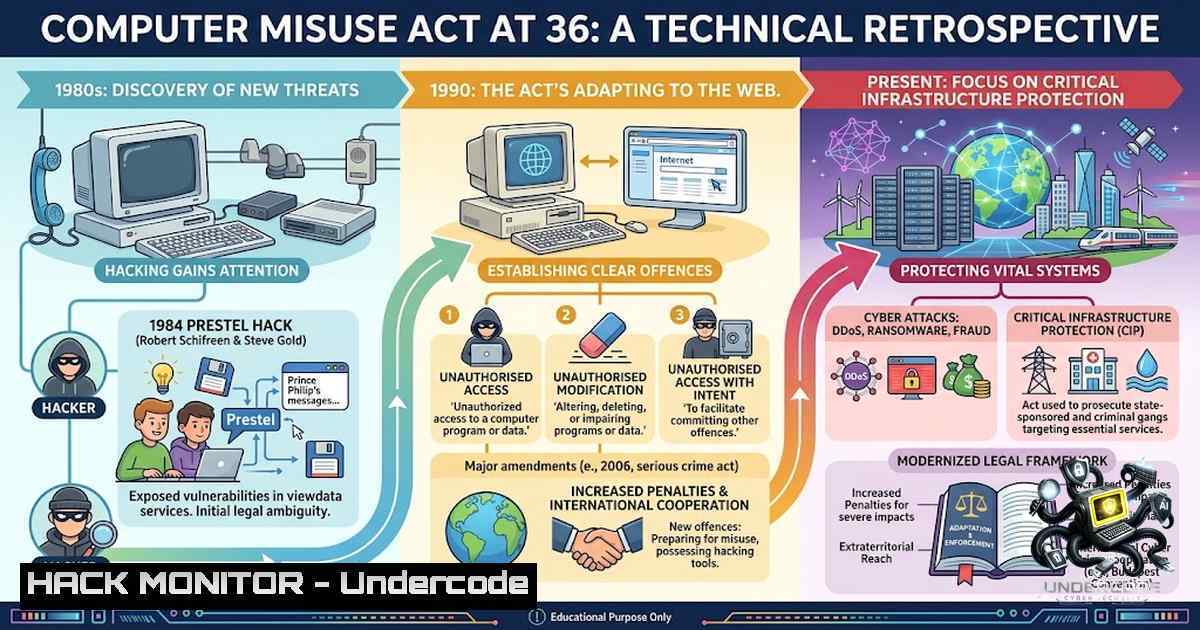
On 29 August 1990, the United Kingdom enacted the Computer Misuse Act (CMA), a landmark piece of legislation born from a glaring legal void exposed by Robert Schifreen and Stephen Gold’s 1985 hack into British Telecom’s Prestel service, where they accessed the Duke of Edinburgh’s private email mailbox. At the time, prosecutors were forced to rely on the Forgery and Counterfeiting Act—a law never designed for digital intrusion. Today, the CMA remains the cornerstone of UK cybercrime law, yet its three-decade-old framework struggles to address modern threats ranging from ransomware to AI-driven attacks, while simultaneously creating legal uncertainty for the very security professionals tasked with defending the nation’s digital infrastructure. This article examines the Act’s technical evolution, its application in recent high-profile prosecutions, and the practical security controls organizations must implement to stay compliant and resilient.
Learning Objectives & Secrets:
- Objective 1: Understand the CMA’s three-tier offence structure – Master the distinctions between Section 1 (unauthorised access), Section 2 (access with intent to commit further offences), and Section 3/3ZA (unauthorised acts with intent to impair or recklessly risking serious damage).
-
Objective 2 Secret Tip: Leverage lawful access controls as a legal defence – Document every system access with proper authorization, maintain audit trails, and implement role-based access controls (RBAC) to demonstrate that security research and penetration testing activities fall outside the CMA’s “unauthorised” definition.
-
Objective 3 Secret Tip: Proactive threat hunting as compliance – Deploy continuous monitoring and rootkit detection (e.g.,
rkhunter,chkrootkit) not only for security but to establish a documented chain of custody that proves good-faith defensive actions, strengthening any potential legal defence under emerging statutory protections.
You Should Know:
- The CMA’s Technical Offence Structure and Prosecution Landscape
The Computer Misuse Act 1990 establishes three primary offences, each with escalating severity and technical requirements:
- Section 1 – Unauthorised Access to Computer Material: A person is guilty if they cause a computer to perform any function with intent to secure access to any program or data held in the computer, knowing that the access is unauthorised. The maximum sentence is two years imprisonment and an unlimited fine. Crucially, intent does not need to be directed at a specific program or data—opportunistic hacking still qualifies.
-
Section 2 – Unauthorised Access with Intent to Commit Further Offences: This applies when the unauthorised access is coupled with intent to commit or facilitate the commission of a further offence.
-
Section 3ZA – Unauthorised Acts Causing or Creating Risk of Serious Damage: Introduced by the Serious Crime Act 2015, this section criminalises acts that cause or create a significant risk of serious damage to human welfare, the environment, or the economy. The maximum penalty is life imprisonment.
Recent prosecutions demonstrate the Act’s modern application. In July 2026, Owen Flowers (18) and Thalha Jubair (20) became the first hackers successfully prosecuted under Section 3ZA for the 2024 Transport for London (TfL) hack. The attack rendered 148 TfL systems inoperable, cost £29 million to remediate, and exposed the personal data of millions of Oystercard holders. The National Crime Agency estimated that a successful network shutdown could have cost the UK economy up to £56 billion. Flowers was also linked to cyberattacks on US healthcare providers SSM Health and Sutter Health, with Telegram messages revealing he acknowledged his actions “might kill some 90-year-old on life support”.
Step‑by‑step guide: Implementing CMA‑compliant access controls
 Linux: Audit all user logins and session activity
last -a  Show complete login history with hostnames
lastlog  Report last login of all users
who /var/log/wtmp  Currently logged-in users

Linux: Monitor real-time authentication attempts
sudo tail -f /var/log/auth.log  Debian/Ubuntu
sudo tail -f /var/log/secure  RHEL/CentOS

Windows (PowerShell): Audit logon events
Get-EventLog -LogName Security -InstanceId 4624,4625 -1ewest 50
 Event 4624 = successful logon, 4625 = failed logon

Windows: List all user accounts and their last logon
Get-LocalUser | Select-Object Name, LastLogon

Linux: Set up file integrity monitoring for critical system files
sudo apt install aide  Debian/Ubuntu
sudo yum install aide  RHEL/CentOS
sudo aideinit
sudo aide --check  Run initial database comparison

Linux: Harden SSH configuration against unauthorised access
sudo sed -i 's/PermitRootLogin yes/PermitRootLogin no/g' /etc/ssh/sshd_config
sudo sed -i 's/PasswordAuthentication yes/PasswordAuthentication no/g' /etc/ssh/sshd_config
sudo systemctl restart sshd
These commands establish an audit trail that demonstrates authorised access only, providing critical evidence should any access be questioned under the CMA.
- The Researcher’s Dilemma: CMA Reform and Statutory Defence
For over three decades, the CMA has inadvertently criminalised legitimate cybersecurity research. Security professionals conducting vulnerability research, penetration testing, or threat intelligence operations face potential prosecution because the Act does not distinguish between malicious hackers and good-faith defenders. In one striking example, cybersecurity consultant Simon Whittaker narrowly avoided arrest after his work was mistakenly linked to the WannaCry attack.
The UK government has pledged to reform the CMA, with Security Minister Dan Jarvis announcing in December 2025 that a “statutory defence” would be introduced for researchers who spot and share vulnerabilities responsibly. However, proposed amendments to the Data (Use and Access) Bill that would have established this defence failed to pass, and subsequent government plans have been criticised as offering protections so narrow that most researchers would remain exposed. The CyberUp Campaign continues to lobby for a clear, workable statutory defence covering vulnerability research and threat intelligence.
Step‑by‑step guide: Conducting legally defensible security research
 1. Always obtain written authorisation before testing
 Document scope, timeline, and specific systems

<ol>
<li>Use dedicated testing environments where possible
Isolate penetration testing from production systems</p></li>
<li><p>Linux: Run reconnaissance tools with explicit logging
nmap -sV -p- --reason --open -oA target_scan 192.168.1.0/24
-sV: version detection, --reason: show reason for port state</p></li>
<li><p>Web application testing with OWASP ZAP or Burp Suite
Always use proxy logs to document every request made</p></li>
<li><p>Linux: Network traffic capture for audit purposes
sudo tcpdump -i eth0 -w security_audit_$(date +%Y%m%d).pcap -C 100 -W 10
Captures rotating 100MB files, keeping 10 generations</p></li>
<li><p>Windows: Enable advanced audit policies for detailed logging
auditpol /set /subcategory:"Detailed File Share" /success:enable /failure:enable
auditpol /set /subcategory:"File System" /success:enable /failure:enable</p></li>
<li><p>Document every finding with timestamps and evidence
Maintain a signed chain of custody for all collected data
3. Rootkit Detection and Unauthorised Access Monitoring
Rootkits represent one of the most insidious forms of unauthorised access, allowing attackers to maintain persistent, hidden control over compromised systems. The CMA criminalises not only initial access but also any act that modifies or impairs computer data without authorisation.
Step‑by‑step guide: Deploying rootkit detection on Linux systems
 Install rkhunter (Rootkit Hunter)
sudo apt update && sudo apt install rkhunter -y  Debian/Ubuntu
sudo yum install epel-release && sudo yum install rkhunter -y  RHEL/CentOS

Run a comprehensive system scan
sudo rkhunter --check --sk --rwo
 --check: run all tests, --sk: skip keypress prompts, --rwo: report warnings only

Update rkhunter's file property database after legitimate system changes
sudo rkhunter --propupd

Review the log for anomalies
sudo cat /var/log/rkhunter.log | grep -i "warning|found"

Install chkrootkit as a complementary detection tool
sudo apt install chkrootkit -y  Debian/Ubuntu
sudo chkrootkit | tee ~/chkrootkit_$(date +%Y%m%d).log

Check for hidden processes and network connections
sudo unhide -f  Fast scan for hidden processes
sudo unhide -p  Check for hidden processes using procfs
ss -antlp  List all listening ports with process information
netstat -antlp  Alternative network connection listing

Linux: Monitor for unauthorised SUID/SGID binaries
sudo find / -perm -4000 -type f 2>/dev/null  SUID files
sudo find / -perm -2000 -type f 2>/dev/null  SGID files
4. Cloud Infrastructure Hardening and API Security
With the CMA’s broad definition of “computer” encompassing cloud servers and APIs, organisations must extend compliance controls to their cloud environments. The Act applies to any computer performing functions in the UK, regardless of where the server physically resides.
Step‑by‑step guide: Cloud security hardening
 AWS CLI: Enforce MFA for all IAM users
aws iam list-users --query 'Users[].UserName' --output text | while read user; do
aws iam list-mfa-devices --user-1ame $user --query 'MFADevices[]' --output text
done

AWS: Enable CloudTrail for comprehensive API logging
aws cloudtrail create-trail --1ame security-audit-trail --s3-bucket-1ame your-audit-bucket
aws cloudtrail start-logging --1ame security-audit-trail

AWS: List all security groups with overly permissive rules
aws ec2 describe-security-groups --filters Name=ip-permission.cidr,Values='0.0.0.0/0' \
--query 'SecurityGroups[].[GroupName,GroupId]' --output table

Azure CLI: Enable diagnostic settings for all resources
az monitor diagnostic-settings create --1ame security-audit \
--resource /subscriptions/{subscription-id}/resourceGroups/{rg}/providers/Microsoft.Compute/virtualMachines/{vm} \
--logs '[{"category": "AuditLogs","enabled": true}]'

GCP: Audit IAM policy bindings
gcloud projects get-iam-policy your-project-id --format=json > project_iam_policy.json
gcloud asset list --content-type=resource --format=json --project=your-project-id

Kubernetes: Enable audit logging
 Add to kube-apiserver configuration:
 --audit-log-path=/var/log/kubernetes/audit.log
 --audit-log-maxage=30
 --audit-log-maxbackup=10
 --audit-policy-file=/etc/kubernetes/audit-policy.yaml
5. Vulnerability Exploitation and Mitigation Strategies
Understanding attack vectors is essential for both defence and compliance. The CMA criminalises not only successful intrusions but also attempts that cause a computer to perform any function with intent to secure access.
Step‑by‑step guide: Vulnerability assessment and mitigation
 Linux: Install and run Lynis for system hardening audits
sudo apt install lynis -y  Debian/Ubuntu
sudo yum install lynis -y  RHEL/CentOS
sudo lynis audit system --quick | tee lynis_report_$(date +%Y%m%d).log

Debian-specific vulnerability scanning
sudo apt install debsecan -y
sudo debsecan | grep -v "fixed"  Show unfixed vulnerabilities

Network vulnerability scanning with nmap scripts
nmap --script vuln --script-args vulns.showall -sV -p 80,443,22 target_ip

Web application directory enumeration (authorised testing only)
gobuster dir -u http://target -w /usr/share/wordlists/dirb/common.txt -t 50

Linux: Check for world-writable files that could be exploited
sudo find / -type f -perm -o+w 2>/dev/null | grep -v /proc | grep -v /sys

Linux: Check for weak password policies
sudo cat /etc/pam.d/common-password | grep -v "^"  Debian/Ubuntu
sudo cat /etc/security/pwquality.conf  RHEL/CentOS

Windows: Check for weak local security policies
secedit /export /cfg c:\security_policy_export.txt
type c:\security_policy_export.txt | findstr "PasswordHistorySize MaximumPasswordAge"

Linux: Implement fail2ban for brute force protection
sudo apt install fail2ban -y
sudo systemctl enable fail2ban && sudo systemctl start fail2ban
sudo fail2ban-client status sshd
What Undercode Say:
- Key Takeaway 1: The Computer Misuse Act’s three-tier structure (Sections 1, 2, and 3/3ZA) provides a graduated legal framework that has successfully prosecuted everything from opportunistic hacking to critical infrastructure attacks, with the TfL case demonstrating that Section 3ZA carries life imprisonment for reckless acts risking serious damage.
-
Key Takeaway 2: The Act’s 1990-era drafting creates a fundamental tension—it criminalises unauthorised access without exception, yet modern cybersecurity defence requires authorised “intrusions” to identify vulnerabilities. The UK government’s commitment to statutory defence for researchers marks a pivotal shift, but the narrow scope of proposed protections leaves most security professionals in legal limbo.
The CMA represents both a pioneering legislative achievement and an increasingly anachronistic framework. Its passage was catalysed by Schifreen and Gold’s Prestel hack—an act that today would seem almost quaint compared to the scale of modern cyber threats. The TfL prosecution shows the Act’s enduring relevance, yet the Whitaker near-arrest and the ongoing CyberUp campaign reveal its fundamental flaw: a law that cannot distinguish between a threat actor and a defender is a law that ultimately weakens national security. Organisations must therefore implement rigorous technical controls—audit trails, access logs, rootkit detection, and vulnerability management—not only to prevent breaches but to document good-faith defensive activities. As the CMA reform process continues, the technical community must engage with policymakers to ensure that any statutory defence is practical, comprehensive, and recognises the reality that securing digital systems requires the very skills that the Act was designed to criminalise.
Prediction:
- +1 The CMA reform process, now included in the National Security Bill, will likely produce a statutory defence for security researchers by 2027, aligning UK cyber law with frameworks in the US and EU and boosting the UK’s cybersecurity industry.
-
+1 Increased prosecutions under Section 3ZA will deter sophisticated cybercriminal groups targeting critical national infrastructure, as the TfL case establishes a powerful sentencing precedent.
-
-1 If reform stalls or produces an overly narrow defence, the UK risks losing cybersecurity talent to jurisdictions with clearer legal protections, weakening national resilience.
-
-1 The CMA’s ambiguity around “computer” definitions in cloud and IoT contexts will create increasing legal uncertainty as distributed systems proliferate, potentially deterring necessary security research.
-
+1 Organisations that implement comprehensive audit logging and access control systems will gain a competitive advantage, demonstrating CMA compliance and reducing legal exposure in an evolving regulatory landscape.
▶️ Related Video (74% Match):
https://www.youtube.com/watch?v=94zJVdOBixs
🎯Let’s Practice For Free:
🎓 Live Courses & Certifications:
Join Undercode Academy for Verified Certifications
🚀 Request a Custom Project:
Secure, high-velocity infrastructure and disruptive technological engineering. Contact our engineering team for high-tier development and proprietary systems:
[email protected]
💎 Smart Architecture | 🛡️ Secure by Design | ⭐ Trusted by Thousands
IT/Security Reporter URL:
Reported By: https://lnkd.in/p/eNsV_ZaA – Hackers Feeds
Extra Hub: Undercode MoN
Basic Verification: Pass ✅


