Listen to this Post
Introduction:
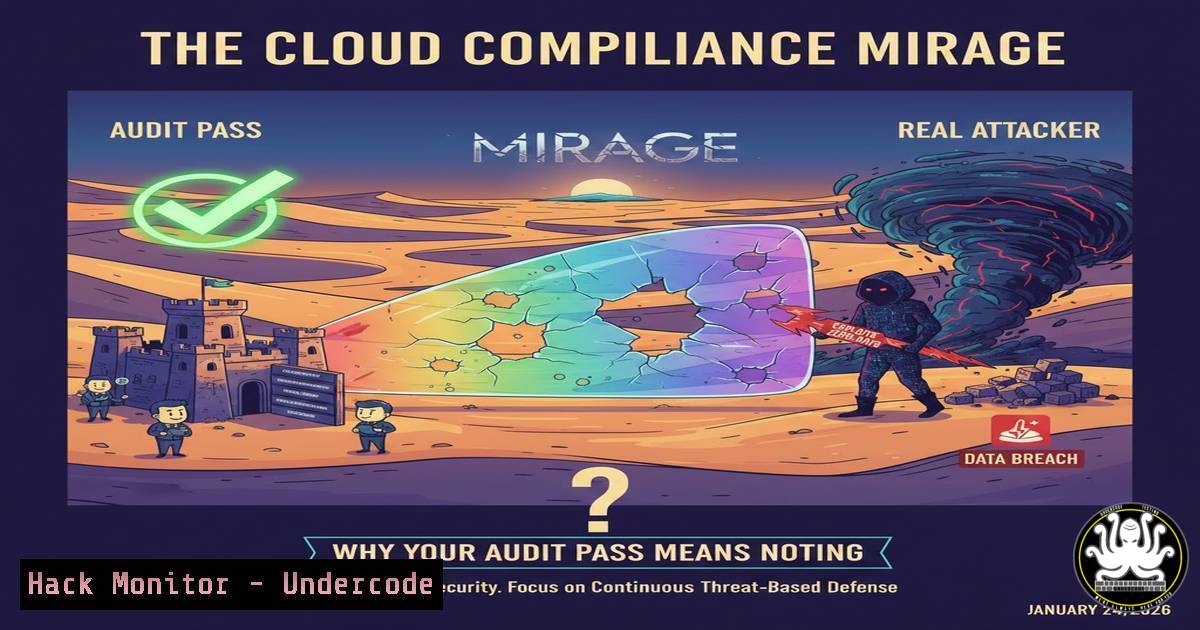
Many organizations operate under a dangerous illusion: that passing cloud compliance audits equates to robust security. In reality, checklists and static dashboards often miss the complex, multi-step attack paths that adversaries exploit. This article deconstructs the critical gap between perceived compliance and actual resilience, providing a technical blueprint for moving from theoretical security to attack-informed defense.
Learning Objectives:
- Understand the technical components of a real-world cloud attack path, from initial compromise to data exfiltration.
- Learn practical, hands-on methods to safely emulate attacker tradecraft in your own AWS, Azure, or GCP environments.
- Implement actionable hardening measures and continuous validation cycles that go beyond compliance frameworks.
You Should Know:
1. The Initial Foothold: Compromising Cloud Credentials
The first step in nearly every cloud breach is credential theft. Attackers rarely brute force; they phish, leak keys from public repositories, or exploit misconfigured services to harvest tokens.
Step‑by‑step guide explaining what this does and how to use it.
- Simulate Credential Harvesting: Use `TruffleHog` or `git-secrets` to scan your Git history for accidentally committed keys.
Install and run TruffleHog
docker run -it -v "$PWD:/pwd" trufflesecurity/trufflehog:latest git file:///pwd --only-verified
- Check for Instance Metadata Service (IMDS) Misconfiguration: Attackers can steal IAM roles attached to EC2 instances if IMDSv1 is enabled or security is lax.
From a compromised host, attempt to query the IMDS (This is for demonstration in a test lab ONLY)
curl http://169.254.169.254/latest/meta-data/iam/security-credentials/
- Mitigation: Enforce IMDSv2, use hardware-backed key management (AWS KMS, Azure Key Vault), and implement short-lived credentials via IAM Roles Anywhere.
2. Privilege Escalation and Enumeration
With initial credentials, attackers map your environment and seek to elevate privileges. Overly permissive IAM policies are the primary enabler.
Step‑by‑step guide explaining what this does and how to use it.
- Enumerate Permissions: Use the `awsscout2` or `PACU` (AWS) and `Stormspotter` (Azure) to visualize accessible resources and permissions.
Scout2 example (use with authorized, test credentials only)
python scout.py --profile test-profile --report-dir ./scout-report
- Identify Dangerous Policies: Look for wildcard actions (
s3:,ec2:) and resources (""). Manually review or use `iamlive` to capture IAM activity. - Mitigation: Implement the principle of least privilege (PoLP) using tools like `Policy Sentry` to generate minimal IAM policies. Regularly run automated tools like `Prowler` or `ScoutSuite` to flag over-permissive policies.
3. Lateral Movement via Compute Resources
Compute instances (EC2, VMs, containers) are springboards. Attackers seek to exploit weak network controls and instance profiles to hop between environments.
Step‑by‑step guide explaining what this does and how to use it.
- Discover Network Paths: Use `CloudMapper` to map VPCs, subnets, and security groups.
python cloudmapper.py collect --account-name test
python cloudmapper.py report --account-name test
- Test for Network Isolation Failures: In a safe, instrumented test environment (like
TerraGoat), use `nmap` to check if a compromised instance can reach sensitive internal services.sudo nmap -sV -p 1433,3306,5432 10.0.1.0/24 Scan for databases
- Mitigation: Enforce strict network segmentation with security groups and NACLs. Use just-in-time (JIT) access for administrative protocols and service mesh for microservices.
4. Persistence and Backdooring
Adversaries establish persistence to maintain access. This involves creating backdoor users, functions, or hidden infrastructure.
Step‑by‑step guide explaining what this does and how to use it.
- Simulate Backdoor IAM User: Attempt to create a user with administrative privileges or attach an existing policy.
Command an attacker might run (Demo in lab only)
aws iam create-user --user-name BackdoorUser
aws iam attach-user-policy --user-name BackdoorUser --policy-arn arn:aws:iam::aws:policy/AdministratorAccess
- Establish Persistence via Lambda: Create a malicious Lambda function triggered by CloudWatch Events to periodically call back to a C2 server.
- Mitigation: Enable IAM Access Analyzer, monitor CloudTrail logs for critical API calls (
CreateUser,AttachUserPolicy,CreateFunction), and deploy detective controls using AWS GuardDuty or Azure Sentinel.
5. Data Exfiltration Techniques
The final stage is stealing data. Attackers exploit overly permissive storage policies or use trusted services as exfiltration channels.
Step‑by‑step guide explaining what this does and how to use it.
- Identify Sensitive Data Stores: Use automated tools to locate unencrypted S3 buckets, RDS instances, or storage accounts.
- Simulate Data Theft: Attempt to copy data to an external account or region.
Simulate unauthorized S3 copy (Lab use only)
aws s3 cp s3://target-sensitive-bucket/ ./stolen-data --recursive
- Mitigation: Enforce bucket policies with explicit deny for unauthorized principals, enable default encryption, and use VPC Endpoints to prevent data from leaving the trusted network. Monitor data transfer spikes with VPC Flow Logs and anomaly detection.
6. Building a Continuous Attack Emulation Program
Manual testing is not enough. Security must integrate continuous, automated attack simulations.
Step‑by‑step guide explaining what this does and how to use it.
- Deploy a Breach and Attack Simulation (BAS) Tool: Implement tools like `Mitigant’s Cloud Attack Emulation` (https://lnkd.in/dPXykDtG),
Stratus Red Team, or `Atomic Red Team` for cloud. - Automate Attack Playbooks: Schedule regular simulations of TTPs (Tactics, Techniques, and Procedures) like the MITRE ATT&CK Cloud Matrix.
Example using Stratus Red Team against AWS (Authorized testing only)
stratus detonate aws.credential-access.ec2-get-password-data
- Integrate with CI/CD: Fail build pipelines if attack simulations succeed, ensuring new code does not introduce critical attack paths.
What Undercode Say:
- Compliance is a Snapshot, Resilience is a Movie. Audit reports are a point-in-time assessment that cannot account for the dynamic, chained techniques of a determined adversary. Real security is measured by the mean time to detect and respond to simulated breaches.
- The Defender’s Asymmetry is Your Greatest Risk. You must secure every asset, while an attacker needs only one path. Automated attack emulation is the only scalable method to identify and prioritize the closure of these paths before they are exploited maliciously.
Prediction:
The future of cloud security will be dominated by AI-driven, continuous attack emulation platforms. Compliance frameworks will evolve to require evidence from automated offensive testing, not just configuration snapshots. The convergence of BAS, threat intelligence, and security orchestration (SOAR) will create self-healing cloud environments that automatically reconfigure in response to simulated attacks, fundamentally shifting the paradigm from reactive compliance to proactive, adversarial resilience.
▶️ Related Video (80% Match):
🎯Let’s Practice For Free:
IT/Security Reporter URL:
Reported By: Https: – Hackers Feeds
Extra Hub: Undercode MoN
Basic Verification: Pass ✅


