Listen to this Post
Introduction:
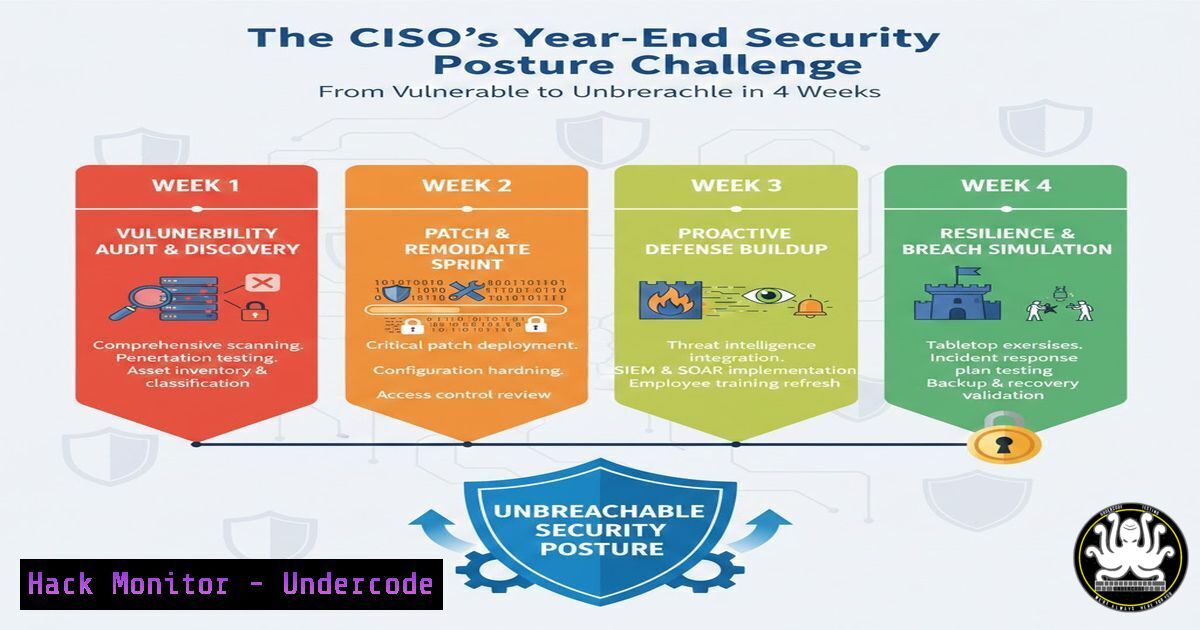
As the year concludes, security leaders face the same recurring resolution: to finally harden their organization’s cybersecurity posture. Yet persistent vulnerabilities, alert fatigue, and expanding attack surfaces often derail these intentions, leaving systems exposed and compliance gaps unaddressed. This structured challenge provides a methodological approach to transforming security hygiene through focused, measurable actions across key domains.
Learning Objectives:
- Implement immediate hardening measures across endpoint, network, and cloud infrastructure
- Establish continuous monitoring and incident response capabilities
- Develop sustainable security governance processes for long-term resilience
You Should Know:
- Endpoint Hardening: Locking Down Your First Line of Defense
Modern endpoints represent the most frequent initial attack vector, requiring systematic hardening beyond basic antivirus solutions. Begin by inventorying all assets – you cannot protect what you don’t know exists.
Step-by-step guide:
- Deploy automated asset discovery using native tools:
Linux network discovery
nmap -sP 192.168.1.0/24
Windows inventory via PowerShell
Get-WmiObject -Class Win32_ComputerSystem
Get-WmiObject -Class Win32_BIOS
- Implement application whitelisting policies:
AppLocker audit mode (Windows)
Set-AppLockerPolicy -LDAP "LDAP://DC=domain,DC=com" -Audit
Linux integrity monitoring
aide --init && aide --check
- Enforce full-disk encryption across all devices:
Enable BitLocker (Windows)
Enable-BitLocker -MountPoint "C:" -EncryptionMethod XtsAes256
Verify encryption status
Manage-BDE -Status
2. Network Segmentation: Containing Lateral Movement
Flat networks enable rapid adversary movement once perimeter defenses are breached. Microsegmentation creates virtual boundaries that contain breaches and limit damage.
Step-by-step guide:
- Map current network traffic flows:
Continuous flow monitoring
ntopng -i eth0 -W "admin:password@localhost:3000"
- Implement VLAN segmentation:
Cisco IOS example
configure terminal
vlan 10
name SERVERS
vlan 20
name USER_NETWORK
interface vlan10
ip address 10.1.10.1 255.255.255.0
- Deploy firewall rules following least privilege:
iptables example for server segmentation
iptables -A FORWARD -s 10.1.20.0/24 -d 10.1.10.0/24 -j DROP
iptables -A FORWARD -s 10.1.20.0/24 -d 10.1.10.50 -p tcp --dport 22 -j ACCEPT
3. Cloud Security Posture Management: Eliminating Misconfigurations
Cloud misconfigurations represent one of the fastest-growing attack vectors, with storage bucket exposures and identity oversights leading to significant breaches.
Step-by-step guide:
- Implement infrastructure-as-code security scanning:
Terraform security scan
tfsec .
Checkov for Kubernetes
checkov -d /path/to/k8s/manifests
- Enforce multi-factor authentication universally:
AWS CLI MFA enforcement { "Version": "2012-10-17", "Statement": [{ "Effect": "Deny", "Action": "", "Resource": "", "Condition": {"BoolIfExists": {"aws:MultiFactorAuthPresent": false}} }] } - Configure automated compliance monitoring:
AWS Config rule for unrestricted SSH
aws configservice put-config-rule --config-rule '{
"ConfigRuleName": "restricted-ssh",
"Source": {"Owner": "AWS", "SourceIdentifier": "RESTRICTED_INCOMING_TRAFFIC"},
"InputParameters": "{\"blockedPort1\":\"22\", \"blockedPort2\":\"3389\"}"
}'
4. API Security: Protecting Your Digital Transformation Core
APIs now represent over 80% of web traffic yet frequently lack adequate security controls, making them prime targets for data exfiltration.
Step-by-step guide:
- Implement comprehensive API inventory:
API discovery using traffic inspection
tcpdump -i any -w api_traffic.pcap port 443 or port 80
Process with API discovery tool
apicrawl --pcap api_traffic.pcap --output api_inventory.json
- Deploy API security testing:
OWASP ZAP API scan
zap-api-scan.py -t https://api.example.com/openapi.json -f openapi
- Configure rate limiting and anomaly detection:
Django REST Framework example
REST_FRAMEWORK = {
'DEFAULT_THROTTLE_RATES': {
'anon': '100/day',
'user': '1000/minute',
'api_key': '10000/hour'
}
}
- Vulnerability Management: From Reactive Patching to Predictive Defense
Traditional vulnerability management cycles are too slow for modern threat landscapes, requiring continuous assessment and automated remediation.
Step-by-step guide:
- Implement automated vulnerability scanning:
Nessus CLI scan
nessuscli scan launch --policy "Basic Network Scan" --targets 192.168.1.0/24
OpenVAS automated assessment
gvm-cli socket --xml "<create_task><name>Weekly Scan</name>...</create_task>"
- Prioritize remediation using EPSS scores:
Python script to query EPSS API import requests def get_epss_score(cve_id): response = requests.get(f"https://api.first.org/epss/v2/{cve_id}") return response.json()['data']['epss'] - Deploy automated patch management:
Linux automated security updates
apt-get install unattended-upgrades
dpkg-reconfigure -plow unattended-upgrades
Windows WSUS approval
Get-WsusServer | Approve-WsusUpdate -Update (Get-WsusUpdate -Classification Security)
- Incident Response Readiness: From Theory to Muscle Memory
Tabletop exercises alone cannot prepare organizations for real breaches. Regular technical drills build the muscle memory needed for effective response.
Step-by-step guide:
- Develop breach simulation scenarios:
Atomic Red Team test execution
atomic-red-team-executor --technique T1055 --check-prereqs
atomic-red-team-executor --technique T1055 --execute
- Implement SIEM alert validation:
// Sentinel query for failed logons
SecurityEvent
| where EventID == 4625
| where TimeGenerated > ago(1h)
| summarize FailedCount = count() by Account, Computer
| where FailedCount > 10
- Conduct containment drills:
Isolate compromised host
iptables -A INPUT -s $COMPROMISED_IP -j DROP
iptables -A OUTPUT -d $COMPROMISED_IP -j DROP
Windows firewall block
New-NetFirewallRule -DisplayName "Block_Compromised" -Direction Outbound -Action Block -RemoteAddress $COMPROMISED_IP
7. Security Governance: Establishing Sustainable Processes
Technical controls without governance processes create security debt that accumulates over time, undermining all other efforts.
Step-by-step guide:
- Implement security metrics dashboard:
-- Mean Time to Detect (MTTD) calculation
SELECT AVG(detection_time - compromise_time) as mttd
FROM security_incidents
WHERE quarter = 'Q4';
- Establish regular compliance reporting:
Automated CIS compliance scanning
lynis audit system --quick
Generate compliance report
oscap xccdf eval --profile stig-rhel7-server-upstream --results scan.xml
- Deploy security awareness training integration:
Phishing simulation API integration
import requests
def launch_phishing_simulation(template_id, user_group):
response = requests.post(
"https://api.knowbe4.com/v1/phishing/campaigns",
json={"template_id": template_id, "target_group": user_group}
)
return response.json()['campaign_id']
What Undercode Say:
- Immediate Action Over Perfection: Organizations that implement 80% of controls effectively outperform those pursuing 100% perfection but moving slowly. The threat landscape evolves faster than perfect solutions can be deployed.
- Continuous Validation Beats Periodic Audits: Security controls degrade over time through system changes, new vulnerabilities, and evolving attack techniques. Automated continuous validation provides the only reliable assurance.
The transformation from vulnerable to resilient requires shifting from project-based security initiatives to embedded operational practices. While technical controls form the foundation, sustainable security emerges from the intersection of automated enforcement, continuous monitoring, and organizational accountability. The organizations that will thrive in 2025’s threat landscape are those treating security not as annual compliance exercise but as core operational discipline woven into every technology decision and implemented through verifiable, automated controls.
Prediction:
The convergence of AI-powered attacks and expanding software supply chain vulnerabilities will render traditional annual security assessments obsolete by 2026. Organizations that fail to implement continuous security validation and automated remediation will experience breach rates 300% higher than those embracing automated security operations. The CISO role will bifurcate into two distinct profiles: strategic risk advisors overseeing AI-augmented security platforms, and outdated compliance managers struggling with breach aftermaths—determined entirely by their adoption of continuous security transformation practices.
🎯Let’s Practice For Free:
IT/Security Reporter URL:
Reported By: Anjali Vatsalya – Hackers Feeds
Extra Hub: Undercode MoN
Basic Verification: Pass ✅


