Listen to this Post
Introduction:
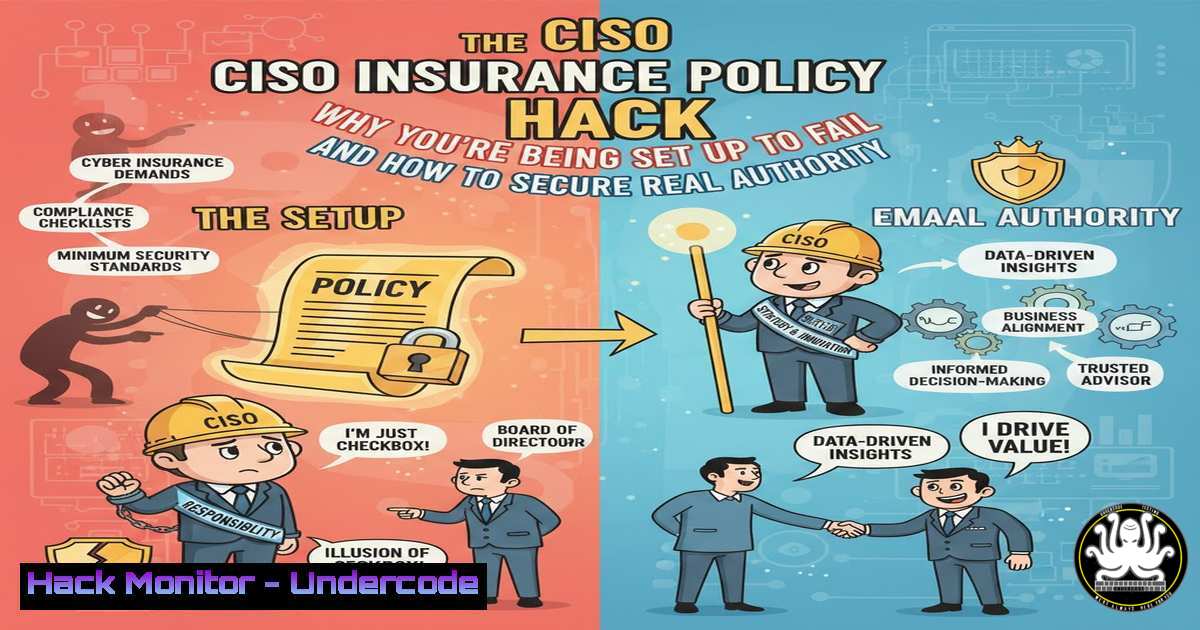
In the aftermath of a major security breach, the firing of the Chief Information Security Officer (CISO) has become a predictable corporate ritual. This phenomenon points to a deeper, systemic flaw in how organizations perceive and empower security leadership. Many CISOs are not hired to architect resilient systems but to act as a human insurance policy—a designated accountable party when the inevitable incident occurs. This article deconstructs the “CISO as Scapegoat” architecture and provides a technical and procedural guide for security leaders to validate their true authority and build enforceable security governance from day one.
Learning Objectives:
- Identify the organizational red flags that indicate a security role is structured as a liability shield rather than a leadership position.
- Implement technical controls and governance mechanisms that translate policy into enforceable action.
- Establish irrefutable, data-driven accountability for risk acceptance decisions outside the security team’s mandate.
You Should Know:
- Diagnosing Your Role: The Dashboard vs. Leverage Audit
The original post highlights that initial questions often focus on “dashboards, not leverage.” This is a critical diagnostic. Dashboards provide optics; leverage is the authority to change system states. To audit your real authority, you must map your sanctioned capabilities.
Step‑by‑step guide:
Step 1: Toolchain Inventory. Catalog all security tools you “own” (e.g., CrowdStrike, Wiz, Splunk). For each, determine if you have the administrative rights to enforce policy or only to view alerts.
Step 2: Policy Enforcement Point (PEP) Analysis. Identify where technical enforcement happens. For example, can you push a block rule in the WAF (e.g., Cloudflare, AWS WAF) without a separate change ticket? Execute a test:
 Example: Check if you have AWS WAFv2 update permissions via CLI. This command lists your effective permissions.
aws iam simulate-principal-policy --policy-source-arn arn:aws:iam::123456789012:user/YourUser --action-names wafv2:UpdateWebACL
A denied action signals your role is observational.
Step 3: Change Control Review. Analyze the last 10 critical security change requests. How many were rejected or watered down by non-security business units? A high ratio indicates your authority is illusory.
- Engineering Time Over Tool Budget: The Real Control
“If your budget buys tools but never engineering time…You’re underwriting it.” True security is embedded in architecture and code, not bolted-on. You must secure dedicated development sprints for security debt and control implementation.
Step‑by‑step guide:
Step 1: Quantify Security Debt. Use static (SAST) and dynamic (DAST) tools to create a prioritized backlog. Integrate findings into engineering management platforms (e.g., Jira):
 Using a SAST tool like Semgrep to output results in Jira-compatible format
semgrep scan --config auto --json --output findings.json
 Process the JSON to create tickets via Jira REST API (simplified example)
curl -X POST -u user:token -H "Content-Type: application/json" https://your-domain.atlassian.net/rest/api/3/issue -d @security_ticket.json
Step 2: Secure Commitment in CI/CD. Mandate security gates in the pipeline. For example, prevent builds with critical vulnerabilities:
 Example GitLab CI pipeline snippet
security_scan:
stage: test
script:
- trivy fs --severity CRITICAL,HIGH --exit-code 1 .
allow_failure: false  This makes the build fail on critical findings
Step 3: Track “Security Sprint” Velocity. Work with engineering leads to dedicate a percentage of each sprint (e.g., 15-20%) to security stories. Measure and report this as a key security KPI.
3. From “Influence” to Enforcement: Making Exceptions Expire
The post notes “exceptions never expire.” Influence-based security relies on memory; enforcement-based security relies on automated expiration.
Step‑by‑step guide:
Step 1: Implement a Technical Exception Registry. Move exceptions out of spreadsheets and into a system that can trigger automated actions. A simple start is a dedicated Git repository where exception tickets are filed.
Step 2: Automate Expiration with Webhooks. Use the registry’s API to create time-bound exceptions. When the expiry date passes, automatically trigger remediation.
 Example pseudo-code for an automated exception expiration webhook
import requests, datetime
 Query exception registry API for expired items
expired_exceptions = query_api("expires_on < today")
for exc in expired_exceptions:
 Trigger a ticketing system to re-assess
create_jira_ticket(f"Exception {exc['id']} expired", exc['owner'])
 If exception was for a firewall rule, call API to disable it
if exc['type'] == 'firewall_rule':
requests.post(FIREWALL_API_URL, json={'rule_id': exc['context'], 'action': 'disable'}, auth=(API_KEY, ''))
Step 3: Enforce Compensating Controls. For any accepted exception, require a technical compensating control (e.g., stricter logging, network segmentation). Document this control as infrastructure-as-code (Terraform, CloudFormation) to ensure it’s deployed.
4. Turning “Accept Risk” into Signed Accountability
The moment a business unit overrides your security recommendation is the moment of highest risk. Your job is to ensure that decision is formally captured and attributable.
Step‑by‑step guide:
Step 1: Integrate Risk Acceptance into Workflow Tools. Don’t use email. Use the platforms where decisions are made (Jira, ServiceNow). Create a mandatory “Risk Acceptance” field that requires VP-level approval for critical risks.
Step 2: Document with Immutable Audit Trails. Ensure the approval action is logged in an immutable ledger. Cloud provider audit logs (AWS CloudTrail, GCP Audit Logs) can help:
 Query CloudTrail for a specific change approval event by a user
aws cloudtrail lookup-events --lookup-attributes AttributeKey=Username,[email protected] --start-time 2023-10-01 --end-time 2023-10-02
Step 3: Periodic Attestation Reviews. Quarterly, present all accepted risks with their owners to executive leadership. This creates organizational memory and prevents plausible deniability post-breach.
5. Pre-Breach Authority Validation: The “Block Launches” Test
“Empowerment…is measured by what you can stop.” Can you actually halt a major product launch for a critical, unmitigated security flaw?
Step‑by‑step guide:
Step 1: Define Technical Kill-Switches. Work with DevOps to establish automated security gates that can fail a deployment pipeline. This should be based on objective, severe criteria (e.g., critical CVE in production image, missing MFA on public-facing service).
Step 2: Conduct a Tabletop Exercise. Simulate a scenario where a launch is 48 hours away and a critical vulnerability is found. Walk through the process of invoking the stop. Who do you call? What system do you use? Is there a pre-authorized playbook?
Step 3: Formalize the Authority. The outcome of the exercise should be a documented “Security Hold Authority” charter, signed by the CEO and Board, granting you explicit, unilateral authority to delay any launch for a defined set of severe conditions. Without this document, your authority is a suggestion.
What Undercode Say:
- Key Takeaway 1: The scapegoat mechanism is not created during a breach; it is pre-engineered through organizational design that separates accountability from authority. A security leader’s first task must be to audit and amend this design.
- Key Takeaway 2: Real security power is not measured by budget or headcount, but by the ability to automatically enforce policy within technical systems (CI/CD, cloud consoles, IAM) and to mandate irrevocable business accountability for accepted risks.
The central analysis is that cybersecurity’s value is being perverted by a corporate risk-transfer strategy. Companies purchase a “human insurance policy” in the form of a CISO to satisfy boards and regulators, creating a morally hazardous environment where real investment in resilience is sidelined. The technical controls and governance steps outlined above serve a dual purpose: they genuinely improve security posture while simultaneously acting as litmus tests for organizational sincerity. If you cannot implement these enforceable controls, you have empirically confirmed your role as the expendable policy, not the transformative leader. The breach will merely be the triggering event that collects on that policy.
Prediction:
In the next 3-5 years, we will see a rise in legal and regulatory scrutiny directed not just at breached companies, but at their governance structures. Courts and regulators (like the SEC) will begin piercing the “scapegoat firewall” to assign liability to executives and boards who deliberately structured their security leadership to be ineffective yet accountable. This will force a fundamental shift: CISOs will transition from being hired as cost-center insurance underwriters to being installed as bona fide operational risk officers with codified, board-level authority. The roles that remain as “insurance policies” will become legally toxic, and the professionals who can demonstrate a proven framework for measurable, enforceable security governance will command unprecedented influence and protection.
🎯Let’s Practice For Free:
IT/Security Reporter URL:
Reported By: Joshuacopeland Unpopularopinion – Hackers Feeds
Extra Hub: Undercode MoN
Basic Verification: Pass ✅


