Listen to this Post
Introduction:
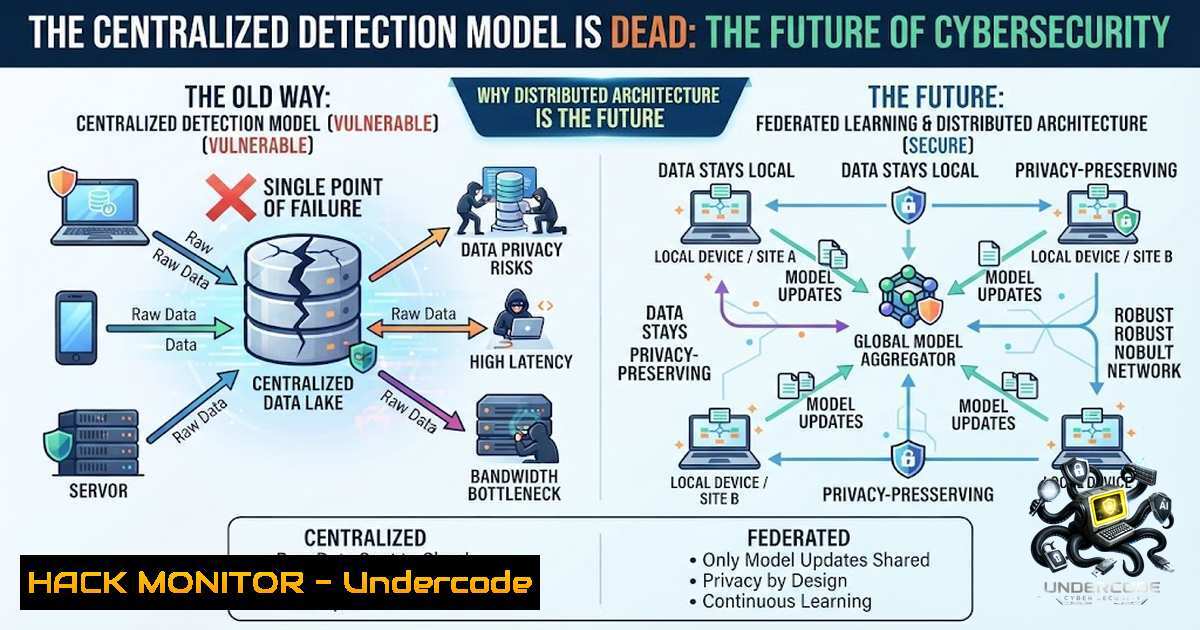
For decades, cybersecurity defenses have relied on a centralized detection model – aggregating vast amounts of telemetry from across the enterprise into a single repository where security information and event management (SIEM) systems and machine learning models analyze the data for threats. While this approach has demonstrated effectiveness in controlled environments, it introduces significant challenges including data privacy vulnerabilities, excessive communication overhead, increased latency, and an inability to keep pace with the scale and diversity of modern enterprise security data. As organizations migrate to cloud-1ative architectures and attackers become more sophisticated, the centralized model is revealing its fundamental limitations – and a paradigm shift toward federated learning and distributed detection is urgently needed.
Learning Objectives:
- Understand the core limitations of centralized intrusion detection systems (IDS) and SIEM architectures in modern enterprise environments
- Learn how federated learning and distributed detection models address privacy, scalability, and real-time detection challenges
- Gain practical knowledge of implementing distributed security architectures using open-source tools and cloud-1ative approaches
You Should Know:
- The Centralization Tax: Why SIEMs Are Failing Modern Security Operations
Security Information and Event Management (SIEM) systems were built for a world that no longer exists. When SIEM became the center of enterprise security operations, perimeters were real, attacks came from outside, moved in one direction, and left evidence in logs you could actually collect. Today’s environment is distributed by design. Identity lives in Okta or Azure AD. Workloads run in AWS and GCP. Endpoints are everywhere. Network traffic moves across providers you don’t fully control. And attackers know exactly how to exploit the gaps between all of it.
The centralization tax manifests in several critical ways:
Log Volume and Cost. Log volumes are growing faster than any organization’s willingness to ingest them. The average enterprise now routes only a fraction of its actual telemetry into its SIEM because full coverage is prohibitively expensive. Security teams make choices – they triage what they send, optimize for “important” logs, and write detection rules against incomplete data. This creates a structural failure: centralization creates a bottleneck at exactly the moment when speed matters most.
Latency and the Past-vs-Present Problem. By the time a log event travels from an endpoint through a collector, through a pipeline, into a SIEM, and against a detection rule, attackers have already moved. That’s not a latency problem you can engineer your way out of – it’s an architectural one. You’re reasoning about the past while attackers are operating in the present.
Static Rules vs. Dynamic Attackers. Detection rules are written by humans, tuned over time, and validated against known attack patterns. That works in a threat landscape that doesn’t evolve, but modern attacker TTPs (tactics, techniques, and procedures) shift faster than most teams can update their Sigma rules. The result is a detection posture that’s perpetually behind.
Practical Commands – Assessing Your SIEM’s Data Coverage:
To understand how much telemetry your organization is actually ingesting, consider these commands:
Linux – Check log volume and ingestion rates:
 Check daily log volume from syslog
grep -c "$(date +%b" "%d)" /var/log/syslog

Monitor log generation rate in real-time
tail -f /var/log/syslog | pv -l > /dev/null

Analyze log source diversity
journalctl --list-boots | wc -l
Windows – Audit log collection coverage:
 Check Windows Event Log sizes
Get-WinEvent -ListLog  | Select-Object LogName, MaximumSizeInBytes, IsEnabled

Count events per log in the last 24 hours
$start = (Get-Date).AddHours(-24)
Get-WinEvent -FilterHashtable @{StartTime=$start} | Group-Object LogName | Sort-Object Count -Descending

Identify missing critical logs
auditpol /get /category:
Cloud – AWS CloudTrail ingestion assessment:
 Check CloudTrail trail status and log delivery
aws cloudtrail describe-trails --query 'trailList[].[Name,IsMultiRegionTrail,LogFileValidationEnabled]'

Estimate monthly CloudTrail costs
aws cloudtrail get-event-selectors --trail-1ame <your-trail-1ame>
- The Privacy Problem: Centralized Storage Creates a Single Point of Exposure
Centralized IDS and ML models store raw data centrally, increasing privacy risks by up to 60% due to potential data breaches. When all network telemetry, user behavior data, and system logs are aggregated in one location, that repository becomes an attractive and lucrative target for attackers. A single breach of the central repository can expose an organization’s entire security posture and sensitive operational data.
Beyond external threats, centralized data collection raises significant compliance concerns. Regulations like GDPR, HIPAA, and CCPA impose strict requirements on how personal data is collected, stored, and processed. Centralizing telemetry that may contain personally identifiable information (PII) creates compliance challenges that distributed architectures can help mitigate.
Federated Learning: A Privacy-Preserving Alternative. Federated learning (FL) presents a decentralized framework that mitigates the privacy and communication inefficiencies inherent in centralized learning paradigms. In FL, individual devices (clients) train localized models using their respective datasets. Rather than transmitting raw data, these devices share only model updates, such as gradients or weights, with a central server. The server aggregates these updates to construct a global model, which is subsequently distributed back to the clients for iterative refinement.
Research shows that while centralized models can achieve accuracies above 99.7%, federated models attain competitive results at 98.98% – demonstrating that privacy-preserving decentralized learning can be realized with only a marginal performance trade-off.
Practical Commands – Implementing Privacy-Preserving Data Collection:
Linux – Anonymize logs before centralized storage:
 Remove IP addresses from logs
sed -E 's/[0-9]{1,3}.[0-9]{1,3}.[0-9]{1,3}.[0-9]{1,3}/REDACTED_IP/g' /var/log/syslog

Hash usernames for privacy-preserving analysis
awk '{print $1}' /var/log/auth.log | while read user; do echo -1 "$user: "; echo -1 "$user" | sha256sum | cut -d' ' -f1; done

Set up logrotate with encryption
logrotate -f /etc/logrotate.conf && gpg --encrypt --recipient [email protected] /var/log/syslog.1
Windows – Implement data minimization:
 Remove PII from event logs before forwarding
Get-WinEvent -LogName Security | ForEach-Object {
$<em>.Properties | Where-Object { $</em>.Value -match '\S+@\S+.\S+' } | ForEach-Object { $_.Value = "REDACTED_EMAIL" }
}

Configure Windows Event Forwarding with privacy filters
wecutil qc /q
SIEM – Configure data masking rules (Splunk example):
 In transforms.conf
[bash]
REGEX = (\d{1,3}.){3}\d{1,3}
FORMAT = REDACTED_IP
DEST_KEY = _raw

In props.conf
[source::/var/log/]
TRANSFORMS-anonymize = anonymize_ip
3. Scalability Bottlenecks: When Centralization Reaches Its Limits
Centralized intrusion detection systems effectively scale up to around 20 nodes; beyond this, performance and management overhead become limiting factors. In contrast, distributed architectures support large-scale networks with over 100 nodes, maintaining consistent performance through centralized SDN control and decentralized learning.
The scalability challenge is particularly pronounced in IoT-enabled cyber-physical systems, where hundreds or thousands of devices generate continuous telemetry streams. Aggregating all this data at a central server creates communication overhead that can overwhelm network bandwidth and introduce unacceptable latency for real-time threat detection.
The Distributed Alternative. In a distributed approach, sensors are placed within the network to collect and analyze network packets locally. This robust visibility enabled by a distributed approach provides a more comprehensive view of threats and enables efficient incident response. Distributed detectors provide information that allows identification of the nodes launching attacks, rather than just detecting that an attack occurred somewhere in the network.
Practical Commands – Deploying Distributed Detection:
Linux – Set up distributed intrusion detection with Osquery:
 Install Osquery for distributed endpoint monitoring
sudo apt-get install osquery -y  Debian/Ubuntu
sudo yum install osquery -y  RHEL/CentOS

Configure distributed mode
sudo osqueryctl config-check
echo '{"options": {"distributed_plugin": "tls", "distributed_tls_max_attempts": 3}}' | sudo tee /etc/osquery/osquery.conf

Run distributed queries across fleet
osqueryi --json "SELECT  FROM processes WHERE name LIKE '%malware%'"
Deploy Wazuh distributed IDS (agent-based):
 Install Wazuh agent on endpoints
curl -s https://packages.wazuh.com/key/GPG-KEY-WAZUH | apt-key add -
echo "deb https://packages.wazuh.com/4.x/apt/ stable main" | tee /etc/apt/sources.list.d/wazuh.list
apt-get update && apt-get install wazuh-agent -y

Configure agent to connect to distributed manager
sed -i 's/MANAGER_IP/your-manager-ip/g' /var/ossec/etc/ossec.conf
systemctl start wazuh-agent
Cloud-1ative distributed detection with Falco (Kubernetes):
 Install Falco for distributed container runtime security
helm repo add falcosecurity https://falcosecurity.github.io/charts
helm install falco falcosecurity/falco --set falco.jsonOutput=true

Deploy Falco sidecar for distributed detection
kubectl apply -f - <<EOF
apiVersion: apps/v1
kind: DaemonSet
metadata:
name: falco
spec:
selector:
matchLabels:
app: falco
template:
metadata:
labels:
app: falco
spec:
hostPID: true
containers:
- name: falco
image: falcosecurity/falco:latest
args: ["/usr/bin/falco", "-c", "/etc/falco/falco.yaml", "-r", "/etc/falco/falco_rules.yaml"]
securityContext:
privileged: true
EOF
- Non-IID Data: The Hidden Challenge That Breaks Centralized Models
Data generated by IoT devices and distributed systems is inherently heterogeneous, stemming from variations in device specifications, environmental factors, and usage behaviors. This results in non-IID (non-Independent and non-Identically Distributed) data, where samples from different sources exhibit distinct statistical properties.
Two prominent manifestations of non-IID data in networks are data skew and label skew. Data skews occur when devices capture similar types of events or data but with differing frequencies, creating imbalanced distributions across the network. Label skew arises when individual devices are exposed to only a subset of possible classes, leading to significant disparities in label distributions among devices.
In centralized learning, the aggregation of diverse data into a unified global dataset often leads to overfitting on dominant classes, resulting in suboptimal generalization for underrepresented classes or clients. This means that a centralized model trained on a majority of “normal” traffic from well-behaved devices may fail to detect attacks originating from devices with different traffic patterns.
Practical Commands – Detecting Data Skew in Your Environment:
Analyze data distribution across sources:
 Python script to detect data skew
python3 <<EOF
import pandas as pd
import numpy as np
from sklearn.preprocessing import StandardScaler

Load data from multiple sources
sources = ['source1.csv', 'source2.csv', 'source3.csv']
distributions = []
for src in sources:
df = pd.read_csv(src)
distributions.append(df.describe())

Calculate skewness per feature
for i, src in enumerate(sources):
skewness = distributions[bash].loc['mean'].skew()
print(f"Source {i+1} skewness: {skewness:.4f}")
EOF
Monitor feature distribution drift:
 Use Prometheus to monitor metric distributions across nodes
curl -G 'http://localhost:9090/api/v1/query' --data-urlencode 'query=histogram_quantile(0.95, sum(rate(http_request_duration_seconds_bucket[bash])) by (le, instance))'

Check for distribution anomalies
curl -G 'http://localhost:9090/api/v1/query' --data-urlencode 'query=rate(node_network_receive_bytes_total[bash])' | jq '.data.result[].metric.instance'
- The Queue Metaphor: Why SOCs Keep Losing Ground
If you want to understand why security operations keep losing ground, look at how work actually flows through a Security Operations Center (SOC): Alert → Ticket → Analyst → Triage → Escalation → Remediation. That’s a queue. It’s optimized for throughput and closure rates. It measures success in MTTD (Mean Time to Detect) and MTTR (Mean Time to Respond). It rewards analysts who close tickets fast rather than those who understand attacker behavior deeply.
Attackers don’t operate through queues – they operate through paths. They move across identity, cloud, endpoint, and network as a coordinated progression, exploiting gaps between your tools, data silos, and detection coverage. They reason across your entire environment, while you reason in isolated products. The queue model was never built to catch a coordinated path – it was built to process discrete alerts.
Modern Detection Architecture Principles. To break free from the queue model, organizations must adopt:
- Continuous threat exposure management – prioritizing risks based on actual business impact rather than alert volume
2. Feedback loops that improve defenses over time
- Unified semantic data layers that enable security teams and AI agents to run transparent, explainable queries across distributed environments
- Automated response – SDN flow rule updates can reduce response time to less than 1 second, allowing proactive mitigation
Practical Commands – Automating Response and Reducing MTTD/MTTR:
Linux – Automated threat response with Fail2ban:
 Configure automated blocking
sudo apt-get install fail2ban -y
sudo systemctl enable fail2ban

Create custom jail for suspicious patterns
sudo tee -a /etc/fail2ban/jail.local <<EOF
[bash]
enabled = true
port = ssh
filter = sshd
logpath = /var/log/auth.log
maxretry = 3
bantime = 3600
EOF

sudo systemctl restart fail2ban
Windows – Automated response with PowerShell:
 Create a real-time event trigger for suspicious activity
$action = {
$event = $Event.SourceEventArgs.NewEvent
$ip = $event.Properties[bash].Value
New-1etFirewallRule -DisplayName "Blocked $ip" -Direction Inbound -RemoteAddress $ip -Action Block
}
Register-EngineEvent -SourceIdentifier System.Security -Action $action

Implement automated quarantine for compromised endpoints
$compromised = Get-ADComputer -Filter {OperatingSystem -like "Windows"} | Where-Object { (Get-Date) - (Get-ADComputer $_.Name -Properties LastLogonDate).LastLogonDate -gt 30 }
foreach ($computer in $compromised) {
Set-ADComputer -Identity $computer -Enabled $false
Write-Host "Quarantined: $computer"
}
Cloud – Automated response with AWS Lambda and GuardDuty:
import boto3
import json

def lambda_handler(event, context):
 Get GuardDuty findings
client = boto3.client('guardduty')
detector_id = 'your-detector-id'

findings = client.list_findings(DetectorId=detector_id,
FindingCriteria={'Criterion': {'severity': {'Gt': 7}}})

for finding_id in findings['FindingIds']:
detail = client.get_findings(DetectorId=detector_id, FindingIds=[bash])
 Automatically isolate compromised instances
if 'EC2' in str(detail):
instance_id = extract_instance_id(detail)
ec2 = boto3.client('ec2')
ec2.modify_instance_attribute(InstanceId=instance_id,
Groups=['sg-xxxxxxxxxxxxx'])  Isolated security group
return {'statusCode': 200}
What Undercode Say:
- Centralized detection is no longer fit for purpose – the scale, cost, and diversity of modern enterprise security data have rendered monolithic SIEM architectures obsolete
- Federated learning offers a viable path forward – achieving 98.98% of centralized accuracy while preserving privacy and reducing communication overhead is a compelling trade-off
- The architectural shift is inevitable – organizations that fail to modernize their detection architectures will continue to lose ground to attackers who exploit the gaps between siloed tools
- AI is not a silver bullet – trying to “bolt on” AI technology without modernizing the underlying architecture is the wrong approach
- Security operations must shift from queue-based to path-based reasoning – attackers think in terms of coordinated progressions across the entire environment, and defenses must do the same
Analysis: The centralized detection model’s limitations are not merely technical inconveniences – they represent fundamental architectural mismatches with the realities of modern computing. The physics of the data itself is working against legacy SIEM systems. Organizations face a choice: continue investing in increasingly expensive centralized solutions that provide diminishing returns, or embrace distributed architectures that align with how modern infrastructure actually operates. The emergence of federated learning as a practical alternative – delivering near-centralized accuracy with significantly better privacy and scalability – suggests that the industry is approaching an inflection point. The question is not whether the transition will happen, but whether organizations will make the shift proactively or be forced to do so after a breach exposes the gaps in their centralized defenses.
Prediction:
- +1 The adoption of federated learning for intrusion detection will accelerate dramatically over the next 24-36 months, driven by both privacy regulations and the recognition that centralized models cannot scale
- +1 Open-source distributed detection frameworks (Osquery, Wazuh, Falco) will increasingly displace proprietary SIEM solutions as organizations seek cost-effective alternatives to centralized logging
- -1 Organizations that continue to rely on monolithic SIEM architectures will face increasing detection gaps, with centralized IDS achieving only approximately 70% detection accuracy against evolving threats like zero-day attacks
- -1 The centralization tax will worsen as log volumes continue to grow, forcing more organizations to make impossible choices about which telemetry to ingest and which threats to accept
- +1 AI-powered detection systems that leverage distributed architectures and unified semantic data layers will outperform traditional approaches by providing broader contextual signals and enabling real-time correlation across distributed environments
- -1 Security teams that fail to modernize their detection architecture will continue to lose ground, as attackers exploit the gaps between siloed tools and data silos
▶️ Related Video (70% Match):
🎯Let’s Practice For Free:
🎓 Live Courses & Certifications:
Join Undercode Academy for Verified Certifications
🚀 Request a Custom Project:
Secure, high-velocity infrastructure and disruptive technological engineering. Contact our engineering team for high-tier development and proprietary systems:
[email protected]
💎 Smart Architecture | 🛡️ Secure by Design | ⭐ Trusted by Thousands
IT/Security Reporter URL:
Reported By: Jkamdjou The – Hackers Feeds
Extra Hub: Undercode MoN
Basic Verification: Pass ✅


