Listen to this Post
Introduction:
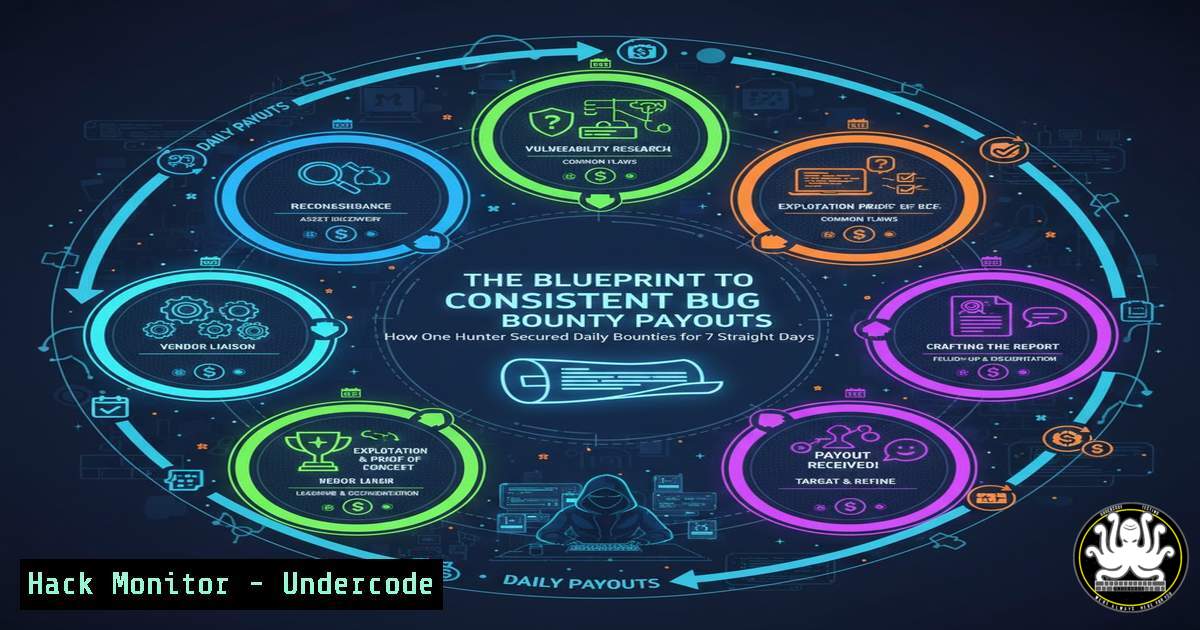
The elusive goal of consistent success in bug bounty hunting is often shrouded in mystery, perceived as luck or elite skill. However, a recent case study of a researcher securing daily bounties for a full week reveals a structured methodology beyond mere chance. This article deconstructs the operational framework, essential tools, and continuous learning ethos required to transform sporadic findings into a reliable vulnerability discovery pipeline, bridging the gap between amateur hunting and professional penetration testing.
Learning Objectives:
- Understand the core methodology and recon-stack for efficient attack surface discovery.
- Learn to automate initial vulnerability scanning and prioritize manual deep-dive testing.
- Develop a continuous learning workflow to stay updated on novel attack vectors and techniques.
You Should Know:
- Foundational Reconnaissance: The Art of Mapping the Attack Surface
The first and most critical step is comprehensive reconnaissance. Successful hunters cast a wide net to discover every possible subdomain, API endpoint, and forgotten asset. This involves using a combination of passive and active tools.
Step‑by‑step guide explaining what this does and how to use it.
Passive Enumeration: Use tools like amass, subfinder, and `assetfinder` to gather subdomains without directly touching the target.
 Example passive enumeration command chain
amass enum -passive -d target.com -o amass_passive.txt
subfinder -d target.com -o subfinder.txt
assetfinder --subs-only target.com | tee assetfinder.txt
sort -u amass_passive.txt subfinder.txt assetfinder.txt > all_subs.txt
Active Enumeration & Probing: Take the consolidated list and probe for live hosts and web servers.
 Use httpx to probe for HTTP/HTTPS servers
cat all_subs.txt | httpx -silent -threads 100 -o live_subs.txt
 Use naabu for fast port scanning on critical assets
naabu -list live_subs.txt -top-ports 1000 -o naabu_ports.txt
Content Discovery: On live web servers, hunt for hidden directories, files, and endpoints using wordlists.
 Using ffuf for fast fuzzing
ffuf -u https://target.com/FUZZ -w /path/to/wordlist.txt -mc 200,403 -ac -c -v
2. Automated Initial Screening and Triage
Manual testing on hundreds of endpoints is impossible. The key is to use automation to filter for low-hanging fruit and common misconfigurations, allowing you to focus manual effort on complex logic flaws.
Step‑by‑step guide explaining what this does and how to use it.
Vulnerability Scanning (Use with Caution): Tools like `nuclei` can identify known CVEs and common misconfigurations. Always comply with program scope and rules.
 Run nuclei with a subset of templates to avoid overwhelming the target
nuclei -list live_subs.txt -t /nuclei-templates/http/exposures/ -t /nuclei-templates/http/misconfiguration/ -o nuclei_findings.txt
JavaScript Analysis: Modern apps bundle secrets and endpoints in JS files. Use tools to extract them.
 Use subjs to find JavaScript files, then linkfinder to extract endpoints
cat live_subs.txt | subjs -c 50 | tee jsfiles.txt
cat jsfiles.txt | xargs -I % bash -c 'echo "Processing: %"; linkfinder -i % -o cli' >> extracted_endpoints.txt
Automated Triage: Write simple scripts or use tools to auto-check for common issues like open S3 buckets, exposed `.git` folders, or default credentials on identified services.
3. Manual Deep-Dive: Beyond the Scanner Results
This is where expertise pays. Automated tools find the obvious; manual testing finds the critical. Focus on business logic, authentication/authorization flows, and complex multi-step processes.
Step‑by‑step guide explaining what this does and how to use it.
Authentication Testing: Test for weak password policies, account enumeration, flawed 2FA bypass, and session management flaws (e.g., session fixation, JWT tampering).
Command for JWT Tampering: Use `jwt_tool` to analyze and test JSON Web Tokens.
python3 jwt_tool.py <JWT_TOKEN_HERE> -C -d /path/to/wordlist.txt
Authorization Testing: Horizontal and Vertical Privilege Escalation. Can you access another user’s data by changing an ID parameter (/api/user/123 to /api/user/124)? Can a user perform admin actions?
API Testing: Fuzz all API endpoints. Test for mass assignment, IDOR, injection in GraphQL queries, and excessive data exposure. Use tools like `kiterunner` to fuzz with actual API request patterns.
- The Continuous Learning Engine: Staying Ahead of the Curve
The landscape evolves daily. The post mentions “Cywer Learning,” highlighting the need for structured education. This involves curated news, practiced labs, and community engagement.
Step‑by‑step guide explaining what this does and how to use it.
Follow Research: Regularly read write-ups on platforms like PentesterLand, watch conference talks (DEF CON, Black Hat), and follow researchers on Twitter/LinkedIn.
Practice on Labs: Apply new techniques in safe environments. Platforms like Hack The Box, PentesterLab, PortSwigger Web Security Academy, and TryHackMe offer labs for all skill levels.
Community Engagement: Join groups like the mentioned “BUG HUNTING” WhatsApp group to exchange tips, targets (where allowed), and collaborate on solving difficult challenges. Sharing knowledge accelerates growth.
5. Operational Security and Professional Reporting
Your technical skill means nothing if you get blocked for aggressive scanning or cannot articulate the vulnerability. Professionalism is key.
Step‑by‑step guide explaining what this does and how to use it.
Respect Scope and Rate Limits: Always adhere to the program’s rules. Use `-rate-limit` flags in tools and random delays in scripts.
Crystal-Clear Reporting: A good report includes a clear title, detailed steps to reproduce (with screenshots/videos), impact analysis, and a realistic remediation suggestion. Proof-of-Concept (PoC) code or curl commands should be included.
 Example PoC curl command for an IDOR vulnerability
curl -H "Authorization: Bearer <VICTIM_TOKEN>" https://api.target.com/v1/user/private_data/<OTHER_USER_ID>
Communication: Be polite and responsive in your communication with security teams.
What Undercode Say:
- Consistency is a System, Not an Accident: The “daily bounty” achievement is the output of a refined, repeatable process combining aggressive reconnaissance, intelligent automation triage, and deep manual testing—not random luck.
- The Learning-Centric Hunter Prevails: The explicit nod to “Cywer Learning” and community groups underscores that the most successful hunters treat cybersecurity as a continuous education, constantly integrating new vulnerability classes and techniques into their methodology.
Prediction:
The barrier to entry for bug bounty hunting will continue to lower with better automation and AI-assisted tools, leading to a more crowded landscape. However, the future high-value hunter will evolve into a specialist—someone who combines this automated workflow with deep, creative expertise in specific domains like SaaS application logic, blockchain/smart contract audits, or embedded systems. Platforms will increasingly favor and reward these specialists who can find complex, business-critical flaws that pure automation misses. Furthermore, we will see a formalization of bug bounty skills into accredited micro-credentials and continuous apprenticeship models, merging the community-based learning shown in the post with structured career pathways.
🎯Let’s Practice For Free:
IT/Security Reporter URL:
Reported By: Vikas Gupta63 – Hackers Feeds
Extra Hub: Undercode MoN
Basic Verification: Pass ✅


