Listen to this Post
Introduction:
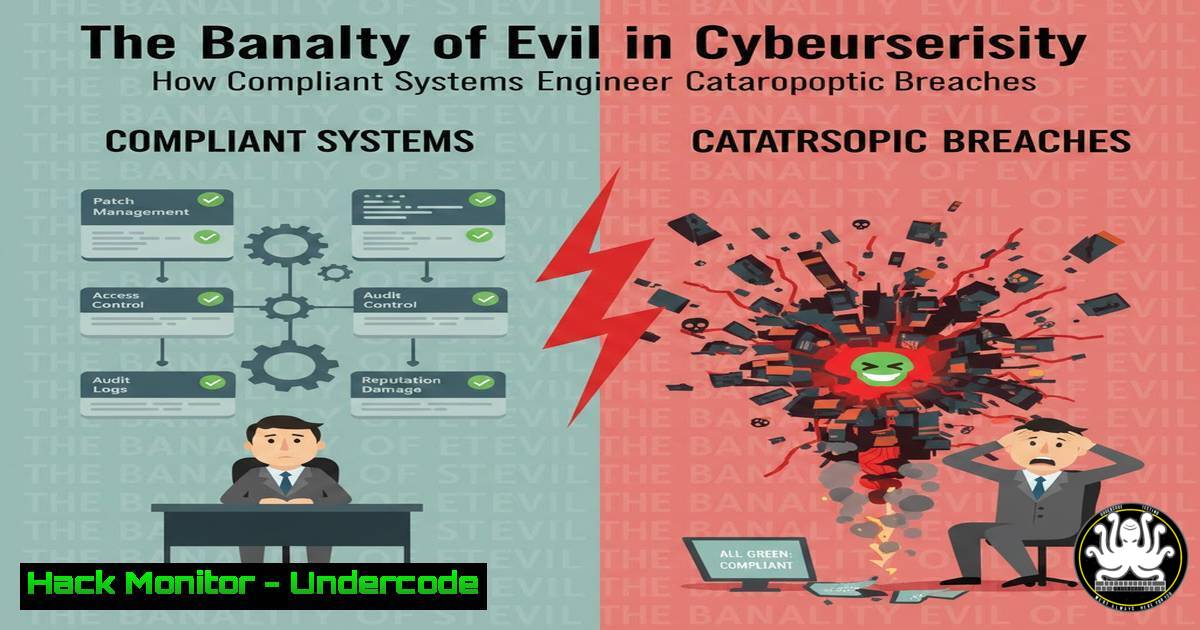
The philosophical concept of the “banality of evil,” applied to modern corporations, reveals a critical vulnerability in cybersecurity and IT governance: systems that reward blind compliance and punish critical thinking. From engineers pushing vulnerable code to meet sprint deadlines to SOC analysts blindly following playbooks without questioning anomalies, the operational landscape is primed for failure not through malice, but through thoughtless adherence to process. This article deconstructs how this inertia manifests in technical environments and provides a framework for embedding ethical, critical judgment into daily IT operations, threat hunting, and security controls.
Learning Objectives:
- Understand how organizational culture and fragmented responsibilities create systemic security blind spots.
- Implement technical controls and auditing practices that force “thinking” and accountability into operational workflows.
- Develop skills to ethically challenge processes, from code review to incident response, mitigating the risk of compliant yet catastrophic failure.
You Should Know:
1. From Philosophical Warning to Technical Audit Trail
The insight that harm stems from thoughtless compliance must be translated into actionable, auditable technical processes. In cybersecurity, thinking means questioning every alert, log entry, and configuration change, not just processing them. This begins with implementing robust audit trails that track not just the what, but the who and why behind actions, enabling retrospective analysis of decision-making chains.
Step‑by‑step guide:
- Implement Comprehensive Logging: On Linux, use `auditd` to track user commands and file access. A critical rule to log all commands by privileged users:
sudo auditctl -a always,exit -F arch=b64 -S execve -F euid=0 -k root_commands
This creates an audit trail (
/var/log/audit/audit.log) for every command executed by the root user, tagged with “root_commands”. - Centralize and Analyze Logs: Use a SIEM (like Elastic Stack or Splunk) to aggregate logs from
auditd, Windows Event Logs (e.g., Event ID 4688 for process creation), and application logs. Create correlation rules to flag sequences of compliant but high-risk actions, like a developer with elevated privileges routinely disabling security controls before deployments. - Conduct “Why” Reviews: In weekly security reviews, don’t just ask if a change was made according to policy. Use the audit trails to ask why it was made. Was it a thoughtless copy-paste from a wiki, or a considered decision? This practice institutionalizes curiosity.
2. Hardening Systems Against Compliant Thoughtlessness
Default configurations and automated deployments can propagate vulnerabilities without a single “evil” actor. The Boeing 737 MAX analogy applies directly to IT: a reliance on automated systems (MCAS) without a culture that prioritizes human oversight and judgment over schedule. System hardening must be dynamic and interrogative.
Step‑by‑step guide:
- Automate Baseline Hardening with Ansible: Use automation not for blind compliance, but to enforce a thoughtful baseline. An example Ansible task to ensure only approved cryptographic protocols are used on a web server:
</li>
</ol>

- name: Harden SSH server configuration
lineinfile:
path: /etc/ssh/sshd_config
regexp: "^{{ item.regexp }}"
line: "{{ item.line }}"
with_items:
- { regexp: '^Ciphers', line: 'Ciphers [email protected],[email protected]' }
- { regexp: '^KexAlgorithms', line: 'KexAlgorithms [email protected]' }
notify: restart sshd
2. Schedule Regular Deviation Checks: Use tools like `lynis` for Linux or `Microsoft Security Compliance Toolkit` for Windows to scan hardened systems. But critically, configure them to report on exceptions to the hardening policy that were approved through change management. Investigate if those exceptions were justified or merely rubber-stamped.
3. Implement Just-in-Time (JIT) Privileged Access: Instead of standing admin rights (which encourage thoughtless use), use a PAM solution. This forces a conscious, logged request for elevation for every specific task, breaking the automation of over-privilege.- Embedding Critical Thinking in API and Cloud Security
The Purdue Pharma analogy—using approved scripts to push harmful products—mirrors API integrations and Infrastructure-as-Code (IaC) templates that are compliant but insecure. A developer using a pre-approved, yet vulnerable, cloud formation template to deploy a database is acting “by the book” while creating a breach vector.
Step‑by‑step guide:
- Shift-Left with Interactive Security Training in CI/CD: Integrate tools like `git-secrets` and `tfsec` (for Terraform) into your pipeline. But go beyond blocking; configure them to educate.
Example pre-commit hook that explains risks
tfsec . --format json | jq -r '.results[] | "WARNING: " + .rule_id + " - " + .long_id + "\n Impact: " + .rule_description'
This provides context, not just a pass/fail, forcing the developer to engage with the why.
- Implement Mandatory Peer Review for Exceptions: When a security scan flags an issue in an IaC template, and a developer requests an exception to meet a deadline, require a formal peer review from a security engineer not on their direct team. The review must document the understood risk and a concrete mitigation timeline.
- Use Service Control Policies (SCPs) in AWS or Azure Policies as a “Circuit Breaker”: Even if a compliant but flawed deployment template runs, have overarching policies that prevent its worst outcomes. For example, a policy that blocks the creation of S3 buckets or storage accounts with public read access, regardless of how the deployment request was approved.
-
Cultivating a Culture of Ethical Dissent in SOC and IR
Arendt’s “career risk silences dissent” is acutely true in Security Operations Centers (SOCs). Analysts may avoid escalating faint anomalies for fear of being wrong, allowing low-and-slow attacks to proceed. Incident Response (IR) can become a box-ticking exercise.
Step‑by‑step guide:
- Create “Red Team” Feedback Channels: Allow any SOC analyst to anonymously submit “what if” scenarios or perceived blind spots to an internal red team. The red team’s mandate includes testing these hypotheses.
- Run “No-Blame” Post-Incident Tabletop Exercises: After a drill or real incident, run a session focused not on procedure, but on decisions. “At point X, Analyst Y had a doubt. What barriers existed to voicing it?” Use technical logs to reconstruct the timeline of human decisions.
-
Measure and Reward “Good Catches”: Implement a metric for “escalations that prevented potential incidents,” even if the initial alert was noisy. Publicly recognize analysts who demonstrated critical thinking, shifting the cultural reward from silence to engaged questioning.
-
Technical Controls for Fragmented Responsibility: The Principle of Least Privilege (PoLP) Revisited
Work fragmentation (“you own your task, not the outcome”) is a technical problem. Over-permissioned service accounts, shared credentials, and poorly segmented networks allow a failure in one thoughtless task to cascade.
Step‑by‑step guide:
- Implement Micro-Segmentation with Zero Trust: Move beyond VLANs. Use host-based firewalls and identity-aware proxies. On Windows, use precise PowerShell commands to configure firewall rules for specific applications:
New-NetFirewallRule -DisplayName "AllowAppXOverHTTPS" -Direction Outbound -Program "C:\App\appx.exe" -RemotePort 443 -Protocol TCP -Action Allow
- Enforce Credential Segmentation: Use group Managed Service Accounts (gMSAs) in Windows or dedicated service principals in Azure/AWS for each application, preventing lateral movement using a single compromised service account.
- Deploy Canary Tokens and Deception Technology: Place fake credentials (canary tokens) and decoy systems (honeypots) in your environment. When accessed, they trigger a high-fidelity alert, indicating that an attacker (or a thoughtless automated process) is moving beyond its intended boundaries. This technical control makes the consequence of fragmented responsibility immediately visible.
What Undercode Say:
- Compliance is the Floor, Not the Ceiling: A checklist-driven security program only mitigates known, past threats. It creates a dangerous illusion of safety while innovative attackers and systemic failures exploit the gaps between the rules.
- The Most Dangerous Vulnerability is Cultural: You can have perfect AES-256 encryption and still suffer a catastrophic breach because a culture of silence and compliance allowed a flawed assumption to go unchallenged. Technical controls must be designed to provoke necessary friction and questioning.
The analysis of Wells Fargo, Boeing, and Purdue reveals a pattern where individuals are incentivized to optimize for local metrics (speed, cost, sales) at the expense of global system safety. In IT, this translates to developers optimized for deployment speed, sysadmins for uptime, and SOC analysts for ticket closure rates—all while security becomes a secondary constraint. The “banality of evil” in cybersecurity is the SQL injection introduced by a developer under pressure to meet a sprint goal, approved by a tired peer reviewer, and deployed by an automation tool following its scripts perfectly. The mitigation is not more rules, but systems—both human and technical—that are designed to surface and reconcile these conflicting incentives through mandatory judgment points, transparent audit trails, and psychological safety to dissent.
Prediction:
In the next 3-5 years, regulatory frameworks (like evolving SEC rules and EU’s DSA/DMA) will move beyond mandating security controls to requiring demonstrable cultures of critical security judgment. Organizations will be audited on their “decision audit trails” and the health of their internal dissent channels. Concurrently, AI-driven security tools will evolve from simple alerting to “judgment simulation,” modeling the potential downstream impacts of a configuration change or an approved exception, and forcing a pause in the process to consider scenarios beyond the immediate task. The failure to operationalize ethical, critical thinking will become a quantifiable liability, moving from a philosophical concern to a direct driver of cyber insurance premiums, stock valuation, and legal accountability.
▶️ Related Video (84% Match):
🎯Let’s Practice For Free:
IT/Security Reporter URL:
Reported By: Major Sumit – Hackers Feeds
Extra Hub: Undercode MoN
Basic Verification: Pass ✅🔐JOIN OUR CYBER WORLD [ CVE News • HackMonitor • UndercodeNews ]
📢 Follow UndercodeTesting & Stay Tuned:
- Embedding Critical Thinking in API and Cloud Security


