Listen to this Post
Introduction:
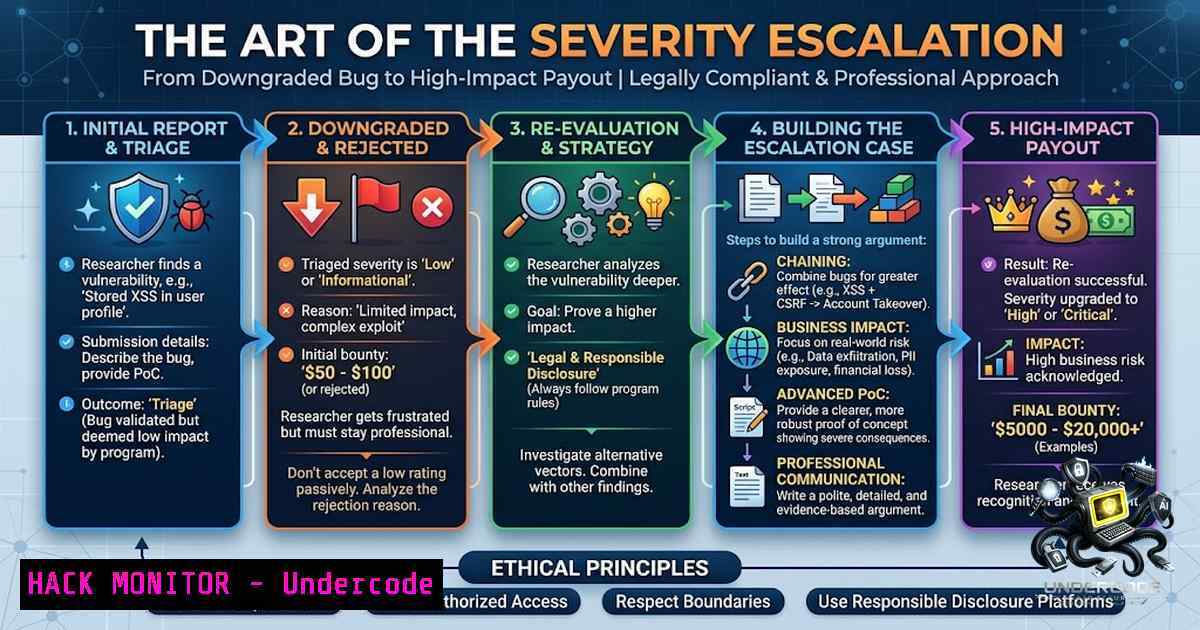
In the competitive arena of bug bounty hunting, discovering a vulnerability is only half the battle; the other half is effectively communicating its business impact to convince triagers of its true severity. A common frustration among security researchers is having a legitimate finding downgraded to a lower severity than it deserves, often due to a report that describes the “what” but fails to explain the “why”. This article deconstructs the methodology for escalating a bug’s severity, transforming a low-priority report into a high-impact finding, and successfully negotiating with security teams, just as Subhash Kumawat demonstrated in his recent experience.
Learning Objectives:
- Master the art of crafting a compelling bug report that translates technical findings into tangible business risk.
- Develop advanced proof-of-concept (PoC) techniques that demonstrate the true exploitability and impact of a vulnerability.
- Learn strategic communication frameworks to effectively negotiate severity and bounty amounts with program triagers.
You Should Know:
1. Pre-Submission Reconnaissance: Building an Irrefutable Foundation
Before writing a single line of your report, your evidence chain must begin with comprehensive asset discovery and context gathering. Relying solely on automated scanners yields superficial results that are easy to dismiss. This foundational work provides the context needed to argue why a vulnerability in a specific component matters.
Step-by-Step Guide:
- Subdomain Enumeration & Asset Mapping: Use tools like
subfinder,amass, and `httpx` to build a comprehensive target scope.Linux - Enumerate live subdomains subfinder -d target.com -silent | httpx -silent -threads 50 > live_subs.txt amass enum -passive -d target.com -o amass_output.txt
-
Technology Stack Fingerprinting: Identify frameworks, JavaScript libraries, and cloud services using `wappalyzer` and
nmap.Linux - Fingerprint web technologies nmap -sV --script=http-wappalyzer -p80,443,8000,8080 target.com -oN tech_stack.txt
-
Historical Context & Git Recon: Use `waybackurls` and `GoLinkFinder` to discover hidden parameters, endpoints, and leaked secrets in historical data.
Linux - Discover historical endpoints
echo "target.com" | waybackurls | grep -E "api|admin|config" > historical_endpoints.txt
-
Windows Alternative for Asset Discovery: Use PowerShell for basic reconnaissance.
Windows PowerShell - Basic host discovery
Test-Connection -ComputerName target.com -Count 1
Resolve-DnsName target.com
2. Vulnerability Validation: From Potential to Proven Exploitability
Finding a potential flaw is step one. Proving it is exploitable in the context of the application is what separates a low-severity finding from a critical one. Avoid reporting theoretical issues. Your goal is to demonstrate a clear, reproducible chain of exploitation that leads to a tangible impact.
Step-by-Step Guide:
- Capture and Document All Leaks: Use a proxy tool like Burp Suite or OWASP ZAP to intercept all server responses. Save every unique response containing leakage.
-
Catalog Exposed Data: Create a structured table to map exposed data points to potential attack vectors.
| Exposed Data Point | Potential Use for an Attacker | Example Command/Tool |
| : | : | : |
| Server: `nginx/1.18.0 (Ubuntu)` | Version-specific exploit research | `searchsploit nginx 1.18.0` |
| `X-Powered-By: Express` | Node.js/Express framework attacks | `npm audit` for Express CVEs |
| Internal IP: `10.10.15.3` | Network mapping & pivot point | `nmap -sV 10.10.15.3` |
- Enumerate Further: Use initial leaks to check for more severe disclosures like `.env` files containing API keys or database credentials.
Linux - Check for common sensitive files
for path in /.env /config.json /api/health /api/debug /api/users; do
curl -s "https://target.com$path" | head -c 500
done
-
Develop a Working Proof-of-Concept (PoC): A well-documented PoC allows triage analysts to quickly replicate and validate the security issue. This should include test code, scripts, or a step-by-step reproduction that an engineer can run. Pseudocode or prose descriptions are insufficient.
Python - Example PoC for an IDOR vulnerability
import requests</p></li>
</ul>

<p>url = "https://target.com/api/user/profile"
cookies = {"session": "victim_session_cookie"}
response = requests.get(url, cookies=cookies)

if response.status_code == 200 and "email" in response.text:
print("[!] Vulnerability Confirmed: Accessed another user's profile.")
print(response.text)
else:
print("[-] Exploitation failed.")
3. Crafting the Report: The Art of Persuasion
The vulnerability itself is only half the battle; the other half is selling its impact. A technically accurate report that fails to make a compelling case for business risk will likely receive a low severity rating.
Step-by-Step Guide:
- Focus on Business Risk, Not Just CVSS: Don’t just list a raw CVSS score. Translate the technical severity into business impact. Explain what an attacker could actually do, not just what the vulnerability is.
-
Use Precise and Impactful Terminology: Instead of calling it a “privacy issue,” highlight the exposure of Personally Identifiable Information (PII) or sensitive financial data.
-
Demonstrate the Attack Chain: Show how an attacker can chain the vulnerability with other weaknesses to achieve a critical impact, such as account takeover, data breach, or privilege escalation.
-
Structure Your Report Professionally:
- Be descriptive and impactful (e.g., “Critical Account Takeover via Leaked Session Cookie”).
- Summary: Briefly overview the vulnerability, its severity, and the affected component.
- Steps to Reproduce: Provide a clear, numbered list of steps an engineer can follow to replicate the issue.
- Proof of Concept: Include your working PoC code, screenshots, or video.
- Impact: Clearly articulate the business risk, potential data loss, and security ramifications.
- Remediation: Suggest a strategic fix, not just a tactical patch.
4. The Negotiation: Escalating the Severity
If your report is initially downgraded, do not simply accept it. As Subhash Kumawat’s experience shows, explaining the issue properly and asking for a re-check can lead to a severity upgrade and an increased bounty.
Step-by-Step Guide:
- Respond Professionally and with Evidence: Do not get emotional. Calmly and professionally reiterate the impact and provide additional proof if necessary.
-
Reframe the Vulnerability: Sometimes, the issue isn’t the bug, but how it’s perceived. By fundamentally reframing the vulnerability, you can demonstrate a much higher impact.
-
Highlight the Business Context: Emphasize the business criticality of the affected asset. A vulnerability in a core authentication system or one handling sensitive customer data carries more weight.
-
Reference the Program’s Own Severity Criteria: Point to the program’s bounty table or severity guidelines. For instance, if the program lists “Authentication Bypass” as Critical or High, and your finding enables that, make the direct connection.
5. Linux & Windows Commands for Vulnerability Assessment
Here are some essential commands for vulnerability assessment and penetration testing on both Linux and Windows systems.
Linux Commands:
- Network Scanning:
Scan open ports with version detection
nmap -sV -p- 192.168.1.10
-
Web Application Fuzzing:
Fuzz for directories and files
ffuf -u https://target.com/FUZZ -w /path/to/wordlist.txt
-
Exploit Research:
Search for known exploits
searchsploit apache 2.4
Windows Commands (PowerShell & CMD):
-
Network Reconnaissance:
PowerShell - Test network connectivity
Test-Connection -ComputerName target.com
PowerShell - Resolve IP address
Resolve-DnsName target.com
-
System Information:
CMD - Get system information
systeminfo
CMD - List active network connections
netstat -ano
-
User and Group Management (often abused by attackers):
CMD - List all users
net user
CMD - Add a new user (requires admin privileges)
net user hacker P@ssw0rd /add
CMD - Add user to Administrators group
net localgroup Administrators hacker /add
6. Cloud Hardening & API Security
Modern bug bounty programs often focus on cloud environments and APIs. Here are key areas to check.
Step-by-Step Guide:
- Check for Publicly Exposed Cloud Storage: Look for open S3 buckets, Azure Blob Storage, or Google Cloud Storage that may contain sensitive data.
Linux - Check if an S3 bucket is publicly accessible
aws s3 ls s3://target-bucket/ --1o-sign-request
-
Test for API Authentication Bypasses: Attempt to access authenticated endpoints without valid credentials or by manipulating tokens.
Linux - Test API endpoint without authentication
curl -X GET https://api.target.com/v1/users
-
Look for Injection Flaws: Test for SQL injection, command injection, and NoSQL injection in API parameters.
Linux - Simple SQL injection test
curl "https://target.com/api/search?q=test' OR '1'='1"
What Undercode Say:
- Key Takeaway 1: A bug’s severity is not just determined by its technical impact but by how effectively you communicate its business risk. A well-crafted report that tells a compelling story of exploitation is more likely to be taken seriously.
- Key Takeaway 2: Persistence and professional communication are crucial. If your finding is downgraded, don’t hesitate to engage with the security team, provide additional proof, and clearly explain why the issue deserves a higher severity rating. As demonstrated, this can lead to a successful upgrade and a larger bounty.
Analysis:
The core lesson from Subhash Kumawat’s experience is that the bug bounty process is a dialogue, not a one-way submission. Many researchers treat a triager’s initial severity rating as final, missing the opportunity to advocate for their findings. However, security teams are often open to re-evaluation if presented with new evidence or a clearer articulation of risk. This requires a shift in mindset from “finding bugs” to “solving business problems.” By framing a vulnerability in terms of its potential financial, reputational, or regulatory impact, a researcher elevates their status from a reporter to a partner in security. The key is to be respectful, evidence-based, and persistent, turning a potential point of conflict into a collaborative effort to improve the organization’s security posture. This approach not only increases bounty payouts but also builds lasting relationships with security teams, leading to invitations to private programs and a stronger reputation in the security community.
Prediction:
- +1 The trend of AI-assisted triage will make the quality and clarity of reports even more critical. AI systems will be trained to parse reports for specific keywords and evidence of impact, rewarding well-structured submissions.
- +1 There will be a growing emphasis on “business impact” as a core component of severity scoring, with programs moving beyond CVSS to incorporate factors like data sensitivity and user base size.
- -1 The increasing sophistication of attack chains will make it harder for single-issue reports to be classified as Critical, pushing researchers to find and demonstrate more complex, multi-step exploits.
- -1 As bug bounty programs become more crowded, the competition for high bounties will intensify, making the ability to effectively communicate and negotiate a critical differentiator for successful hunters.
▶️ Related Video (84% Match):
🎯Let’s Practice For Free:
🎓 Live Courses & Certifications:
Join Undercode Academy for Verified Certifications
🚀 Request a Custom Project:
Secure, high-velocity infrastructure and disruptive technological engineering. Contact our engineering team for high-tier development and proprietary systems:
[email protected]
💎 Smart Architecture | 🛡️ Secure by Design | ⭐ Trusted by ThousandsIT/Security Reporter URL:
Reported By: Ciphernest Bugbounty – Hackers Feeds
Extra Hub: Undercode MoN
Basic Verification: Pass ✅🔐JOIN OUR CYBER WORLD [ CVE News • HackMonitor • UndercodeNews ]
📢 Follow UndercodeTesting & Stay Tuned:


