
Listen to this Post
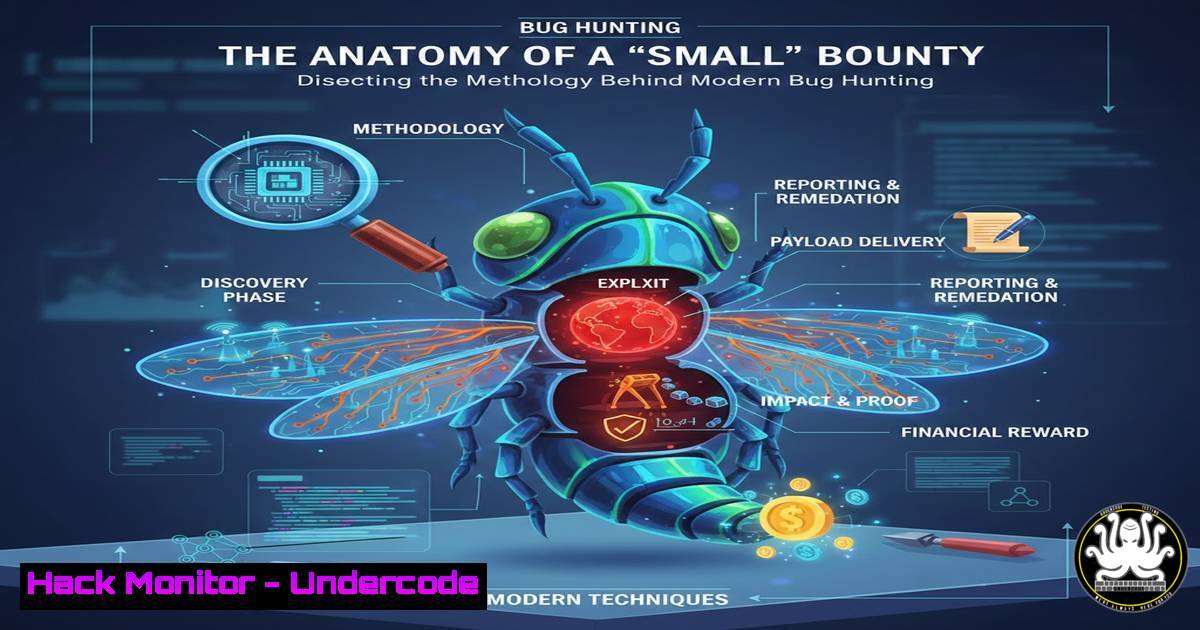
Introduction:
In the world of cybersecurity, a “small bounty” notification on LinkedIn often belies the complex technical orchestration required to find even the most minor vulnerability. These validations from bug bounty programs represent the culmination of meticulous reconnaissance, precise exploitation, and secure reporting. While the monetary reward might be modest, the methodology used to uncover these flaws is identical to that used for critical, high-paying findings. This article dissects the lifecycle of a bug bounty discovery, providing a technical roadmap for aspiring security researchers.
Learning Objectives:
- Understand the reconnaissance and fingerprinting phases of a bug bounty engagement.
- Learn how to automate the discovery of hidden endpoints and parameters.
- Identify common injection flaws and understand how to craft proof-of-concept (PoC) payloads.
- Master the use of essential command-line tools (Linux) for web application testing.
You Should Know:
1. The Reconnaissance Phase: Mapping the Attack Surface
Before a single payload is sent, the attack surface must be mapped. This involves discovering subdomains, hidden directories, and technologies powering the target. For a target like example.com, we begin with subdomain enumeration.
Step‑by‑step guide:
We use a combination of passive and active techniques. First, we gather data from certificate transparency logs and search engines using tools like `assetfinder` and httpx.
 Install tools (if not already installed)
go install github.com/tomnomnom/assetfinder@latest
go install github.com/projectdiscovery/httpx/cmd/httpx@latest

Step 1: Find subdomains
assetfinder --subs-only example.com | tee subdomains.txt

Step 2: Probe for live hosts and extract technologies and status codes
cat subdomains.txt | httpx -title -tech-detect -status-code -follow-redirects -o live_hosts.txt
This command filters the list of potential subdomains down to actual live web servers, displaying their page titles and the technologies they run (e.g., WordPress, Nginx, React). This tells us exactly where to focus our efforts.
2. Directory Busting and Endpoint Discovery
Once we have a live host, the next step is to find hidden files and directories that aren’t linked on the public site. This is crucial for finding admin panels, backup files, or API endpoints.
Step‑by‑step guide:
We use a tool like `ffuf` (Fuzz Faster U Fool) with a common wordlist. This sends thousands of HTTP requests to guess file paths.
 Step 1: Download a common wordlist (if not available)
 sudo apt install seclists -y
 Wordlist location: /usr/share/seclists/Discovery/Web-Content/common.txt

Step 2: Run ffuf against the target
ffuf -u https://target.com/FUZZ -w /usr/share/seclists/Discovery/Web-Content/common.txt -ac -c -t 100
– -ac: Auto-calibrates filtering to ignore false positives.
– -c: Adds colorized output.
– -t 100: Uses 100 threads for speed.
Look for HTTP 200 (OK), 403 (Forbidden), or 301 (Redirect) responses. A 403 on an `admin` directory is often a sign that the directory exists and needs further testing for bypass techniques.
3. Parameter Analysis and Fuzzing
Modern web applications rely heavily on parameters (GET/POST). Finding a hidden parameter that the developer trusts but doesn’t properly sanitize can lead to SQL Injection (SQLi) or Cross-Site Scripting (XSS).
Step‑by‑step guide:
We use `ffuf` again, but this time to fuzz for parameter names on a specific endpoint.
 Step 1: Fuzz for GET parameters
ffuf -u 'https://target.com/api/user?FUZZ=1' -w /usr/share/seclists/Discovery/Web-Content/burp-parameter-names.txt -fs 1234
– -fs 1234: Filters out responses with a specific size (the default “invalid parameter” response size), leaving only hits where the parameter changed the application’s behavior.
If we find a parameter like debug, admin, or id, we proceed to test its value. For a potential SQLi, we would manually test using payloads like `’` or `”` to break the query structure.
4. Exploitation: Crafting the Proof of Concept
Imagine we discovered an endpoint `https://target.com/profile` with a parameter `user_id` that seems vulnerable to Insecure Direct Object References (IDOR). This flaw allows us to access another user’s data by simply changing an ID number.
Step‑by‑step guide (Linux Command Line):
We can use `curl` to craft a request to test this.
 Step 1: Test access to our own profile (e.g., user_id=100)
curl -X GET "https://target.com/profile?user_id=100" -H "Cookie: session=YOUR_SESSION_COOKIE" -v

Step 2: Attempt to access another user's profile (e.g., user_id=101)
curl -X GET "https://target.com/profile?user_id=101" -H "Cookie: session=YOUR_SESSION_COOKIE" -v
If the response for user 101 returns private data (email, address) that isn’t our own, we have confirmed an IDOR. The PoC is simply the two `curl` commands and the resulting JSON/HTML output showing the unauthorized data access.
5. Reporting and Remediation Guidance
The final step is writing a concise report. For an IDOR like the one above, the remediation is to implement robust access control checks on the server-side.
Code Snippet (Conceptual – PHP Example):
// Insecure Code
$user_id = $_GET['user_id'];
$user_data = $db->query("SELECT  FROM users WHERE id = " . $user_id);
echo json_encode($user_data->fetch_assoc());

// Secure Code (with authorization check)
session_start();
$logged_in_user_id = $_SESSION['user_id'];
$requested_user_id = $_GET['user_id'];

// Verify the logged-in user owns the requested resource
if ($logged_in_user_id == $requested_user_id) {
$user_data = $db->prepare("SELECT  FROM users WHERE id = ?");
$user_data->bind_param("i", $requested_user_id);
$user_data->execute();
echo json_encode($user_data->get_result()->fetch_assoc());
} else {
http_response_code(403);
echo json_encode(["error" => "Unauthorized"]);
}
What Undercode Say:
- Methodology over Money: The size of a bounty is irrelevant; the process of discovery is what hones a hacker’s skill. Automated reconnaissance followed by manual validation is the proven formula for success.
- Defense in Depth: This scenario highlights that application security cannot rely on “security by obscurity.” Hidden directories and parameters will be found with tools like ffuf. Developers must implement strict access controls and input validation on the server side, assuming every endpoint is public.
Analysis: The journey from a LinkedIn post celebrating a small bounty to the technical deep-dive reveals the true nature of cybersecurity. It is a discipline of persistence and precision. Bug bounty hunting serves as a critical force multiplier for the industry, providing continuous, community-driven security assessments that often outpace internal QA teams. As applications grow more complex, the automation used by hunters will become more sophisticated, but the fundamental principles of trust boundaries and input validation will remain the cornerstone of defense.
Prediction:
The rise of AI-assisted code generation will lead to a new wave of vulnerabilities, as developers may blindly trust AI-suggested code blocks. Bug bounty hunters will increasingly shift their focus to auditing AI-generated code for logic flaws and insecure default configurations, creating a new specialty in “LLM-assisted application security testing.”
▶️ Related Video (82% Match):
https://www.youtube.com/watch?v=5jcm3XrV-c0
🎯Let’s Practice For Free:
IT/Security Reporter URL:
Reported By: Aditya Singh4180 – Hackers Feeds
Extra Hub: Undercode MoN
Basic Verification: Pass ✅


