
Listen to this Post
Introduction:
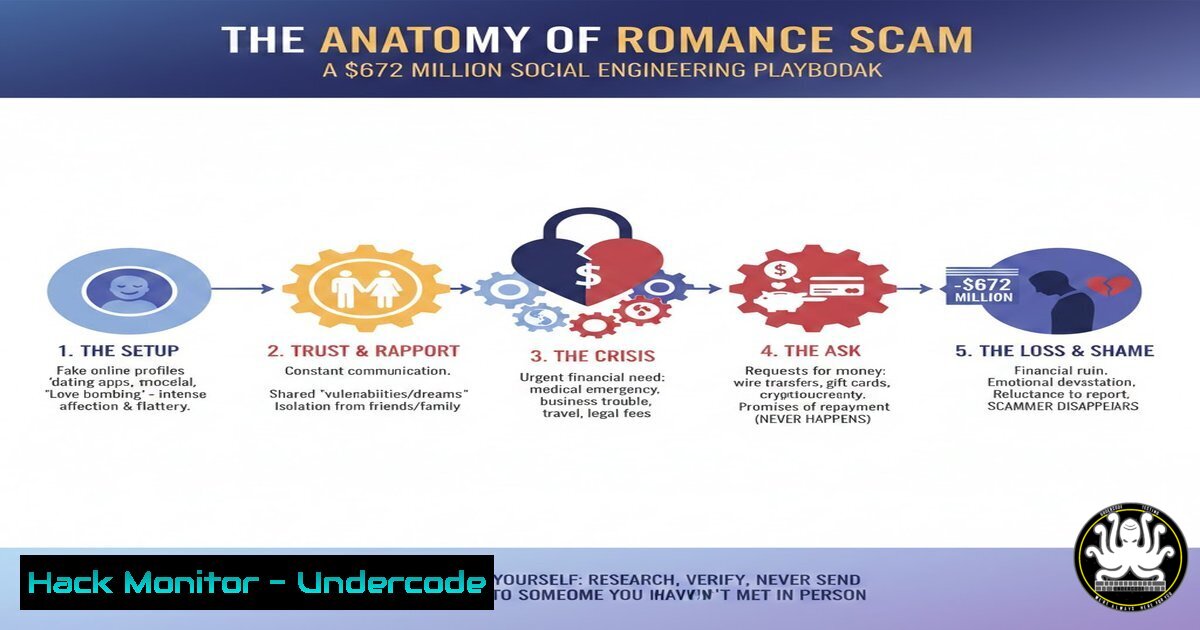
In 2024, romance scams extorted approximately $672 million from victims, with adults over 60 accounting for more than half of that total ($390 million). These are not random acts of deception but highly organized criminal operations running sophisticated social engineering playbooks. By understanding the psychological manipulation tactics—grooming, manufactured urgency, and isolation—individuals and security professionals can identify the red flags before financial devastation occurs.
Learning Objectives:
- Identify the five-stage life cycle of a romance scam to recognize attacks in progress.
- Understand the psychological vulnerabilities (loneliness, trust, politeness) that scammers exploit.
- Learn technical and operational countermeasures, including OSINT verification and reporting protocols.
You Should Know:
1. The Grooming Phase: Building False Trust
Scammers begin by establishing a friendship, which quickly escalates to flirtation. They create a persona designed to mirror the victim’s desires, often using stolen photographs and fabricated biographies. This phase leverages principles of social proof and reciprocity; the scammer may send small gifts or constant attention to lower the victim’s defenses. The goal is to transition the relationship from a transactional online interaction to an emotional dependency.
2. The “Future Faking” Red Flag
A hallmark of these operations is the premature discussion of marriage, destiny, or a shared future. In legitimate relationships, such topics emerge organically over time. In a scam, this is a deliberate tactic to accelerate emotional investment. If you encounter this pattern, a simple reverse image search of profile photos or a domain lookup on the sender’s email address can often reveal inconsistencies. Use Linux command-line tools for initial reconnaissance:
 Check domain registration details for anomalies
whois suspiciousdomain.com

Perform a DNS lookup to verify if the email server matches the claimed location
dig mx suspiciousdomain.com

Use curl to check for exposed metadata on profile images
curl -I "https://example.com/profile.jpg"
3. The Impossibility of Meeting
Despite extensive planning, in-person meetings are always cancelled due to last-minute “emergencies”—a business deal gone wrong, a family crisis, or a robbery abroad. This is the scammer’s way of maintaining anonymity while continuing the narrative. For the target, this is a critical juncture. If you are assisting a potential victim, guide them to use OSINT frameworks like `theHarvester` to see if the scammer’s details appear in any data breaches or scam databases.
 Gather emails and related domains associated with a suspect profile
theHarvester -d suspectdomain.com -b all
- The Financial Escalation: From Small Requests to Liquidation
Requests begin small—perhaps for a phone card or a small gift. Once the first payment is made, the psychological barrier is broken. Scammers then escalate to “emergency” medical bills, travel expenses, or investment opportunities. In 2024, the average loss per victim was substantial. From a cybersecurity perspective, this is similar to an advanced persistent threat (APT) moving from initial access to data exfiltration. If money has been sent, immediate action is required. On Windows, you can use native tools to capture evidence before contacting authorities:Capture network connections to identify potential C2 communication (if malware involved) netstat -anob > scam_connections.txt Capture active processes to check for remote access tools tasklist /v > running_processes.txt Archive the browser history to document the interaction timeline Copy-Item "$env:APPDATA..\Local\Google\Chrome\User Data\Default\History" .\
5. Enforced Secrecy: The Isolation Tactic
The scammer will insist the relationship remain a secret, claiming that “others won’t understand our connection.” This is designed to sever the victim from their support network, leaving them without a reality check. If you suspect a loved one is in this situation, approach them with empathy, not judgment. Provide them with tools to verify information independently, such as checking public court records or using scam-reporting websites.
6. The Incident Response: Banking and Law Enforcement
If a transfer has occurred, time is of the essence. Contact the financial institution immediately to initiate a clawback or freeze. Then, file a detailed report with the FBI’s Internet Crime Complaint Center (IC3.gov). When filing, include all digital artifacts: email headers, IP addresses (if available), and transaction IDs. Analyzing email headers can reveal the true origin of a message, bypassing the scammer’s claimed location:
 Analyze email headers to find the originating IP
grep "Received: from" email_header.txt | head -1
 Then geolocate the IP
curl ipinfo.io/192.0.2.1
7. Proactive Defense: Conversation Auditing
Just as security teams audit network logs, individuals should audit suspicious conversations. Look for inconsistencies in stories, refusal to video chat, or pressure to move communication off a dating platform to unencrypted messaging apps. For the technically savvy, setting up a burner VOIP number or a dedicated email address for online dating can help compartmentalize risk.
What Undercode Say:
- Key Takeaway 1: Romance scams are a high-reward form of social engineering that exploit universal human needs, not just technical ignorance. The $672 million lost in 2024 represents a transfer of wealth from the vulnerable to organized crime, mirroring the structure of corporate phishing campaigns.
- Key Takeaway 2: The most effective defense is a combination of technical verification (OSINT, reverse image search, domain analysis) and human intervention (breaking the isolation). Cybersecurity professionals must extend their expertise to their personal circles, treating family members as end-users who need security awareness training.
- Analysis: This scam vector thrives on the “politeness” and loneliness of the digital age. As AI-generated deepfakes become more accessible, the grooming phase will become even more convincing, making it harder to distinguish a real person from a synthetic identity. The cybersecurity community must develop better digital literacy tools and reporting mechanisms that are as easy to use as the scammer’s initial message.
Prediction:
The integration of Generative AI will automate the grooming process, allowing scammers to scale their operations across multiple victims simultaneously with hyper-personalized narratives. In response, we will likely see the rise of “digital relationship firewalls”—AI-powered tools that analyze communication patterns and flag coercion tactics in real-time, similar to how email filters detect phishing.
▶️ Related Video (84% Match):
🎯Let’s Practice For Free:
IT/Security Reporter URL:
Reported By: Zacharylewis1 Made – Hackers Feeds
Extra Hub: Undercode MoN
Basic Verification: Pass ✅


