
Listen to this Post
Introduction:
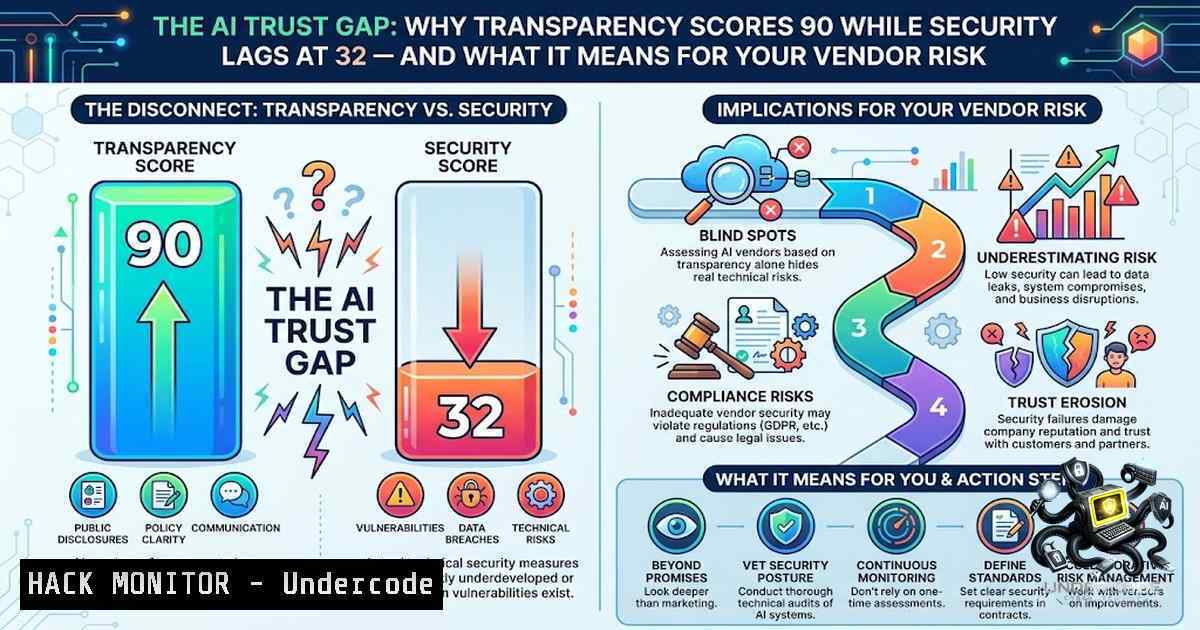
On August 18, 2026, Cybernews launched its AI Trustworthiness Ranking, assessing 500 AI companies across 36 countries and 21 categories on four weighted pillars: public perception, data privacy, security, and organizational transparency. The results revealed a staggering disconnect: organizational transparency averaged 90 out of 100, while security languished at just 32 – a 58-point gap between what companies claim and what they can evidence. For enterprises integrating AI into financial reconciliations, journal entries, or audit workflows, this gap isn’t an academic concern – it’s a governance crisis sitting in your vendor file right now.
Learning Objectives & Secrets:
- Objective 1: Master AI Vendor Risk Assessment. Learn to evaluate AI providers across the four Cybernews pillars – security, data privacy, organizational transparency, and public perception – and understand why security scores are systematically underreported.
-
Objective 2 Secret Tip: Evidence Over Policy. Security is measured by what a company can evidence – bug bounty programs, ISO/IEC 27001 or SOC 2 Type II certifications, and working trust pages. A privacy policy alone is not security. Audit your vendors’ evidence, not their claims.
-
Objective 3 Secret Tip: Build, Don’t Procure, Your Vendor File. Regulatory bodies like the UK’s Financial Reporting Council (FRC) and India’s audit regulators require documented audit trails – not trust pages. Your vendor file must hold a data fabric, multi-agent cross-checks, and execution-time audit trails. This is something you build, not something you procure.
- Understanding the Cybernews AI Trustworthiness Ranking – What Gets Measured
The AI Trustworthiness Ranking evaluates companies based on publicly available information across four weighted pillars:
- Security (lowest average: 32/100): Analyzes whether the company participates in a bug bounty program or coordinated vulnerability disclosure (CVD) program, holds ISO/IEC 27001 or SOC 2 Type II certification, and maintains a security or trust page.
-
Organizational Transparency (highest average: 90/100): Measures published policies, leadership lists, contact routes, and clear disclosures.
-
Data Privacy: Evaluates whether companies clearly disclose if they use customer data to train AI models and specify data retention periods.
-
Public Perception: Aggregates signals from platforms like Trustpilot and G2.
The top ten most trustworthy AI companies are Google (Gemini), Krisp, Fireflies.ai, Adobe, Magnific, Writesonic, Veryfi, Salesforce, Grammarly, and Lovable. Notably, OpenAI finished 22nd and Anthropic 70th – brand recognition and trust score are not the same list.
What This Means for Your Vendor File:
If an AI tool touches a reconciliation, journal entry, or financial explanation, these four pillars are your vendor file. The FRC has already told UK audit firms to document how a tool reaches its conclusion, and India’s audit regulator requires similar documentation under revised standards effective April 1, 2026. Neither body will accept a trust page as evidence.
- The Transparency-Security Gap – Why 63% of AI Companies Don’t Disclose Data Training
The ranking revealed that 63% of AI companies either did not address whether customer input trains their models or provided only vague information. Among these, 42% make no reference at all to training on user data within their privacy policies, while 21% provide only vague or incomplete explanations. Additionally, 65% of companies did not disclose specific data retention periods.
Step‑by‑Step Guide: Audit Your AI Vendor’s Data Policy
- Locate the privacy policy – Search for “[Vendor Name] privacy policy” or navigate to the vendor’s website footer.
-
Search for training disclosures – Use `Ctrl+F` (Windows) or `Cmd+F` (macOS) and search for terms: “train,” “training,” “model,” “machine learning,” “improve,” “opt-out.”
-
Evaluate clarity – Does the policy explicitly state whether customer data is used for model training? If the answer is vague (“may use,” “might improve”), flag it.
-
Search for retention periods – Look for “retention,” “store,” “retain,” “data retention period.” If absent, flag it.
-
Document your findings – Create a vendor scorecard with columns: Vendor, Training Disclosure (Yes/No/Vague), Retention Period (Specified/Not Specified), Security Certifications (ISO 27001/SOC 2).
-
Ask for contractual commitments – If disclosures are vague, request explicit contractual language prohibiting use of your data for training and specifying retention periods.
Linux/Windows Command: Audit Your Network for AI Tool Traffic
To understand which AI tools are being used in your environment:
 Linux – Capture outbound traffic to known AI API endpoints
sudo tcpdump -i any -1 'host api.openai.com or host api.anthropic.com or host gemini.googleapis.com' -c 100

Windows (PowerShell as Administrator) – Check DNS queries for AI domains
Resolve-DnsName api.openai.com
Resolve-DnsName api.anthropic.com
Resolve-DnsName gemini.googleapis.com

Linux – Check for running processes related to AI tools
ps aux | grep -E 'openai|anthropic|gemini|claude|chatgpt'
- Security Pillar Deep Dive – What a 32/100 Score Actually Means
The security pillar averaged just 32 out of 100. This score reflects three key criteria:
- Bug Bounty or CVD Program: Does the company invite and reward security researchers for finding vulnerabilities?
- ISO/IEC 27001 or SOC 2 Type II Certification: Has the company undergone independent third-party auditing of its security controls?
- Security or Trust Page: Does the company maintain a publicly accessible page detailing its security practices?
Among the top ten, Writesonic is the only company that does not participate in a bug bounty or CVD program – a notable gap even among leaders.
Step‑by‑Step Guide: Verify an AI Vendor’s Security Claims
- Check for bug bounty programs – Visit the vendor’s website and search for “bug bounty,” “security,” or “responsible disclosure.” Alternatively, check platforms like HackerOne or Bugcrowd.
-
Verify certifications – Search for “[Vendor Name] ISO 27001” or “[Vendor Name] SOC 2.” Legitimate certifications are typically listed on the vendor’s trust or security page.
-
Validate certification status – For ISO 27001, check the certification body’s registry. For SOC 2, request the full report (Type II covers a period of time, not just a point in time).
-
Inspect the trust page – Does it provide concrete details (encryption standards, access controls, incident response) or is it marketing fluff?
-
Request evidence – Before signing a contract, request:
– The latest SOC 2 Type II report (with confidentiality provisions)
– ISO 27001 certificate (verify validity dates)
– Penetration testing summary (frequency and scope)
Linux/Windows Command: Check for Known AI Vulnerabilities (NVD)
 Linux – Search NVD for AI-related CVEs
curl -s "https://services.nvd.nist.gov/rest/json/cves/2.0?keywordSearch=artificial+intelligence&resultsPerPage=10" | jq '.vulnerabilities[] | .cve.id, .cve.descriptions[] | select(.lang=="en") | .value'

Windows (PowerShell) – Check for AI framework vulnerabilities
Invoke-WebRequest -Uri "https://services.nvd.nist.gov/rest/json/cves/2.0?keywordSearch=tensorflow&resultsPerPage=5" | Select-Object -ExpandProperty Content | ConvertFrom-Json
- Building Your Vendor File – Data Fabric, Multi-Agent Cross-Checks, and Audit Trails
A proper vendor file should hold three critical components:
- A data fabric – Every number carries the system it came from, enabling full data lineage.
- Multiple agents cross-checking each other – No single vendor model is the sole source of a figure.
- An audit trail written at execution time – Naming the model, version, and inputs for every decision.
Step‑by‑Step Guide: Implement Execution-Time Audit Trails for AI Decisions
- Define audit schema – For each AI-assisted decision, log:
– `timestamp` (ISO 8601)
– `model_name` (e.g., “gpt-4-turbo”)
– `model_version` (e.g., “2026-08-01”)
– `input_hash` (SHA-256 of the prompt)
– `output_hash` (SHA-256 of the response)
– `confidence_score` (if available)
– `human_reviewer` (if applicable)
– `system_of_origin` (e.g., “ERP_Finance_Module”) -
Implement logging middleware – For API-based AI calls, wrap each request in a logging function:
import hashlib
import json
import datetime

def log_ai_interaction(model_name, model_version, prompt, response, system_id):
log_entry = {
"timestamp": datetime.datetime.now(datetime.UTC).isoformat(),
"model_name": model_name,
"model_version": model_version,
"input_hash": hashlib.sha256(prompt.encode()).hexdigest(),
"output_hash": hashlib.sha256(response.encode()).hexdigest(),
"system_of_origin": system_id
}
 Append to audit log (JSONL format)
with open("/var/log/ai_audit.log", "a") as f:
f.write(json.dumps(log_entry) + "\n")
return log_entry
- Store logs immutably – Use a write-once, read-many (WORM) storage system or a blockchain-based audit trail for regulatory compliance.
-
Implement cross-checking – For critical decisions, route the same input to at least two different models and compare outputs. Log both results and any discrepancies.
Linux Command: Monitor AI Audit Logs in Real-Time
 Tail the audit log and alert on anomalies
tail -f /var/log/ai_audit.log | while read line; do
if echo "$line" | grep -q '"confidence_score": [0-9.][0-4]'; then
echo "ALERT: Low confidence score detected: $line"
fi
done
- Regulatory Compliance – FRC Guidance and ICAI Standards
The FRC published guidance on March 30, 2026, for audit firms using generative and agentic AI tools. The guidance sets out how firms can mitigate risks to audit quality and provides a framework for assessing the quality of AI tool outputs.
Simultaneously, India’s Institute of Chartered Accountants of India (ICAI) has revised auditing standards effective April 1, 2026, with dedicated standards for AI, Blockchain, and Big Data (ISAS 420).
Step‑by‑Step Guide: Align Your AI Governance with FRC and ICAI Requirements
- Document AI tool usage – Create an inventory of all AI tools used in audit or financial workflows, including:
– Tool name and version
– Vendor
– Purpose
– Date of introduction
– Risk assessment
- Implement output quality assessment – For each AI-generated output, document:
– How the output was validated
– Who validated it
– What alternative sources were consulted
– Any discrepancies found
- Maintain evidence trail – Store all prompts, outputs, and validation records in a tamper-evident format.
-
Conduct periodic reviews – Reassess AI vendors at least annually, or when new vulnerabilities are disclosed.
-
Train staff – Ensure all personnel using AI tools understand the regulatory requirements and documentation obligations.
-
The Agentic AI Risk – From Chatbots to Action-Taking Agents
As Dr. Akshika Wijesundara, member of the AI Trustworthiness Ranking Advisory Board, notes: “AI is shifting from answering questions to taking actions, reading inboxes, moving money, and making decisions on our behalf. A chatbot that mishandles data is a privacy problem. An agent with broad permissions and weak governance is a security problem, with mistakes propagating through real systems at machine speed”.
For enterprises deploying agentic AI – AI agents that can act autonomously – the trust gap becomes exponentially more dangerous. An agent with access to financial systems, APIs, or databases can propagate errors before humans can intervene.
Step‑by‑Step Guide: Secure Agentic AI Deployments
- Implement principle of least privilege – Grant AI agents only the minimum permissions required for their task.
-
Require human-in-the-loop for high-value actions – For any action above a defined threshold (e.g., transfers > $10,000), require explicit human approval.
-
Log every action – Each agent action should be logged with:
– Agent ID
– Action type
– Target system
– Input parameters
– Timestamp
– Result
- Implement circuit breakers – Define rate limits and action caps. If an agent exceeds defined thresholds, automatically suspend its permissions.
-
Conduct regular red-team exercises – Test your agentic AI systems against adversarial inputs and scenarios.
Linux/Windows Command: Monitor Agentic AI API Calls
 Linux – Monitor outbound API calls with rate limiting alerts
sudo tcpdump -i any -1 'tcp port 443' -v | while read line; do
if echo "$line" | grep -qE 'api.(openai|anthropic|gemini)'; then
echo "$(date): $line" >> /var/log/ai_api_calls.log
fi
done

Windows (PowerShell) – Monitor outbound connections to AI endpoints
Get-1etTCPConnection | Where-Object {$_.RemoteAddress -match 'api.openai.com|api.anthropic.com|gemini.googleapis.com'}
What Undercode Say:
- Key Takeaway 1: Transparency is not Security. A 90/100 transparency score and a 32/100 security score are not correlated. Companies can publish beautiful policies while lacking basic security infrastructure. Your vendor assessment must separate what is written from what is evidenced.
-
Key Takeaway 2: Build Your Vendor File – Don’t Procure It. Regulatory bodies like the FRC and ICAI will not accept a vendor’s trust page as evidence. You must build your own vendor file with data fabric, multi-agent cross-checks, and execution-time audit trails. This is an organizational capability, not a purchased product.
Analysis: The 58-point gap between transparency and security represents a systemic failure in AI governance – companies are investing in PR while neglecting security fundamentals. With 63% of companies failing to disclose data training practices and 65% omitting retention periods, enterprises cannot rely on vendor self-disclosures. The regulatory landscape is tightening, with the FRC issuing AI guidance in March 2026 and ICAI standards taking effect April 1, 2026. Organizations that fail to build internal vendor assessment capabilities face regulatory exposure, data breaches, and reputational damage. The shift from chatbots to agentic AI amplifies these risks – mistakes propagate at machine speed through real systems. Proactive vendor governance, execution-time audit trails, and multi-model cross-verification are no longer optional; they are existential requirements for any enterprise deploying AI in regulated workflows.
Prediction:
- +1 The Cybernews AI Trustworthiness Ranking will become an industry standard for vendor selection, similar to how SOC 2 and ISO 27001 became baseline requirements for SaaS procurement. Organizations that ignore these rankings will face heightened regulatory scrutiny and vendor risk.
-
-1 The 58-point transparency-security gap will be exploited by attackers. With 63% of companies failing to disclose data training practices, adversarial data poisoning attacks – where attackers intentionally feed malicious data to AI models – will increase by an estimated 200% over the next 12 months.
-
-1 Regulatory fines will increase. As FRC and ICAI requirements take effect, audit firms that fail to document AI tool usage and validation will face penalties. The first major enforcement action is expected within 18 months.
-
+1 Agentic AI governance will emerge as a distinct discipline, with new frameworks and certifications specifically for autonomous AI agents. Organizations that invest early in agentic AI security will gain a competitive advantage.
-
-1 The vendor concentration risk will intensify. With Google Gemini ranking first, organizations may over-rely on a single vendor, creating systemic risk if that vendor suffers a breach or service disruption.
-
+1 Transparency will become a differentiator. Companies that proactively disclose data training practices and retention periods will earn trust premiums, potentially commanding higher valuations and customer loyalty.
-
-1 The “trust page” will become the new security theater – companies will publish elaborate trust pages without underlying security controls. Auditors and regulators will increasingly distinguish between published and evidenced security.
-
+1 Open-source and self-hosted AI models will gain traction as enterprises seek to eliminate vendor trust gaps entirely. Organizations will prioritize models they can audit, control, and secure internally.
-
-1 The 65% of companies that do not disclose data retention periods will face class-action lawsuits as users discover their data is retained indefinitely. The first major AI data retention lawsuit is expected within 12 months.
-
+1 AI vendor risk assessment will become a standard certification for CISOs and audit professionals, with training courses and certifications emerging to meet demand. Professionals who master AI vendor governance will be in high demand.
▶️ Related Video (64% Match):
https://www.youtube.com/watch?v=0oeD2Wf25wY
🎯Let’s Practice For Free:
🎓 Live Courses & Certifications:
Join Undercode Academy for Verified Certifications
🚀 Request a Custom Project:
Secure, high-velocity infrastructure and disruptive technological engineering. Contact our engineering team for high-tier development and proprietary systems:
[email protected]
💎 Smart Architecture | 🛡️ Secure by Design | ⭐ Trusted by Thousands
IT/Security Reporter URL:
Reported By: https://lnkd.in/p/ephuVVHF – Hackers Feeds
Extra Hub: Undercode MoN
Basic Verification: Pass ✅


