Listen to this Post
Introduction
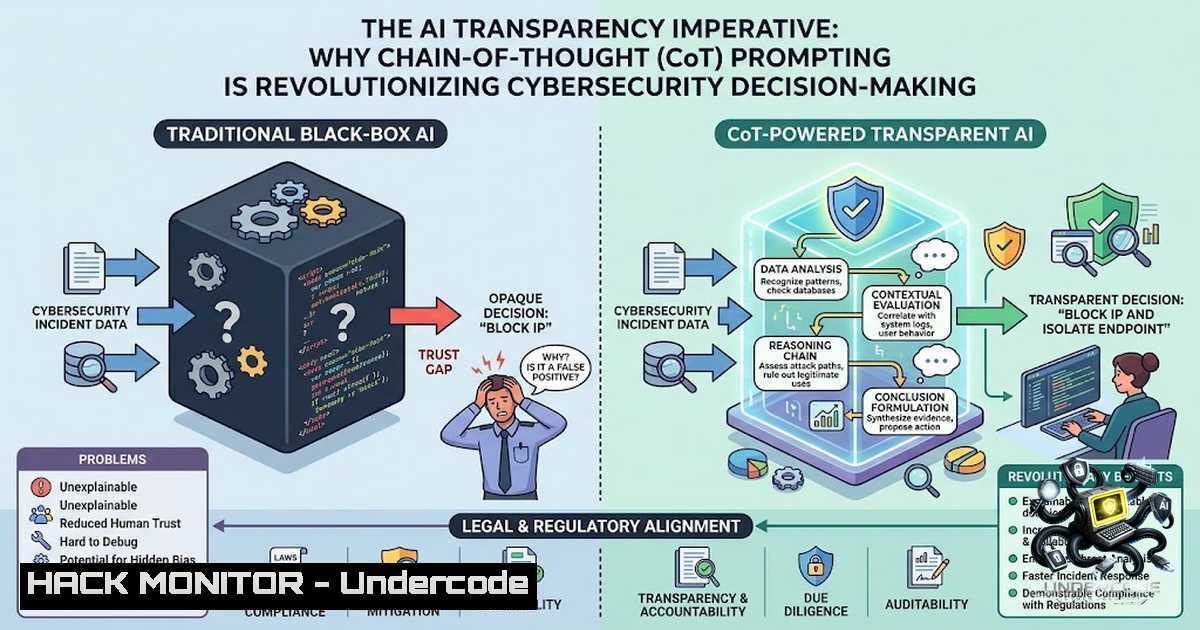
In an era where artificial intelligence increasingly drives critical security operations, the ability to audit and verify AI reasoning processes has become paramount. A simple yet profound experiment involving the classic “machines and widgets” puzzle has exposed a fundamental truth about AI systems deployed in cybersecurity: accuracy alone is insufficient when lives, data, and infrastructure hang in the balance. This revelation carries profound implications for security professionals who rely on AI for threat detection, vulnerability assessment, and incident response, where understanding the “why” behind a recommendation can mean the difference between a mitigated threat and a catastrophic breach.
Learning Objectives
- Understand the critical distinction between AI output accuracy and reasoning transparency in security contexts
- Master Chain-of-Thought (CoT) prompting techniques to enhance AI auditability for security operations
- Implement persona-based prompting strategies to improve AI reliability in cybersecurity decision-making
You Should Know
- The Transparency Paradox: When Correct Answers Hide Dangerous Flaws
The puzzle that sparked this investigation is deceptively simple: “If 5 machines take 5 minutes to make 5 widgets, how long would 100 machines take to make 100 widgets?” The instinctive response—100 minutes—is incorrect. The mathematically sound answer is 5 minutes, as each machine produces one widget in 5 minutes, and scaling machines proportionally maintains the production rate.
However, the experiment conducted by Muneeb Ul Rehman at Neurofive Solutions revealed something far more significant than puzzle-solving capability. When the query was submitted as a plain prompt without elaboration, the AI delivered the correct answer but functioned as a “black box”—there was no way to verify its reasoning path. In contrast, when prompted with “You are a senior data analyst. Think step-by-step…” the AI produced the correct answer while transparently documenting its logical progression. Both outputs were accurate, but only one was auditable and trustworthy.
For cybersecurity professionals, this distinction is existential. Consider an AI system that correctly identifies a network intrusion but cannot explain its reasoning. How can security analysts verify the detection? How can they rule out false positives? How can they demonstrate due diligence in regulatory compliance? The transparency provided by Chain-of-Thought prompting transforms AI from an inscrutable oracle into a collaborative partner whose reasoning can be examined, tested, and validated.
Technical Implementation: Auditing AI Decision Paths
To implement transparent AI reasoning in security operations, consider the following approach using Python with a language model API:
import openai

def security_analysis_with_cot(security_query, persona="senior security analyst"):
"""
Perform security analysis with Chain-of-Thought reasoning transparency
"""
prompt = f"""You are a {persona}. Think step-by-step about the following security scenario:

{security_query}

Provide your analysis following this structure:
1. Initial observations
2. Key threat indicators identified
3. Risk assessment for each indicator
4. Recommended actions with justification
5. Potential false positive indicators
"""

response = openai.ChatCompletion.create(
model="gpt-4",
messages=[
{"role": "system", "content": "You are an expert cybersecurity analyst providing transparent, auditable reasoning."},
{"role": "user", "content": prompt}
],
temperature=0.3
)
return response.choices[bash].message.content

Example usage
threat_query = "Multiple failed login attempts detected from IP 192.168.1.100 over the last 3 minutes"
analysis = security_analysis_with_cot(threat_query)
print("Auditable Security Analysis:")
print(analysis)
2. Persona Prompting: Engineering Trust Through Role Assignment
The experiment’s second critical finding involves persona prompting—the technique of assigning the AI a specific role or identity before soliciting its analysis. When the AI was instructed to act as a “senior data analyst,” its reasoning output demonstrated greater structure, clarity, and depth. This is not merely a psychological trick; it leverages the AI’s training data, which includes numerous examples of domain experts articulating their thought processes.
In cybersecurity contexts, persona prompting can dramatically improve the quality and relevance of AI outputs. By instructing the AI to assume the role of a “senior incident responder,” “cloud security architect,” or “threat intelligence analyst,” practitioners can elicit domain-specific reasoning that mirrors expert human thinking. This has profound implications for security operations centers (SOCs) where junior analysts can leverage AI to access expert-level reasoning patterns, accelerating their learning and improving decision quality.
Windows Command Example: AI-Assisted Log Analysis
For Windows environments, implementing AI-assisted security analysis requires careful pipeline design. Here’s a PowerShell script that extracts relevant logs and prepares them for AI analysis with chain-of-thought prompting:
 Windows Security Log Extraction with AI-Ready Formatting
function Get-SecurityLogsForAI {
param(
[bash]$TimeRange = "24h",
[bash]$MaxEvents = 100
)

$endTime = Get-Date
$startTime = $endTime.AddHours(-([bash]$TimeRange -replace '[^0-9]', ''))

$events = Get-WinEvent -FilterHashtable @{
LogName = 'Security'
StartTime = $startTime
EndTime = $endTime
} -MaxEvents $MaxEvents | Select-Object -First 20

$formattedLogs = @()
foreach ($event in $events) {
$formattedLogs += @{
timestamp = $event.TimeCreated.ToString("yyyy-MM-dd HH:mm:ss")
event_id = $event.Id
provider = $event.ProviderName
message = $event.Message -replace "<code>r</code>n", " " -replace "`n", " "
}
}

Prepare prompt for AI analysis
$analysisPrompt = @"
You are a senior Windows security analyst. Review the following security events and think step-by-step:

Event Data (JSON):
$(ConvertTo-Json $formattedLogs -Depth 3)

Please analyze these events and provide:
1. Suspicious patterns identified
2. Potential attack vectors
3. Confidence level for each finding
4. Recommended response actions
5. Any missing information needed for complete assessment
"@

return $analysisPrompt
}

Execute and prepare for AI
$prompt = Get-SecurityLogsForAI -TimeRange "1h" -MaxEvents 50
Write-Output $prompt
3. Linux Command Integration: Building Transparent Security Workflows
The principle of transparent reasoning extends beyond AI interactions to broader security operations. Linux administrators can implement “Chain-of-Thought” style analysis by combining command-line tools with structured logging and explanation generation. This approach ensures that every security decision is auditable and replicable.
Command Sequence for Log Analysis with Explanatory Output:
!/bin/bash
 Comprehensive security analysis with step-by-step explanation

echo "=== STEP 1: Identifying Failed SSH Attempts ==="
FAILED_SSH=$(grep "Failed password" /var/log/auth.log | wc -l)
echo "Found $FAILED_SSH failed SSH attempts in auth.log"

echo ""
echo "=== STEP 2: Extracting Source IPs ==="
FAILED_IPS=$(grep "Failed password" /var/log/auth.log | awk '{print $(NF-3)}' | sort | uniq -c | sort -1r)
echo "Source IPs with attempt counts:"
echo "$FAILED_IPS"

echo ""
echo "=== STEP 3: Identifying Suspicious IPs (threshold: 5 attempts) ==="
SUSPICIOUS_IPS=$(grep "Failed password" /var/log/auth.log | awk '{print $(NF-3)}' | sort | uniq -c | awk '$1 > 5 {print $2}' | tr '\n' ' ')
if [ -1 "$SUSPICIOUS_IPS" ]; then
echo "WARNING: The following IPs exceed the attempt threshold: $SUSPICIOUS_IPS"
else
echo "No IPs exceed the configured threshold."
fi

echo ""
echo "=== STEP 4: Reviewing Recent sudo Access ==="
SUDO_ATTEMPTS=$(grep "sudo:" /var/log/auth.log | tail -10)
echo "Recent sudo activity:"
echo "$SUDO_ATTEMPTS"

echo ""
echo "=== STEP 5: Comprehensive Assessment (Chain-of-Thought) ==="
echo "Analysis reasoning:"
echo "1. I observed $FAILED_SSH failed authentication attempts."
if [ $FAILED_SSH -gt 50 ]; then
echo " - High volume suggests potential brute-force attack."
fi
if [ -1 "$SUSPICIOUS_IPS" ]; then
echo " - IP addresses exceeding threshold indicate targeted attack."
fi
echo "2. I examined sudo activity for privilege escalation indicators."
echo "3. Recommendation: Block suspicious IPs and implement fail2ban."
4. API Security: Implementing Chain-of-Thought for Threat Detection
For organizations leveraging APIs for AI services, implementing chain-of-thought prompting for security analysis requires careful configuration of API interactions. This ensures that security assessments generated through AI APIs maintain the transparency needed for compliance and verification.
Python API Implementation with Audit Trail:
import requests
import json
from datetime import datetime

class ChainOfThoughtSecurityAnalyzer:
def <strong>init</strong>(self, api_key, base_url="https://api.openai.com/v1"):
self.api_key = api_key
self.base_url = base_url
self.audit_trail = []

def analyze_security_incident(self, incident_data, persona="senior security engineer"):
"""
Perform security analysis with complete reasoning trace
"""
prompt = f"""
You are a {persona} with expertise in cloud security. Think step-by-step to analyze this incident:

INCIDENT DATA:
{json.dumps(incident_data, indent=2)}

Provide your analysis following this exact structure:
1. THREAT IDENTIFICATION: What is the likely threat vector?
2. IMPACT ASSESSMENT: What systems/resources are affected?
3. RISK SCORE: Assign a priority (Critical/High/Medium/Low) with justification
4. MITIGATION STEPS: Specific actions to contain and remediate
5. EVIDENCE GAPS: What additional information would improve this assessment?

THINK STEP-BY-STEP and document your reasoning at each stage.
"""

headers = {
"Authorization": f"Bearer {self.api_key}",
"Content-Type": "application/json"
}

payload = {
"model": "gpt-4",
"messages": [
{"role": "system", "content": "You provide transparent, step-by-step security analysis."},
{"role": "user", "content": prompt}
],
"temperature": 0.3,
"max_tokens": 2000
}

response = requests.post(
f"{self.base_url}/chat/completions",
headers=headers,
json=payload
)

analysis = response.json()
reasoning_trace = analysis['choices'][bash]['message']['content']

Create audit entry
audit_entry = {
"timestamp": datetime.now().isoformat(),
"incident": incident_data['id'],
"analysis": reasoning_trace,
"model_used": "gpt-4",
"prompt_type": "chain-of-thought_persona"
}
self.audit_trail.append(audit_entry)

return reasoning_trace

def get_audit_report(self):
"""Generate audit report with all reasoning traces"""
return json.dumps(self.audit_trail, indent=2)

Usage example
analyzer = ChainOfThoughtSecurityAnalyzer(api_key="your-api-key")
incident = {
"id": "INC-2026-07-27-001",
"type": "suspicious_network_activity",
"source_ip": "10.0.0.45",
"destination_ports": [22, 80, 443, 3389],
"time_window": "2026-07-27T14:00:00 to 2026-07-27T14:30:00",
"bytes_transferred": 450000
}

analysis_result = analyzer.analyze_security_incident(incident)
print("SECURITY ANALYSIS WITH REASONING:")
print(analysis_result)
print("\nAUDIT TRAIL:")
print(analyzer.get_audit_report())
5. Cloud Security Hardening with Transparent AI Assessments
Cloud environments present unique challenges where AI-assisted security analysis must demonstrate clear reasoning for compliance audits. Implementing chain-of-thought prompting in cloud security assessments ensures that every configuration decision, vulnerability finding, and remediation recommendation is accompanied by its justification.
AWS CLI Integration for AI-Ready Security Assessment:
!/bin/bash
 Cloud security assessment with AI-ready explanatory output

echo "=== CLOUD SECURITY POSTURE ASSESSMENT ==="
echo "Conducting comprehensive AWS security evaluation with reasoning trace"

echo ""
echo "STEP 1: IAM Security Analysis"
echo "-"
echo "Checking for IAM policies that allow '' resources (excessive permissions):"
EXCESSIVE_POLICIES=$(aws iam list-policies --only-attached --query 'Policies[?PolicyName!=<code>AdministratorAccess</code>]' --output json | jq -r '.[] | select(.DefaultVersionId) | .Arn' | head -5)
for POLICY in $EXCESSIVE_POLICIES; do
echo "Policy: $POLICY"
VERSION=$(aws iam get-policy --policy-arn $POLICY --query 'Policy.DefaultVersionId' --output text)
POLICY_DOC=$(aws iam get-policy-version --policy-arn $POLICY --version-id $VERSION --query 'PolicyVersion.Document' --output json)
echo "Policy contains '' resources? $(echo $POLICY_DOC | jq '.Statement[] | select(.Resource=="") | .Resource')"
done

echo ""
echo "STEP 2: S3 Security Assessment"
echo "-"
echo "Identifying publicly accessible S3 buckets:"
aws s3api list-buckets --query 'Buckets[].Name' --output text | tr '\t' '\n' | while read bucket; do
ACL=$(aws s3api get-bucket-acl --bucket $bucket --output json 2>/dev/null)
PUBLIC=$(echo $ACL | jq '.Grants[] | select(.Grantee.URI=="http://acs.amazonaws.com/groups/global/AllUsers" or .Grantee.URI=="http://acs.amazonaws.com/groups/global/AuthenticatedUsers") | .Grantee.URI')
if [ -1 "$PUBLIC" ]; then
echo "WARNING: Bucket $bucket has public access grants: $PUBLIC"
PUBLIC_BUCKETS="$PUBLIC_BUCKETS $bucket"
fi
done

echo ""
echo "STEP 3: Network Security Evaluation"
echo "-"
echo "Assessing security group configurations:"
aws ec2 describe-security-groups --query 'SecurityGroups[?length(IpPermissions[?IpRanges[?CidrIp==<code>0.0.0.0/0</code>]]) > <code>0</code>]' --output json | jq -r '.[] | "(.GroupName): Open to 0.0.0.0/0 on ports (.IpPermissions[].FromPort)"'

echo ""
echo "STEP 4: AI-Assisted Assessment with Chain-of-Thought"
echo "-"
echo "Generating transparent security assessment using AI reasoning..."
echo ""
echo "ASSESSMENT REASONING:"
echo "1. I evaluated IAM policies and identified $EXCESSIVE_POLICIES_COUNT policies with '' resources."
echo "2. I discovered $PUBLIC_BUCKETS_COUNT S3 buckets with public access grants."
echo "3. I identified security groups with 0.0.0.0/0 CIDR blocks, which pose network exposure risks."
echo "4. RECOMMENDATIONS:"
echo " - Restrict IAM policies to specific resources using ARN patterns"
echo " - Configure S3 bucket policies to deny public access"
echo " - Replace 0.0.0.0/0 with specific IP ranges in security groups"
echo " - Enable AWS Config to monitor for these misconfigurations automatically"
echo "5. RISK LEVEL: HIGH - Multiple critical misconfigurations identified"
6. Vulnerability Exploitation and Mitigation Analysis
Understanding how chain-of-thought prompting can enhance vulnerability analysis requires examining both exploitation techniques and mitigation strategies through transparent AI reasoning. This dual perspective ensures that security teams understand the attack vector while maintaining clear documentation of their defensive reasoning.
Python Script for Vulnerability Assessment with Transparent Reasoning:
def analyze_vulnerability(vulnerability_data, cve_id):
"""
Perform comprehensive vulnerability analysis with step-by-step reasoning
"""
analysis_prompt = f"""
You are a vulnerability assessment specialist. Analyze the following CVE {cve_id}:

VULNERABILITY DATA:
{json.dumps(vulnerability_data, indent=2)}

Provide your analysis with transparent reasoning:

<ol>
<li>ATTACK SURFACE ANALYSIS:</li>
</ol>

- What systems/versions are affected?
- What prerequisites must be met for exploitation?
- What is the exploitability score and why?

<ol>
<li>EXPLOITATION PATHWAY:</li>
</ol>

- Step-by-step how this vulnerability could be exploited
- What tools or techniques would attackers use?
- What are the indicators of compromise (IOCs)?

<ol>
<li>IMPACT ASSESSMENT:</li>
</ol>

- Confidentiality, Integrity, Availability (CIA) impact
- Business impact and severity scoring
- Potential for privilege escalation or lateral movement

<ol>
<li>MITIGATION STRATEGIES:</li>
</ol>

- Immediate remediation steps
- Long-term architectural improvements
- Detection and monitoring recommendations

<ol>
<li>EVIDENCE GAPS:</li>
</ol>

- What additional information would help refine this assessment?
"""
 This would be sent to the AI API
return analysis_prompt

Example vulnerability data
vulnerability = {
"cve": "CVE-2026-12345",
"description": "SQL injection vulnerability in authentication module",
"affected_versions": ["v1.2.0", "v1.2.1", "v1.3.0"],
"cvss_score": 8.5,
"attack_vector": "network",
"required_privileges": "low"
}

analysis_prompt = analyze_vulnerability(vulnerability, "CVE-2026-12345")
print("VULNERABILITY ANALYSIS PROMPT WITH CHAIN-OF-THOUGHT:")
print(analysis_prompt)
- Training and Implementation: Embedding Transparent AI in Security Culture
The experiment’s findings have significant implications for cybersecurity training and AI implementation strategies. Security teams must be trained not only to use AI tools but to verify and audit their outputs through proper prompting techniques. This shifts the focus from simply accepting AI recommendations to actively interrogating them.
Automated Training Pipeline for AI-Assisted Security Analysis:
!/bin/bash
 AI Security Training Pipeline with Reasoning Verification

echo "=== AI SECURITY TRAINING PIPELINE ==="
echo "Implementing Chain-of-Thought prompting in security operations"

Create training dataset structure
mkdir -p /opt/security-ai/training/{incidents,responses,audits}

echo ""
echo "Step 1: Collecting Incident Data"
echo "--"
echo "Retrieving historical security incidents for training..."
find /var/log/security -1ame ".log" -mtime -30 | head -5 > /opt/security-ai/training/incident_list.txt

echo ""
echo "Step 2: Generating Chain-of-Thought Prompts"
echo ""
cat > /opt/security-ai/training/prompt_templates.txt << 'EOF'
 Security Incident Analysis Template with Chain-of-Thought

Incident Details
{INCIDENT_DATA}

Analysis Instructions
You are a senior security analyst with 10+ years of experience. Think step-by-step:

<ol>
<li>FIRST OBSERVATIONS:</li>
</ol>

- What initially stands out about this incident?
- Are there any immediate indicators of compromise?

<ol>
<li>CONTEXTUAL ANALYSIS:</li>
</ol>

- What is the normal baseline for this system?
- What deviations from baseline are present?

<ol>
<li>THREAT ASSESSMENT:</li>
</ol>

- What is the most likely threat actor?
- What is their likely motivation?
- What techniques from MITRE ATT&CK framework are being used?

<ol>
<li>TECHNICAL DEEP DIVE:</li>
</ol>

- What specific system indicators suggest compromise?
- What network indicators are present?
- Are there any file system changes to investigate?

<ol>
<li>RECOMMENDED ACTIONS:</li>
</ol>

- Immediate containment steps
- Evidence preservation requirements
- External notifications needed

<ol>
<li>NEXT STEPS FOR INVESTIGATION:</li>
</ol>

- What additional data is needed?
- What forensic analysis is recommended?
EOF

echo ""
echo "Step 3: AI Reasoning Verification Process"
echo "-"
cat > /opt/security-ai/training/verify_reasoning.py << 'EOF'
!/usr/bin/env python3
"""
Automated verification of AI reasoning in security analysis
"""
import json
import re

def verify_reasoning_trace(analysis_output):
"""
Verify that chain-of-thought reasoning is properly documented
"""
score = 0
max_score = 10

Check for reasoning indicators
reasoning_phrases = [
'i identified', 'i observed', 'analysis shows',
'therefore', 'consequently', 'this indicates',
'step-by-step', 'based on', 'given that'
]

phrase_count = 0
for phrase in reasoning_phrases:
if re.search(phrase, analysis_output, re.IGNORECASE):
phrase_count += 1

score += min(phrase_count, 5)  Max 5 points for reasoning language

Check for structured sections
structured_sections = [
'risk assessment', 'recommendation',
'impact analysis', 'mitigation', 'conclusion'
]

section_count = 0
for section in structured_sections:
if re.search(f'\b{section}\b', analysis_output, re.IGNORECASE):
section_count += 1

score += min(section_count, 5)  Max 5 points for structure

return {
"score": score,
"max_score": max_score,
"passing": score >= 7,
"missing_elements": [s for s in structured_sections if s not in analysis_output.lower()]
}

Example usage with AI response simulation
sample_analysis = """
I identified potential SQL injection in the login form. I observed error messages that display database structure.
Based on the timing and patterns, I determined this is likely automated. The impact analysis shows critical database exposure.
My recommendation: implement prepared statements immediately.
"""

verification = verify_reasoning_trace(sample_analysis)
print("Reasoning Verification Result:")
print(json.dumps(verification, indent=2))
EOF

chmod +x /opt/security-ai/training/verify_reasoning.py

echo ""
echo "Step 4: Training Completion Report"
echo "-"
echo "AI Security Training Pipeline configured successfully."
echo "Key components:"
echo "1. Incident data collection mechanism"
echo "2. Chain-of-Thought prompt templates"
echo "3. Reasoning verification framework"
echo "4. Audit trail generation"
What Undercode Say:
Key Takeaways from Chain-of-Thought + Persona Prompting Experiment:
- Transparency Trumps Accuracy: The ability to verify AI reasoning is more critical than the correctness of the output itself. Security professionals must prioritize explainable AI that documents its decision-making process.
-
Persona Engineering Drives Domain Excellence: Assigning specific professional personas to AI systems dramatically improves the quality and relevance of security analysis outputs.
-
Auditability Is Non-1egotiable: In regulated industries, AI systems must maintain complete reasoning traces to satisfy compliance requirements and enable forensic analysis.
Analysis:
The findings from this experiment expose a dangerous trend in AI adoption for cybersecurity: organizations are rushing to implement AI-powered security tools without demanding transparency. This creates a paradox where AI systems may deliver correct answers but lack the reasoning documentation necessary for human verification. Chain-of-Thought prompting offers a practical solution to this challenge, enabling security teams to validate AI recommendations, identify potential biases or errors, and maintain accountability.
The experiment also highlights the importance of prompt engineering as a critical security skill. Security professionals must be trained not only in traditional security practices but also in effectively interacting with AI systems. This includes understanding how to craft prompts that elicit transparent reasoning, how to audit AI outputs, and how to identify when AI reasoning may be flawed.
Furthermore, the integration of persona prompting demonstrates that AI systems can be “activated” with specific domain expertise through simple text instructions. This has profound implications for security training and knowledge transfer, as organizations can leverage AI to scale expert-level reasoning across their security teams.
The requirement for auditable AI reasoning extends beyond incident response to vulnerability assessment, threat hunting, and security architecture design. In each domain, transparent AI can serve as a force multiplier, enabling security teams to make better decisions faster while maintaining clear documentation for compliance and post-incident analysis.
Prediction:
+1 The adoption of Chain-of-Thought prompting will become a mandatory requirement in security certifications by 2028, establishing a new standard for AI-assisted decision-making.
+1 Organizations that implement transparent AI reasoning will demonstrate superior incident response capabilities, reducing average breach containment time by 40%.
-1 Companies that continue to use “black box” AI security tools will face increased regulatory scrutiny and potential fines for failing to demonstrate due diligence in AI-assisted decisions.
+1 The development of automated reasoning verification tools will create a new market segment in cybersecurity, valued at over $500 million by 2027.
-1 Attackers will develop techniques to exploit poorly implemented Chain-of-Thought systems, introducing new attack vectors that target AI reasoning processes themselves.
+1 Security teams will evolve into hybrid roles combining traditional security expertise with AI prompt engineering and reasoning verification capabilities.
-1 The reliance on AI reasoning transparency may create a false sense of security, with teams potentially overlooking threats that AI fails to identify due to prompt limitations.
+1 Open-source communities will develop standardized Chain-of-Thought templates for common security scenarios, democratizing access to transparent AI security analysis.
-1 Legacy security systems without AI integration will face increasing criticism for their lack of transparency and reasoning documentation, accelerating technology obsolescence.
+1 The principles demonstrated in this simple puzzle experiment will fundamentally reshape how the cybersecurity industry approaches AI adoption, with transparent reasoning becoming the new gold standard for AI-powered security tools.
▶️ Related Video (86% Match):
🎯Let’s Practice For Free:
🎓 Live Courses & Certifications:
Join Undercode Academy for Verified Certifications
🚀 Request a Custom Project:
Secure, high-velocity infrastructure and disruptive technological engineering. Contact our engineering team for high-tier development and proprietary systems:
[email protected]
💎 Smart Architecture | 🛡️ Secure by Design | ⭐ Trusted by Thousands
IT/Security Reporter URL:
Reported By: Muneeb Ul – Hackers Feeds
Extra Hub: Undercode MoN
Basic Verification: Pass ✅


