Listen to this Post
Introduction:
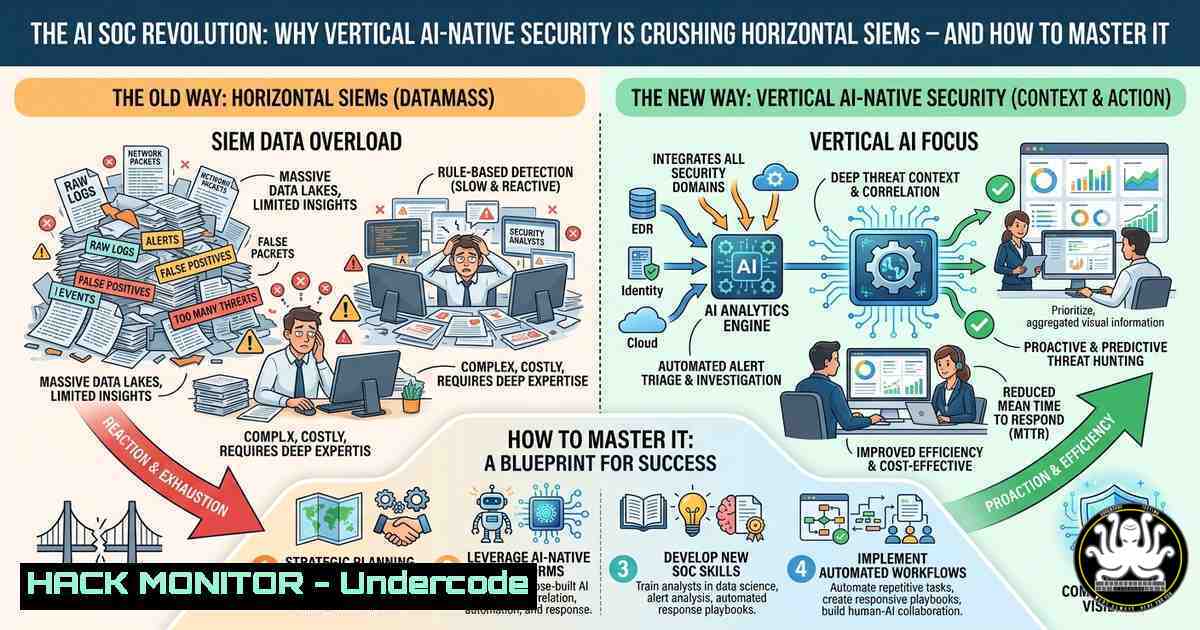
Traditional Security Information and Event Management (SIEM) systems aggregate logs from across your stack, but they’re drowning in noisy, low-fidelity data. The emerging paradigm shift moves AI-driven threat detection and response directly into each security domain—cloud, endpoint, email, identity, and insider risk—where the richest context lives. This article explores why vertical AI Security Operations Center (SOC) solutions outperform horizontal “single pane of glass” approaches and provides hands-on technical guidance to implement AI-native triage and response across key vectors.
Learning Objectives:
- Understand the fundamental difference between horizontal AI SOC (centralized reasoning) and vertical AI SOC (domain-native reasoning) and why ground truth ownership determines response efficacy.
- Learn to configure and use AI-powered triage commands and scripts for cloud security (inspired by Wiz), EDR (CrowdStrike-style), email security (Abnormal-like), and insider risk detection (Above approach).
- Implement practical Linux, Windows, and API security hardening steps that leverage local context for automated remediation, with real command-line examples.
You Should Know:
1. Cloud Security: Native Triage and Remediation (Wiz-Style)
Extended version of the post content:
In cloud environments, the context required to act—resource configurations, IAM bindings, network policies, and workload vulnerabilities—lives with the cloud provider APIs and agentless scanners. Horizontal SIEMs only see a fraction of these signals, leading to alert fatigue. Vertical AI solutions like Wiz embed reasoning directly into cloud metadata, enabling automated, precise remediation.
Step‑by‑step guide to simulate cloud-native AI triage using open-source tools:
- Enumerate cloud assets with native context (AWS example):
Use AWS CLI to pull resource configurations that an AI would analyze for risk.List all S3 buckets with public access block status aws s3api list-buckets --query 'Buckets[].Name' --output text | xargs -I {} aws s3api get-bucket-public-access-block --bucket {} --output json Find unencrypted EBS volumes aws ec2 describe-volumes --query 'Volumes[?Encrypted==<code>false</code>].{ID:VolumeId,Size:Size,Snapshot:SnapshotId}' -
Automated remediation via AWS Lambda (AI decision engine):
Deploy a Python function that reacts to misconfigurations.
 Lambda triggered by CloudTrail or Config
def remediate_public_bucket(bucket_name):
import boto3
s3 = boto3.client('s3')
s3.put_public_access_block(
Bucket=bucket_name,
PublicAccessBlockConfiguration={
'BlockPublicAcls': True,
'IgnorePublicAcls': True,
'BlockPublicPolicy': True,
'RestrictPublicBuckets': True
}
)
print(f"Remediated {bucket_name}")
- Linux command to continuously monitor cloud SDK logs and trigger local AI scripts:
Tail AWS CloudTrail logs from S3 and pipe into a local ML model (pseudo-code)
aws logs tail /aws/cloudtrail/logs --since 5m | grep -i "unauthorized" | tee /var/log/cloud_anomalies.log
Run custom LLM-based triage (requires model setup)
python /opt/ai_triage/classify_anomaly.py --input /var/log/cloud_anomalies.log --action remediate
-
Endpoint Detection and Response: Native AI Triage (CrowdStrike-Style)
Extended version:
EDR sensors generate rich telemetry—process trees, registry changes, memory patterns. Vertical AI uses this ground truth to stop ransomware in seconds without waiting for a central SIEM to correlate.
Step‑by‑step guide to emulate AI-powered EDR triage with Sysmon + Python:
- Enable Sysmon on Windows for deep process lineage:
Download Sysmon from Microsoft and deploy a configuration that captures process creation, network connections, and file changes.Run as Administrator sysmon64.exe -accepteula -i sysmonconfig.xml Example minimal config snippet (save as sysmonconfig.xml): <Sysmon> <EventFiltering> <ProcessCreate onmatch="include"/> <FileCreateTime onmatch="include"/> </EventFiltering> </Sysmon>
-
Use PowerShell to extract live EDR events and feed into a local AI classifier:
Get-WinEvent -FilterHashtable @{LogName='Microsoft-Windows-Sysmon/Operational'; ID=1} -MaxEvents 50 |
ForEach-Object {
$proc = $<em>.Properties[bash].Value;
$parent = $</em>.Properties[bash].Value;
if ($proc -match "powershell. -enc") {
Write-Host "Suspicious encoded command detected: $proc"
Invoke local AI API endpoint
Invoke-RestMethod -Uri http://localhost:5000/triage -Method Post -Body (@{process=$proc; parent=$parent} | ConvertTo-Json)
}
}
3. Linux EDR triage with auditd and falco:
Install Falco (cloud-native runtime security) to act as a local AI decision engine.
sudo apt install falco -y
 Custom rule to detect crypto mining
echo '- rule: Crypto miner detection
desc: Detect processes with high CPU and known miner strings
condition: (proc.name contains "minerd" or evt.arg contains "stratum")
output: "Miner detected: %proc.name (cmdline=%proc.cmdline)"
priority: CRITICAL' | sudo tee -a /etc/falco/falco_rules.local.yaml
sudo systemctl restart falco
 Test with a fake miner
./minerd --url stratum+tcp://fake.pool:3333
3. Email Security: Native AI Response (Abnormal-Style)
Extended version:
Email security requires understanding linguistic context, sender reputation, and behavioral anomalies—data that never reaches a SIEM. Vertical AI solutions like Abnormal analyze email metadata and content inline to quarantine phishing automatically.
Step‑by‑step guide to build a local AI email triage script (Python + IMAP):
- Extract email headers and body for AI analysis (Linux/Windows):
import imaplib, email, re
mail = imaplib.IMAP4_SSL('imap.gmail.com')
mail.login('your_email', 'app_password')
mail.select('inbox')
result, data = mail.uid('search', None, 'UNSEEN')
for uid in data[bash].split():
_, msg_data = mail.uid('fetch', uid, '(RFC822)')
raw_email = msg_data[bash][bash]
msg = email.message_from_bytes(raw_email)
from_addr = msg['From']
subject = msg['Subject']
body = ""
if msg.is_multipart():
for part in msg.walk():
if part.get_content_type() == "text/plain":
body = part.get_payload(decode=True).decode()
else:
body = msg.get_payload(decode=True).decode()

Simple AI simulation: detect known phishing indicators
if re.search(r"verify your account|urgent action required", body, re.I):
print(f"Phishing suspected: {subject} from {from_addr}")
Auto-move to spam via IMAP
mail.uid('copy', uid, '[bash]/Spam')
mail.uid('store', uid, '+FLAGS', '\Deleted')
mail.expunge()
mail.close()
mail.logout()
2. Windows Task Scheduler automation for continuous triage:
$action = New-ScheduledTaskAction -Execute "python.exe" -Argument "C:\scripts\email_triage.py"
$trigger = New-ScheduledTaskTrigger -Once -At (Get-Date) -RepetitionInterval (New-TimeSpan -Minutes 5)
Register-ScheduledTask -TaskName "EmailAITriage" -Action $action -Trigger $trigger
- Insider Risk and Data Security: Native Context (Above-Style)
Extended version:
Insider threats require analyzing user behavior, file access patterns, and DLP events. A horizontal SIEM loses the sequence and intent. Vertical AI, as built by Above, keeps the original sensor’s full context to distinguish malicious downloads from normal work.
Step‑by‑step guide to implement insider risk indicators on Linux/Windows:
- Linux: Monitor user file access anomalies with inotify and AI scoring.
Install inotify-tools sudo apt install inotify-tools -y Monitor sensitive directory for mass file reads inotifywait -m -r -e access /sensitive_data --format '%w%f %e %T' --timefmt '%s' | while read file event time; do user=$(who am i | awk '{print $1}') current_count=$(find /sensitive_data -type f -newer /tmp/last_check -print | wc -l) if [ $current_count -gt 100 ]; then echo "Potential data exfiltration: $user accessed $current_count files in short period" Call AI API for risk scoring curl -X POST http://localhost:8080/risk -H "Content-Type: application/json" -d "{\"user\":\"$user\",\"file\":\"$file\",\"count\":$current_count}" fi touch /tmp/last_check done -
Windows: PowerShell script to detect USB mass storage and flag anomalous copying.
Register for USB device insertion events Register-WmiEvent -Query "SELECT FROM Win32_VolumeChangeEvent WHERE EventType=2" -Action { $drive = $event.SourceEventArgs.NewEvent.DriveName $files = Get-ChildItem $drive -Recurse -File -ErrorAction SilentlyContinue if ($files.Count -gt 500) { $user = [System.Security.Principal.WindowsIdentity]::GetCurrent().Name Write-EventLog -LogName "Security" -Source "InsiderRiskAI" -EventId 4001 -Message "High volume copy from $drive by $user - $($files.Count) files" Trigger automated response: block device via registry Set-ItemProperty -Path "HKLM:\SYSTEM\CurrentControlSet\Services\USBSTOR" -Name "Start" -Value 4 } } -
Identity and Data Security: AI-Native Response (Emerging Pattern)
Extended version:
Identity providers (Okta, Azure AD) generate authentication logs that contain the ground truth for lateral movement and privilege escalation. A vertical AI acts on failed logins, MFA fatigue, and token issuance patterns to automatically disable compromised accounts.
Step‑by‑step guide to simulate identity AI triage with Azure CLI and PowerShell:
- Query Azure AD sign-in logs for anomalies and auto-remediate.
Install AzureAD module Install-Module AzureAD -Force Connect-AzureAD Get risky sign-ins (multiple failed MFA from different IPs) $riskyUsers = Get-AzureADAuditSignInLogs -Top 100 | Where-Object { $<em>.Status.ErrorCode -eq 50055 -and ($</em>.IPAddress -notin $knownIPs) } | Group-Object UserPrincipalName foreach ($user in $riskyUsers) { if ($user.Count -gt 5) { Write-Host "Disabling user: $($user.Name)" Disable account via Azure AD $userObj = Get-AzureADUser -SearchString $user.Name Set-AzureADUser -ObjectId $userObj.ObjectId -AccountEnabled $false Send alert to SOC Invoke-RestMethod -Uri "https://your-siem-ingestor/api/alert" -Method Post -Body (@{user=$user.Name; action="disabled"} | ConvertTo-Json) } } -
Linux: Monitor /var/log/auth.log for brute-force and auto-block with AI threshold.
Tail SSH logs and apply adaptive threshold tail -F /var/log/auth.log | while read line; do if echo "$line" | grep -q "Failed password"; then ip=$(echo "$line" | grep -oE '([0-9]{1,3}.){3}[0-9]{1,3}') count=$(grep "Failed password from $ip" /var/log/auth.log | wc -l) if [ $count -gt 10 ]; then echo "Blocking $ip via iptables" sudo iptables -A INPUT -s $ip -j DROP Optionally log to AI model for correlation python /opt/ai_identity/correlate_failures.py --ip $ip --count $count fi fi done -
API Security and Cloud Hardening for Vertical AI
Extended version:
When building your own vertical AI triage, you need secure APIs between sensors and response engines. This section covers hardening those connections.
Step‑by‑step guide to secure your AI triage API (using NGINX + mTLS):
1. Generate self-signed client and server certificates (Linux).
 Generate CA key
openssl genrsa -out ca.key 4096
openssl req -new -x509 -days 365 -key ca.key -out ca.crt
 Server certificate
openssl genrsa -out server.key 4096
openssl req -new -key server.key -out server.csr
openssl x509 -req -days 365 -in server.csr -CA ca.crt -CAkey ca.key -set_serial 01 -out server.crt
2. Configure NGINX as reverse proxy with mTLS.
server {
listen 443 ssl;
server_name ai-triage.internal;
ssl_certificate /etc/nginx/ssl/server.crt;
ssl_certificate_key /etc/nginx/ssl/server.key;
ssl_client_certificate /etc/nginx/ssl/ca.crt;
ssl_verify_client on;
location /triage {
proxy_pass http://localhost:5000;
proxy_set_header X-Client-Cert $ssl_client_escaped_cert;
}
}
3. Test with a valid client certificate:
curl --cert client.crt --key client.key --cacert ca.crt https://ai-triage.internal/triage -d '{"event":"suspicious_process"}'
What Undercode Say:
- Key Takeaway 1: Horizontal AI SOC solutions fail because they operate on “shallow signals” stripped of original sensor context. The future belongs to vertical AI agents embedded within each security domain—cloud, endpoint, email, identity, and insider risk—that own the ground truth and the response loop.
- Key Takeaway 2: Security teams should prioritize building or adopting domain-native AI triage over centralized SIEM overlay. Practical implementation requires tool-specific automation (AWS CLI, Sysmon, Falco, IMAP scripts, AzureAD PowerShell) and local machine learning models that can act without waiting for cross-correlation.
Analysis (around 10 lines):
Aviv Nahum’s prediction that AI SOC would go vertical rather than horizontal is already materializing in market leaders like Wiz (cloud), CrowdStrike (endpoint), Abnormal (email), and Above (insider risk). The core insight is that contextual richness beats breadth—an AI that sees the full process tree on an endpoint can stop ransomware immediately, whereas a SIEM that receives only summarized logs cannot differentiate a benign admin script from a malicious one. For practitioners, this means shifting investment from log aggregation to embedding lightweight AI models directly into sensors. The commands provided above demonstrate how to achieve local triage with open-source tools: using inotify for file anomalies, Falco for runtime detection, and PowerShell for identity auto-remediation. However, the challenge remains integration—each vertical AI must still share high-confidence alerts with a minimal orchestration layer. The consolidation that Aviv predicts will likely happen around the data plane (e.g., a unified data lake for audit trails) while keeping the decision plane distributed. Teams that fail to adopt vertical AI risk drowning in SIEM noise and losing the speed advantage that attackers already exploit. Finally, as APIs become the primary attack vector, securing the communication between vertical AI agents (using mTLS as shown) is non-negotiable.
Prediction:
Within 24 months, we will see the first major SIEM vendors acquire or replicate vertical AI capabilities for specific domains, leading to a “hybrid” market where a lightweight horizontal layer exists solely for compliance and high-level dashboarding, but all real-time response happens at the edge. The consolidation will start in cloud security and EDR, where vendors like Wiz and CrowdStrike will expand into adjacent domains (e.g., Wiz adding identity security), forcing pure-play horizontal platforms to pivot or perish. Meanwhile, open-source frameworks for building custom vertical AI triage will emerge, enabling organizations to keep ground truth on-premises for air-gapped environments. The ultimate winner will be the vendor that solves the secure, low-latency orchestration between vertical agents without re-centralizing the decision logic.
▶️ Related Video (72% Match):
🎯Let’s Practice For Free:
IT/Security Reporter URL:
Reported By: Avivon My – Hackers Feeds
Extra Hub: Undercode MoN
Basic Verification: Pass ✅


