
Listen to this Post
Introduction:
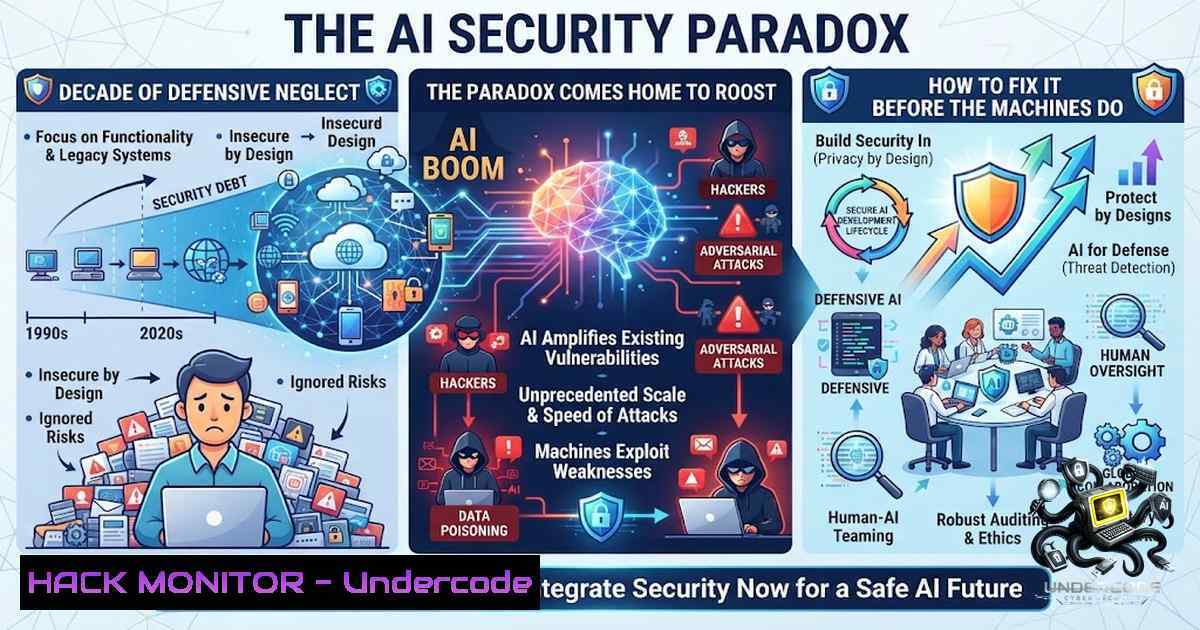
The Five Eyes intelligence alliance recently issued a rare joint warning: advanced AI models capable of overwhelming government and enterprise defenses are not years away—they are months away. This is not a technology problem. It is a human problem, rooted in decades of underinvestment in defensive education, a cultural obsession with offensive cyber capabilities, and a systemic failure to teach foundational security engineering. As Andy Jenkinson of WHITETHORN SHIELD aptly observes, AI has not created these weaknesses; it simply exposes them at machine speed, turning every inherited DNS misconfiguration and identity blind spot into an exploit waiting to happen.
Learning Objectives:
- Understand how AI accelerates vulnerability discovery and automates reconnaissance, lowering attack barriers to an unprecedented scale.
- Identify critical blind spots in DNS, identity, trust, and infrastructure security that AI-powered attackers will target first.
- Master practical, command-line-driven techniques to harden systems, detect AI-enabled threats, and build resilient defenses that can keep pace with machine-speed adversaries.
You Should Know:
- DNS Is the New Battleground—And AI Is Already Mapping Your Weaknesses
The post’s author is explicitly named an expert in Internet Asset & DNS Vulnerabilities and Threat Intelligence. That is no accident. DNS remains one of the most neglected pillars of enterprise security, yet it is the primary channel for command-and-control (C2) traffic, data exfiltration, and reconnaissance. AI-powered attackers now automate DNS enumeration, typosquatting detection, and homographic domain attacks at scale. If your DNS logs are not being actively analyzed for anomalous patterns, you are flying blind.
Step‑by‑Step Guide: DNS Threat Hunting and Hardening
Step 1: Enumerate DNS Cache for Suspicious Entries
On Windows, use the following command to inspect the local DNS resolver cache for recently resolved hostnames that may indicate C2 beaconing:
ipconfig /displaydns | Select-String -Pattern "Record Name" | ForEach-Object { $_ -replace ".Record Name. . . . . . : ", "" } | Sort-Object -Unique
On Linux, inspect the systemd-resolved cache or use `dig` to query specific records:
 View cached entries (systemd-resolved)
resolvectl query example.com

Perform a reverse DNS lookup to identify suspicious IPs
for ip in $(cat suspicious_ips.txt); do dig -x $ip +short; done
Step 2: Detect DNS Tunneling and DGA Activity
DNS tunneling and domain generation algorithms (DGA) are classic C2 techniques now supercharged by AI. Deploy a detection pipeline that combines entropy analysis, beaconing frequency, and TXT record inspection. A Python-based agent can automate this:
 DNS C2 Detection Agent - Excerpt
 Combines Shannon entropy, beaconing detection, and DGA classification
 Source: Anthropic Cybersecurity Skills repository
import re
import math
from collections import Counter

def shannon_entropy(s):
p, lns = Counter(s), float(len(s))
return -sum(count/lns  math.log(count/lns, 2) for count in p.values())

Flag domains with high entropy (potential DGA)
domain = "s7f9k2m4n8q3.example.com"
if shannon_entropy(domain.split('.')[bash]) > 4.5:
print(f"[bash] High entropy domain: {domain}")
Step 3: Harden DNS Server Configuration
Prevent DNS amplification attacks by restricting recursive queries to authorized internal subnets. On BIND, edit /etc/named.conf:
options {
recursion yes;
allow-recursion { 192.168.0.0/16; 10.0.0.0/8; };
allow-query { any; };
version "not available";  Hide version information
};
On Windows Server DNS, use PowerShell to restrict recursion:
Set-DnsServerRecursionScope -1ame "InternalSubnet" -EnableRecursion $true
Set-DnsServerRecursionScope -1ame "External" -EnableRecursion $false
- Identity and Access Management (IAM) Is the New Perimeter—And AI Is Picking the Lock
Parvesh Paliwal’s comment—“Defenders have their budgets and limitations—offenders do not”—cuts to the heart of the IAM crisis. AI can now brute-force credentials, craft spear-phishing payloads, and exploit misconfigured service principals in seconds. The old reactive model of access control is obsolete.
Step‑by‑Step Guide: Implementing Least Privilege with AI‑Resistant Controls
Step 1: Audit and Harden sudoers on Linux
Review `/etc/sudoers` and restrict commands per user or group. Use `visudo` to avoid syntax errors:
 Grant specific commands only
deployer ALL=(ALL) NOPASSWD: /usr/bin/systemctl restart nginx, /usr/bin/journalctl -u nginx

Prevent shell escapes
Defaults !requiretty
Step 2: Enforce Privileged Access Management (PAM) with Temporary Elevation
Configure PAM to require multi-factor authentication for any privilege escalation. Edit /etc/pam.d/sudo:
auth required pam_google_authenticator.so
auth sufficient pam_unix.so nullok try_first_pass
On Windows, use PowerShell to enforce Just Enough Administration (JEA):
 Create a JEA role capability file
New-PSRoleCapabilityFile -Path .\MyRole.psrc -Description "Limited Access for Helpdesk"

Register the session configuration
Register-PSSessionConfiguration -1ame "MyJEA" -RoleCapabilityDefinitionFile .\MyRole.psrc
Step 3: Automate Least Privilege Audits
Use Ansible to enforce IAM policies across your fleet. Example playbook to disable root SSH and enforce sudo:
- name: Harden SSH and sudo
hosts: all
tasks:
- name: Disable root SSH login
lineinfile:
path: /etc/ssh/sshd_config
regexp: '^PermitRootLogin'
line: 'PermitRootLogin no'
notify: restart sshd

<ul>
<li>name: Ensure sudoers.d includes restrictive rules
copy:
dest: /etc/sudoers.d/restrict
content: |
%admins ALL=(ALL) ALL
%developers ALL=(ALL) /usr/bin/systemctl restart
- AI-Powered Vulnerability Discovery Is Here—And It’s Open Source
The barrier to entry for offensive AI has collapsed. Autonomous AI pentesters like Strix and Briar can now scan web applications, inject real payloads, validate exploits, and generate professional reports—all without human intervention. Organizations that do not adopt AI-driven defense will be outmaneuvered by adversaries who do.
Step‑by‑Step Guide: Deploying AI-Assisted Vulnerability Scanning
Step 1: Install and Run an Autonomous AI Pentester
Briar is a free, open-source AI pentester that runs locally without Docker. Install it via pip:
pip install briar-pentest
Run a scan against a target web application:
briar scan --target https://your-app.com --ai-provider ollama --model llama3
Step 2: Integrate AI-Powered Code Review into CI/CD
Argus scans GitHub repositories or local codebases, combining industry-standard tools with LLM-based review to find issues that rule-based scanners miss. Integrate it into your pipeline:
argus scan --repo /path/to/repo --output report.html
Step 3: Automate CVE Triage with AI Agents
Use CVEresearcher to automatically contextualize new vulnerabilities, check for active exploitation, and analyze exploit maturity:
 Set up the agent
git clone https://github.com/Brrrew/CVEresearcher
cd CVEresearcher
python -m venv venv
source venv/bin/activate
pip install -r requirements.txt

Run triage on a specific CVE
python cve_triage.py --cve CVE-2025-1234 --output report.json
- Cloud and AI Workloads Demand a Unified Security Framework
The convergence of AI inference pipelines with cloud infrastructure creates a dual attack surface where cloud security standards and AI governance frameworks intersect without unified enforcement. Every AI workload becomes another potential entry point, and shadow AI deployments are proliferating faster than security teams can track.
Step‑by‑Step Guide: Hardening AI Workloads in Multi-Cloud Environments
Step 1: Enforce Consistent Identity Controls Across Providers
Use a cloud-agnostic identity broker (e.g., Azure AD, Okta) and enforce conditional access policies that require device compliance and MFA for all AI service accounts.
Step 2: Implement Behavioral Threat Detection for LLMs
Deploy runtime protection that monitors prompt patterns, output anomalies, and API usage spikes. Example using Falco (cloud-1ative runtime security):
- rule: Suspicious AI API Usage
desc: Detect unusually high volume of LLM API calls
condition: >
evt.type=connect and
evt.dir=< and
fd.sip in (aws_lambda_ips, openai_ips) and
evt.rawres >= 100
output: "High AI API usage detected (user=%user.name, count=%evt.rawres)"
priority: WARNING
Step 3: Standardize Data Residency and Compliance
Use infrastructure-as-code (Terraform) to enforce data residency policies across AWS, Azure, and GCP:
resource "aws_s3_bucket" "ai_training_data" {
bucket = "ai-training-data-${var.environment}"
force_destroy = false

lifecycle_rule {
enabled = true
transition {
days = 30
storage_class = "GLACIER"
}
}
}

resource "aws_s3_bucket_public_access_block" "block_public" {
bucket = aws_s3_bucket.ai_training_data.id
block_public_acls = true
block_public_policy = true
ignore_public_acls = true
restrict_public_buckets = true
}
- Defensive Education Must Shift from Theory to Simulated Reality
The generational knowledge gap highlighted in the post is not an exaggeration. Cybersecurity curricula have historically prioritized offense over resilience, producing professionals who can break systems but not build them securely. Virtual cyber-ranges and AI-driven Capture-the-Flag exercises are now essential to bridge this gap.
Step‑by‑Step Guide: Building a Defensive Cyber-Range with AI Scenarios
Step 1: Deploy a Local Cyber-Range Using Open Source Tools
Use tools like `cloudgoat` (AWS) or `ADLab` (Active Directory) to create realistic vulnerable environments.
Step 2: Integrate AI-Generated Attack Scenarios
Feed real-world threat intelligence into your training platform to generate dynamic adversary emulation plans. Use MITRE ATT&CK mappings to create AI-generated playbooks.
Step 3: Measure and Improve Defensive Response Times
Track metrics like Mean Time to Detect (MTTD) and Mean Time to Respond (MTTR) during exercises. Use AI analytics to identify systemic weaknesses in your defense-in-depth strategy.
What Undercode Say:
- Key Takeaway 1: AI is not the root cause of systemic insecurity; it is the accelerant that exposes decades of defensive neglect. The Five Eyes warning is a clarion call to reinvest in foundational security engineering, not just offensive cyber capabilities.
- Key Takeaway 2: The security industry suffers from a dangerous knowledge gap where qualified professionals possess critical blind spots in DNS, identity, and infrastructure security. Bridging this gap requires a fundamental shift from theory-heavy education to hands-on, simulation-based training that mirrors real-world AI-driven attack patterns.
Analysis:
The conversation threads reveal a deep frustration among seasoned practitioners. Andy Jenkinson’s reference to the DuPont and Purdue Pharma scandals draws a stark parallel: when profit motives override ethical responsibility, systemic harm follows. Corina Pantea’s observation that professionals are “cognitively impaired” by waiting for official alerts underscores a culture of reactive compliance rather than proactive resilience. Bernhard Biedermann’s lament that decision-makers seek “flash inspiration without effort or cost” highlights the executive disconnect that leaves security teams under-resourced and overwhelmed. The overarching message is clear: the industry has prioritized surveillance and offense over defense, and AI is now forcing a long-overdue reckoning.
Prediction:
- -1: The current trajectory of underinvestment in defensive education will lead to a catastrophic AI-powered supply chain attack within the next 18 months, targeting a critical infrastructure provider and causing widespread operational disruption.
- -1: Organizations that continue to treat AI security as a niche specialty rather than a core competency will experience a 300% increase in successful breaches by 2027, driven by automated AI reconnaissance and exploitation.
- +1: Forward-thinking enterprises that adopt AI-driven defensive automation, invest in cyber-range training, and enforce zero-trust IAM will achieve measurable resilience gains, reducing their MTTD by over 60% within two years.
- +1: The growing demand for AI security certifications—such as ISACA’s AAISM and CompTIA SecAI+—will catalyze a new generation of security professionals who are equipped to defend against machine-speed adversaries.
- -1: If the cybersecurity industry does not fundamentally reform its educational paradigms and prioritise resilience over compliance, AI will become the ultimate force multiplier for systemic insecurity—and the attackers will win.
▶️ Related Video (62% Match):
🎯Let’s Practice For Free:
🎓 Live Courses & Certifications:
Join Undercode Academy for Verified Certifications
🚀 Request a Custom Project:
Secure, high-velocity infrastructure and disruptive technological engineering. Contact our engineering team for high-tier development and proprietary systems:
[email protected]
💎 Smart Architecture | 🛡️ Secure by Design | ⭐ Trusted by Thousands
IT/Security Reporter URL:
Reported By: Andy Jenkinson – Hackers Feeds
Extra Hub: Undercode MoN
Basic Verification: Pass ✅


