
Listen to this Post
Introduction
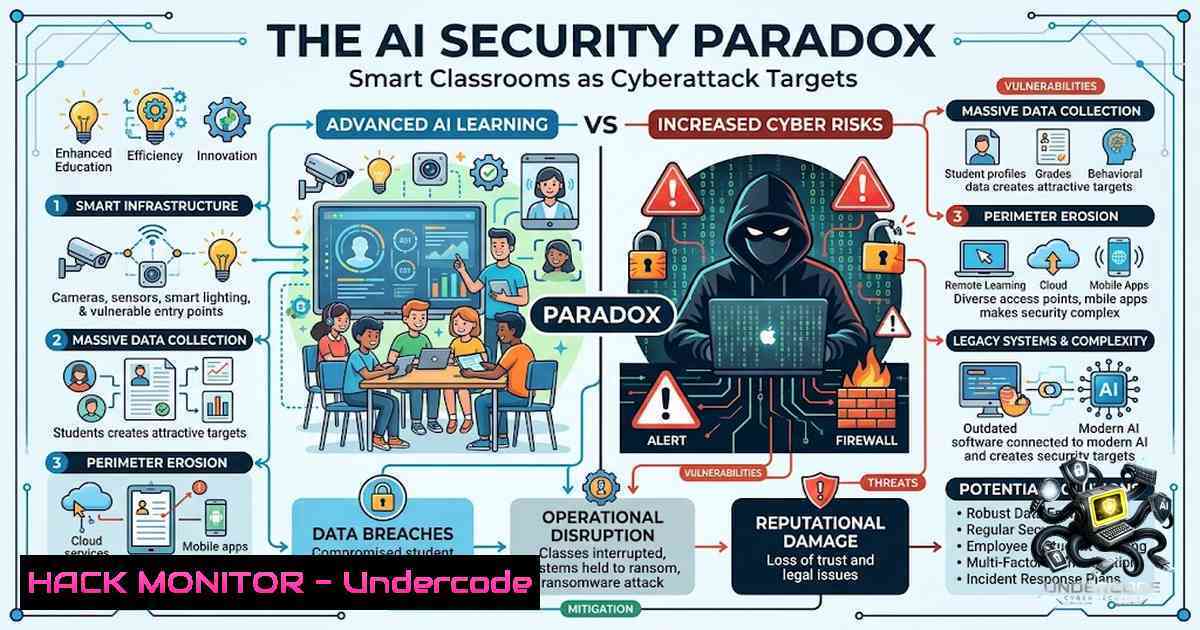
The rapid integration of generative AI, cloud computing, and IoT into modern education has created an unprecedented attack surface that cybersecurity professionals are struggling to secure. As universities worldwide embrace digital transformation initiatives—including those highlighted in recent academic publishing opportunities—the intersection of educational technology and cybersecurity presents both extraordinary learning opportunities and critical vulnerabilities that demand immediate attention.
Learning Objectives
- Understand the cybersecurity implications of integrating AI, cloud computing, and IoT in educational environments
- Master practical security controls for protecting digital learning platforms against emerging threats
- Develop skills in identifying and mitigating vulnerabilities specific to AI-powered educational systems
- Learn to implement defense-in-depth strategies across hybrid educational technology stacks
You Should Know
- The Hidden Dangers of Generative AI in Academic Publishing and Education
When educational institutions rush to adopt generative AI tools like large language models (LLMs) for research, content creation, and student assessment, they inadvertently expose sensitive academic data to potential breaches. The call for book chapters on “Quality Education for Sustainable Development” emphasizes AI in education, but security professionals must recognize that every AI integration point becomes a potential data exfiltration channel.
What This Means for Security Teams:
Educational AI systems typically process highly sensitive data including student records, research manuscripts, proprietary academic content, and personally identifiable information (PII). Without proper security controls, these systems can be exploited through prompt injection attacks, model inversion attacks, or training data poisoning.
Step-by-Step Guide to Securing AI Integration in Education:
- Conduct an AI Risk Assessment – Map all AI touchpoints in your educational ecosystem, including LLM interfaces, learning analytics platforms, and automated assessment tools.
-
Implement API Security Controls – For any AI service API integration, enforce:
– Rate limiting to prevent abuse
– Authentication using OAuth 2.0 or API keys with rotation policies
– Request validation to prevent injection attacks
– Comprehensive logging with correlation to user sessions
- Deploy Data Loss Prevention (DLP) for AI Inputs – Configure DLP policies to monitor and block sensitive data (e.g., Social Security numbers, research data, student PII) from being submitted to external AI models.
Example Implementation:
For educational institutions using Azure OpenAI, configure content filters and data loss prevention:
 Python example: Sanitizing inputs to educational AI API
import re
import hashlib

def sanitize_input(user_input):
 Remove PII patterns
pii_patterns = [r'\b\d{3}-\d{2}-\d{4}\b',  SSN
r'\b[A-Za-z0-9._%+-]+@[A-Za-z0-9.-]+.[A-Z|a-z]{2,}\b']  Email
for pattern in pii_patterns:
user_input = re.sub(pattern, '[bash]', user_input)

Add request fingerprint for audit trail
request_hash = hashlib.sha256(user_input.encode()).hexdigest()[:8]
return user_input, request_hash
Linux Command to Monitor AI API Traffic:
 Monitor outbound API traffic for unusual patterns
sudo tcpdump -i eth0 -1 dst port 443 | grep -E "api.openai.com|azure.com" | tee -a /var/log/ai_api_traffic.log

Set up real-time alerting for excessive API calls
watch -1 5 'grep "api.openai.com" /var/log/ai_api_traffic.log | wc -l'
- Securing Smart Classrooms: IoT Vulnerabilities That Could Expose Your Entire Network
The mention of “Smart Classrooms & IoT” in academic discussions introduces significant cybersecurity challenges that IT administrators must address. Smart boards, IoT sensors, student response systems, and classroom cameras create a massive attack surface often overlooked in educational technology planning.
The Reality of IoT Insecurity:
Many educational IoT devices ship with default credentials, unencrypted communication protocols, and outdated firmware. A compromised smart projector or classroom camera can serve as an entry point to the entire campus network, potentially leading to ransomware attacks, data breaches, or surveillance of faculty and students.
Step-by-Step IoT Security Hardening Guide:
- Network Segmentation with VLANs – Isolate all IoT devices on dedicated VLANs with strict firewall rules preventing lateral movement:
Cisco IOS Example - Creating an IoT VLAN
configure terminal
vlan 200
name IoT_Classroom_Devices
exit
interface vlan 200
ip address 192.168.200.1 255.255.255.0
no shutdown
-
Implement 802.1X Authentication – For wired and wireless IoT devices that support it, enforce certificate-based authentication:
Linux - Generate device certificates using OpenSSL
openssl genrsa -out iot_device.key 2048
openssl req -1ew -key iot_device.key -out iot_device.csr -subj "/CN=classroom-smartboard-01"
openssl x509 -req -in iot_device.csr -CA ca.crt -CAkey ca.key -CAcreateserial -out iot_device.crt -days 365
-
Continuous Vulnerability Scanning – Deploy automated scanning for IoT firmware vulnerabilities:
Nmap scan for IoT devices with default credentials
nmap -sV --script=broadcast-dhcp-discover,http-default-accounts,ftp-anon 192.168.200.0/24

Shodan command-line to check for exposed IoT devices
shodan search "port:80 http.title:'Smart Classroom'" --limit 100
-
Regular Firmware Update Process – Create a scheduled update policy with testing in a staging environment before production deployment.
Windows Command for IoT Device Inventory:
 PowerShell - Scan local subnet for IoT device fingerprints
For ($i=1; $i -lt 255; $i++) {
$ip = "192.168.200.$i"
if (Test-Connection -ComputerName $ip -Count 1 -Quiet) {
$response = Invoke-WebRequest -Uri "http://$ip" -TimeoutSec 2 -ErrorAction SilentlyContinue
if ($response.Headers -match "IoT|SmartBoard|Camera") {
Write-Host "Potential IoT device found at $ip"
$response.Headers | Out-File -Append "iot_inventory.txt"
}
}
}
- Cloud Security in Education: Protecting Academic Data in Hybrid Environments
As educational institutions migrate to cloud platforms (as referenced in “Cloud Computing in Education”), security professionals must address misconfigurations, identity management failures, and data protection gaps that are prevalent in academic cloud deployments.
Critical Cloud Security Challenges in Education:
- Overly permissive IAM policies that grant students or faculty excessive privileges
- Unsecured storage buckets containing research data, exam papers, or student records
- Lack of encryption for data at rest and in transit
- Insufficient logging and monitoring capabilities
Step-by-Step Cloud Hardening for Educational Environments:
- Implement Principle of Least Privilege – Review and restrict IAM roles for all users:
// AWS IAM Policy Example - Faculty limited to specific S3 prefixes
{
"Version": "2012-10-17",
"Statement": [
{
"Effect": "Allow",
"Action": "s3:GetObject",
"Resource": "arn:aws:s3:::edu-research-data/${aws:username}/"
},
{
"Effect": "Deny",
"Action": "s3:DeleteObject",
"Resource": ""
}
]
}
2. Enable Comprehensive Cloud Logging:
 AWS CLI - Enable S3 server access logging
aws s3api put-bucket-logging --bucket edu-data-bucket \
--bucket-logging-status '{"LoggingEnabled":{"TargetBucket":"log-bucket","TargetPrefix":"s3-logs/"}}'

Azure CLI - Enable diagnostic logging for Storage
az storage account blob-service-properties update \
--account-1ame eduaccount --resource-group security-rg \
--enable-logging true
3. Deploy Encryption at All Layers:
 PowerShell - Enforce Azure Storage encryption
az storage account encryption-scope create \
--account-1ame eduaccount --resource-group security-rg \
--encryption-scope-1ame student-data-scope \
--source Microsoft.Storage
- Configure Security Center / Defender for Cloud with auto-remediation policies.
-
Regular Compliance Audits using tools like AWS Config, Azure Policy, or GCP Security Command Center.
4. Blockchain for Academic Credentialing: Security Implications
The “Blockchain for Academic Credentialing” topic mentioned in the call for book chapters presents promising security advantages but also introduces unique vulnerabilities that must be addressed before widespread adoption.
Security Benefits of Blockchain Credentialing:
- Immutable record of academic achievements preventing forgery
- Decentralized verification reducing reliance on centralized database breaches
- Student-controlled digital identities enhancing privacy
Critical Security Considerations:
- Private key management becomes paramount—lost keys mean lost credentials
- Smart contract vulnerabilities could allow credential manipulation
- Oracle attacks if external data feeds are used for verification
- Regulatory compliance with GDPR and data protection laws regarding the right to be forgotten
Step-by-Step Secure Implementation Guide:
- Multi-Signature Wallet Requirement – Require multiple institutional approvers for credential issuance:
// Solidity Smart Contract Example - Multi-signature credential issuance contract EduCredential { mapping(address => bool) public approvers; mapping(bytes32 => bool) public credentials;</li> </ol> function issueCredential(address student, string memory degree) public { require(approvers[msg.sender], "Not an authorized approver"); bytes32 credentialHash = keccak256(abi.encodePacked(student, degree, block.timestamp)); credentials[bash] = true; } }- Implement Key Recovery Mechanisms – Use threshold signatures or hardware security modules for key management.
-
Regular Smart Contract Audits – Engage third-party security firms to review credentialing contracts.
-
Data Minimization – Store only hashes of credential data on-chain with off-chain encrypted storage for full records.
-
Learning Analytics Security: Protecting Student Data in Educational Data Mining
With “Learning Analytics & Educational Data Mining” becoming central to modern education, securing the data pipeline from collection to analysis is critical for maintaining student privacy and institutional trust.
Data Security Risks in Learning Analytics:
- Unauthorized access to predictive models that contain sensitive student performance data
- Re-identification attacks on anonymized datasets
- Model extraction attacks that could reveal training data patterns
- Insider threats from researchers accessing analytics databases
Step-by-Step Security Implementation:
1. Implement Data Anonymization using differential privacy:
 Python - Differential privacy for student performance data
import numpy as np

def add_differential_privacy(data, epsilon=0.1, sensitivity=1.0):
noise = np.random.laplace(0, sensitivity/epsilon, len(data))
return [d + n for d, n in zip(data, noise)]

Apply to grade distribution before sharing
grades = [85, 92, 78, 95, 88, 91, 84, 79]
anonymized_grades = add_differential_privacy(grades)
2. Encrypt Analytics Databases:
-- PostgreSQL example - Enable Transparent Data Encryption
CREATE EXTENSION pgcrypto;
ALTER TABLE student_performance SET (encryption = 'AES-256');
- Implement Role-Based Access Control (RBAC) for analytics dashboards:
// RBAC Configuration Example { "roles": { "researcher": { "permissions": ["view_aggregated_data", "export_anonymized_data"], "dataScope": "department_level" }, "professor": { "permissions": ["view_own_student_data"], "dataScope": "course_level" } } } -
Monitor for Anomalous Query Patterns that may indicate data exfiltration:
Linux - Monitor database query logs for bulk exports
tail -f /var/log/postgresql/postgresql.log | grep -E "SELECT.student|COPY.student|pg_dump"
-
Cybersecurity Training for Faculty and Students: The Human Firewall
Despite technological controls, human error remains the greatest vulnerability in educational cybersecurity. The integration of emerging technologies requires comprehensive training programs for all stakeholders.
Essential Training Components:
- Phishing Awareness – Conduct regular simulated phishing campaigns:
Example command to setup Gophish on Linux for phishing simulations
wget https://github.com/gophish/gophish/releases/latest/download/gophish-v0.12.1-linux-64bit.zip
unzip gophish-v0.12.1-linux-64bit.zip
./gophish &  Runs on https://localhost:3333
-
Secure AI Usage Guidelines – Train faculty on prompt engineering best practices and sensitive data handling when using generative AI.
-
IoT Security Awareness – Educate staff on recognizing and reporting suspicious IoT device behavior.
-
Incident Response Drills – Conduct tabletop exercises simulating data breaches and ransomware attacks.
What Undercode Say
Key Takeaway 1: The Convergence of AI and Education Security is Inevitable – As the call for book chapters on AI in education illustrates, the integration of generative AI, learning analytics, and blockchain will transform educational delivery. However, every emerging technology introduces new attack vectors that require proactive security measures. The gap between academic innovation and cybersecurity implementation must be bridged through comprehensive security frameworks that address AI-specific threats like prompt injection, model poisoning, and data leakage.
Key Takeaway 2: Defense-in-Depth Requires Multi-Layer Security Across the Entire Educational Technology Stack – From IoT devices in smart classrooms to cloud-based learning management systems, educational institutions must implement coordinated security controls. This includes network segmentation, encryption, access controls, continuous monitoring, and regular security testing. The hybrid nature of modern educational technology demands security professionals who understand both traditional IT security and emerging threat landscapes in AI, IoT, and blockchain.
Analysis: The educational sector is experiencing digital transformation at unprecedented speed, driven by competitive pressures to adopt AI and other emerging technologies. While this creates valuable learning opportunities, it also makes education a prime target for cybercriminals seeking sensitive research data, student PII, and intellectual property. The challenge for institutions is maintaining security without hindering academic innovation, requiring security professionals to become trusted partners in the digital transformation journey rather than roadblocks.
Prediction
+1 The growing emphasis on AI security education will create new specialized roles for cybersecurity professionals in academia, including AI Security Officers and Educational Technology Risk Managers, driving significant job growth in the education technology security sector.
-P As learning analytics become more sophisticated with AI, new privacy-preserving technologies like federated learning and homomorphic encryption will see widespread adoption in educational settings, reducing data exposure while maintaining analytical capabilities.
-1 Without immediate action, the rush to integrate generative AI and IoT in education will lead to major data breaches and privacy violations, potentially causing a regulatory backlash that could slow educational technology adoption by 2-3 years.
-1 The shortage of cybersecurity professionals with AI and educational technology expertise will create a skills gap, making many institutions vulnerable to sophisticated attacks targeting their digital learning platforms.
+1 Blockchain credentialing systems, once properly secured, will reduce credential fraud and identity theft in academic settings, saving institutions millions in verification costs and enhancing the value of academic credentials globally.
▶️ Related Video (86% Match):
🎯Let’s Practice For Free:
🎓 Live Courses & Certifications:
Join Undercode Academy for Verified Certifications
🚀 Request a Custom Project:
Secure, high-velocity infrastructure and disruptive technological engineering. Contact our engineering team for high-tier development and proprietary systems:
[email protected]
💎 Smart Architecture | 🛡️ Secure by Design | ⭐ Trusted by ThousandsIT/Security Reporter URL:
Reported By: Sandeep Chouhan – Hackers Feeds
Extra Hub: Undercode MoN
Basic Verification: Pass ✅🔐JOIN OUR CYBER WORLD [ CVE News • HackMonitor • UndercodeNews ]
📢 Follow UndercodeTesting & Stay Tuned:


