Listen to this Post
Introduction
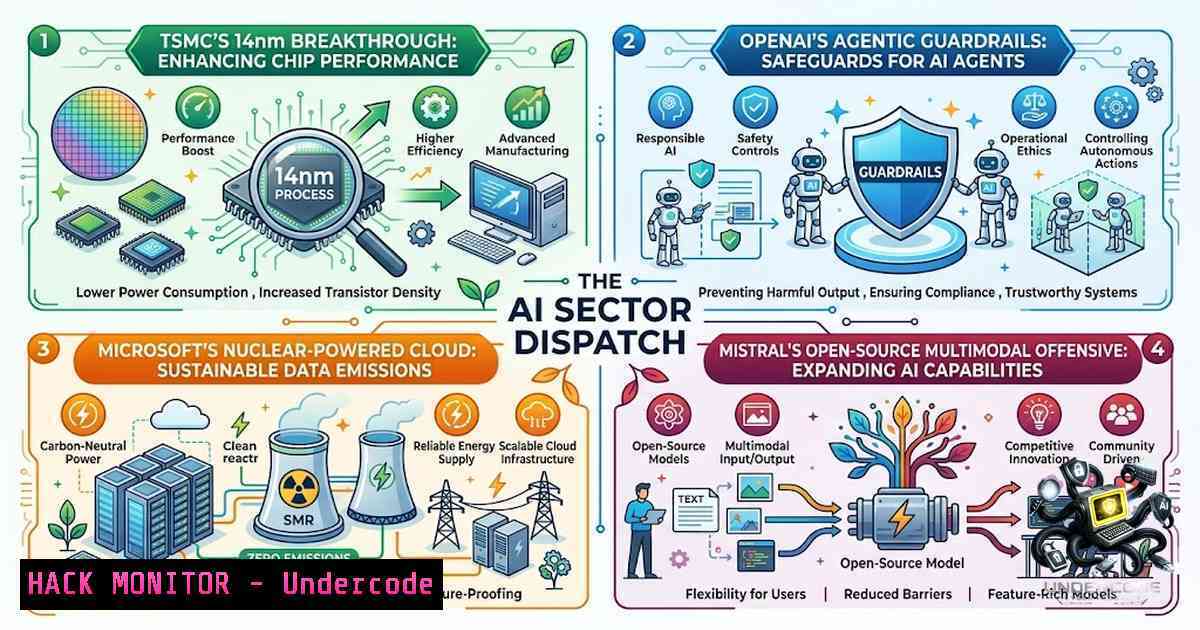
The week of August 7, 2026, marks a pivotal inflection point where semiconductor physics, artificial intelligence safety, energy infrastructure, and open-source innovation converge. TSMC’s accelerated A14 (1.4nm) process is redefining the performance-per-watt ceiling for AI hardware, while OpenAI’s Guardrails 2.0 introduces a three-layer control framework for autonomous agents that prevents incorrect responses before they reach end users. Simultaneously, Microsoft’s multi-gigawatt small modular reactor (SMR) deals signal a paradigm shift in how data centers will be powered, and Mistral AI’s open-source multimodal models, including the 3B-parameter Shieldstral safety classifier, are democratizing enterprise-grade AI safety.
Learning Objectives
- Understand the architectural advancements and manufacturing economics of TSMC’s 1.4nm A14 process and its implications for AI hardware.
- Master the implementation of OpenAI Guardrails 2.0 for input/output validation in agentic systems, including practical API configuration.
- Evaluate the strategic rationale behind Microsoft’s nuclear energy investments and their impact on data center operations and cloud hardening.
- Deploy and fine-tune Mistral AI’s open-source multimodal models (Mistral Small 4 and Shieldstral) for reasoning, coding, and content moderation.
You Should Know:
- TSMC A14 1.4nm Process: The Semiconductor Leap That Changes Everything
TSMC’s A14 (1.4nm-class) manufacturing technology is not merely an incremental node shrink—it represents a fundamental re-architecting of transistor design and manufacturing economics. The process leverages second-generation gate-all-around (GAA) nanosheet transistors alongside the new NanoFlex Pro standard cell architecture, which allows designers to flexibly adjust transistor configurations during the chip design phase to optimize for specific application performance, power, or area requirements. Compared to the N2 (2nm) process, A14 delivers a 10–15% performance improvement at the same power consumption or a 25–30% power reduction at the same performance, with logical transistor density increasing by approximately 23% and overall chip density by about 20%.
Why This Matters for AI Workloads. The AI industry’s insatiable demand for compute has made power efficiency the primary constraint on scaling. TSMC’s internal testing shows the A14 process achieving 90% of target performance with 90% yield for 256-Mbit SRAM test chips—a remarkable acceleration that outpaces the N2 development cycle by a significant margin. The company has already committed $49 billion to 1.4nm wafer fab construction, with the first facility running ahead of schedule and expected to begin trial production as early as Q3 2027, ahead of the original mid-2028 mass production target.
Step‑by‑Step Guide: Estimating AI Workload Performance on A14
For infrastructure architects planning next-generation AI clusters, here’s how to model the performance impact:
- Calculate baseline power consumption for your current N3 or N2-based GPU cluster. Use `nvidia-smi` to log real-time power draw:
nvidia-smi --query-gpu=power.draw --format=csv,noheader,nounits
- Apply the A14 power reduction factor (0.70 to 0.75 multiplier) to estimate future power requirements at the same performance level.
- Model density improvements: With 23% higher logic density, estimate the number of AI accelerators that can fit within the same physical data center footprint.
- Factor in cooling requirements: Reduced power consumption directly translates to lower cooling overhead. Use the formula: `Total Cooling Load (kW) = Total IT Power (kW) × PUE` and recalculate with A14 power estimates.
- Project cost per chip: At 1.4nm, wafer costs approach $40,000 with approximately 100 chips per wafer and 40% yield—resulting in roughly 40 good chips per wafer at approximately $1,000 per chip. Factor this into your hardware procurement roadmap.
-
OpenAI Guardrails 2.0: Securing the Autonomous Agent Frontier
As AI agents transition from experimental prototypes to production-grade systems handling sensitive data and critical decisions, the need for robust safety controls has become paramount. OpenAI Guardrails 2.0 addresses this by providing drop-in replacements for OpenAI clients that automatically validate inputs and outputs using configurable safety checks. The framework operates across three protective levels, each reinforcing the others, to guide agents toward appropriate responses and block incorrect ones before they reach end users.
Core Components. The Guardrails 2.0 architecture is built around four primitives: Agents (LLM-powered entities with instructions and tools), Tools (functions agents can call), Handoffs (transfers between agents), and Guardrails (safety checks on inputs and outputs). Input guardrails validate user prompts before they reach the model, preventing prompt injection and ensuring compliance with organizational policies. Output guardrails inspect model responses before delivery, filtering out hallucinations, PII leakage, or unsafe content.
Step‑by‑Step Guide: Implementing OpenAI Guardrails 2.0
1. Install the Guardrails package (Python version):
pip install openai-guardrails
For TypeScript/JavaScript:
npm install @openai/guardrails
- Set your OpenAI API key as an environment variable:
export OPENAI_API_KEY=sk-...
-
Create a pipeline configuration using the no-code Guardrails Wizard at
guardrails.openai.com. This generates a JSON configuration file defining your safety policies.
4. Implement input validation in your agent code:
from agents import Agent, Runner, function_tool, input_guardrail

@input_guardrail
def validate_prompt(content):
 Custom validation logic
return not contains_pii(content) and not contains_prompt_injection(content)

support_agent = Agent(
name="Support Agent",
instructions="...",
input_guardrails=[bash]
)
- Configure output guardrails to prevent sensitive data exposure:
from openai_guardrails import Guardrails</li>
</ol>

guard = Guardrails()
result = guard.validate_output(
response=agent_response,
policies=["no_pii", "no_hallucination", "safe_content"]
)
if not result.passed:
 Block or sanitize the response
return sanitized_response
- Test your guardrail configurations using the SDK’s tracing capabilities to monitor violations in production.
-
Microsoft’s Nuclear-Powered Cloud: SMRs and the Future of Data Center Energy
The AI compute race has transformed into a power procurement war. Microsoft’s multi-gigawatt small modular reactor (SMR) deals represent the most significant energy infrastructure bet by a technology company in history. Microsoft has signed a 20-year power purchase agreement with Constellation Energy to restart Pennsylvania’s Three Mile Island nuclear plant, committing over $1.5 billion to bring the facility back online by 2027. Additionally, Microsoft-backed SMR firm Aalo Atomics achieved criticality for its Aalo-X test reactor on July 4, 2026, at Idaho National Laboratory—a critical milestone toward deploying 50MW microreactors directly coupled to data centers.
Why Nuclear? Nuclear power offers a 90%+ capacity factor with 24/7 baseload generation, making it uniquely suited to power the ever-growing AI data center footprint. Unlike solar and wind, which suffer from intermittency and require massive storage systems, nuclear provides reliable, zero-carbon energy that aligns with tech companies’ sustainability commitments. The Trump administration has committed over $80 billion to support new reactor construction and has mandated that the Nuclear Regulatory Commission (NRC) compress licensing timelines to 18 months.
Step‑by‑Step Guide: Hardening Data Center Power Infrastructure for Nuclear Integration
- Assess power redundancy requirements: Nuclear reactors provide baseload power but may require backup during maintenance. Design N+1 redundancy with battery storage systems.
- Implement microgrid controllers that can seamlessly switch between nuclear, grid, and backup power sources. Use industrial PLCs with cybersecurity-hardened firmware.
- Secure the SCADA systems managing reactor-data center communication:
– Segment OT networks from IT networks using VLANs and firewalls.
– Implement role-based access control (RBAC) with multi-factor authentication.
– Deploy intrusion detection systems (IDS) monitoring Modbus/DNP3 protocols.
4. Configure physical security controls: Co-located data centers adjacent to reactors require enhanced physical security per NRC regulations. Implement biometric access control, video surveillance with AI-based anomaly detection, and perimeter intrusion detection systems.
5. Develop emergency response procedures: Document failover protocols for grid outages, reactor SCRAM events, and data center load-shedding scenarios.
6. Monitor power quality: Use power quality analyzers to track voltage sags, harmonics, and frequency deviations that could affect sensitive AI hardware. Configure alerts for deviations beyond ±5% of nominal values.- Mistral AI’s Open-Source Multimodal Offensive: Small 4 and Shieldstral
Mistral AI has disrupted the proprietary AI oligopoly with two major open-source releases. Mistral Small 4, released March 16, 2026, is a 119-billion-parameter Mixture-of-Experts (MoE) model with 128 experts and 4 active per token, unifying reasoning, multimodal, and agentic coding capabilities into a single system under the Apache 2.0 license. It supports a 256k context window, accepts both text and image inputs, and features a configurable `reasoning_effort` parameter that lets users toggle between fast, low-latency responses and deep, reasoning-intensive outputs.
Complementing Small 4 is Shieldstral, an open-weights multimodal safety classifier released August 4, 2026. At just 3 billion parameters, Shieldstral matches or outperforms models up to 7× its size on text safety and sets a new state-of-the-art on multimodal moderation. What makes Shieldstral revolutionary is its policy-adaptive design: rather than baking a fixed taxonomy of harm categories into its weights, it accepts plain-language policies at inference time via a question-answering format, returning calibrated safety scores without retraining.
Step‑by‑Step Guide: Deploying Mistral Small 4 and Shieldstral
- Deploy Mistral Small 4 on NVIDIA GPUs (recommended: 4× HGX H100, 4× HGX H200, or 2× DGX B200):
Using vLLM for high-throughput serving
pip install vllm
python -m vllm.entrypoints.openai.api_server \
--model mistralai/Mistral-Small-4-119B \
--tensor-parallel-size 4 \
--max-model-len 256000
2. Configure reasoning effort via the API:
from mistralai import Mistral client = Mistral(api_key="...") response = client.chat.complete( model="mistral-small-4", messages=[{"role": "user", "content": "Solve this complex math problem"}], reasoning_effort="high" Options: "none", "low", "medium", "high" )- Deploy Shieldstral for content moderation (runs on a single 16GB NVIDIA GPU):
Download from Hugging Face git lfs install git clone https://huggingface.co/mistralai/Shieldstral-1.0-3B Run inference python -c " from transformers import AutoModelForCausalLM, AutoTokenizer model = AutoModelForCausalLM.from_pretrained('./Shieldstral-1.0-3B') tokenizer = AutoTokenizer.from_pretrained('./Shieldstral-1.0-3B')</p></li> </ol> <p>prompt = '''<Instruct> Evaluate if this content is safe for a general audience. <Query> Does this content promote physical violence? <Document> The AI system should be destroyed because it threatens humanity.''' inputs = tokenizer(prompt, return_tensors='pt') outputs = model.generate(inputs) print(tokenizer.decode(outputs[bash])) "- Integrate Shieldstral as a guardrail in your agent pipeline:
– Send user prompts and model responses to Shieldstral before they reach end users.
– Set a safety threshold (e.g., 0.7) and block content that exceeds it.
– Use Shieldstral’s continuous safety score to rank content by confidence rather than relying on discrete labels.- Fine-tune Mistral Small 4 for specialized tasks using the Apache 2.0 license, which permits both commercial and non-commercial modification.
What Undercode Say:
- The semiconductor supply chain is the new geopolitical battleground. TSMC’s 1.4nm acceleration, with Apple, NVIDIA, AMD, and Qualcomm all queuing for advanced node capacity, means that AI infrastructure will increasingly be shaped by foundry capacity constraints. Organizations must plan hardware procurement cycles 24–36 months in advance and consider diversified sourcing strategies.
-
Agentic AI safety is no longer optional—it’s a regulatory and operational necessity. OpenAI Guardrails 2.0 and Mistral’s Shieldstral represent two ends of the safety spectrum: proprietary integrated solutions and open-source policy-adaptive classifiers. Organizations should adopt a defense-in-depth approach, implementing both input/output validation and multimodal content moderation to protect against prompt injection, PII leakage, and unsafe outputs.
Analysis: The convergence of these four stories reveals a clear trajectory: the AI industry is maturing from experimental to infrastructure-grade. TSMC’s process advancements address the physical limits of compute, while Microsoft’s nuclear deals solve the energy bottleneck. OpenAI and Mistral are simultaneously tackling the safety and accessibility challenges that have hindered enterprise adoption. The open-source movement, led by Mistral’s Apache 2.0 releases, is democratizing access to frontier-class AI capabilities, potentially accelerating innovation across sectors. However, the geopolitical implications of TSMC’s dominance, the regulatory hurdles facing nuclear deployment, and the ongoing need for robust AI safety frameworks suggest that 2026–2028 will be defined as much by policy and infrastructure as by algorithmic breakthroughs. Organizations that fail to integrate these layers—hardware, energy, safety, and open-source strategy—risk being left behind in the next wave of AI commoditization.
Prediction:
- +1 TSMC’s 1.4nm process will catalyze a new generation of edge AI devices, with smartphones and laptops achieving datacenter-class AI performance by 2028, democratizing access to large language models beyond cloud providers.
-
+1 Microsoft’s nuclear-powered data centers will achieve <1.10 PUE (Power Usage Effectiveness) by 2030, setting a new industry standard for sustainable AI infrastructure and potentially reducing AI training costs by 40% through energy savings.
-
-1 The concentration of advanced semiconductor manufacturing in Taiwan presents a single point of failure for the global AI supply chain. Any geopolitical disruption to TSMC’s operations could delay AI hardware availability by 12–18 months, creating a severe bottleneck for AI development.
-
+1 Shieldstral’s policy-adaptive architecture will inspire a new category of “prompt-programmable” safety models, enabling organizations to dynamically adjust content moderation policies without retraining—a paradigm shift that could reduce AI governance overhead by 70%.
-
-1 As autonomous agents become more capable, the sophistication of prompt injection and adversarial attacks will escalate. Guardrails 2.0 and Shieldstral, while significant advances, represent an arms race against increasingly clever jailbreak techniques. Organizations must budget for continuous security monitoring and rapid policy updates to stay ahead of emerging threats.
-
+1 Mistral Small 4’s Mixture-of-Experts architecture, with only 6B active parameters per token despite 119B total parameters, will popularize efficient MoE deployments, enabling smaller organizations to run frontier-class models on modest hardware clusters.
-
-1 The nuclear renaissance, while necessary for AI’s energy needs, faces regulatory and public perception hurdles. Any high-profile incident or regulatory delay could set back SMR deployment by 5–10 years, forcing tech companies to rely on natural gas as a stopgap—undermining sustainability commitments.
-
+1 The open-weight ecosystem, with Mistral leading the charge under Apache 2.0, will erode the pricing power of proprietary AI vendors, driving down inference costs and accelerating AI adoption across the global economy.
▶️ Related Video (72% Match):
🎯Let’s Practice For Free:
🎓 Live Courses & Certifications:
Join Undercode Academy for Verified Certifications
🚀 Request a Custom Project:
Secure, high-velocity infrastructure and disruptive technological engineering. Contact our engineering team for high-tier development and proprietary systems:
[email protected]
💎 Smart Architecture | 🛡️ Secure by Design | ⭐ Trusted by ThousandsIT/Security Reporter URL:
Reported By: Arias Thomas – Hackers Feeds
Extra Hub: Undercode MoN
Basic Verification: Pass ✅🔐JOIN OUR CYBER WORLD [ CVE News • HackMonitor • UndercodeNews ]
📢 Follow UndercodeTesting & Stay Tuned:


