
Listen to this Post
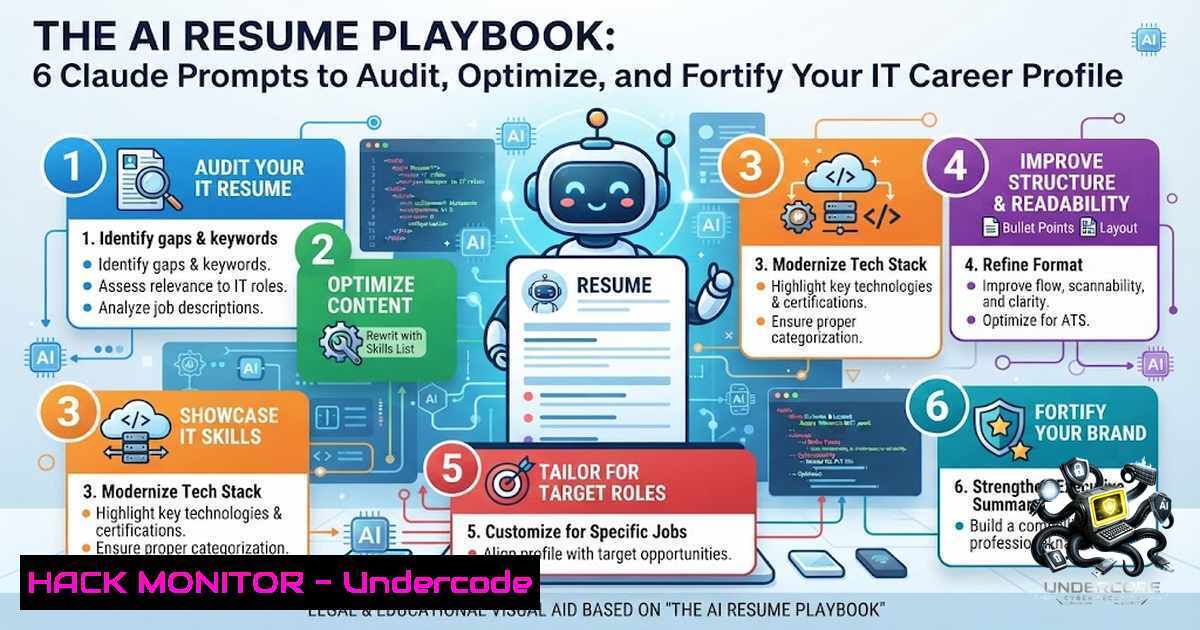
Introduction:
In the hyper-competitive landscape of cybersecurity and IT recruitment, your CV is effectively your first line of defense—yet most professionals treat it like a legacy system, patching it with generic buzzwords and outdated formats. This article transforms the traditional CV into a strategic asset, leveraging Claude AI as your personal career security analyst to conduct a penetration test on your professional narrative, ensuring your value proposition is not only visible but irresistible to both human recruiters and algorithmic Applicant Tracking Systems (ATS).
Learning Objectives:
- Master the art of extracting and articulating your most significant technical achievements using AI-driven narrative construction.
- Learn to perform a granular gap analysis between your current skill set and specific job descriptions to optimize your application strategy.
- Acquire the skills to deconstruct and rebuild your CV bullet points into high-impact, metric-driven statements that resonate with cybersecurity and IT hiring managers.
1. Compiling Your Executive Career Summary
This isn’t just a summary; it is your attack surface analysis. Most candidates list responsibilities without context, creating a “noisy” profile that fails to catch a recruiter’s eye. The goal here is to use Claude to synthesize your entire career history into a potent, concise executive summary that defines your core value proposition.
Step-by-step guide explaining what this does and how to use it:
1. Data Extraction: Compile a raw text file containing your complete work history, major projects, and certifications (e.g., CISSP, OSCP, AWS Solutions Architect).
2. Strategic Prompting: Input a prompt like: “Based on the following experience, generate a three-sentence executive summary for a senior cybersecurity role. Focus on my unique blend of [Your Specific Area, e.g., Cloud Security & Incident Response]. Highlight my most quantifiable achievement.”
3. Iterative Refinement: Use the output as a foundation. Analyze it for gaps—does it capture your leadership in implementing a Zero Trust architecture or your role in mitigating a major DDoS attack?
4. Fusion: Merge the AI-generated narrative with your own voice. The AI provides the structure and keywords; you provide the authenticity and nuance.
2. Engineering the Role-Fit Map
Treat the job description like a vulnerability assessment report. You need to map your own environment (your skills) against the required security posture (the job requirements). This is where you identify the “missing patches” before you even apply.
Step-by-step guide explaining what this does and how to use it:
1. Data Input: Copy and paste the job description and your CV into Claude.
2. Gap Analysis Ask: “Analyze this job description against my CV. Identify specific skills mentioned in the JD that are weak or absent in my experience. Categorize them as ‘matches,’ ‘skill gaps,’ and ‘opportunities for growth.'”
3. Strategic Planning: Focus on the “skill gaps.” If the role requires extensive knowledge of Kubernetes security and you have none, you might prioritize a CKA certification before applying or find a way to demonstrate related experience (e.g., Docker security).
4. Application Strategy: Prioritize applications where your “matches” percentage is highest, and use the AI to suggest how to spin existing experience to cover some of the gaps.
3. Refactoring Weak Bullet Points
In development, you refactor code to improve its efficiency and readability. In CV writing, you refactor bullet points to be potent, achievement-based statements. This transforms a passive description into an active demonstration of value.
Step-by-step guide explaining what this does and how to use it:
1. Extract Weak Points: Identify bullet points that are purely descriptive (e.g., “Responsible for managing firewalls”).
2. “Rewrite the following CV bullet points using the STAR method (Situation, Task, Action, Result). Make them result-oriented and include metrics where possible. If no metric exists, infer one based on industry standards.”
3. Before and After: Before: “Managed cloud infrastructure.” After: “Orchestrated the migration of a multi-region AWS infrastructure, achieving a 30% cost reduction and improving system uptime to 99.99% through the implementation of Infrastructure as Code (IaC) with Terraform.”
4. Verification: Cross-reference the generated metrics with your actual experience. Ensure the claims are defensible. The AI helps you frame your achievements, not fabricate them.
4. Optimizing for the ATS Firewall
Applicant Tracking Systems (ATS) are the firewall of the recruitment process. If your CV doesn’t contain the right keywords, it gets dropped before a human ever sees it. This is a technical SEO task for your professional profile.
Step-by-step guide explaining what this does and how to use it:
1. Keyword Extraction: Feed the job description to Claude and ask: “Extract a list of 15-20 key hard and soft skills, tools, and frameworks mentioned in this job description.”
2. Placement Strategy: Ask: “Review my CV and show me where I can naturally place these extracted keywords without keyword stuffing. Suggest modifications to my skills section and bullet points to reflect them.”
3. Command Line Analogy (for IT Pros): Think of this like grepping a log file for specific error codes. Just as you use grep "error" /var/log/syslog, you are using Claude to grep the JD for the keywords that matter, then embedding them in your profile.
4. Balance: The goal is seamless integration. For example, instead of just listing “Python,” you might write: “Developed automation scripts in Python to streamline SOC alert triage, reducing MTTD by 20%.”
5. Hardening Your Professional Profile
Your headline and “About” section are your command-line arguments—they are the first thing your system (the recruiter) executes to see if you are the right process for the job. This step is about system hardening; it enhances your profile’s integrity and builds immediate credibility.
Step-by-step guide explaining what this does and how to use it:
1. Profile Audit: Provide Claude with your current LinkedIn headline, “About” section, and CV summary.
2. “Generate 5 compelling headlines and a 150-word ‘About’ section for a professional in [Your Field]. Ensure the headline includes high-impact roles/titles (e.g., ‘Cloud Security Architect’), and the ‘About’ section weaves a narrative that connects my experience to a future of proactive security strategy.”
3. Cross-Platform Consistency: Ensure the narrative on LinkedIn, your CV, and GitHub are aligned. Discrepancies look like unpatched vulnerabilities.
4. The “Before You Apply” Principle: A hardened profile acts as a continuous source of inbound interest, giving you leverage in negotiations before you even initiate an application.
6. Simulating the Recruiter’s Penetration Test
Before you deploy your application, you need to test it. This is the equivalent of a vulnerability scan. You are using Claude to play the role of a hostile or critical reviewer, probing your CV for weak spots, logical fallacies, and areas of potential rejection.
Step-by-step guide explaining what this does and how to use it:
1. Adversarial Prompting: Ask Claude: “Act as a senior hiring manager in a Fortune 500 tech firm. Review my CV critically. Point out any missing achievements, sections that seem weak, unclear language, or anything that could lead to a rejection.”
2. Reverse Engineering: Ask: “If you were trying to reject this candidate, what would your primary reason be?” This forces the AI to find the most glaring flaw, which you can then address.
3. Iterative Patching: Take the feedback and apply it. Run the test again. Like updating an IDS signature, you improve your defenses against initial filtering.
4. Linux/Windows Command: In a security context, this is similar to running `nessus` or `openvas` on your own network to find holes before the bad guys do. The goal is to see where you are “exposed” and patch it before the recruiter (the external threat) finds it.
7. The AI-Assisted Skills Inventory
This section ensures your CV is accurate and comprehensive. Many IT professionals overlook foundational skills or downplay their complexity. Claude can help you dissect a project and identify all the discrete skills it encompasses.
Step-by-step guide explaining what this does and how to use it:
1. Project Input: Provide a detailed description of a major project you worked on (e.g., “Implemented a new SIEM platform”).
2. Skill Breakdown “Based on this project description, create a comprehensive list of both technical and soft skills used. Include specific technologies, protocols, and methodologies.”
3. Categorization: Ask Claude to categorize these skills (e.g., “Networking,” “Cloud,” “Scripting,” “Project Management”).
4. Gap Check: Compare this list to what is currently on your CV. You may find you have experience with Splunk, Python, and AWS Lambda that you weren’t explicitly listing, giving you immediate keywords to add.
What Undercode Say:
- Key Takeaway 1: AI is a tool for articulation and optimization, not fabrication. It elevates your existing skills to a language that resonates with the industry, but the foundation must be authentic experience.
- Key Takeaway 2: Treat your CV as a living document subject to continuous iteration. Just as you wouldn’t deploy a system without testing, don’t apply for a job without running a “recruiter test” on your application materials.
Analysis:
The process of AI-driven CV optimization mirrors the security principles of defense-in-depth. Each prompt acts as a layer of validation: the summary defines the perimeter, the role-fit map identifies vulnerabilities, and the recruiter test simulates an external adversary. By adopting this framework, cybersecurity and IT professionals can move beyond passive job seeking to active, strategic career management. The ultimate aim is not just to get past the ATS but to present a narrative so compelling that a recruiter cannot help but engage. This methodology shifts the paradigm from “I have skills” to “I solve specific, high-value problems,” which is the core currency of any technical career.
Prediction:
- +1 The integration of LLMs like Claude into the job search process will level the playing field, enabling highly skilled but introverted technical professionals to articulate their value as effectively as their more extroverted peers.
- +1 We will see the emergence of “Career Prompt Engineering” as a distinct and valuable skill set, with professionals building specialized prompt libraries for different roles, industries, and career stages.
- -1 As AI-generated applications become more common, the ATS and recruiters will evolve to detect and de-prioritize “over-optimized” CVs, leading to a new arms race between generative optimization and authentic human expression.
- +1 The future of recruitment will shift towards interactive, real-time assessments (e.g., AI-moderated technical interviews) as the static CV becomes devalued, further emphasizing the importance of demonstrable skills over documented history.
- -1 There is a risk that candidates will rely too heavily on AI without critical review, leading to generic, cookie-cutter profiles that fail to distinguish them, paradoxically hurting their chances in a crowded market.
▶️ Related Video (76% Match):
🎯Let’s Practice For Free:
🎓 Live Courses & Certifications:
Join Undercode Academy for Verified Certifications
🚀 Request a Custom Project:
Secure, high-velocity infrastructure and disruptive technological engineering. Contact our engineering team for high-tier development and proprietary systems:
[email protected]
💎 Smart Architecture | 🛡️ Secure by Design | ⭐ Trusted by Thousands
IT/Security Reporter URL:
Reported By: Arslan Ansari – Hackers Feeds
Extra Hub: Undercode MoN
Basic Verification: Pass ✅


