Listen to this Post
Introduction:
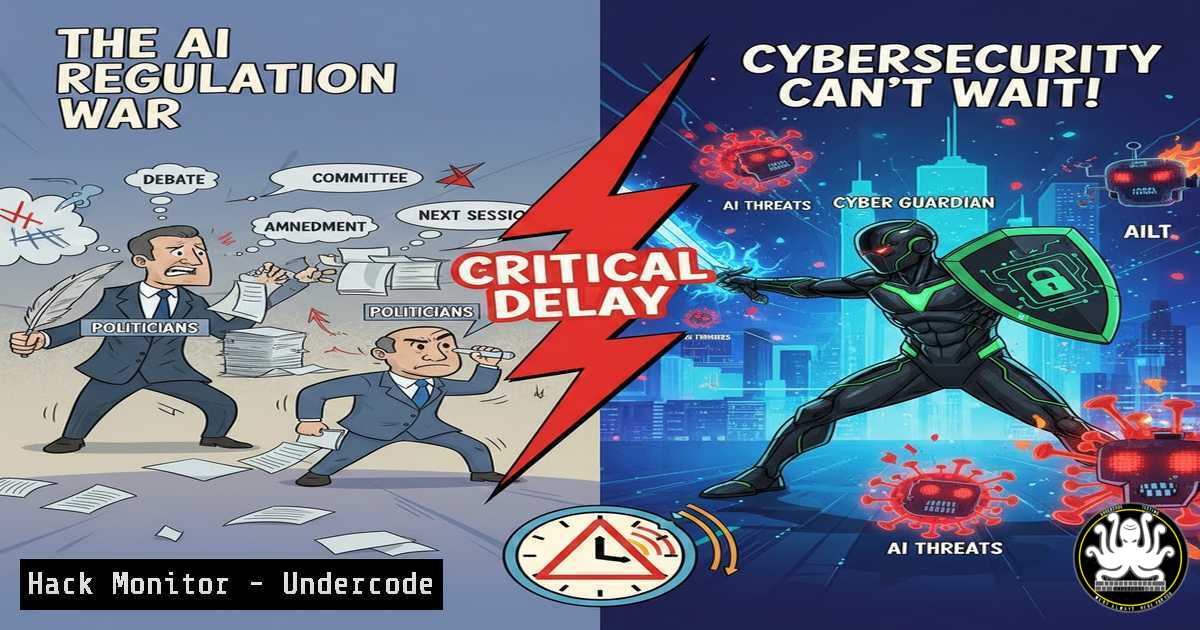
The recent executive order attempting to federalize AI regulation has ignited a legal and political firestorm, highlighting a critical reality for IT and cybersecurity professionals: the governance vacuum around artificial intelligence is a tangible security threat. While courts debate jurisdictional authority, organizations are left navigating a fragmented landscape where rapidly evolving AI tools outpace any existing security frameworks, creating unprecedented vulnerabilities in data privacy, model integrity, and adversarial attacks.
Learning Objectives:
- Understand the direct cybersecurity risks created by unregulated and rapidly deployed AI systems.
- Learn immediate, actionable steps to secure AI development pipelines and production environments, regardless of policy shifts.
- Develop a governance blueprint that aligns with both potential state-level regulations and core security principles.
You Should Know:
- AI Model Hardening: Your First Line of Defense
The core vulnerability lies in the AI models themselves. Without mandated security standards, models are susceptible to data poisoning, adversarial examples, and model theft. Security must be integrated into the Machine Learning Operations (MLOps) pipeline.
Step‑by‑step guide explaining what this does and how to use it.
Step 1: Implement Model Signing and Integrity Verification. Treat your trained model files like critical binaries. Use hashing to ensure they haven’t been tampered with post-training.
Linux Command (Generate SHA-256 Hash):
sha256sum your_model.pkl > model.sha256
 To verify later:
sha256sum -c model.sha256
Step 2: Adversarial Training. Fortify your models by training them on data that includes adversarial examples. Use frameworks like IBM’s `Adversarial Robustness Toolbox` (ART).
Basic Python Snippet using ART:
from art.estimators.classification import SklearnClassifier
from art.attacks.evasion import FastGradientMethod
import pickle

Load your model
model = pickle.load(open('your_model.pkl', 'rb'))
classifier = SklearnClassifier(model=model)
 Create and apply adversarial attack simulator
attack = FastGradientMethod(estimator=classifier, eps=0.1)
x_train_adv = attack.generate(x_train)
 Retrain on adversarial dataset
model.fit(x_train_adv, y_train)
Step 3: Secure Model Registry. Use a private, secure registry (e.g., MLflow, AWS SageMaker Model Registry) with strict IAM policies to control access to model artifacts, rather than storing them on insecure shared drives.
2. Data Privacy and Sovereignty in AI Training
State laws like GDPR and CCPA already impose strict rules on personal data. AI training sets that ignore these principles create massive compliance and breach risks. You must anonymize data and track provenance.
Step‑by‑step guide explaining what this does and how to use it.
Step 1: Implement Synthetic Data Generation. For development and testing, use synthetic data to eliminate privacy risk. Tools like `Synthea` (for healthcare) or `SDV` (Synthetic Data Vault) can create realistic, non-real data.
Linux Command to install SDV:
pip install sdv
Step 2: Enforce Data Tagging and Lineage. Use a metadata management tool like Apache Atlas or OpenMetadata to tag data with classifications (PII, PCI) and track its flow through the entire AI pipeline. This is crucial for compliance audits.
Step 3: Deploy Differential Privacy. Add statistical noise to training data to prevent memorization of individual records. Use libraries like Google’s TensorFlow Privacy.
Basic Tutorial Step:
from tensorflow_privacy.privacy.optimizers import dp_optimizer
 Wrap your standard optimizer (e.g., SGD)
optimizer = dp_optimizer.DPKerasSGDOptimizer(
l2_norm_clip=1.0,
noise_multiplier=0.3,
num_microbatches=1,
learning_rate=0.01)
 Use this optimizer when compiling your Keras model
model.compile(optimizer=optimizer, loss='categorical_crossentropy')
3. Securing AI APIs and Inference Endpoints
Exposed model endpoints are prime targets for attacks like model inversion (extracting training data) or membership inference (determining if specific data was in the training set).
Step‑by‑step guide explaining what this does and how to use it.
Step 1: Rigorous API Authentication and Rate Limiting. Never deploy an AI endpoint without an API gateway. Use keys, OAuth 2.0, and strict rate limiting.
Example NGINX rate limiting config for an API endpoint:
location /api/v1/predict {
limit_req zone=model_api burst=10 nodelay;
auth_request /auth-validate;
proxy_pass http://ai_model_server:8000;
}
Step 2: Input Sanitization and Monitoring. Monitor for anomalous inference requests. Deploy Web Application Firewalls (WAF) configured with rules specific to your expected input shape and data types. Log all queries for anomaly detection.
4. Cloud Infrastructure Hardening for AI Workloads
AI training requires powerful, often cloud-based, infrastructure. Misconfigurations here can lead to catastrophic data leaks or crypto-mining hijacks.
Step‑by‑step guide explaining what this does and how to use it.
Step 1: Enforce Least-Privilege Access with IAM. Your training instances should not have broad `S3FullAccess` or similar roles. Create scoped policies.
AWS CLI command to attach a minimal policy:
aws iam attach-role-policy --role-name your-training-role --policy-arn arn:aws:iam::aws:policy/AmazonS3ReadOnlyAccess
Step 2: Encrypt Data at Rest and in Transit. Ensure all data volumes (EBS, EFS) and S3 buckets used for training are encrypted with KMS keys. Enforce TLS 1.2+ for all data movement.
Step 3: Use Isolated VPCs and Security Groups. Place training clusters in a private subnet with no public IP. Security groups should only allow necessary ports (e.g., SSH from a bastion host).
5. Proactive Vulnerability Management in AI Dependencies
AI relies on a complex stack of open-source libraries (TensorFlow, PyTorch, scikit-learn) which are frequent targets for vulnerability exploits.
Step‑by‑step guide explaining what this does and how to use it.
Step 1: Automated Dependency Scanning. Integrate tools like Trivy, Snyk, or `Safety` (for Python) directly into your CI/CD pipeline.
Linux Command to scan a Python project with Safety:
safety check -r requirements.txt --full-report
Step 2: Patching and Immutable Infrastructure. Treat your training environments as ephemeral. Use infrastructure-as-code (Terraform, CloudFormation) and container images. Patch by rebuilding the image from a updated base, not by patching in-place.
Step 3: Software Bill of Materials (SBOM). Generate an SBOM for every AI model artifact you produce, listing all dependencies. This is becoming a regulatory expectation.
Use Syft to generate an SBOM:
syft your-ai-model:latest -o spdx-json > sbom.json
What Undercode Say:
- Governance Gap = Security Debt: The policy paralysis at the federal level does not absolve organizations of responsibility. The lack of external regulation means you must impose stricter internal governance, treating AI systems as critical infrastructure with corresponding security controls.
- Shift Security Left in MLOps: The speed of AI development demands that security is not a final audit point but is integrated into every stage of the AI/ML lifecycle—from data collection and labeling to model training, deployment, and monitoring. The technical steps outlined above are not optional best practices; they are the minimum viable security posture for any organization using AI today.
Prediction:
The legal challenges to the executive order will result in prolonged uncertainty, accelerating a patchwork of state-level AI security and privacy laws akin to the current data breach notification landscape. This will force enterprises operating nationally to adopt the strictest applicable state standard as their de facto baseline, increasing compliance complexity. Technically, this environment will catalyze the rise of “AI Security Posture Management” (AISPM) as a dedicated cybersecurity niche, with tools automating compliance checks, model hardening, and attack surface monitoring. The organizations that prosper will be those that decouple their technical AI security strategy from the political theater, building agile, principle-based frameworks that can adapt to any regulatory outcome.
▶️ Related Video (84% Match):
🎯Let’s Practice For Free:
IT/Security Reporter URL:
Reported By: Richardstaynings President – Hackers Feeds
Extra Hub: Undercode MoN
Basic Verification: Pass ✅


