Listen to this Post
Introduction:
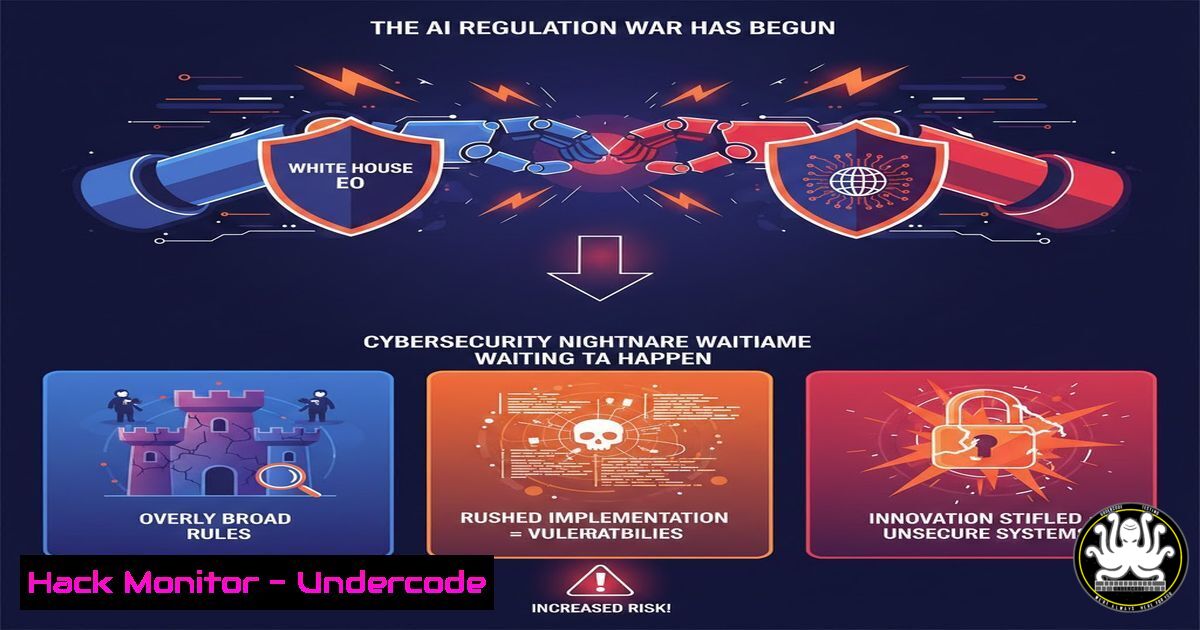
The recent White House Executive Order (EO) on Artificial Intelligence, far from providing clarity, has ignited a regulatory battlefield between federal and state authorities. This legal limbo creates a critical vulnerability window for organizations, as conflicting directives and prolonged court battles undermine coherent AI security and governance frameworks. Cybersecurity and compliance teams now face the daunting task of navigating a fractured landscape where enforcement is unpredictable but imminent.
Learning Objectives:
- Understand the immediate compliance risks posed by the conflict between federal EO directives and state consumer protection laws.
- Learn practical steps to inventory, secure, and govern AI systems amidst regulatory uncertainty.
- Implement technical controls for AI security, including API hardening, model monitoring, and data governance, to mitigate enforcement risks.
You Should Know:
1. Immediate Actions: The 90-Day AI Governance Sprint
The EO sets in motion 90-day deadlines for federal agencies. For your organization, this translates to an immediate governance sprint. Do not wait for legal clarity; assume state Attorneys General will use existing unfair/deceptive practice statutes to target AI systems.
Step‑by‑step guide:
- Inventory All AI Systems: Catalog every AI model, API, and automated decision system in use. This includes third-party SaaS tools with AI features.
Command Example (Cloud Inventory): For AWS, use the `aws bedrock list-foundation-models` CLI command to start inventorying Amazon Bedrock usage. For Azure AI services, use Azure Resource Graph queries in PowerShell:Search-AzGraph -Query "resources | where type contains 'Microsoft.CognitiveServices/accounts'". - Map Data Flows: Document all training data, input data, and output data for each system. Create data lineage diagrams to identify privacy and bias risk points.
- Conduct a Gap Assessment: Audit current AI systems against the NIST AI Risk Management Framework (RMF) and relevant OWASP standards (OWASP AI Security & Privacy Guide, LLM Top 10). Identify gaps in security, bias detection, and transparency.
2. Hardening AI APIs and Integration Points
AI systems are often attacked through their APIs. With regulatory scrutiny rising, securing these interfaces is non-negotiable.
Step‑by‑step guide:
- Implement Strict Authentication & Rate Limiting: Enforce OAuth 2.0 or API keys for all AI model APIs. Use a gateway like Kong or Apache APISIX to enforce rate limits and prevent abuse.
NGINX Configuration Snippet for Rate Limiting:
location /v1/chat/completions {
limit_req zone=ai_api burst=20 nodelay;
proxy_pass http://ai_model_backend;
auth_request /_validate_jwt;
}
2. Sanitize Inputs and Monitor Outputs: Treat all prompts as untrusted input. Implement a sanitization layer to filter for prompt injection attempts, PII, and malicious content. Log all outputs for audit trails.
3. Use API Security Tools: Deploy tools like Wallarm or Traceable AI to detect and block anomalous API traffic targeting your AI endpoints.
3. Implementing Model & Data Governance Controls
Regulators will focus on biased outputs and data abuse. Proactive governance is your best defense.
Step‑by‑step guide:
- Establish a Model Registry: Use MLflow or Kubeflow to track model versions, lineages, and training datasets. This is critical for auditability.
- Automate Bias and Drift Detection: Implement continuous monitoring for model fairness and performance drift.
Python Snippet (Using Fairlearn & Evidently):
from evidently.report import Report
from evidently.metrics import DataDriftTable, ClassificationPerformanceMetrics
 Generate a drift report for model in production
drift_report = Report(metrics=[DataDriftTable(), ClassificationPerformanceMetrics()])
drift_report.run(reference_data=reference, current_data=current)
drift_report.save_html('model_drift_report.html')
3. Enforce Data Access Controls: Apply strict RBAC (Role-Based Access Control) to training datasets. Encrypt sensitive data at rest and in transit. For cloud object stores (AWS S3, Azure Blob), enable bucket policies that block public access by default.
4. Preparing for Incident Response and Regulatory Inquiry
When (not if) a state AG inquiry arrives, your response time and evidence will be scrutinized.
Step‑by‑step guide:
- Create an AI-Specific IRP: Extend your Cybersecurity Incident Response Plan (IRP) to include AI failure scenarios: bias incidents, data leaks via model inversion, or widespread harmful outputs.
- Enable Comprehensive Logging: Ensure all AI system interactions (prompts, responses, user IDs, model versions, system performance) are logged centrally to a secured, immutable SIEM (e.g., Splunk, Elastic SIEM).
Linux Command to Forward Logs: Use `rsyslog` to forward application logs:. @<siem_server_ip>:514. - Run a Tabletop Exercise: Simulate a regulatory inquiry triggered by a biased AI hiring tool output. Practice assembling the cross-functional team (Legal, Compliance, AI Eng, Security) and producing the required evidence (model cards, audit logs, mitigation actions) within 72 hours.
5. Building a Agile, Policy-Agnostic Security Foundation
Since the legal landscape is in flux, build security that outlasts policy debates.
Step‑by‑step guide:
- Adopt a “Secure by Design” AI Development Lifecycle: Integrate security checkpoints (threat modeling, secure code review for ML pipelines, adversarial testing) into your MLOps pipeline.
- Leverage Open-Security Frameworks: Base your controls on policy-agnostic frameworks like the MITRE ATLAS (Adversarial Threat Landscape for AI Systems) knowledge base and the OWASP guides. This demonstrates due diligence regardless of the regulating body.
- Automate Compliance Evidence Gathering: Use tools like HashiCorp Vault to manage AI secrets and generate access audit logs. Implement Infrastructure as Code (IaC) with Terraform or AWS CloudFormation to ensure security baselines are consistently deployed, creating automatic documentation of your environment.
What Undercode Say:
- Key Takeaway 1: The Executive Order creates perilous uncertainty, not clarity. Treating it as a compliance holiday is a catastrophic mistake. The real enforcement threat for the next 2-5 years will come from state AGs using decades-old consumer protection laws.
- Key Takeaway 2: The only viable strategy is to implement robust, technical AI governance controls now. Security focused on model integrity, data lineage, API protection, and comprehensive logging will satisfy the core requirements of any future federal rule and defend against current state-level enforcement.
Analysis:
The post correctly identifies the EO as a weak vehicle that prioritizes political theater over durable policy. However, the resulting chaos is not a reason for inaction—it’s a call to arms for cybersecurity and governance professionals. The technical steps outlined above are not just best practices; they are a strategic shield. By building a verifiable, secure AI infrastructure, organizations can create defensible evidence of due care. This approach turns a compliance vulnerability into a resilience asset. The coming “regulation through litigation” era will be won by those who can technically demonstrate responsible AI stewardship, not just those who argue legal nuance.
Prediction:
The legal battles will stagnate for years, but AI adoption will accelerate. This gap will lead to a surge in “regulation by enforcement,” where high-profile lawsuits against companies for AI harms (bias, fraud, privacy violations) set de facto standards. The first major case resulting in a 9-figure settlement will become the new benchmark, forcing organizations to rapidly retrofit governance. Consequently, AI security and GRC tools that provide auditable evidence chains will see explosive demand. Companies that defer action, waiting for “final rules,” will face existential compliance debt and potentially business-ending enforcement actions.
▶️ Related Video (70% Match):
🎯Let’s Practice For Free:
IT/Security Reporter URL:
Reported By: Rocklambros Aigovernance – Hackers Feeds
Extra Hub: Undercode MoN
Basic Verification: Pass ✅


