Listen to this Post
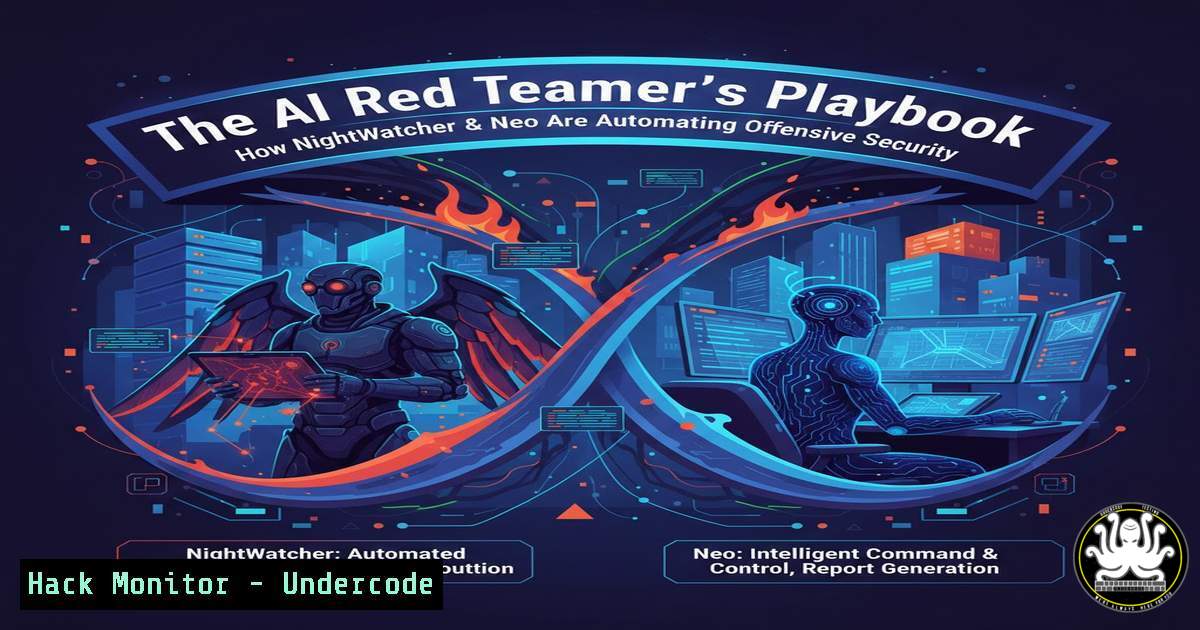
Introduction:
The convergence of artificial intelligence and offensive security is transitioning from theoretical discussion to operational reality. As showcased at Black Hat MEA 2025, forward-thinking red teams are building tactical alliances with AI, not merely for defensive analytics but to actively enhance penetration testing, infrastructure management, and evasion. This shift promises to redefine the speed, scale, and sophistication of security assessments.
Learning Objectives:
- Understand the dual-pillar approach of AI in red teaming: Defensive Infrastructure Monitoring (NightWatcher) and Offensive Task Automation (Neo).
- Learn the core concepts of canary tokens, multi-agent AI systems, and Retrieval-Augmented Generation (RAG) in a security context.
- Explore practical command-line and configuration steps to implement similar monitoring and automation in your own lab environment.
You Should Know:
1. NightWatcher: Proactive Infrastructure Compromise Detection
NightWatcher operates on the principle of proactive compromise detection for red team infrastructure (e.g., C2 servers, phishing domains). Instead of waiting for logs to show an intrusion, it seeds the infrastructure with “canary tokens” — digital tripwires that alert the team when touched by defenders, threat hunters, or automated scanners.
Step‑by‑step guide explaining what this does and how to use it.
Concept: Deploy hidden files, URLs, API endpoints, and DNS records that appear legitimate but are uniquely identifiable. When accessed, they trigger an alert.
Implementation (Linux-based C2 Server):
Create Canary Tokens: Use tools like `CanaryTokens` (from Thinkst) or build simple scripts.
Canary File: Place a file with a tempting name in your web root.
sudo touch /var/www/html/c2server/private_keys_backup.tar.gz
 Embed a unique tracking pixel or a web bug that calls home
echo '<img src="https://your-monitoring-domain.com/log.php?token=abc123" width="0" height="0" />' >> /var/www/html/c2server/readme.html
Canary DNS Record: Add a rarely-queried DNS `A` record for a subdomain like staging.malicious-domain.com. Monitor for any queries to it.
Canary Process: Run a low-privilege, seemingly benign process that sends a heartbeat.
 Script: /opt/scripts/health_monitor.sh
while true; do
curl -s "https://your-monitoring-domain.com/heartbeat?host=$(hostname)" > /dev/null
sleep 300
done
 If the heartbeat stops, the server might be taken down.
Set Up Alerting: Configure a lightweight listener (e.g., a Flask app) on your secure monitoring server to parse the incoming token triggers and send alerts via Telegram, Slack, or email.
- Neo: A Multi-Agent RAG System for Penetration Testing Automation
Neo represents the offensive pillar: an AI system that automates parts of the penetration testing lifecycle. By leveraging a multi-agent framework and RAG, it can reason about a target, select appropriate tools, execute steps, and interpret results, all guided by a curated knowledge base of security tools, CVEs, and methodologies.
Step‑by‑step guide explaining what this does and how to use it.
Concept: Break down the pentest process into specialized AI agents (Reconnaissance, Vulnerability Analysis, Exploitation, Reporting) connected to a tool database and a safe execution environment (sandbox).
Implementation Guide (Lab Setup):
Step 1: Build the RAG Knowledge Base: Ingest trusted security documentation (OWASP guides, tool man pages, CWE listings, MITRE ATT&CK) into a vector database like ChromaDB or Weaviate.
 Example using LangChain and ChromaDB (Python)
from langchain.document_loaders import DirectoryLoader
from langchain.text_splitter import RecursiveCharacterTextSplitter
from langchain.embeddings import OpenAIEmbeddings
from langchain.vectorstores import Chroma

loader = DirectoryLoader('/path/to/security/docs', glob="/.md")
documents = loader.load()
text_splitter = RecursiveCharacterTextSplitter(chunk_size=1000, chunk_overlap=200)
docs = text_splitter.split_documents(documents)
vectorstore = Chroma.from_documents(documents=docs, embedding=OpenAIEmbeddings(), persist_directory="./rag_db")
Step 2: Design Agent Workflow: Using a framework like LangGraph or AutoGen, define agents and their interaction logic.
Recon Agent: Given a target, queries RAG for best tools, then executes commands like `nmap -sV -O target.com` or subfinder -d target.com.
Analysis Agent: Takes `nmap` XML output, queries RAG for CVEs related to found services (e.g., searchsploit Apache 2.4.52), and recommends potential exploits.
Execution Agent (Sandboxed): In a controlled environment (e.g., a Docker container), attempts validated, non-destructive exploitation steps.
Step 3: Safe Command Execution: Implement a strict command allow-list and sandbox. Never allow raw, unvetted LLM output to run on a main system.
 Example Docker sandbox for tool execution
docker run --rm -v /tmp/scan:/output kali-linux:latest nmap -oX /output/scan.xml $TARGET
 The agent then reads /tmp/scan/scan.xml for analysis.
- Hardening Your AI Red Team Toolkit: Security and OPSEC
When deploying AI systems, you must secure the tools themselves to prevent them from becoming attack vectors.
Step‑by‑step guide explaining what this does and how to use it.
Concept: Apply infrastructure hardening, API security, and logging to your AI red team assets.
Key Actions:
Network Isolation: Place NightWatcher’s monitoring server and Neo’s orchestration server in separate, tightly controlled VPCs/VLANs with strict inbound/outbound rules.
API Key Management: Never hardcode keys. Use secret managers or environment variables.
 Linux/MacOS
export OPENAI_API_KEY="your-key-here"
 In your Python script
import os
api_key = os.getenv('OPENAI_API_KEY')
Audit Logging: Log all AI agent decisions, commands executed, and data accessed.
 Simple logging in Python
import logging
logging.basicConfig(filename='neo_operations.log', level=logging.INFO, format='%(asctime)s - %(agent)s - %(action)s')
logging.info('Recon Agent initiated Nmap scan on target XYZ')
4. Vulnerability Exploitation: The AI-Assisted Workflow
This section details how an agent like Neo would navigate from a discovered vulnerability to a proof-of-concept.
Step‑by‑step guide explaining what this does and how to use it.
- Input: Neo’s Analysis Agent identifies `Apache HTTP Server 2.4.49` from Nmap results.
- RAG Query: The agent queries its vector database with “CVE Apache 2.4.49 path traversal”.
- Retrieval: It retrieves information about CVE-2021-41773, including exploit code snippets and mitigation advice.
- Planning: The Execution Agent formulates a safe test using
curl.Sandboxed command generated by the agent curl -s --path-as-is "http://target.com/cgi-bin/.%2e/%2e%2e/%2e%2e/%2e%2e/etc/passwd"
- Analysis: The agent parses the response for `root:x:` to confirm vulnerability, then logs the finding for the report.
5. The Human-in-the-Loop: Irreplaceable Judgement
Despite automation, critical decisions—scope approval, risk assessment, lateral movement, and data handling—must remain under human operator control. Configure Neo to request explicit approval before any action classified as “potentially disruptive” or “outside defined scope.”
What Undercode Say:
- AI is a Force Multiplier, Not a Replacement: Tools like NightWatcher and Neo excel at handling volume, monotony, and 24/7 monitoring, freeing human operators for complex strategic thinking and creativity.
- The OPSEC Paradox: Introducing AI systems increases your attack surface. The infrastructure running these tools must be fortified with even greater rigor than traditional red team infrastructure to avoid catastrophic compromise.
The demonstrated tools signify a paradigm shift. The core risk is not AI autonomously “hacking,” but the exponential increase in efficiency and decrease in detection time it affords to both attackers and defenders. The real “tactical alliance” is between the red teamer’s expertise and the AI’s processing power. However, this arms race escalates operational security (OPSEC) requirements, as AI-driven infrastructure itself becomes a high-value target. Ethical and controlled use within strict scope boundaries is non-negotiable.
Prediction:
Within the next 18-24 months, we will see the emergence of first-generation, fully integrated AI red team platforms combining the NightWatcher and Neo philosophies. These platforms will feature autonomous, self-healing infrastructure that can migrate C2 channels upon detection and AI agents capable of basic exploit chain development. This will compress attack timelines dramatically, forcing a corresponding revolution in AI-driven blue team and detection systems. The focus of advanced red teaming will shift from manual execution to overseeing AI agents, designing sophisticated attack graphs, and maintaining the OPSEC of the increasingly complex AI-assisted attack platform itself.
🎯Let’s Practice For Free:
IT/Security Reporter URL:
Reported By: Ziadhammad Just – Hackers Feeds
Extra Hub: Undercode MoN
Basic Verification: Pass ✅


