Listen to this Post
Introduction:
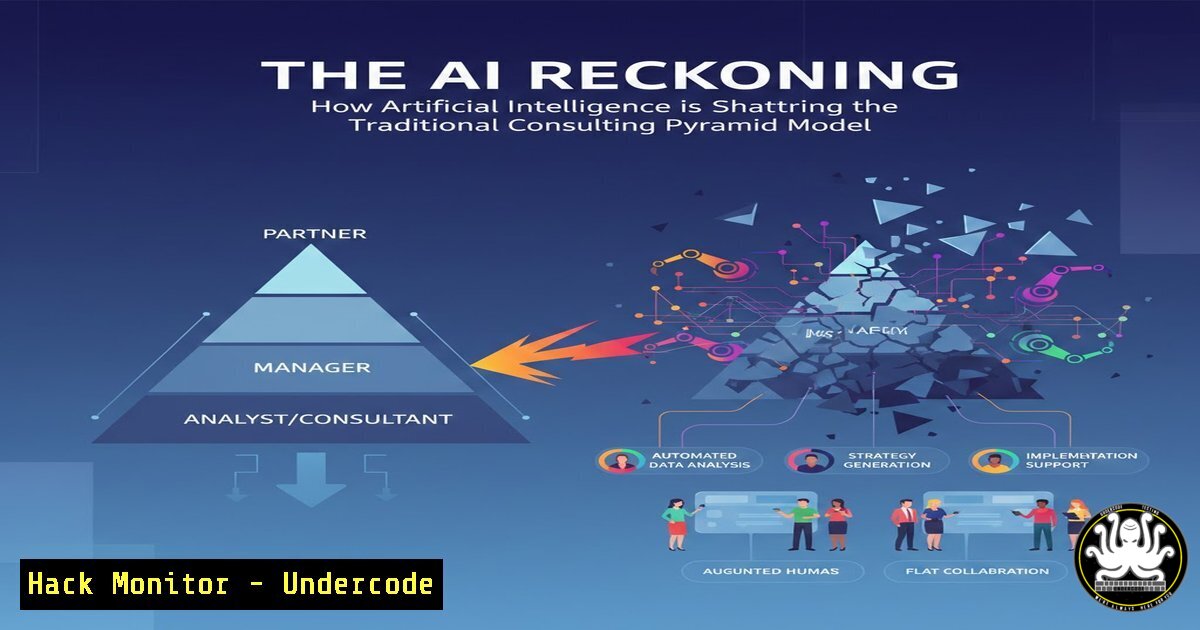
The foundational pyramid model of legacy consulting firms, built on layers of junior analysts feeding senior partners, is undergoing a seismic, technology-driven collapse. Artificial Intelligence now executes the core “consulting loop” of data gathering, analysis, and framework application with incomparable efficiency, rendering traditional human-heavy delivery models obsolete. This forces a fundamental paradigm shift where human professionals must transcend mere information processing to provide visionary strategy, ethical governance, and hands-on technical implementation—especially in critical fields like cybersecurity and IT transformation.
Learning Objectives:
- Understand how AI automates traditional consulting tasks like threat intelligence aggregation, compliance auditing, and risk assessment.
- Learn the technical skills and tools practitioners need to evolve from advisors to “cyber-AI integrators” and solution builders.
- Develop a roadmap for implementing AI-augmented security operations (AI SecOps) and resilient IT frameworks within modern enterprises.
You Should Know:
- Automating the GRC (Governance, Risk, Compliance) Consultant with AI
The traditional Governance, Risk, and Compliance consultant spent weeks manually mapping controls, reviewing logs, and compiling reports. AI can now ingest and correlate petabytes of structured and unstructured data from contracts, system configurations, and security logs in hours.
Step‑by‑step guide:
Step 1: Data Ingestion Pipeline: Use an ELT (Extract, Load, Transform) tool like `Apache NiFi` or a cloud-native service (AWS Glue) to pull data from sources: CMDBs, cloud trails (e.g., AWS CloudTrail logs), SIEM alerts, and policy documents.
Linux Command to tail and pipe logs: `tail -f /var/log/secure | grep -i “failed” | tee failed_auth.log`
Step 2: AI-Powered Analysis: Implement a Natural Language Processing (NLP) model using a service like Azure Cognitive Services or an open-source library (spaCy) to read and classify policy documents against standards like NIST CSF or ISO 27001.
Sample Python snippet using spaCy for entity recognition in a policy doc:
import spacy
nlp = spacy.load("en_core_web_sm")
doc = nlp(open("security_policy.pdf", "r").read())
for ent in doc.ents:
if ent.label_ in ["WORK_OF_ART", "LAW"]:  Often catches framework names
print(f"Found standard/control: {ent.text}")
Step 3: Automated Reporting: Use a templating engine (Jinja2) with the AI-generated findings to auto-populate a compliance dashboard or report, highlighting gaps and providing remediation scripts.
- From Talk to Tools: The Practitioner-Led Security Transformation
The new model values professionals who can build and deploy, not just advise. This means creating actual security tooling and automated response playbooks.
Step‑by‑step guide: Building a Basic Threat Intelligence Feeder with Python
Step 1: Set up a virtual environment and install requests and `pyeti` (Yeti API) or similar threat intel library: `python3 -m venv threat_env && source threat_env/bin/activate && pip install requests pyeti`
Step 2: Write a script to pull indicators from an open-source feed (e.g., AlienVault OTX) and compare them to local firewall logs.
import requests
import pandas as pd
OTX_API_KEY = "your_key"
url = f"https://otx.alienvault.com/api/v1/pulses/subscribed"
headers = {"X-OTX-API-KEY": OTX_API_KEY}
response = requests.get(url, headers=headers)
pulses = response.json().get('results', [])
 Extract IOCS (simplified)
iocs = [indicator for pulse in pulses for indicator in pulse.get('indicators', [])]
df_iocs = pd.DataFrame(iocs)
df_iocs.to_csv('latest_iocs.csv', index=False)
Step 3: Integrate this CSV with your SIEM (e.g., Splunk ES, Elastic SIEM) via a scheduled cron job to automatically update watchlists: `0 /6 /path/to/your/python_script.py`
3. Hardening AI Systems: The New Consulting Frontier
As clients deploy AI, consultants must now secure the AI pipeline itself—a complex task involving model, data, and API security.
Step‑by‑step guide: Basic Adversarial Input Testing for a Client’s AI Model API
Step 1: Reconnaissance: Identify the target model API endpoint and expected input schema using tools like `Burp Suite` or Postman.
Step 2: Crafting Perturbations: Use a library like `TextAttack` (for NLP) or `Foolbox` (for image models) to generate adversarial examples designed to cause misclassification.
Linux command to install TextAttack: `pip install textattack`
Step 3: Automated Probing: Create a script to send perturbed inputs and log unexpected outputs, rate-limiting to avoid disruption.
import requests
import json
from textattack.augmentation import WordNetAugmenter
augmenter = WordNetAugmenter()
original_text = "Legitimate user login request."
perturbed_texts = augmenter.augment(original_text)
for text in perturbed_texts:
payload = {"input": text}
response = requests.post("https://client-ai-api/classify", json=payload)
if response.json().get('label') != "LEGITIMATE":
print(f"Potential adversarial bypass: {text}")
4. Upskilling Lab: Building Your Own Cyber-AI Sandbox
The modern consultant needs a hands-on lab environment to test scenarios.
Step‑by‑step guide: Deploy a Isolated Testbed with Docker & Cali Linux Tools
Step 1: Install Docker on your machine (sudo apt-get install docker.io for Debian-based systems).
Step 2: Pull and run containers for a vulnerable web app (DVWA), a SIEM (Wazuh), and a network monitor (Zeek).
docker run --rm -d -p 80:80 vulnerables/web-dvwa
docker run --name wazuh -d -p 55000:55000 wazuh/wazuh-indexer:latest
Step 3: Use the lab to practice injecting malicious payloads, observing detection logic, and tuning AI-driven alert correlation rules within the SIEM console.
- The Human Imperative: Vision, Ethics, and Irreplaceable Judgment
AI cannot navigate moral ambiguity or formulate a compelling North Star vision. This is the new high ground for professionals.
Step‑by‑step guide: Implementing an AI Decision Review Board (AIDRB) Framework
Step 1: Draft a charter defining the AIDRB’s scope: reviewing AI model purposes, bias assessments, and incident response protocols for security AI.
Step 2: Establish a continuous monitoring dashboard that tracks key ethical and security metrics: model drift, fairness scores (using libraries like AI Fairness 360), and explainability scores for critical decisions.
Step 3: Schedule mandatory “human-in-the-loop” review gates for high-stakes operations, such as automated threat quarantines affecting critical infrastructure or privileged account revocations.
What Undercode Say:
- AI is the Ultimate Disruptor, Not Just a Tool: It doesn’t just improve consulting efficiency; it dismantles the very economic model of leveraging junior human hours for analytical work. Firms that cling to the pyramid will collapse under their own cost structure.
- The New Value Equation is Technical Depth + Strategic Vision: Survival depends on consultants who can both architect a zero-trust AI deployment pipeline and articulate its strategic imperative to the board. The middle layer—pure process managers—is vanishing.
Analysis: The commentary highlights a crucial pivot: AI’s efficiency uncouples revenue from headcount in the traditional sense. The future “consulting” firm will look more like a collective of elite practitioner-architects, supported by powerful AI co-pilots, delivering accelerated, code-level transformations. The focus shifts from selling time to selling proven, automated intellectual property (like security playbooks, hardened AI models, and compliance-as-code frameworks). The cybersecurity angle is particularly potent, as the threat landscape evolves faster than any human-only team can track, making AI integration not a luxury but a survival necessity for both consultants and their clients.
Prediction:
Within 3-5 years, the consulting landscape will bifurcate. Legacy pyramid firms will face irrelevance or become purely relationship-driven lobbyists. The dominant new players will be agile, tech-native studios offering “Transformation-as-Code.” These entities will use AI to conduct hyper-fast diagnostics, automatically generate and deploy remediation code (infrastructure, security policies, application patches), and provide continuous assurance via embedded AI agents. Cybersecurity services will become predominantly subscription-based “Cyber AI Operations” where clients pay for a continuously learning, self-hardening system posture, not for hours of PowerPoint creation. The consultant of the future is a hybrid: part strategic ethicist, part prompt engineer, and part security engineer, commanding premiums for irreplaceable human judgment applied at the intersection of technology, risk, and business value.
🎯Let’s Practice For Free:
IT/Security Reporter URL:
Reported By: David Clark – Hackers Feeds
Extra Hub: Undercode MoN
Basic Verification: Pass ✅


