
Listen to this Post
Introduction:
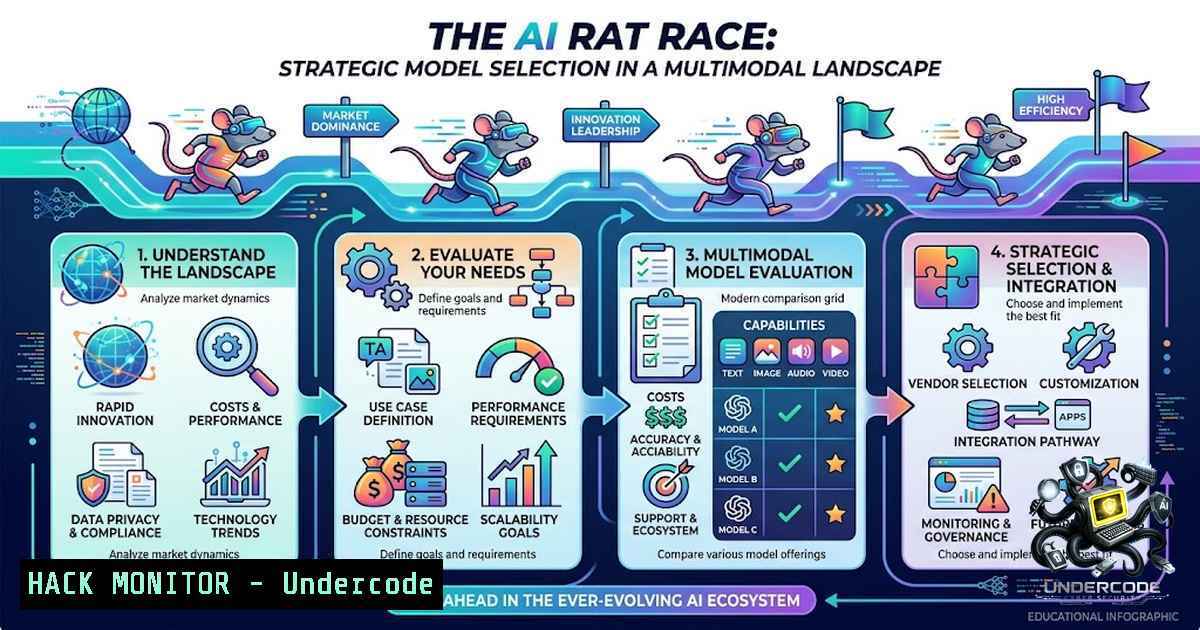
The rapid commoditization of large language models has shifted the competitive landscape from simple benchmark domination to strategic specialization, with the new AA-AnalystAgent benchmark exposing critical performance gaps between leading models. Google’s Gemini 3.7 Flash unexpectedly leading the pack underscores that “efficiency” and “task-specific precision” are now more valuable than raw size or parameter count. As organizations integrate AI into security operations, development pipelines, and automated decision-making, the ability to dynamically select and orchestrate models for different tasks—rather than relying on a single generalist—has become a crucial technical and strategic capability.
Learning Objectives & Secrets:
- Objective 1: Master Benchmark Interpretation – Understand how to read independent benchmarks like AA-AnalystAgent, focusing on “perfect task completion across five attempts” as a measure of reliability rather than average performance.
- Objective 2 Secret Tips: Latency vs. Cost Analysis – Always pair accuracy data with per-token cost and latency metrics. Gemini 3.7 Flash likely wins on a “cost-per-correct-solution” ratio, not just raw accuracy.
- Objective 3 Secret Tips: Task-Specific Routing Architecture – Build a lightweight router (using a small classifier or simple logic) that sends simple queries to cheaper/faster models and complex, multi-step reasoning tasks to high-performers like Opus or GPT-5.6.
You Should Know:
1. API Performance Testing & Benchmarking
To replicate the AA-AnalystAgent benchmark or test models in your environment, you can build a simple Python evaluation harness. The benchmark uses “perfect execution” across 5 attempts, meaning you need to test consistency, not just a single run.
Step‑by‑Step Guide:
First, install the necessary libraries. Then, create a script to run a single prompt multiple times and analyze the output for pass/fail criteria.
– Linux/macOS:
python3 -m venv ai-bench && source ai-bench/bin/activate
pip install openai anthropic google-generativeai tqdm pandas
– Windows (PowerShell):
python -m venv ai-bench; .\ai-bench\Scripts\activate
pip install openai anthropic google-generativeai tqdm pandas
Create a file `benchmark_runner.py`:
import os
import time
from openai import OpenAI
from anthropic import Anthropic
import google.generativeai as genai

Initialize clients
client_openai = OpenAI(api_key=os.getenv("OPENAI_KEY"))
client_anthropic = Anthropic(api_key=os.getenv("ANTHROPIC_KEY"))
genai.configure(api_key=os.getenv("GEMINI_KEY"))

def test_model(provider, model_name, prompt, attempts=5):
results = []
for i in range(attempts):
try:
if provider == "openai":
response = client_openai.chat.completions.create(
model=model_name, messages=[{"role": "user", "content": prompt}]
)
results.append(response.choices[bash].message.content)
elif provider == "gemini":
model = genai.GenerativeModel(model_name)
response = model.generate_content(prompt)
results.append(response.text)
except Exception as e:
results.append(f"Error: {str(e)}")
time.sleep(0.5)  Respect rate limits
 Implement your own evaluation logic here
return results

Example: Test a complex reasoning prompt
test_prompt = "Analyze this network log for anomalies: [INSERT LOG]"
print(test_model("gemini", "gemini-3.7-flash-high", test_prompt))
2. Multimodal Model Orchestration & Router Design
Building a production-grade AI router is essential for cost and performance optimization. You can use a smaller model (like GPT-4o-mini) to classify incoming tasks and route them accordingly.
Step‑by‑Step Guide:
Use the `instructor` library to force structured output from the router for better control.
– Installation (All OS): `pip install instructor`
– Router Code Snippet:
import instructor
from pydantic import BaseModel
from openai import OpenAI

class RouterDecision(BaseModel):
assigned_model: str
reason: str
confidence: float

client = instructor.from_openai(OpenAI())

def route_query(user_query: str):
response = client.chat.completions.create(
model="gpt-4o-mini",
response_model=RouterDecision,
messages=[
{"role": "system", "content": "Analyze complexity. Route to 'gemini-flash' for simple tasks, 'claude-opus' for complex logic/code, or 'gpt-sol' for creative."},
{"role": "user", "content": user_query}
]
)
return response

Test router
print(route_query("Write a Python script to parse a CSV file."))
3. Cloud API Security Hardening for AI Pipelines
When using multiple API keys, you must secure credentials and audit access. Implement role-based access control (RBAC) in your cloud provider to restrict which services can call specific AI APIs.
Step‑by‑Step Guide (Azure/AWS):
- AWS: Store keys in AWS Secrets Manager and attach an IAM policy that allows access only to the specific Lambda function running the router.
- Linux CLI command to fetch secret securely:
aws secretsmanager get-secret-value --secret-id ai/api-keys --query SecretString --output text | jq -r '.OPENAI_KEY'
- Audit Logging: Enable CloudTrail for API calls to detect anomalous usage patterns—a spike in Gemini usage might indicate a misconfigured router.
4. Fine-Tuning for Specific Domains (Security Focus)
While general models are good, security teams should fine-tune a base model (e.g., Llama 3 or Mistral) on specific threat intel datasets to improve performance on internal tasks, bypassing the reliance on closed-source APIs.
Step‑by‑Step Guide using Unsloth (for efficient fine-tuning):
- Install: `pip install unsloth`
– Python Script to prepare dataset:from unsloth import FastLanguageModel model, tokenizer = FastLanguageModel.from_pretrained( model_name = "unsloth/llama-3-8b-bnb-4bit", max_seq_length = 2048, dtype = None, load_in_4bit = True, ) Add your own training loop with QLoRA
This is critical for security tasks where data privacy prevents using external APIs.
5. Evaluation & Visualization (AA-Analyst Clone)
To visualize your own benchmark results, use Matplotlib to create radar charts or bar graphs comparing models across multiple tasks (e.g., coding, reasoning, security analysis).
Step‑by‑Step Guide:
- Install: `pip install matplotlib`
– Script to generate results:import matplotlib.pyplot as plt import numpy as np</li> </ul> models = ['Gemini 3.7 Flash', 'Claude Opus 5', 'GPT-5.6 Sol'] scores = [60.0, 53.8, 47.5] plt.figure(figsize=(10,6)) bars = plt.bar(models, scores, color=['blue', 'orange', 'green']) plt.ylabel('AA-AnalystAgent Score (%)') plt.title('Independent Benchmark Results') plt.ylim(0, 100) for bar in bars: yval = bar.get_height() plt.text(bar.get_x() + bar.get_width()/2, yval + 1, round(yval, 1), ha='center', va='bottom') plt.show()6. Containerization for Reproducible AI Testing
Ensure your benchmarking environment is reproducible by using Docker.
Step‑by‑Step Guide:
- Dockerfile:
FROM python:3.10-slim
WORKDIR /app
COPY requirements.txt .
RUN pip install -r requirements.txt
COPY . .
CMD ["python", "benchmark_runner.py"]
- Build & Run:
docker build -t ai-benchmark .
docker run --env-file .env ai-benchmark
7. What Undercode Say:
- Key Takeaway 1: The “Flash” model phenomenon demonstrates that optimization (quantization, distillation) can outpace raw parameter growth, creating a strategic advantage for teams that prioritize efficiency.
- Key Takeaway 2: The industry is moving toward a “model-as-a-service” marketplace where the best model for a given task is determined in real-time by a router, not by a single provider.
Analysis:
The benchmark data reveals a fascinating divergence: Gemini’s Flash variant beating heavier models suggests Google has cracked a code in architecture optimization. However, this is a snapshot. The real value lies not in chasing the leaderboard but in building internal evaluation pipelines that replicate your specific use cases. The 60% score also indicates that these models still fail 40% of complex tasks—human oversight remains critical. For security professionals, this is a wake-up call to implement AI access logs and anomaly detection to prevent automated systems from making unchecked decisions. The “rat race” is less about who wins and more about how you build a resilient, multi-tenant system that can swap models without engineering overhead.
Prediction:
- +1: Within 18 months, open-source models will match these scores on specialized security tasks, democratizing access to top-tier AI reasoning.
- +1: We will see the emergence of “AI Routing as a Service” (ARAAS) becoming a standard cloud offering, reducing latency and cost by 40% for enterprises.
- -1: The dependency on multiple API providers increases the attack surface, leading to a new class of “model poisoning” and “API key theft” attacks targeting routing logic.
- -1: As models specialize, cybersecurity teams will face a “configuration drift” nightmare, trying to maintain security baselines across dozens of rapidly updating AI endpoints.
▶️ Related Video (86% Match):
🎯Let’s Practice For Free:
🎓 Live Courses & Certifications:
Join Undercode Academy for Verified Certifications
🚀 Request a Custom Project:
Secure, high-velocity infrastructure and disruptive technological engineering. Contact our engineering team for high-tier development and proprietary systems:
[email protected]
💎 Smart Architecture | 🛡️ Secure by Design | ⭐ Trusted by ThousandsIT/Security Reporter URL:
Reported By: https://lnkd.in/p/e64JYahj – Hackers Feeds
Extra Hub: Undercode MoN
Basic Verification: Pass ✅🔐JOIN OUR CYBER WORLD [ CVE News • HackMonitor • UndercodeNews ]
📢 Follow UndercodeTesting & Stay Tuned:
- Dockerfile:


