Listen to this Post
Introduction:
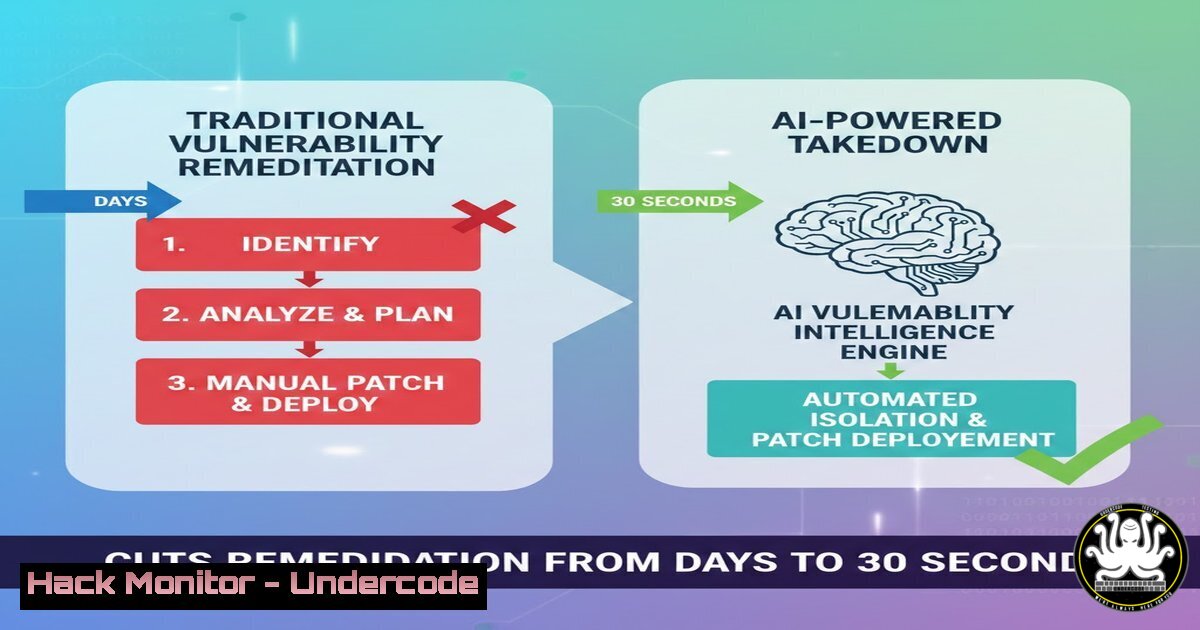
The traditional vulnerability management lifecycle is a marathon of manual effort, often stretching from disclosure to remediation over days or weeks. Now, AI is compressing this timeline to mere seconds. This article deconstructs a next‑generation AI‑Sec‑Ops workflow, demonstrating how intelligent automation is transforming threat response from a reactive chore into a proactive, seamless operation.
Learning Objectives:
- Understand the components of an integrated AI‑Sec‑Ops pipeline for vulnerability management.
- Learn the technical steps for automating reconnaissance, analysis, and remediation.
- Explore the commands, tools, and scripts that enable this high‑velocity response.
You Should Know:
- The Trigger: Ingestion and Processing of Vulnerability Intelligence
The process begins when a new vulnerability disclosure (e.g., a CVE notice from a vendor or a NVD feed) enters the system. The AI doesn’t just read the CVE ID; it parses the full description, CVSS score, affected versions, and, crucially, any proof‑of‑concept (PoC) code or indicators of compromise.
Step‑by‑step guide:
- The system ingests the disclosure via a secured API endpoint or a monitored email inbox. A simple webhook listener can capture this data.
Example: A minimal Flask webhook receiver to capture vulnerability data from flask import Flask, request import json app = Flask(<strong>name</strong>) @app.route('/webhook/cve', methods=['POST']) def handle_cve(): data = request.json cve_id = data.get('id') description = data.get('description') Write to processing queue with open('/opt/secops/queue/cve_queue.json', 'a') as f: json.dump(data, f) f.write('\n') return 'OK', 200 if <strong>name</strong> == '<strong>main</strong>': app.run(host='0.0.0.0', port=5000, ssl_context='adhoc') - Natural Language Processing (NLP) models extract key entities: software names (e.g.,
Apache Tomcat), version ranges (9.0.0 to 9.0.40), and impacted configurations.
2. Intelligent Reconnaissance: Discovering Affected Assets
With the target software identified, the AI queries all integrated asset inventories—CMDB, cloud providers (AWS, Azure, GCP), and active directory—to build a target list. It then performs credentialed or agent‑based discovery to validate the installed software.
Step‑by‑step guide:
- Query internal inventories. For example, using the `aws` CLI to find EC2 instances with a specific tag.
aws ec2 describe-instances --filters "Name=tag:Application,Values=Tomcat" --query 'Reservations[].Instances[].PrivateIpAddress' --output text
- Perform authenticated scans to verify the exact version. An Ansible playbook snippet:
</li>
</ol>

- name: Check Tomcat version on target hosts
hosts: tomcat_servers
tasks:
- name: Get Tomcat version
shell: /opt/tomcat/bin/version.sh | grep "Server version"
register: tomcat_version
- name: Register vulnerable instance
set_fact:
vulnerable_host: "{{ inventory_hostname }}"
when: "'9.0.0' in tomcat_version.stdout and '9.0.40' in tomcat_version.stdout"
3. Impact Analysis and Prioritization
Not all instances are equally critical. The AI correlates the asset data with business context from the CMDB—owner, environment (prod/dev), and sensitivity—to calculate a business‑risk‑adjusted priority score.
Step‑by‑step guide:
- Enrich host data with business context from a SQL CMDB.
SELECT server.hostname, app.business_unit, app.criticality_tier FROM servers server JOIN applications app ON server.app_id = app.id WHERE server.hostname IN ('host1', 'host2'); - Apply a scoring formula:
Final_Score = CVSS_Base_Score Criticality_Tier_Multiplier. Critical production systems get the highest multiplier, guiding remediation order.
4. Automated Remediation Workflow Orchestration
For known vulnerabilities with standardized patches or mitigations, the system can auto‑remediate. For critical, widespread patches (e.g., Log4Shell), it may deploy temporary firewall blocks or WAF rules while patching rolls out.
Step‑by‑step guide:
- Patch Deployment: Execute a patch via configuration management.
Using SaltStack to patch a specific package
salt 'vulnerable_host' pkg.install name=tomcat9 version='9.0.41'
- Compensating Control: Add an emergency WAF rule (e.g., AWS WAFv2 CLI).
aws wafv2 update-web-acl \
--name Prod-WebACL \
--scope REGIONAL \
--id abc12345 \
--lock-token a1b2c3d4 \
--rules file://new_rule_to_block_exploit.json
5. Validation and Reporting
Post‑remediation, the system runs a targeted vulnerability scan to confirm the fix and updates all tickets and dashboards, providing a closed‑loop audit trail.
Step‑by‑step guide:
- Run a targeted scan with a tool like Nuclei.
nuclei -u https://target-host.com -id CVE-2023-12345 -silent
- If the scan returns clean, close the incident ticket via API (e.g., ServiceNow).
curl -X PATCH -H "Authorization: Bearer $SN_TOKEN" \
-H "Content-Type: application/json" \
https://instance.service-now.com/api/now/table/incident/INC0010001 \
-d '{"state":"6", "close_notes":"Resolved via automated patch deployment."}'
What Undercode Say:
- The Human Role Shifts from Executor to Orchestrator. The “30 seconds of manual effort” signifies the approval or oversight moment, not the labor. The security analyst’s value moves to designing, tuning, and trusting the automation pipeline.
- Integration Depth is the Real Innovation. The magic isn’t in a single AI model, but in the seamless handoff between systems—from intelligence ingestion to asset management to change control. This requires robust APIs and a well‑modeled asset inventory, which remains a significant challenge for many organizations.
Prediction:
The demonstrated workflow is a precursor to fully autonomous Security Operations Centers (SOCs). Within 3‑5 years, we will see widespread adoption of AI agents that not only remediate but also proactively hunt for vulnerabilities by simulating attacker behaviors against their own environments. The focus will shift from “responding to disclosures” to “preventing exploitability,” with AI generating and testing custom patches for zero‑days before official vendor releases. This will, however, escalate the arms race, forcing attackers to develop AI‑driven exploits designed to evade AI‑driven detection and response loops.
▶️ Related Video (80% Match):
🎯Let’s Practice For Free:
IT/Security Reporter URL:
Reported By: Briansgagne Ks – Hackers Feeds
Extra Hub: Undercode MoN
Basic Verification: Pass ✅🔐JOIN OUR CYBER WORLD [ CVE News • HackMonitor • UndercodeNews ]
📢 Follow UndercodeTesting & Stay Tuned:
- Enrich host data with business context from a SQL CMDB.


