Listen to this Post
Introduction:
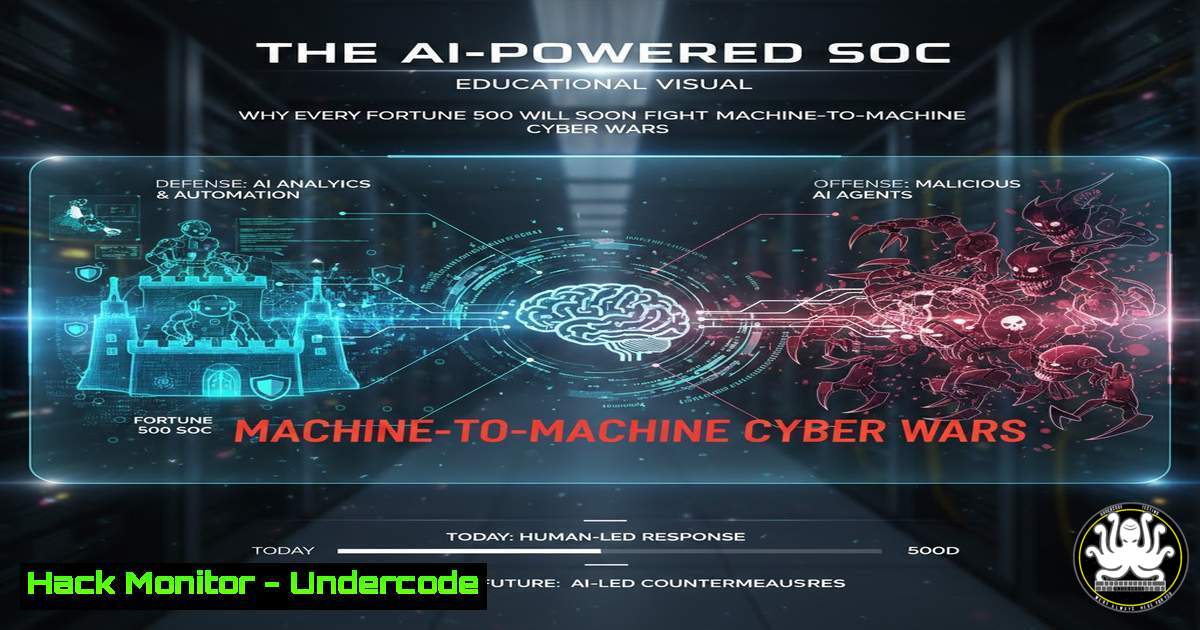
The integration of Artificial Intelligence into cybersecurity is no longer an emerging trend but the central paradigm shifting defense strategies and threat landscapes alike. As highlighted by Alex Stamos at Reddit’s SnooSec conference, the industry is rapidly evolving from human-centric security operations to a hybrid model where AI agents handle the bulk of defense, supervised by smaller, elite teams of senior engineers. This transition compels organizations to abandon legacy security postures and prepare for a future where vulnerability exploitation is automated, forcing a reactive race against zero-days that will soon impact every major corporation.
Learning Objectives:
- Understand the immediate impact of AI on Security Operations Centers (SOC), Application Security (AppSec), and Threat Intelligence.
- Analyze the strategic shift toward “VulnOps” and the necessity of preparing for machine-speed zero-day exploitation.
- Implement practical commands and configurations to simulate and defend against automated, AI-driven attack scenarios.
You Should Know:
1. The New SOC: Supervising the Machine-to-Machine Conflict
The prediction that “humans will be supervising machine-to-machine conflict” necessitates a fundamental change in how we monitor infrastructure. Traditional SOC analysts relying on manual log checking are obsolete. Instead, Security Engineers must act as shepherds for AI agents that ingest and respond to alerts. To prepare for this, one must master the automation tools that serve as the foundation for these AI agents. For instance, understanding how to deploy and manage open-source SIEMs like Wazuh, which can be configured to trigger automated responses via scripting.
Step‑by‑step guide: Automating Log Analysis with Wazuh and Scripted Responses
1. Install Wazuh Agent (Linux): On a test Ubuntu machine, install the agent to forward logs to a manager.
curl -s https://packages.wazuh.com/key/GPG-KEY-WAZUH | apt-key add -
echo "deb https://packages.wazuh.com/4.x/apt/ stable main" | tee -a /etc/apt/sources.list.d/wazuh.list
apt-get update
apt-get install wazuh-agent
2. Configure Active Response: Edit the agent configuration (/var/ossec/etc/ossec.conf) to define a command that triggers upon a specific alert (e.g., failed SSH logins).
<command>
<name>disable-account</name>
<executable>disable-account.sh</executable>
<timeout_allowed>no</timeout_allowed>
</command>

<active-response>
<command>disable-account</command>
<location>local</location>
<rules_id>5710</rules_id> <!-- Rule ID for SSH authentication failure -->
</active-response>
3. Create the Response Script: Create `/var/ossec/active-response/bin/disable-account.sh` to parse the username and lock the account.
!/bin/bash
USERNAME=$(echo $2 | cut -d "=" -f 2)
/usr/sbin/usermod -L $USERNAME
logger "Wazuh Active Response: Disabled account $USERNAME due to multiple failures"
This simulates the “machine” part of the conflict, showing how infrastructure can react instantly without human intervention, a precursor to AI-supervised logic.
- Building on Legos: Integrating Vendor Security APIs Securely
The concept of “Building on Legos” refers to assembling security postures from specialized vendor components. This requires robust API security, as these components communicate via REST APIs. A misconfigured API call can expose your entire infrastructure. Modern AI agents will autonomously query these APIs, requiring defenders to harden them against both external attackers and accidental internal misuse.
Step‑by‑step guide: Hardening API Access for Automated Tools
Assume you are configuring a vulnerability scanner (like Tenable or a custom Python script) that uses an API key to query your cloud provider’s security posture.
1. Avoid Hardcoding Credentials: Never embed API keys in scripts. Use environment variables or a secrets manager like HashiCorp Vault.
2. Implement Principle of Least Privilege: When generating an API key for your “AI Agent,” scope it specifically. On AWS, create an IAM policy that only allows the specific `Describe` and `List` actions required.
{
"Version": "2012-10-17",
"Statement": [
{
"Effect": "Allow",
"Action": [
"ec2:DescribeInstances",
"s3:ListAllMyBuckets",
"guardduty:ListDetectors"
],
"Resource": ""
}
]
}
3. Secure the API Call in a Script: Use Python to call the AWS API securely, pulling the key from the environment, and logging the action for audit trails.
import boto3
import os
import logging

Configure logging for the AI agent's actions
logging.basicConfig(filename='ai_security_audit.log', level=logging.INFO)

Securely fetch credentials
session = boto3.Session(
aws_access_key_id=os.environ.get('AWS_ACCESS_KEY'),
aws_secret_access_key=os.environ.get('AWS_SECRET_KEY'),
region_name='us-east-1'
)

client = session.client('ec2')
instances = client.describe_instances()
logging.info(f"AI Agent queried EC2 instances. Result count: {len(instances['Reservations'])}")
print(instances)
This ensures that when the “machine” builds upon these “Legos,” the connections are hardened and auditable, a critical prerequisite for the VulnOps era.
3. VulnOps: Preparing for the Zero-Day Onslaught
Alex Stamos’s prediction that in “6-9 months it’ll be everyone” worrying about zero-days signifies the death of the “patch Tuesday” luxury. VulnOps is the practice of treating vulnerability management as a continuous, high-priority operational process, not a monthly checklist. This involves rapidly deploying virtual patches and leveraging eBPF (Extended Berkeley Packet Filter) or Web Application Firewall (WAF) rules to mitigate exploits before an official patch is available.
Step‑by‑step guide: Implementing a Virtual Patch with ModSecurity (WAF)
When a zero-day is announced for a web application (e.g., a critical RCE in a popular CMS), you cannot wait for the vendor.
1. Analyze the PoC: Understand the exploit vector. For example, if the exploit uses a specific pattern in a `POST` parameter.
2. Write a ModSecurity Rule: Create a custom rule in `/etc/modsecurity/custom_rules.conf` to block the attack pattern.
 Block requests containing the specific zero-day payload pattern
SecRule REQUEST_FILENAME "/wp-admin/admin-ajax.php" \
"chain,phase:2,t:none,t:urlDecodeUni,block,msg:'Zero-day Exploit Attempt Blocked',id:1000001"
SecRule REQUEST_BODY "@contains malicious_payload_string" \
"t:none,t:urlDecodeUni"
3. Reload and Monitor: Reload Apache/Nginx to apply the rule. Immediately monitor the error logs for false positives.
 For Apache
sudo systemctl reload apache2
 Tail the ModSecurity audit log
sudo tail -f /var/log/modsec_audit.log
This is VulnOps in action: using configuration-as-code to buy time against automated scanning bots looking for the latest disclosed zero-day.
4. Quotable Logic: Implementing AI Guardrails
The humorous quip, “if you’re using a good model, not Grok,” underscores a serious point about supply chain security in AI. If your security AI agent relies on a Large Language Model (LLM) to make decisions, that model itself is an attack surface. Defenders must implement guardrails to prevent prompt injection or data poisoning that could cause the AI to misclassify threats or expose data.
Step‑by‑step guide: Sanitizing Input to AI Models
If your AI agent uses an LLM to summarize security logs, you must sanitize the logs before sending them.
1. Identify Sensitive Data: Use regex to redact IPs, usernames, or credentials from log strings before they are sent to the model.
import re

def sanitize_log(log_entry):
 Redact IP addresses
log_entry = re.sub(r'\b(?:[0-9]{1,3}.){3}[0-9]{1,3}\b', '[bash]', log_entry)
 Redact potential passwords (e.g., after 'password=')
log_entry = re.sub(r'(password[=:]\s)\S+', r'\1[bash]', log_entry, flags=re.IGNORECASE)
return log_entry

raw_log = "User 192.168.1.10 failed login with password Summer2024!"
safe_log = sanitize_log(raw_log)
print(safe_log)  Output: User [bash] failed login with password [bash]!
2. Implement an Output Checker: Before the AI agent executes a command based on the LLM’s suggestion, validate the command against a list of allowed actions to prevent “confused deputy” attacks.
- DFIR in the Age of AI: Automated Containment
Digital Forensics and Incident Response (DFIR) will be revolutionized by AI. When an AI agent detects a machine-to-machine attack, it must be able to autonomously contain the threat. This requires mastering orchestration tools that interface with cloud provider APIs.
Step‑by‑step guide: Automated Instance Isolation via AWS CLI
If your IDS detects a cryptocurrency miner on an EC2 instance, an AI agent could immediately isolate it.
1. Tag the Instance for Isolation: The detection tool tags the malicious instance.
aws ec2 create-tags --resources i-1234567890abcdef0 --tags Key=Quarantine,Value=Yes
2. Trigger Lambda Function: A CloudWatch Event monitors for this tag change and triggers a Lambda function.
3. Lambda Isolation Code (Python): The function applies a strict security group to the instance.
import boto3

def lambda_handler(event, context):
ec2 = boto3.client('ec2')
instance_id = event['detail']['resource-id']
 Apply a quarantine security group that blocks all traffic except to a forensics server
ec2.modify_instance_attribute(
InstanceId=instance_id,
Groups=['sg-0quarantinegroupid']
)
print(f"Instance {instance_id} moved to quarantine group.")
This closes the loop from detection to remediation in seconds, a speed only achievable through machine-led response.
What Undercode Say:
- The Human Role Evolves, Not Vanishes: The shift to machine-led defense does not eliminate the need for security professionals but elevates them. The “fewer, more senior people” will focus on strategic oversight, tuning the AI agents, and handling complex forensic investigations that the machines flag as ambiguous.
- The Zero-Day Democracy is Here: The barrier to exploiting zero-days is collapsing. Small and medium businesses can no longer rely on “security through obscurity.” The democratization of AI-driven exploit tools means every connected organization is a target and must adopt a “assume breach” mentality with robust detection and response capabilities.
- API Security is the New Perimeter: As organizations “build on Legos,” the glue holding these components together—APIs and cloud configurations—becomes the primary attack surface. Defenders must shift left to secure these interfaces and implement strict governance to prevent the AI agents themselves from being manipulated into exposing the data they are meant to protect.
Prediction:
Within the next 18 months, we will witness the first major “AI vs. AI” cyber incident where a worm capable of leveraging generative AI to rewrite its own code to evade detection spreads autonomously, countered only by defensive AI networks sharing real-time signatures and containment strategies without human intervention. This will cement the role of the CISO as a manager of machine intelligence rather than a manager of human analysts.
▶️ Related Video (82% Match):
🎯Let’s Practice For Free:
IT/Security Reporter URL:
Reported By: Clintgibler Stamos – Hackers Feeds
Extra Hub: Undercode MoN
Basic Verification: Pass ✅


