Listen to this Post
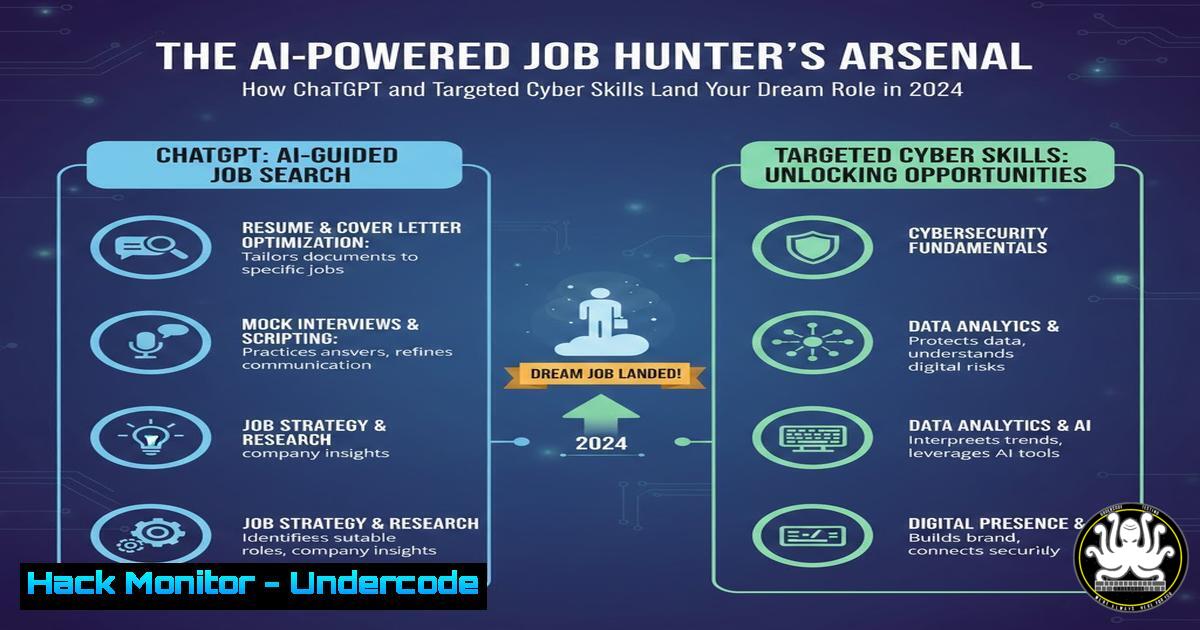
Introduction:
The modern job search has evolved into a technical and strategic operation, blending artificial intelligence with targeted skill acquisition. While AI tools like ChatGPT revolutionize application crafting, the underlying demand for verifiable technical expertise—particularly in cybersecurity, IT, and AI—remains paramount. This guide provides a tactical framework for leveraging generative AI to navigate the job market while building the hard skills that make candidates irresistible to employers.
Learning Objectives:
- Master prompt engineering to automate and optimize every stage of the job application process.
- Identify and pursue critical upskilling pathways in cybersecurity, AI, and IT support through verified certification courses.
- Develop a cohesive personal branding and networking strategy amplified by AI tools.
- Understand the technical environment of job hunting, including basic automation and data privacy considerations.
- Formulate a long-term career strategy that balances AI-assisted efficiency with genuine skill development.
You Should Know:
1. Resume Optimization as a Data Formatting Task
A resume is a structured data document designed for both human recruiters and Applicant Tracking Systems (ATS). Using ChatGPT effectively requires treating it as a data formatting and keyword optimization engine.
Step‑by‑step guide explaining what this does and how to use it.
1. Deconstruct the Job Description: Isolate key nouns (technologies like “SIEM,” “Python,” “React”) and action verbs (“orchestrated,” “hardened,” “developed”).
2. Craft a Targeted Input your existing resume bullet points and the job description. Use: `”Rephrase my resume bullet points below to match the keywords and tone of this job description [Paste Job Description]. Focus on incorporating the skills [List 3-5 key skills]. My experience: [Paste 2-3 bullet points].”`
3. Iterate and Quantify: Command the AI to add quantifiable metrics. `”Add quantifiable metrics (percentages, timeframes, dollar amounts) to these revised bullet points.”`
4. ATS Compatibility Check: While AI can help, use a simple local tool like `pdftotext` (Linux) to ensure parsability. Command: `pdftotext your_resume.pdf – | head -20` to confirm text extraction is clean.
2. AI-Driven Interview Preparation: Simulating Technical Scenarios
ChatGPT can be a dynamic sparring partner for technical and behavioral interviews, especially for IT and cyber roles.
Step‑by‑step guide explaining what this does and how to use it.
1. Request Scenario Generation: For a cybersecurity analyst role, prompt: `”Act as an interviewer. Ask me five increasingly difficult technical interview questions about network security monitoring and provide a model answer for the first one.”`
2. Practice Incident Response: Simulate a real-world scenario. `”Describe a hypothetical incident where a Linux server shows signs of a brute-force SSH attack. As the responder, what are your first five commands? I will respond with my actions.”`
You could then practice commands like checking auth logs: `sudo tail -100 /var/log/auth.log | grep “Failed password”` or blocking an IP with iptables: sudo iptables -A INPUT -s 192.168.1.100 -j DROP.
3. Analyze Your Answers: Paste your proposed answers and ask for critique: `”From a senior engineer’s perspective, critique this response for technical accuracy and communication clarity: [Paste your answer].”`
3. Strategic Upskilling: Linking AI Advice to Verified Courses
The post lists critical courses. Use AI to build a learning path, but anchor it in these reputable certifications.
Step‑by‑step guide explaining what this does and how to use it.
1. Skill Gap Analysis: Prompt ChatGPT: `”Analyze this job description [Paste JD] and cross-reference the required skills with the following available courses [List courses from post, e.g., Google Cybersecurity, Google AI Essentials]. Recommend the top 2 courses that would best address the gaps.”`
2. Create a Learning Schedule: `”Create a 10-week part-time study plan to complete the Google Cybersecurity Certificate, including weekly topics and hands-on practice goals.”`
3. Hands-On Application: For IT Support or Cyber courses, practice in a safe lab. Set up a virtual machine (VirtualBox/VMware) and create a simple batch script (Windows) to automate a system check:
@echo off
systeminfo | findstr /C:"Total Physical Memory"
wmic logicaldisk get size,freespace,caption
netstat -an | find /C "LISTENING"
Or, in Linux, a bash script to monitor logins:
!/bin/bash
echo "Recent SSH login attempts:"
grep "Accepted password" /var/log/auth.log | tail -5
- LinkedIn & Network Automation: The API-Aware Job Hunter
Optimizing your LinkedIn profile goes beyond text. Understanding the platform’s technical ecosystem is key.
Step‑by‑step guide explaining what this does and how to use it.
1. Profile Keyword Injection: Use AI to generate a headline and “About” section rich in terms like “vulnerability management,” “CI/CD,” “SIEM,” “Python automation.”
2. Intelligent Outreach: For networking, move beyond basic templates. Use AI to analyze a profile before connecting. `”Based on this LinkedIn profile summary [Paste summary], draft a personalized connection request that mentions one shared technical interest.”`
3. Ethical Automation Awareness: Be aware that recruiters may use Boolean search. Include relevant terms in your profile text (e.g., “Wireshark,” “NIST CSF,” “AWS,” “React Hooks”). Understand that tools like Selenium or the LinkedIn API (used ethically) power job searches; taking the Google IT Support course helps understand these underlying systems.
- The Technical Core: Why These Specific Courses Are Non-Negotiable
The recommended courses form a foundation for the most in-demand digital roles.
Step‑by‑step guide explaining what this does and how to use it.
Google Cybersecurity Certificate: Provides hands-on with Linux command line, SQL for log analysis, and SIEM basics—directly translating to commands and concepts used daily.
Google AI Essentials: Demystifies prompt engineering and AI project lifecycles, making you an effective AI user and collaborator.
Google IT Support: Builds core competency in OS, networking, and system administration—the bedrock of any technical career.
Meta Front-End & Google UX Design: For developers, these translate directly into prototyping, accessibility, and user-centered design—skills AI cannot replicate.
Power BI Data Analyst: Complements cybersecurity (threat intelligence visualization) and business roles, teaching data modeling and visualization.
What Undercode Say:
- AI is a Force Multiplier, Not a Replacement: ChatGPT excels at drafting, structuring, and simulating, but it cannot earn a certification, perform a hands-on pentest, or build genuine professional relationships for you. The value is in the synergy.
- Skills are the Currency, AI is the Exchange: The listed courses (Cybersecurity, AI, IT Support) address fundamental skill gaps. An AI-optimized resume for a SOC analyst role is worthless without the practical knowledge from the Google Cyber certificate to back it up in an interview lab.
Analysis: The post brilliantly juxtaposes two pillars of modern career advancement: AI-assisted process efficiency and verified technical education. The danger lies in over-relying on the former while neglecting the latter. The job market, especially in tech, is adapting to AI; recruiters can spot AI-generated content, and interviews will increasingly include practical, unrehearsed tests. The successful candidate uses AI to handle the volume and polish of applications, then dedicates the saved time to the deep, hands-on learning provided by the recommended technical courses. This creates a virtuous cycle: better skills lead to better prompts and more targeted applications, resulting in higher-quality opportunities.
Prediction:
Within two years, AI-assisted job application will become the baseline standard, devaluing generic, non-AI-optimized applications. Simultaneously, the demand for the foundational IT, cybersecurity, and AI literacy taught in these certificate programs will skyrocket, as they represent skills AI cannot autonomously apply. We will see a bifurcation in the job market: those who use AI and upskill will accelerate their careers, while those who rely solely on AI for content generation will face increased scrutiny and technical screening. Furthermore, “Prompt Crafting for Career Development” may become a formalized subtrack within professional coaching and adult education curricula.
▶️ Related Video (74% Match):
🎯Let’s Practice For Free:
IT/Security Reporter URL:
Reported By: Udham Singh – Hackers Feeds
Extra Hub: Undercode MoN
Basic Verification: Pass ✅


