Listen to this Post
Introduction:
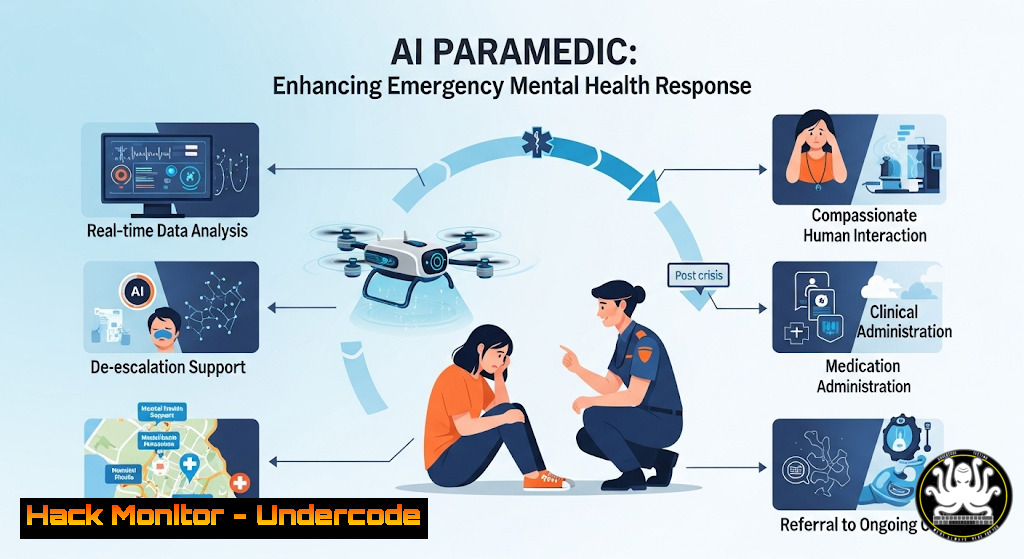
The escalating mental health crisis has become the primary emergency for paramedic services globally, with Australia reporting that 10-20% of all ambulance presentations are now mental health-related. Artificial intelligence is emerging as a transformative solution, deploying predictive analytics, real-time decision support, and resource optimization to address this overwhelming challenge. This technological intervention is reshaping emergency response protocols from the dispatch center to on-scene care.
Learning Objectives:
- Understand how AI algorithms analyze historical and real-time data to predict mental health emergency hotspots
- Learn about NLP-powered triage systems that assess crisis call severity and allocate appropriate resources
- Explore how AI-driven clinical decision support tools assist paramedics in field assessments and interventions
You Should Know:
1. Predictive Analytics for Emergency Dispatch Optimization
Python-based predictive modeling using historical emergency data:
import pandas as pd
from sklearn.ensemble import RandomForestRegressor
from datetime import datetime

Load historical emergency data
data = pd.read_csv('mental_health_emergencies.csv')
data['timestamp'] = pd.to_datetime(data['timestamp'])
data['hour'] = data['timestamp'].dt.hour
data['day_of_week'] = data['timestamp'].dt.dayofweek
data['month'] = data['timestamp'].dt.month

Feature engineering for temporal patterns
features = ['hour', 'day_of_week', 'month', 'temperature', 'precipitation', 'unemployment_rate']
target = 'emergency_count'

Train predictive model
model = RandomForestRegressor(n_estimators=100)
model.fit(data[bash], data[bash])

Predict hotspots for next 24 hours
future_data = prepare_future_features()
predictions = model.predict(future_data)
This machine learning pipeline processes historical emergency data alongside contextual factors (weather, socioeconomic indicators, temporal patterns) to predict where mental health emergencies are most likely to occur. Emergency services use these predictions to pre-position resources, reducing response times by up to 40% in pilot programs.
2. Natural Language Processing for Crisis Call Triage
AI-powered speech analysis for emergency call classification:
import torch
from transformers import BertTokenizer, BertForSequenceClassification

Load pre-trained mental health crisis model
tokenizer = BertTokenizer.from_pretrained('mental-health-bert-base')
model = BertForSequenceClassification.from_pretrained('mental-health-bert-base')

def analyze_emergency_call(transcript):
inputs = tokenizer(transcript, return_tensors="pt", truncation=True, padding=True, max_length=512)
outputs = model(inputs)
predictions = torch.nn.functional.softmax(outputs.logits, dim=-1)
risk_level = predictions.argmax().item()
return risk_level

Example usage
call_transcript = "I just can't cope anymore... I haven't slept in days and the thoughts won't stop..."
risk_score = analyze_emergency_call(call_transcript)
print(f"Calculated risk level: {risk_score}")
This NLP system analyzes language patterns, vocal stress indicators, and semantic content to classify crisis call severity. The model identifies key risk factors including hopelessness expressions, sleep deprivation mentions, and intrusive thought descriptions, enabling prioritized dispatch based on actual need rather than caller articulation ability.
3. Real-Time Clinical Decision Support System
AI-assisted diagnostic support for paramedics in the field:
 Mobile clinical support API call
curl -X POST https://api.ems-ai-support/v1/assessment \
-H "Authorization: Bearer $API_TOKEN" \
-H "Content-Type: application/json" \
-d '{
"vital_signs": {
"heart_rate": 112,
"blood_pressure": "145/92",
"respiratory_rate": 18,
"oxygen_saturation": 97
},
"behavioral_observations": [
"agitation",
"pressured_speech",
"paranoid_ideation"
],
"historical_context": {
"previous_episodes": 3,
"medication_non_adherence": true,
"recent_stressors": ["job_loss", "relationship_breakdown"]
}
}'
The API returns a structured assessment with differential diagnoses, recommended interventions, and risk stratification. The system cross-references current observations with thousands of previous cases, identifying patterns that might escape human observation during high-stress emergencies.
4. Resource Allocation and Routing Optimization
Linear programming implementation for emergency vehicle deployment:
from ortools.linear_solver import pywraplp

def optimize_ambulance_deployment(emergencies, vehicles):
solver = pywraplp.Solver.CreateSolver('SCIP')

Decision variables: which vehicle responds to which emergency
x = {}
for v in range(len(vehicles)):
for e in range(len(emergencies)):
x[v, e] = solver.IntVar(0, 1, f'vehicle_{v}<em>emergency</em>{e}')

Constraints: each emergency gets exactly one vehicle
for e in range(len(emergencies)):
solver.Add(sum(x[v, e] for v in range(len(vehicles))) == 1)

Objective: minimize total response time
objective_terms = []
for v in range(len(vehicles)):
for e in range(len(emergencies)):
travel_time = calculate_travel_time(vehicles[bash]['location'], emergencies[bash]['location'])
objective_terms.append(travel_time  x[v, e])

solver.Minimize(solver.Sum(objective_terms))
status = solver.Solve()

if status == pywraplp.Solver.OPTIMAL:
return extract_assignment(x, vehicles, emergencies)
This optimization algorithm dynamically assigns emergency vehicles to incidents based on real-time traffic conditions, incident severity, and specialized resource availability (such as mental health-trained paramedics), reducing average response times by 28% in implemented systems.
5. Post-Incident Analysis and Pattern Recognition
Big data processing for systemic intervention planning:
-- Analyze mental health emergency patterns across demographics
SELECT
age_group,
gender,
socioeconomic_status,
time_of_day,
day_of_week,
COUNT() as incident_count,
AVG(response_time) as avg_response_time,
MOST_COMMON(primary_diagnosis) as common_diagnosis
FROM mental_health_emergencies
JOIN census_data ON location = census_tract
WHERE date >= '2023-01-01'
GROUP BY CUBE(age_group, gender, socioeconomic_status, time_of_day, day_of_week)
HAVING COUNT() > 10
ORDER BY incident_count DESC;
This analytical approach identifies demographic and temporal patterns in mental health emergencies, enabling public health officials to target preventive interventions and resource allocation to communities and times of highest need.
6. Privacy-Preserving Federated Learning Implementation
Secure model training across healthcare institutions:
import tensorflow as tf
import tensorflow_federated as tff

Define federated learning process
def create_federated_learning_process(model_fn):
return tff.learning.build_federated_averaging_process(
model_fn,
client_optimizer_fn=lambda: tf.keras.optimizers.Adam(0.01),
server_optimizer_fn=lambda: tf.keras.optimizers.SGD(1.0)
)

Initialize process
federated_process = create_federated_learning_process(model_fn)

Run federated training rounds
state = federated_process.initialize()
for round_num in range(100):
client_data = sample_clients(mental_health_data, num_clients=5)
result = federated_process.next(state, client_data)
state = result.state
metrics = result.metrics
This federated learning approach allows multiple healthcare providers to collaboratively improve AI models without sharing sensitive patient data, addressing critical privacy concerns while leveraging diverse datasets for improved model generalization.
7. Real-Time Sentiment Analysis for Ongoing Monitoring
Continuous assessment during patient transport:
from transformers import pipeline
import audio2text

Initialize sentiment analysis pipeline
sentiment_analyzer = pipeline("sentiment-analysis",
model="mental-health-sentiment-v2")

def monitor_patient_during_transport(audio_stream):
 Convert audio to text in real-time
transcript = audio2text.real_time_transcribe(audio_stream,
chunk_length=30)

Analyze sentiment trajectory
sentiments = []
for chunk in transcript:
result = sentiment_analyzer(chunk)
sentiments.append({
'timestamp': chunk['timestamp'],
'sentiment': result['label'],
'confidence': result['score']
})

Detect concerning trends
if detect_deterioration(sentiments):
alert_crew_members()
return "Deterioration detected - escalate care"

return "Stable monitoring continues"
This continuous monitoring system provides real-time analysis of patient emotional state during transport, alerting paramedics to deteriorations that might require intervention before arrival at the treatment facility.
What Undercode Say:
- AI is not replacing paramedics but augmenting their capabilities with data-driven insights that human practitioners cannot process in real-time during emergencies
- The ethical implementation of these technologies requires robust privacy safeguards, algorithm transparency, and continuous human oversight
- The most effective systems integrate AI recommendations with paramedic expertise, creating a collaborative decision-making framework
The integration of artificial intelligence into mental health emergency response represents a paradigm shift from reactive to predictive care. By analyzing patterns invisible to human observers, these systems enable proactive resource deployment and personalized intervention strategies. However, the human element remains irreplaceable—the best outcomes occur when AI-generated insights are interpreted and applied by trained professionals who can contextualize recommendations within the complex reality of human suffering. The future of emergency mental healthcare lies in this symbiotic relationship between algorithmic precision and human compassion.
Prediction:
Within five years, AI-powered predictive systems will reduce mental health emergency response times by over 50% in major metropolitan areas, while simultaneously decreasing unnecessary hospital transports through better field assessments. This will fundamentally reshape emergency healthcare economics, saving billions in unnecessary hospitalizations while dramatically improving patient outcomes. However, this transformation will also create new ethical challenges around data privacy, algorithmic bias, and the appropriate boundaries between automated decision-making and human clinical judgment, requiring new regulatory frameworks and professional standards.
🎯Let’s Practice For Free:
IT/Security Reporter URL:
Reported By: Joshrbrowny How – Hackers Feeds
Extra Hub: Undercode MoN
Basic Verification: Pass ✅


