
Listen to this Post
Introduction:
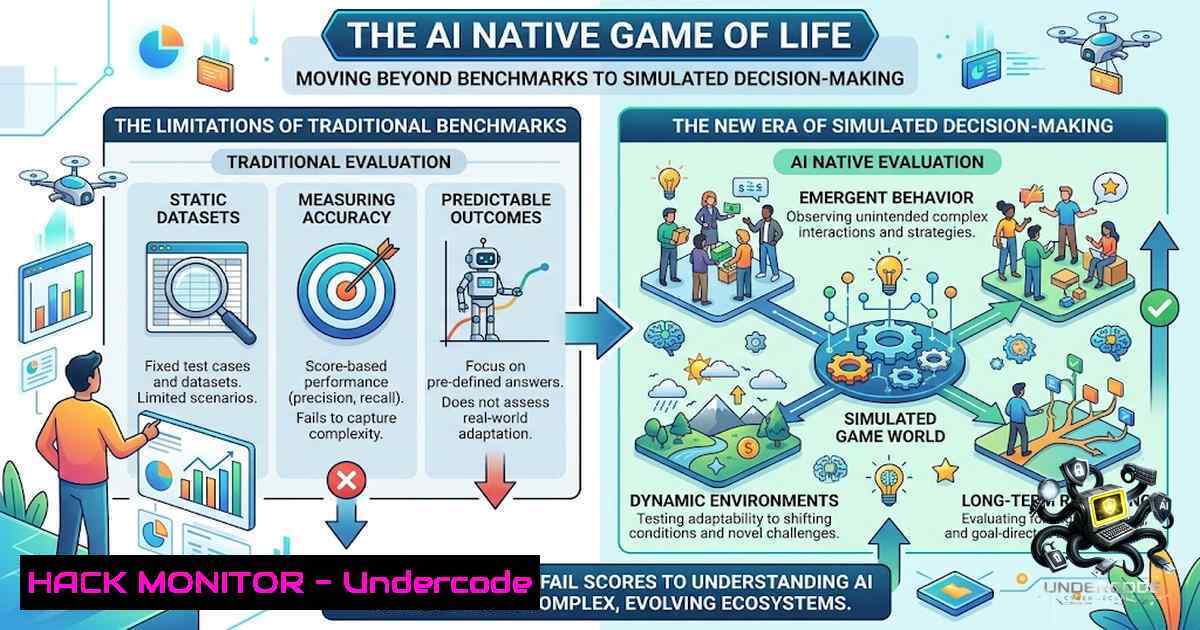
For years, the artificial intelligence community has been obsessed with leaderboards, using static benchmarks like MMLU, GLUE, and SuperGLUE to measure progress. However, these metrics often fail to capture an AI’s ability to adapt, strategize, and make high-quality decisions in dynamic, resource-constrained environments. By reframing AI evaluation as a “Game of Life”—a simulation where agents must manage finite resources like Energy, Time, Skill, Money, and Network—we can fundamentally shift our focus from pure accuracy to strategic resilience and long-term survival.
Learning Objectives & Secrets:
- Objective 1: Understand the AI SDLC as a Game Loop. Learn to conceptualize the AI Software Development Life Cycle (SDLC) not as a linear pipeline, but as a continuous, iterative loop of “Define → Build → Act → Simulate → Evaluate → Learn → Repeat,” mirroring reinforcement learning environments.
- Objective 2 (Secret): Master Resource Arbitrage. Discover how to program agents to balance conflicting resources—for instance, spending “Time” to learn a new “Skill” that reduces the “Money” required for a future task, effectively creating an arbitrage strategy.
- Objective 3 (Secret): Evolving the “Win” Condition. Learn to implement dynamic reward functions that are not hard-coded to a specific objective but rather allow the agent to reinterpret “winning” based on its current state, teaching adaptability and emergent behavior.
You Should Know:
1. Setting Up the Simulation Environment (Linux/Windows WSL)
To begin experimenting with this concept, you need a robust simulation environment. We will use Python with the `mesa` library (Agent-Based Modeling) to create the core architecture.
– Step 1: Install Python and Dependencies. Ensure you have Python 3.9+ installed.
Linux: `sudo apt update && sudo apt install python3 python3-pip -y`
Windows (WSL): Ensure WSL2 is installed, then run the Linux commands inside the Ubuntu terminal.
– Step 2: Create a Virtual Environment. `python3 -m venv game_of_life_env && source game_of_life_env/bin/activate`
– Step 3: Install Required Libraries. `pip install mesa numpy openai` (OpenAI is optional for integrating LLM-based agents).
– Step 4: Architecture Design. Create a Python file (ai_game.py). Define your agent class with attributes: energy, time, skill, money, network. The step function will dictate how these change based on actions.
- Building the Core Agent Logic (The Decision Engine)
The agent’s “brain” must evaluate its state and decide on an action. We will create a simple deterministic model before introducing an LLM API.
– Step 1: Define the Action Space. Possible actions: “LEARN” (spends Time, increases Skill), “WORK” (spends Energy, increases Money), “NETWORK” (spends Money, increases Network), “REST” (recovers Energy).
– Step 2: Implementation of the Step Function.
class AI_Agent(Agent):
def step(self):
 Strategy: If Skill is low, prioritize learning
if self.skill < 5 and self.time > 0:
self.skill += 1
self.time -= 1
elif self.money < 10:
self.money += 2
self.energy -= 1
else:
 Rest to conserve energy for a bigger move
self.energy += 1
– Step 3: Integrating an LLM API. To make it an “AI-1ative” game, replace the hardcoded logic with an API call (e.g., OpenAI).
import openai
def get_ai_decision(state):
prompt = f"Given Energy:{state['energy']}, Time:{state['time']}, Skill:{state['skill']}, Money:{state['money']}, Network:{state['network']}. Choose an action from [LEARN, WORK, NETWORK, REST] to maximize long-term success."
response = openai.ChatCompletion.create(model="gpt-4", messages=[{"role": "user", "content": prompt}])
return response.choices[bash].message.content
3. Resource Constraints and the “Vibe Coding” Approach
The term “Vibe Coding” implies a high-level, intuitive approach to programming where natural language prompts drive the code generation. Here, we use it to define the game rules.
– Step 1: Natural Language Rule Definition. Write a prompt describing the game mechanics: “If an agent spends 2 Time learning a Skill, it gets 1 Skill. If an agent has 2 Skill, it can work on a high-value task that costs less Energy.”
– Step 2: Code Generation. Use an AI coding assistant to translate these rules into functions.
– Step 3: Security Hardening for API Keys. Since we are using an API, security is critical.
Windows CMD: `setx OPENAI_API_KEY “your-api-key”`
Linux: `export OPENAI_API_KEY=”your-api-key”`
Best Practice: Never hardcode keys. Use environment variables or a `.env` file.
4. The Simulation Loop and State Management
The heart of the project is the “Simulate” phase of the SDLC loop.
– Step 1: Batch Processing. Run the simulation over 1000 “ticks.”
– Step 2: Logging States. Log the agent’s state at each interval to create a timeline. `print(f”Tick {t}: E:{agent.energy} T:{agent.time} S:{agent.skill} M:{agent.money} N:{agent.network}”)`
– Step 3: Implementing “Evaluation”. Define a scoring metric. Is it simply the sum of resources, or a weighted average favoring Network? The goal is to let the agent discover this.
 Multi-Objective Evaluation
def evaluate_agent(agent):
 Secret: Prioritize Network over Money for long-term growth
return (agent.money  0.2) + (agent.network  0.8)
5. Visualization and Analytics
To truly “see” the agent make decisions, we need to visualize the simulation.
– Step 1: Set up Mesa’s Visualization Server.
from mesa.visualization.modules import CanvasGrid
from mesa.visualization.ModularVisualization import ModularServer
– Step 2: Create a Grid Map. Display the agent’s position and color-code it based on its dominant resource (e.g., blue for high skill, green for high money).
– Step 3: Running the Server. `server = ModularServer(AIModel,
, "AI Game of Life")` and `server.launch()` to view the simulation in real-time.

<h2 style="color: yellow;">6. Cloud Hardening and API Security for Scale</h2>

If you intend to run thousands of agents simultaneously, you need to consider cloud architecture.
- Step 1: Rate Limiting. Implement backoff strategies to avoid hitting API rate limits.
[bash]
import time
try:
response = get_ai_decision(state)
except openai.error.RateLimitError:
time.sleep(60)
– Step 2: Tool Configuration. Use tools like LangChain or AutoGPT to give the agent access to calculators, search, or external data, moving from a “ReAct” (Reason + Act) loop to a “Vibe” loop.
– Step 3: Logging and Monitoring. Ensure all API requests and responses are logged securely for auditing.
What Undercode Say:
- Key Takeaway 1: The shift from “benchmark accuracy” to “decision quality over time” forces AI to handle temporal credit assignment, a massive leap forward in creating truly autonomous systems.
- Key Takeaway 2: By implementing the “Define → Build → Act → Simulate → Evaluate → Learn → Repeat” loop, we are essentially applying the scientific method to AI growth, allowing for self-correction and emergent survival strategies.
Analysis: The current paradigm evaluates AI on isolated snapshots. This approach is flawed because it ignores the multi-step nature of real-world problems—like managing a project, a network, or a business. The “Game of Life” forces the agent to practice resource management and delay gratification. If an agent spends all its Money on a tool without considering its Energy or Skill, it fails. This model is essentially a low-fidelity simulation of economic and strategic reasoning. For cybersecurity, this translates to running red-team agents that have to spend “Time” to find a vulnerability, “Money” to build an exploit, and “Network” to establish persistence before the “Energy” (system defenses) detects them.
Prediction:
- +1: This model will revolutionize AI safety testing, allowing us to simulate “lifetimes” of an AI in hours to identify dangerous long-term strategies before deployment.
- +1: We will see the emergence of “Game of Life” as a standard evaluation metric, leading to more robust and resilient AI models that can handle unforeseen circumstances.
- -1: The cost of running these simulations using current LLM APIs is prohibitive, potentially limiting research to well-funded organizations and creating an “AI divide.”
- -1: There is a risk that agents learn to “game” the simulation by finding loopholes in the resource constraints rather than truly strategizing, leading to overfitted behaviors.
▶️ Related Video (84% Match):
🎯Let’s Practice For Free:
🎓 Live Courses & Certifications:
Join Undercode Academy for Verified Certifications
🚀 Request a Custom Project:
Secure, high-velocity infrastructure and disruptive technological engineering. Contact our engineering team for high-tier development and proprietary systems:
[email protected]
💎 Smart Architecture | 🛡️ Secure by Design | ⭐ Trusted by Thousands
IT/Security Reporter URL:
Reported By: https://lnkd.in/p/e2qVvEZ5 – Hackers Feeds
Extra Hub: Undercode MoN
Basic Verification: Pass ✅


