Listen to this Post
Introduction:
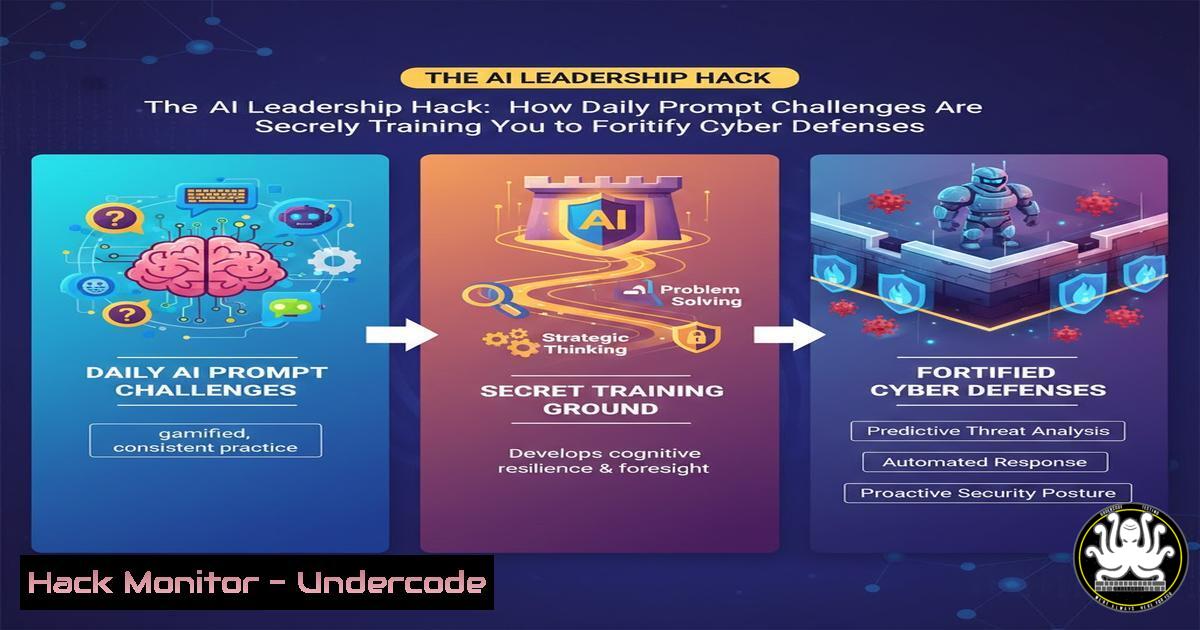
The intersection of artificial intelligence and leadership is no longer just about strategic decision-making; it’s a critical frontline in cybersecurity. As leaders engage with AI companions for personal development, they inadvertently cultivate skills that are essential for securing AI systems against sophisticated threats. This article explores how structured AI prompting exercises can transform leadership habits into robust security protocols, mitigating risks from data poisoning to adversarial attacks.
Learning Objectives:
- Understand the cybersecurity risks inherent in AI-assisted leadership tools and how to mitigate them.
- Learn practical prompt engineering techniques to enhance AI security and operational integrity.
- Implement step-by-step hardening measures for AI APIs, cloud services, and monitoring systems.
You Should Know:
- Securing AI APIs and Models from Injection Attacks
AI models used in leadership companions often rely on APIs that are vulnerable to prompt injection and data leakage. To prevent exploitation, leaders must ensure these interfaces are properly secured.
Step‑by‑step guide explaining what this does and how to use it:
– Step 1: Implement API Authentication and Rate Limiting
Use tokens like OAuth 2.0 and set rate limits to prevent brute-force attacks. For Linux, configure Nginx with:
sudo nano /etc/nginx/nginx.conf
 Add within http block:
limit_req_zone $binary_remote_addr zone=one:10m rate=1r/s;
location /api/ {
limit_req zone=one burst=5;
proxy_pass http://ai_model_backend;
}
– Step 2: Sanitize Input Prompts
Use Python to filter malicious inputs before processing:
import re
def sanitize_prompt(user_input):
 Remove potential injection patterns
cleaned = re.sub(r'[;\]|\&\$`]', '', user_input)
return cleaned[:500]  Limit length
– Step 3: Audit API Logs Regularly
On Windows, use PowerShell to monitor logs:
Get-EventLog -LogName Application -Source "AI-API" -Newest 100 | Where-Object {$_.EntryType -eq "Error"} | Export-Csv "api_audit.csv"
2. Prompt Engineering for Cybersecurity Threat Detection
Daily AI prompts can be tailored to simulate and identify security scenarios, enhancing threat awareness. This turns leadership reflection into proactive security training.
Step‑by‑step guide explaining what this does and how to use it:
– Step 1: Craft Prompts for Phishing Identification
Use an AI tool like OpenAI’s GPT to generate phishing email examples and analyze them. For instance:
"Generate a phishing email targeting a CEO, then list its red flags."
– Step 2: Integrate with Security Tools
Use Python to connect prompts to SIEM systems like Splunk:
import splunklib.client as client
service = client.connect(host='splunk_server', port=8089, username='admin', password='secure_pass')
search_query = 'search index=main "phishing" | stats count by source'
jobs = service.jobs.create(search_query)
– Step 3: Automate Response with Playbooks
Create an automated playbook using Ansible for Linux:
- name: Respond to AI-detected threat
hosts: localhost
tasks:
- name: Quarantine affected system
command: iptables -A INPUT -s {{ malicious_ip }} -j DROP
- name: Alert team
shell: echo "Threat detected from {{ malicious_ip }}" | mail -s "Alert" [email protected]
- Hardening Cloud AI Services Like AWS SageMaker and Azure ML
Leadership AI tools often leverage cloud platforms, which require hardening to prevent misconfigurations and data breaches.
Step‑by‑step guide explaining what this does and how to use it:
– Step 1: Encrypt Data at Rest and in Transit
In AWS, enable encryption for SageMaker notebooks:
aws sagemaker create-notebook-instance \
--notebook-instance-name "secure-ai" \
--instance-type ml.t2.medium \
--role-arn arn:aws:iam::account:role/role-name \
--kms-key-id alias/aws/sagemaker
– Step 2: Restrict Access with IAM Policies
Create a least-privilege policy in AWS IAM to limit access to AI resources.
– Step 3: Enable Logging and Monitoring
Use Azure CLI to set up monitoring for Azure Machine Learning:
az monitor diagnostic-settings create \
--resource "ml-workspace" \
--name "ai-security-logs" \
--storage-account "storaccount" \
--logs '[{"category": "AmlComputeClusterEvent", "enabled": true}]'
- Monitoring AI Systems for Adversarial Attacks and Model Drift
Continuous monitoring is essential to detect anomalies in AI behavior that could indicate security compromises.
Step‑by‑step guide explaining what this does and how to use it:
– Step 1: Set Up Anomaly Detection with Prometheus and Grafana
On Linux, deploy Prometheus to scrape AI model metrics:
wget https://github.com/prometheus/prometheus/releases/download/v2.45.0/prometheus-2.45.0.linux-amd64.tar.gz
tar xvfz prometheus-.tar.gz
cd prometheus-
./prometheus --config.file=prometheus.yml
– Step 2: Implement Model Drift Alerts
Use Python to calculate drift and trigger alerts:
from scipy import stats
import smtplib
def check_drift(new_data, baseline):
statistic, p_value = stats.ks_2samp(new_data, baseline)
if p_value < 0.05:
server = smtplib.SMTP('smtp.gmail.com', 587)
server.starttls()
server.login("user", "pass")
server.sendmail("[email protected]", "[email protected]", "Model drift detected!")
– Step 3: Regular Security Scanning
Use OWASP ZAP on Windows to scan AI web interfaces:
zap-cli quick-scan --self-contained --start-options "-config api.disablekey=true" http://ai-companion-app
- Implementing AI in Security Operations Centers (SOCs) for Leadership Insights
Leaders can use AI prompts to generate security reports and automate SOC tasks, improving response times.
Step‑by‑step guide explaining what this does and how to use it:
– Step 1: Automate Threat Intelligence Feeds
Use Python to fetch feeds and analyze with AI:
import requests
from transformers import pipeline
classifier = pipeline("text-classification", model="distilbert-base-uncased")
feed = requests.get("https://threatfeeds.io/api/data").json()
threats = classifier(feed['text'][:10])
– Step 2: Create AI-Driven Incident Response Scripts
For Linux, write a bash script that uses AI to prioritize incidents:
!/bin/bash
INCIDENT_DATA="$1"
AI_ANALYSIS=$(curl -X POST https://ai-api.com/predict -d "$INCIDENT_DATA")
if [[ "$AI_ANALYSIS" == "CRITICAL" ]]; then
systemctl start incident-response.service
fi
– Step 3: Train Teams with AI Simulations
Use tools like Caldera or Atomic Red Team to run simulated attacks guided by AI prompts.
- Training Teams on AI Security Through Daily Prompt Challenges
Incorporate cybersecurity themes into daily AI exercises, as seen in leadership companions, to build muscle memory for security protocols.
Step‑by‑step guide explaining what this does and how to use it:
– Step 1: Develop a Curriculum of Security Prompts
Create prompts like: “Simulate a DDoS attack response plan using AI-generated network diagrams.”
– Step 2: Use Virtual Labs for Hands-On Practice
Set up a Kubernetes cluster on Linux for training:
minikube start --driver=docker
kubectl create deployment ai-security-lab --image=cybersecurity/challenge
– Step 3: Assess Skills with Capture-the-Flag (CTF) Events
Host CTFs using platforms like HackTheBox, integrating AI tools for clue generation.
- Ensuring Ethical AI and Compliance with GDPR and ISO 27001
Leadership in AI requires adherence to ethical guidelines and regulations to avoid legal risks and biases.
Step‑by‑step guide explaining what this does and how to use it:
– Step 1: Conduct AI Bias Audits
Use IBM’s AI Fairness 360 toolkit in Python:
from aif360.datasets import BinaryLabelDataset
from aif360.metrics import ClassificationMetric
dataset = BinaryLabelDataset(df=your_data, label_names=['label'], protected_attribute_names=['gender'])
metric = ClassificationMetric(dataset, dataset, unprivileged_groups=[{'gender': 0}], privileged_groups=[{'gender': 1}])
print(metric.disparate_impact())
– Step 2: Implement Data Privacy Controls
On Windows, use BitLocker for encryption:
Enable-BitLocker -MountPoint "C:" -EncryptionMethod Aes256 -RecoveryPasswordProtector
– Step 3: Document Compliance with Frameworks
Maintain logs using scripts that align with ISO 27001 Annex A controls.
What Undercode Say:
- Key Takeaway 1: Daily AI prompting exercises, like those in leadership companions, are not just personal development tools; they are covert training grounds for cybersecurity situational awareness, teaching users to anticipate and mitigate AI-specific threats.
- Key Takeaway 2: The integration of AI into leadership practices necessitates a security-first approach, where prompt engineering and model hardening become as routine as financial audits or strategy sessions, preventing costly breaches.
Analysis: The post by Rob May highlights a growing trend: AI as a dual-use tool for leadership and security. While the focus is on reflective prompts, the underlying skills—critical thinking, pattern recognition, and system analysis—are directly transferable to cybersecurity operations. However, without explicit security measures, these AI companions can become attack vectors. Leaders must balance innovation with vigilance, ensuring that AI adoption does not compromise organizational integrity. The step-by-step guides provided here bridge that gap, turning everyday AI interactions into defensive shields.
Prediction:
In the next 2-3 years, AI-driven leadership tools will evolve to include embedded security modules, automatically scanning for threats and generating compliance reports. However, this will also attract advanced persistent threats (APTs) targeting AI models to manipulate decision-making. Organizations that proactively secure their AI ecosystems, using prompts for red-teaming and continuous monitoring, will gain a strategic advantage, turning AI into an immutable line of defense rather than a vulnerability.
▶️ Related Video (76% Match):
🎯Let’s Practice For Free:
IT/Security Reporter URL:
Reported By: Rpvmay Last – Hackers Feeds
Extra Hub: Undercode MoN
Basic Verification: Pass ✅


