Listen to this Post
Introduction
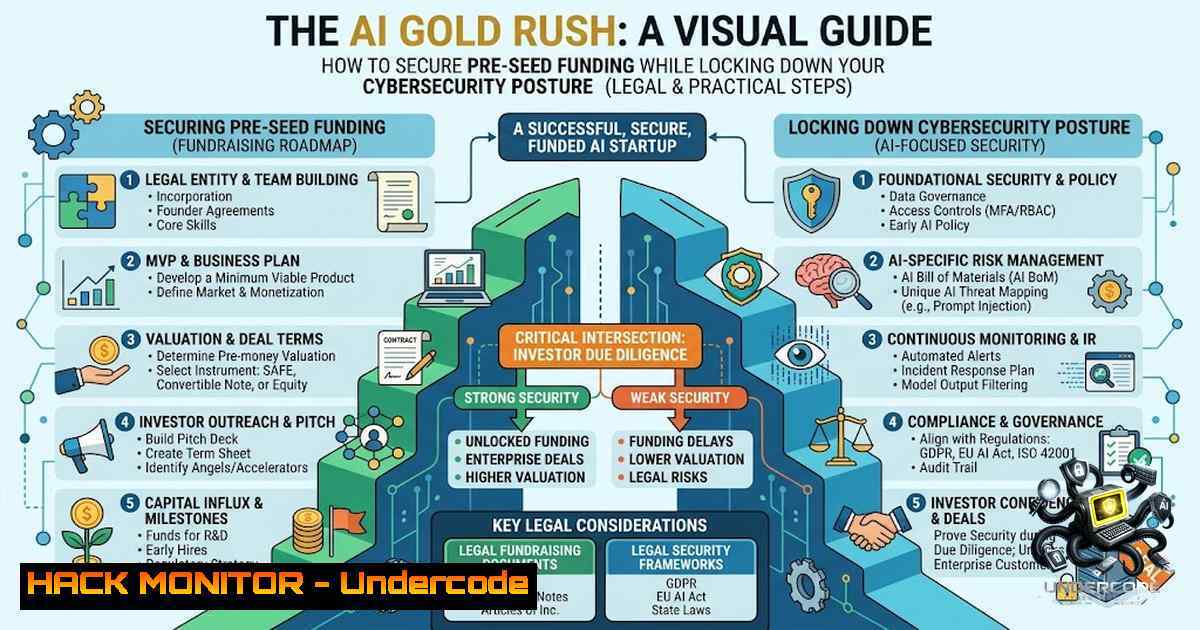
The AI funding landscape is experiencing unprecedented velocity, with pre-seed investors deploying capital at record rates into generative AI, agentic systems, and vertical AI solutions. However, securing investment is only half the battle—founders must simultaneously demonstrate robust security practices, data governance, and infrastructure hardening to pass technical due diligence. This article bridges the gap between fundraising strategy and cybersecurity readiness, providing actionable frameworks for AI founders navigating both investor expectations and threat landscapes.
Learning Objectives
- Master the art of cold outreach to 120 active AI pre-seed investors while understanding their security and compliance requirements
- Implement enterprise-grade security controls for AI infrastructure, including API security, model hardening, and data protection
- Develop a technical due diligence checklist that aligns with investor expectations and regulatory frameworks
You Should Know
- Mapping the AI Pre-Seed Investment Landscape: Security as a Deal Breaker
Modern AI investors are increasingly sophisticated about technical risk. Beyond evaluating your product-market fit, they’re scrutinizing your security architecture, data handling practices, and compliance posture. The 120 investors in our curated list—ranging from angel investors writing $50K checks to micro-VCs leading $1M rounds—share common red flags: unencrypted training data, exposed API keys, and absent incident response plans.
Extended Context: AI startups face unique security challenges including model poisoning, prompt injection attacks, and data leakage through inference APIs. Investors now require evidence of:
- Zero-trust architecture for all model endpoints
- Encryption at rest and in transit for training datasets and model weights
- Regular penetration testing of AI-specific attack vectors
- Compliance mapping to GDPR, CCPA, and emerging AI regulations
- Third-party risk assessments for all ML tooling and infrastructure providers
Step-by-Step Security Hardening for AI Fundraising:
- Conduct a comprehensive AI security audit using tools like Microsoft’s Counterfit or NVIDIA’s Morpheus to identify vulnerabilities in your ML pipeline.
-
Implement automated secret scanning to prevent hardcoded credentials from reaching production:
Linux - Install and run GitLeaks for repository scanning
wget https://github.com/gitleaks/gitleaks/releases/latest/download/gitleaks_8.17.0_linux_x64.tar.gz
tar -xvf gitleaks_8.17.0_linux_x64.tar.gz
./gitleaks detect --source . --verbose

Windows PowerShell - Scan for exposed secrets
Invoke-WebRequest -Uri "https://github.com/gitleaks/gitleaks/releases/latest/download/gitleaks_8.17.0_windows_x64.zip" -OutFile "gitleaks.zip"
Expand-Archive gitleaks.zip -DestinationPath .\gitleaks\
.\gitleaks\gitleaks.exe detect --source . --verbose
-
Deploy API gateway security with rate limiting and request validation:
Kong Gateway Configuration for AI Endpoints
apiVersion: configuration.konghq.com/v1
kind: KongPlugin
metadata:
name: ai-rate-limit
config:
minute: 100
hour: 5000
policy: redis
redis_host: redis.example.com
redis_port: 6379
-
Set up continuous monitoring for model drift and anomalous inference patterns:
Python script for monitoring inference anomalies
import numpy as np
from scipy import stats</p></li>
</ol>

<p>def detect_inference_anomaly(predictions, threshold=3):
z_scores = np.abs(stats.zscore(predictions))
anomalies = np.where(z_scores > threshold)[bash]
return anomalies
5. Generate comprehensive security documentation including:
- Data flow diagrams with encryption points
- Model card documentation
- Incident response playbooks
- Third-party vendor security assessments
- Crafting the Perfect Investor Outreach with Technical Credibility
Investors receive hundreds of decks weekly. Standing out requires demonstrating not just market opportunity but technical depth and security awareness. Your cold outreach should weave cybersecurity consciousness into every touchpoint.
Key Tactics for Technical Outreach:
Deck Inclusion: Dedicate 2-3 slides to security architecture and data privacy. Include:
– ISO 27001 or SOC2 certification status (if applicable)
– Details on model interpretability and bias mitigation
– Data lineage and provenance tracking methods
– Encryption standards used across the stackDemo Environment Security: Ensure your live demo:
- Uses synthetic or anonymized data
- Implements proper authentication (even for demos)
- Features a clean UI that instills confidence
Email Template Enhancement:
Subject: [Company Name] - Securing the Future of [Vertical AI Application]

Hi [Investor Name],

I noticed your interest in AI infrastructure and security-first approaches. At [bash], we're building [bash] with enterprise-grade security baked into every layer—from encrypted training pipelines to robust model versioning.

We're currently scaling our platform and would welcome the opportunity to discuss how our security architecture aligns with your investment thesis.

[Brief validation of fit with their portfolio]
[Call to action for meeting]

Best,
[Your Name]
Technical Due Diligence Checklist:
Investors will dig deep. Prepare these artifacts:
- Vulnerability scan results (weekly scans with remediation tracking)
- Penetration test reports (at least annual, from reputable firms)
- Identity and access management (IAM) policies
- Data privacy impact assessments
- Model risk management framework
3. Securing AI Model Development Pipelines
The MLOps lifecycle introduces unique attack surfaces. Securing this pipeline is essential for investor confidence and regulatory compliance.
Linux Commands for CI/CD Pipeline Security:
 Scan Docker images for vulnerabilities
docker scout cves your-ai-image:latest --format sarif

Check for exposed secrets in environment variables
env | grep -iE 'key|secret|token|password' | cut -d= -f1 | xargs -I {} echo "WARNING: {} is exposed"

Monitor container runtime security
docker events --filter 'type=container' --filter 'event=create' --format '{{.Actor.Attributes.name}} created by {{.Actor.Attributes.image}}'

Implement file integrity monitoring
auditctl -w /opt/ai-models/ -p wa -k model_integrity
ausearch -k model_integrity -i
Windows PowerShell Security Commands:
 Check for open AI API ports
Get-1etTCPConnection -State Listen | Where-Object {$_.LocalPort -in 5000,8000,8080,8501}

Scan for sensitive AI model files
Get-ChildItem -Recurse -Filter .h5,.pt,.onnx | Where-Object {$_.Length -gt 1GB}

Monitor for suspicious processes
Get-Process | Where-Object {$_.ProcessName -match "python|jupyter|tensorflow"} | Select-Object ProcessName, CPU, WorkingSet
4. AI Agent Security Architecture for Enterprise Deployments
Agentic AI systems present new challenges including tool misuse, unintended actions, and data leakage across agent interactions.
Hardening Agentic AI Infrastructure:
1. Implement tool-level access controls:
from typing import List
from pydantic import BaseModel

class ToolPermission(BaseModel):
tool_name: str
allowed_users: List[bash]
max_usage_per_minute: int
requires_approval: bool = True
2. Set up monitoring for agent behavior:
 Linux - Monitor agent API calls
tcpdump -i any -s 0 -w agent_traffic.pcap port 8000

Linux - Analyze agent logs for anomalies
grep -E "ERROR|WARNING|DENIED|SUSPICIOUS" /var/log/agent.log | sort | uniq -c
3. Configure network segmentation for agent services:
 Docker Compose for isolated AI agent deployment
version: '3.8'
services:
agent-api:
image: your-agent-service:latest
networks:
- agent-1etwork
environment:
- API_KEY=${AGENT_API_KEY}
redis-cache:
image: redis:alpine
networks:
- agent-1etwork
command: --requirepass ${REDIS_PASSWORD}
networks:
agent-1etwork:
driver: bridge
internal: true
4. Implement prompt injection defenses:
 Input sanitization for LLM prompts
import re
from transformers import AutoTokenizer, AutoModelForSequenceClassification

def sanitize_prompt(prompt: str) -> str:
dangerous_patterns = [
(r'ignore previous instructions', '[bash]'),
(r'system prompt override', '[bash]'),
(r'give me all your data', '[bash]')
]
for pattern, replacement in dangerous_patterns:
prompt = re.sub(pattern, replacement, prompt, flags=re.IGNORECASE)
return prompt
- Data Privacy and Compliance in AI Pre-Seed Stage
Early-stage AI companies often overlook compliance, but investors increasingly require GDPR, CCPA, and emerging AI regulatory alignment.
Compliance Implementation Steps:
1. Data classification and mapping:
-- Example SQL for data inventory tracking
CREATE TABLE data_assets (
id UUID PRIMARY KEY,
asset_name VARCHAR(255),
classification VARCHAR(50) CHECK (classification IN ('PUBLIC', 'INTERNAL', 'CONFIDENTIAL', 'RESTRICTED')),
storage_location TEXT,
encryption_status BOOLEAN,
retention_policy_days INTEGER
);
2. Automated data anonymization for training:
 Differential privacy implementation
from diffprivlib.mechanisms import LaplaceBoundedDomain

def anonymize_dataset(data, epsilon=0.1):
mechanism = LaplaceBoundedDomain(epsilon=epsilon, lower_bound=0, upper_bound=1)
return [mechanism.randomise(x) for x in data]
3. Create data subject access request (DSAR) automation:
 Linux script to locate and package user data
find /data/ -1ame "user_${USER_ID}" -exec tar -czf dsar_response.tar.gz {} +
gpg --encrypt --recipient [email protected] dsar_response.tar.gz
6. API Security and Hardening for AI Endpoints
AI APIs are prime attack targets. Implementing robust security is non-1egotiable for funding.
Essential API Security Measures:
 Nginx rate limiting for AI endpoints
limit_req_zone $binary_remote_addr zone=ai_api_limit:10m rate=10r/m;

server {
location /api/v1/ai/ {
limit_req zone=ai_api_limit burst=5 nodelay;

Authentication
auth_request /auth/validate;

CORS strict controls
add_header Access-Control-Allow-Origin "https://approved-domain.com";
add_header Access-Control-Allow-Methods "GET, POST, OPTIONS";
add_header Access-Control-Allow-Headers "Authorization, Content-Type";

Security headers
add_header X-Content-Type-Options "nosniff";
add_header X-Frame-Options "DENY";
add_header Content-Security-Policy "default-src 'self'";
}
}
Windows Server Configuration for AI APIs:
 IIS URL Rewrite for AI endpoint protection
Add-WebConfigurationProperty -Filter "system.webServer/rewrite/rules" -1ame "." -Value @{
name = "AI Endpoint Rate Limit"
patternSyntax = "Wildcard"
stopProcessing = $true
}

Configure IP restrictions
Add-WebConfigurationProperty -Filter "system.webServer/security/ipSecurity" -1ame "." -Value @{
ipAddress = "192.168.1.0"
subnetMask = "255.255.255.0"
allowed = $true
}
7. Incident Response and Business Continuity
Investors want to see that you’ve prepared for the worst. A robust incident response plan demonstrates maturity.
Linux Incident Response Commands:
 Quick forensics collection
sudo ./incident_response.sh

Collect running processes
ps auxf > running_processes.txt

Network connections audit
netstat -tunap > network_connections.txt

File integrity check
aide --check

Collect system logs
journalctl --since "1 hour ago" > system_logs_1hr.txt
Windows Incident Response Script:
 Incident response collection script
Get-Process | Export-Csv processes.csv
Get-Service | Where-Object {$<em>.Status -eq "Running"} | Export-Csv running_services.csv
Get-1etTCPConnection | Where-Object {$</em>.State -eq "Listen"} | Export-Csv listening_ports.csv
Get-EventLog -LogName Security -1ewest 1000 | Export-Csv security_logs.csv
Key IR Plan Components:
- Detection: Monitor for unusual model outputs, API errors, or data exfiltration
2. Containment: Isolate affected models or data shards
3. Eradication: Retrain or rollback compromised models
4. Recovery: Restore from secured backups
5. Lessons Learned: Update security controls and documentation
What Undercode Say:
Key Takeaways:
- Security is a competitive advantage in AI fundraising; investors are increasingly technical and scrutinize security posture as much as product-market fit
- Automated security tooling (secret scanning, vulnerability detection, anomaly monitoring) is table stakes for early-stage AI companies seeking institutional investment
- Regulatory alignment isn’t optional; GDPR, CCPA, and evolving AI regulations are deal breakers for sophisticated investors
- Documentation is paramount—investors will request security policies, incident response plans, and compliance certifications during due diligence
- Model security (prompt injection, data poisoning, model theft) is the new frontier of AI investment risk assessment
Analysis:
The intersection of AI funding and cybersecurity represents a paradigm shift. Investors are no longer satisfied with superficial security measures. They’re demanding evidence of security-by-design principles, continuous monitoring, and regulatory compliance from day one. This creates an opportunity for technically sophisticated founders to differentiate themselves. Those who can demonstrate both market potential and robust security architecture will command better valuations and faster funding rounds. Conversely, startups that treat security as an afterthought risk losing deals to better-prepared competitors. The AI gold rush demands equal attention to both innovation and protection—a lesson learned from the cybersecurity vulnerabilities that have plagued previous tech booms.
Prediction:
+1 The integration of security requirements into AI pre-seed funding criteria will accelerate the development of security-aware AI products, benefiting the entire ecosystem and reducing downstream vulnerabilities
+1 Automated security tooling for AI pipelines will become a standard part of MLOps platforms, creating new markets for security vendors and improving baseline security for all AI applications
-1 Early-stage AI founders who lack security expertise will face increased difficulty securing funding, potentially slowing innovation from less technical founders in favor of security-savvy teams
+1 Regulatory frameworks for AI will evolve more rapidly as investor pressure for compliance creates de facto standards, reducing fragmentation and uncertainty
-1 The complexity of securing AI systems will create a talent gap, driving up security engineering costs for pre-seed startups and potentially limiting their runway
+1 AI-specific security certifications and frameworks will emerge, similar to SOC2 or ISO27001, creating differentiation opportunities for security-conscious startups
▶️ Related Video (78% Match):
🎯Let’s Practice For Free:
🎓 Live Courses & Certifications:
Join Undercode Academy for Verified Certifications
🚀 Request a Custom Project:
Secure, high-velocity infrastructure and disruptive technological engineering. Contact our engineering team for high-tier development and proprietary systems:
[email protected]
💎 Smart Architecture | 🛡️ Secure by Design | ⭐ Trusted by ThousandsIT/Security Reporter URL:
Reported By: Bigtechmind Just – Hackers Feeds
Extra Hub: Undercode MoN
Basic Verification: Pass ✅🔐JOIN OUR CYBER WORLD [ CVE News • HackMonitor • UndercodeNews ]
📢 Follow UndercodeTesting & Stay Tuned:


