Listen to this Post
Introduction:
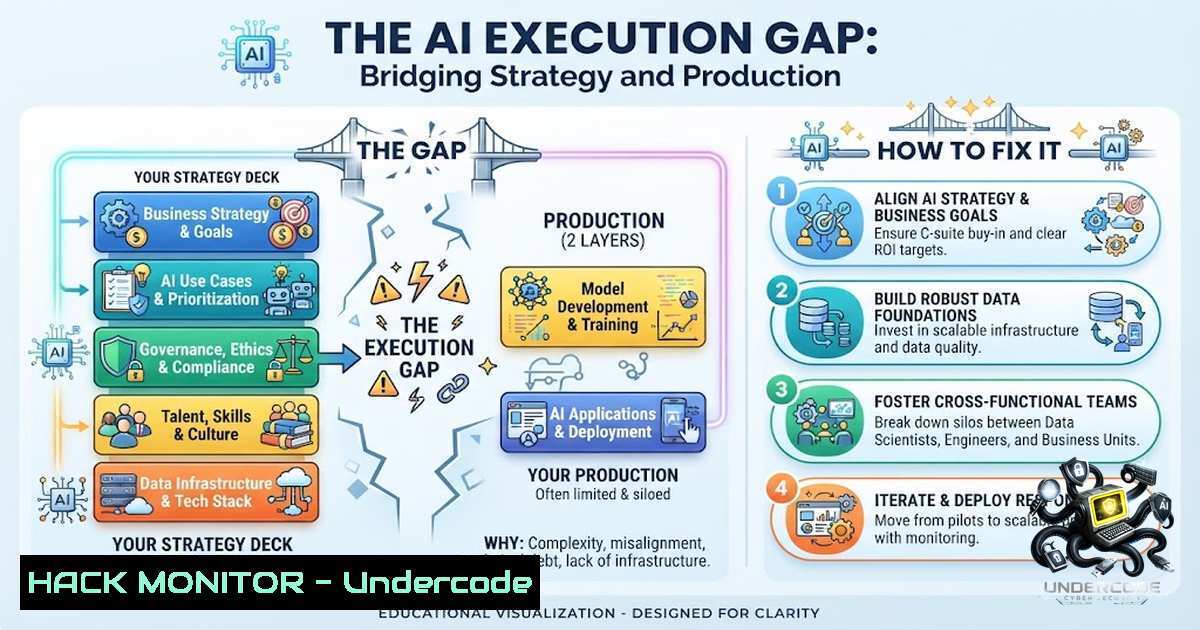
The gap between an AI strategy deck and actual production reality is one of the most expensive blind spots in enterprise technology today. While boards are captivated by 3.6 trillion-dollar market projections, the harsh truth is that most organizations can name five layers of AI sophistication but are only running two – and one of those has no clear owner. This disconnect, which we call the AI Execution Gap, is the difference between a beautiful menu and a functioning kitchen, and it’s where real value – or catastrophic failure – is made.
Learning Objectives:
- Understand the five distinct layers of the AI ecosystem and their real-world functions.
- Identify and measure the “AI Execution Gap” within your own organization.
- Implement a practical, step-by-step framework to bridge the gap with governance, ownership, and technical execution.
- Master the technical commands and security controls needed to move AI from slides to production.
You Should Know:
- The Five Layers of AI: From Data to Autonomy
Gabriel Millien’s framework breaks down the AI ecosystem into five deceptively simple layers. Here is what each one actually does:
- Layer 1: AI and Machine Learning. This is the foundation. It turns raw data into predictive decisions by learning patterns from the past to forecast the future.
- Layer 2: Deep Learning. The engine behind generative AI. This is what enables systems to write, recognize images, and understand speech at scale.
- Layer 3: Cognitive Computing. Where AI begins to understand context, not just keywords. It can pull the right document, answer from your knowledge base, and use external tools to complete tasks.
- Layer 4: Autonomous Systems. AI stops waiting for instructions and starts acting. It breaks a goal into steps, remembers past actions, and knows when to escalate to a human.
- Layer 5: Governance and Applications. The layer that decides if any of it is safe to run. This includes guardrails, human oversight, and a cryptographically verifiable record of every decision the system makes.
Step‑by‑step guide to mapping your own stack:
- Audit Your Current AI Inventory: List every AI/ML model, automation script, and data pipeline currently in production – not in pilot, not in PowerPoint.
- Classify by Layer: For each item, assign it to one of the five layers above. Be ruthless: if it doesn’t have live data flowing through it, it doesn’t count.
- Circle the Live Layers: Draw a circle around only the layers that are actually live today. Write one name beside each circle as the responsible owner.
- Identify the Gap: Everything outside those circles is not your ambition – it is your execution gap. That gap is the real roadmap.
-
The AI Execution Gap: Why Strategy Decks Lie
The visual projects the AI market reaching roughly $3.6 trillion by 2033. That number is why every board is leaning in. However, the wheel does not show the distance between naming these layers and actually running them.
Any company can say it wants autonomous AI. Running it safely, with oversight and a clear record, is a completely different thing. Any company can say it wants governance. Enforcing it on a system already making live decisions is a different job entirely. This pattern repeats even inside regulated Fortune 500 environments: the strategy deck has the whole wheel; the real business runs on two layers, and one of them has no clear owner.
How to identify your gap:
- Run a “live layer” audit in your next AI review.
- For every layer that is not live, document the specific technical, organizational, or security blockers preventing its deployment.
- Prioritize the gap by business impact: which missing layer costs you the most in missed revenue, risk, or inefficiency?
3. Bridging the Gap: Step-by-Step Implementation
Moving from a two-layer reality to a five-layer future requires a systematic approach. Here is a practical roadmap:
Step 1: Solidify the Data Foundation (Layer 1)
Without clean, accessible data, the upper layers are useless. Focus on building robust data pipelines.
– Linux Command (Data Pipeline Monitoring): Use `htop` and `iotop` to monitor system resources during data ingestion.
– Windows Command (Performance Monitoring): Use `Get-Counter` in PowerShell to track disk I/O and memory usage.
– Tool Configuration: Set up Apache Airflow or Prefect for workflow orchestration. Example `docker-compose.yml` snippet for Airflow:
version: '3'
services:
postgres:
image: postgres:13
environment:
POSTGRES_USER: airflow
POSTGRES_PASSWORD: airflow
POSTGRES_DB: airflow
webserver:
image: apache/airflow:2.7.0
command: webserver
ports:
- "8080:8080"
Step 2: Enable Deep Learning at Scale (Layer 2)
Transition from simple ML to deep learning requires GPU infrastructure and MLOps.
– Linux Command (GPU Monitoring): `nvidia-smi` to check GPU utilization and memory.
– Windows Command (GPU Monitoring): `nvidia-smi` also works in Windows with NVIDIA drivers.
– Tutorial: Set up a JupyterHub server with GPU support using Kubernetes. Use `kubectl` to deploy a TensorFlow or PyTorch operator.
Step 3: Implement Cognitive Context (Layer 3)
Deploy a Retrieval-Augmented Generation (RAG) pipeline.
- Code Snippet (Python with LangChain):
from langchain.vectorstores import Chroma
from langchain.embeddings import OpenAIEmbeddings
from langchain.chains import RetrievalQA
Load documents, split, embed, and store in vector DB
vectorstore = Chroma.from_documents(documents, OpenAIEmbeddings())
qa_chain = RetrievalQA.from_chain_type(llm=llm, retriever=vectorstore.as_retriever())
Step 4: Deploy Autonomous Agents (Layer 4)
Use frameworks like AutoGen or CrewAI to build multi-agent systems.
– Security Consideration: Always implement human-in-the-loop (HITL) for high-stakes actions. Use Pydantic for output validation to prevent prompt injection.
Step 5: Enforce Governance (Layer 5)
This is the most critical and most neglected layer.
– Linux Command (Audit Logging): Configure `auditd` to track access to model artifacts and data.
– Windows Command (Audit Logging): Use `auditpol` to set up system audit policies.
– Tool: Deploy MLflow for model tracking and Seldon Core or Kserve for model serving with built-in monitoring.
4. Governance and Ownership: The Missing Layer
The sharpest line in Millien’s post is that governance often has no clear owner. Oversight without an owner tends to get skipped rather than delayed.
Step‑by‑step guide to establishing AI governance:
- Appoint a Chief AI Officer (CAIO) or AI Governance Lead. This person is accountable for the entire lifecycle.
- Define Guardrails: Use Open Policy Agent (OPA) to define policies as code. Example policy to restrict model access:
package kubernetes.admission deny[bash] { input.request.kind.kind == "Pod" input.request.object.metadata.labels["ai-model"] == "true" not input.request.object.spec.securityContext.runAsNonRoot msg = "AI models must run as non-root" } - Implement a Decision Record: Use Amazon SageMaker Model Registry or Google Vertex AI Model Registry to track every model version, approval, and deployment.
- Run Regular Red-Teaming: Use tools like Counterfit or Adversarial Robustness Toolbox (ART) to test model vulnerabilities.
5. Technical Deep Dive: Production-Ready AI Stack
To truly bridge the gap, you need a stack that supports all five layers. Here is a recommended architecture:
- Orchestration: Kubernetes (k8s) with Argo Workflows for complex DAGs.
- Model Serving: Triton Inference Server or TensorFlow Serving with GPU acceleration.
- Monitoring: Prometheus + Grafana for metrics, and Jaeger for distributed tracing.
- Security: Istio for service mesh and mTLS, Vault for secret management.
Linux Commands for Stack Deployment:
 Install k3s (lightweight Kubernetes)
curl -sfL https://get.k3s.io | sh -
 Deploy Prometheus
kubectl create -f https://raw.githubusercontent.com/prometheus-operator/kube-prometheus/main/manifests/setup/prometheus-operator-0servicemonitorCustomResourceDefinition.yaml
 Check pod status
kubectl get pods --all-1amespaces
Windows Commands (using WSL2 or PowerShell):
 Install Chocolatey, then kubectl
choco install kubernetes-cli
 Set context
kubectl config use-context my-ai-cluster
6. Security and Compliance in AI Systems
Security must be woven into every layer, not bolted on at the end.
- API Security: Use OAuth2 and JWT for authentication. Implement rate limiting with NGINX or Envoy.
- Cloud Hardening: Follow the CIS Benchmarks for your cloud provider. Use aws cli or az cli to enforce bucket policies and IAM roles.
- Vulnerability Exploitation/Mitigation: Regularly scan container images with Trivy or Clair.
trivy image my-ai-model:latest --severity HIGH,CRITICAL
- Data Privacy: Implement differential privacy using PySyft or TensorFlow Privacy.
- Compliance: Align with GDPR, HIPAA, or SOC2 by maintaining an immutable audit log. Use Blockchain or AWS QLDB for tamper-proof records.
What Undercode Say:
- Key Takeaway 1: The “menu vs. kitchen” framing exposes a critical truth: naming a capability and operating it under real constraints are entirely different disciplines, yet boards often reward the former.
- Key Takeaway 2: The governance-has-1o-clear-owner point is the sharpest insight; that’s usually where the “two live layers” quietly stop, because oversight without an owner tends to get skipped rather than delayed.
Analysis:
The exercise of circling only what is live and naming an owner is deceptively simple but produces an extremely uncomfortable and useful slide. It forces leadership to confront the gap between aspiration and reality. In my experience building AI systems in regulated environments, focusing early on solid data pipelines and integration at the base layers can make or break downstream AI utility. Without that foundation, even the most sophisticated cognitive or autonomous layers will fail. The AI Execution Gap is not just a technical problem; it is an organizational one that requires clear ownership, rigorous security, and a culture that values execution over presentation.
Prediction:
- +1 Organizations that systematically address the AI Execution Gap will capture disproportionate value from the $3.6 trillion AI market, outperforming peers by 3x in ROI on AI investments.
- -1 Companies that continue to prioritize strategy decks over production reality will face catastrophic failures, including regulatory fines, data breaches, and reputational damage, as autonomous systems make ungoverned decisions.
- +1 The role of the Chief AI Officer will become as critical as the CISO, with governance and ownership becoming board-level agenda items within the next 18 months.
- -1 The gap between named layers and live layers will widen as generative AI hype accelerates, leading to a “bubble” of overpromised and underdelivered AI projects.
- +1 Open-source governance tools (e.g., OPA, MLflow) will mature and become the standard, democratizing AI safety and enabling smaller firms to compete.
- -1 Without clear owners, the governance layer will remain the most common point of failure, with 60% of AI breaches traced back to a lack of oversight and accountability.
- +1 The “circle and name” exercise will become a best practice in AI strategy, similar to incident response tabletop exercises, driving a new era of accountable AI.
- -1 The security debt from rushed AI deployments will take years to remediate, with many organizations forced to decommission entire systems due to unfixable vulnerabilities.
- +1 Regulatory frameworks (e.g., EU AI Act) will accelerate the adoption of governance layers, turning compliance into a competitive advantage for early adopters.
- +1 The AI Execution Gap will be recognized as the single most important metric for AI maturity, replacing vanity metrics like model accuracy or number of pilots.
▶️ Related Video (62% Match):
🎯Let’s Practice For Free:
🎓 Live Courses & Certifications:
Join Undercode Academy for Verified Certifications
🚀 Request a Custom Project:
Secure, high-velocity infrastructure and disruptive technological engineering. Contact our engineering team for high-tier development and proprietary systems:
[email protected]
💎 Smart Architecture | 🛡️ Secure by Design | ⭐ Trusted by Thousands
IT/Security Reporter URL:
Reported By: Gabriel Millien – Hackers Feeds
Extra Hub: Undercode MoN
Basic Verification: Pass ✅


