Listen to this Post
Introduction:
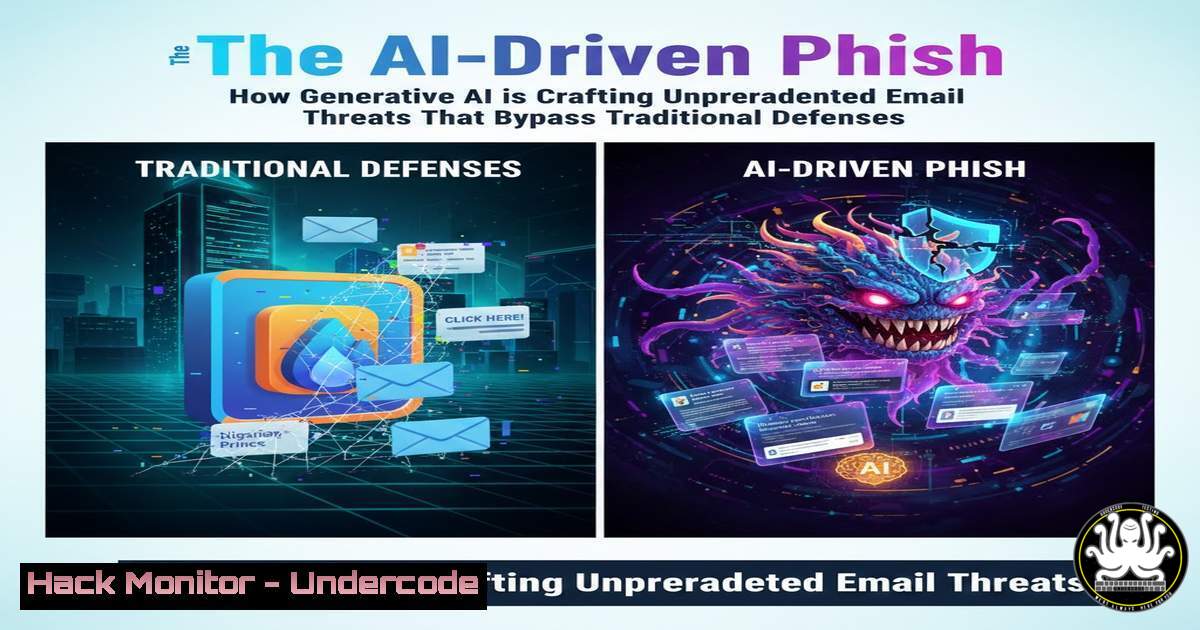
The cybersecurity landscape is facing a seismic shift as generative AI tools are weaponized to create hyper-personalized and linguistically flawless phishing emails at scale. This evolution moves beyond the crude, poorly-worded scams of the past, enabling threat actors to launch sophisticated Business Email Compromise (BEC) and credential harvesting campaigns that easily evade legacy spam filters and employee training based on recognizing “obvious” mistakes.
Learning Objectives:
- Understand the technical mechanisms AI uses to generate persuasive phishing content and automate target research.
- Learn to identify the subtle, new-generation indicators of compromise (IoCs) in AI-crafted communications.
- Implement a layered defense strategy combining technical controls, AI-aware training, and process hardening to mitigate this advanced threat.
You Should Know:
1. The Anatomy of an AI-Generated Phishing Campaign
AI-powered phishing operates on a dangerous feedback loop. Attackers use large language models (LLMs) to scrape and analyze public data from LinkedIn, corporate websites, and news releases to build detailed target profiles. This data then seeds the generation of context-aware emails.
Step-by-Step Guide:
Step 1: Reconnaissance Automation. Attackers use scripts with tools like `linkedin-email-scraper` (often found on GitHub) or paid APIs to gather target lists. A simple Python script using the `requests` and `beautifulsoup4` libraries can automate company blog scraping to understand recent projects and jargon.
Example Command (Ethical Use for Awareness):
`pip install requests beautifulsoup4`
import requests
from bs4 import BeautifulSoup
url = 'https://target-company.com/blog'
response = requests.get(url)
soup = BeautifulSoup(response.content, 'html.parser')
 Extract keywords from post titles
keywords = [tag.text for tag in soup.find_all('h2', class_='post-title')]
print("Scraped Context Keywords:", keywords)
Step 2: Content Generation. Using an LLM API (like OpenAI’s GPT or open-source alternatives), the attacker crafts a prompt: “Draft a concise, urgent email from the CFO,
, to the accounting team regarding a confidential, time-sensitive invoice. Use professional tone and reference recent Q3 initiatives." The output is a grammatically perfect, authoritative email.
 Step 3: Infrastructure Setup. AI is also used to generate variations of malicious domain names that resemble the target (e.g., <code>secure-payment-targetcorp[.]com</code>) and to create convincing landing page clones.

<ol>
<li>Detecting the Undetectable: New Indicators of Compromise (IoCs)
With spelling errors gone, defenders must pivot. New IoCs include anomalous sender behavior, hyper-personalization lacking a prior relationship, and subtle context dissonance.</li>
</ol>

<h2 style="color: yellow;">Step-by-Step Guide:</h2>

Step 1: Analyze Email Headers Meticulously. Use tools like `mxtoolbox.com` or command-line parsers to check <code>Return-Path</code>, <code>Received-SPF</code>, and `DKIM` alignment. An AI-crafted email from a lookalike domain will have header mismatches.

<h2 style="color: yellow;">Example Linux Command to View Headers:</h2>

<h2 style="color: yellow;">`cat email.eml | grep -E "(From|Return-Path|Received-SPF|DKIM)"`</h2>

Step 2: Implement DMARC Reporting. Ensure your domain has a DMARC policy (<code>p=reject</code> or <code>p=quarantine</code>) and monitor aggregate (<code>rua</code>) and forensic (<code>ruf</code>) reports. AI campaigns often fail DMARC alignment.
 Step 3: Behavioral Analysis. Train staff to question hyper-specific urgency, especially if the email references public info but implies a private context. Verify via a pre-established secondary channel (e.g., a phone call).

<h2 style="color: yellow;">3. Hardening Your Email Security Stack</h2>

Traditional signature-based gateways are insufficient. Layer in AI-defensive tools.

<h2 style="color: yellow;">Step-by-Step Guide:</h2>

Step 1: Deploy an API-based Email Security Solution. Solutions like Abnormal Security or Microsoft Defender for Office 365 use AI to establish behavioral baselines for every user, flagging anomalies in communication patterns that rules miss.
 Step 2: Configure Advanced Mail Flow Rules (Microsoft 365). Create rules in the Exchange Admin Center to flag external emails that contain high-confidence internal department names or project codenames scraped by AI.

<h2 style="color: yellow;">Example PowerShell Command to Check/Set Rules:</h2>

[bash]
Get-TransportRule  Review existing rules
New-TransportRule -Name "Flag External High-Risk Keywords" -FromScope "NotInOrganization" -SubjectOrBodyMatchesPatterns "Project Pegasus", "Confidential M&A" -SetHeaderName "X-Security-Level" -SetHeaderValue "Review"
Step 3: Enforce Multi-Factor Authentication (MFA) Universally. This is the critical final layer. AI phishing aims to steal credentials; MFA renders stolen passwords largely useless. Prioritize phishing-resistant MFA (FIDO2/WebAuthn).
4. Conducting AI-Aware Security Awareness Training
Update training modules. Move from “spot the typo” to “validate the request.”
Step-by-step Guide:
Step 1: Run Simulated AI-Phishing Campaigns. Use platforms like KnowBe4 to send AI-generated phishing simulations to your staff. Measure click rates and provide immediate, specific feedback.
Step 2: Teach Contextual Verification. Create a simple, non-punitive process: “If an email creates urgency or requests sensitive actions, forward it to the IT verification hotline or call the sender using a known number from the corporate directory.”
Step 3: Foster a “Question Everything” Culture. Reward employees for reporting suspicious emails, even if they turn out to be benign. This creates a human sensor network.
5. The Emergence of AI-on-AI Cybersecurity
The defense is now also leveraging AI. Security teams are using their own LLMs to analyze threat intelligence and automate response.
Step-by-Step Guide:
Step 1: Leverage SIEM/SOAR with AI Capabilities. Platforms like Splunk ES or Microsoft Sentinel use machine learning to detect anomalous login patterns and automate incident response playbooks.
Step 2: Implement YARA-L Rules for Cloud Logging. In Google Chronicle or similar, write YARA-L rules to detect sequences of events indicative of an AI-phishing success (e.g., login from new region → email forwarding rule creation → large file download).
Example YARA-L Rule Concept:
rule potential_ai_bec {
meta:
author = "SecurityTeam"
description = "Detects behavior chain after possible credential phishing"
events:
$e1.metadata.event_type = "USER_LOGIN"
$e1.principal.location.country != $e2.principal.location.country
$e2.metadata.event_type = "EMAIL_FORWARDING_RULE_CREATED"
$e3.metadata.event_type = "CLOUD_STORAGE_DOWNLOAD"
match:
$e1.principal.user.userid over 1h
condition:
$e1 and $e2 and $e3
}
What Undercode Say:
- The Arms Race is Asymmetric. Defenders must be right every time; attackers only need to succeed once. AI drastically lowers the skill and time barrier for attackers, enabling more frequent and higher-quality campaigns, while defense requires significant investment in new technology and training.
- Human Factors are Now the Primary Attack Surface. With technical lures becoming indistinguishable from legitimate communication, the human element—curiosity, fear of authority, desire to be helpful—is the exploit. Security culture and process are no longer secondary; they are the primary control.
Analysis: The integration of generative AI into the phishing kill chain represents not just an incremental change but a fundamental escalation. It democratizes advanced social engineering, allowing mid-tier threat actors to execute campaigns with the sophistication once reserved for APT groups. The defense strategy must evolve in tandem, moving from a perimeter-based, signature-reliant model to a behavioral, identity-centric, and layered approach. The most resilient organizations will be those that successfully fuse advanced AI-powered technical controls with a continuous, engaged, and empowered human firewall. The future of this conflict will likely see defensive AI automatically generating decoy credentials and systems to waste attacker resources, turning the attacker’s own tool against them.
Prediction:
In the next 12-24 months, we will see the rise of fully autonomous phishing campaigns driven by AI agents that can conduct multi-channel interactions (email, SMS, social media), adapt in real-time to victim responses, and maintain long-term engagement to build trust before striking. This will blur the line between automated attacks and human-driven persistence, necessitating the development of AI-powered deception defense grids and universal adoption of phishing-resistant FIDO2 authentication standards to prevent account takeover entirely.
▶️ Related Video (78% Match):
🎯Let’s Practice For Free:
IT/Security Reporter URL:
Reported By: Ligia Chac%C3%B3n – Hackers Feeds
Extra Hub: Undercode MoN
Basic Verification: Pass ✅


