Listen to this Post
Introduction
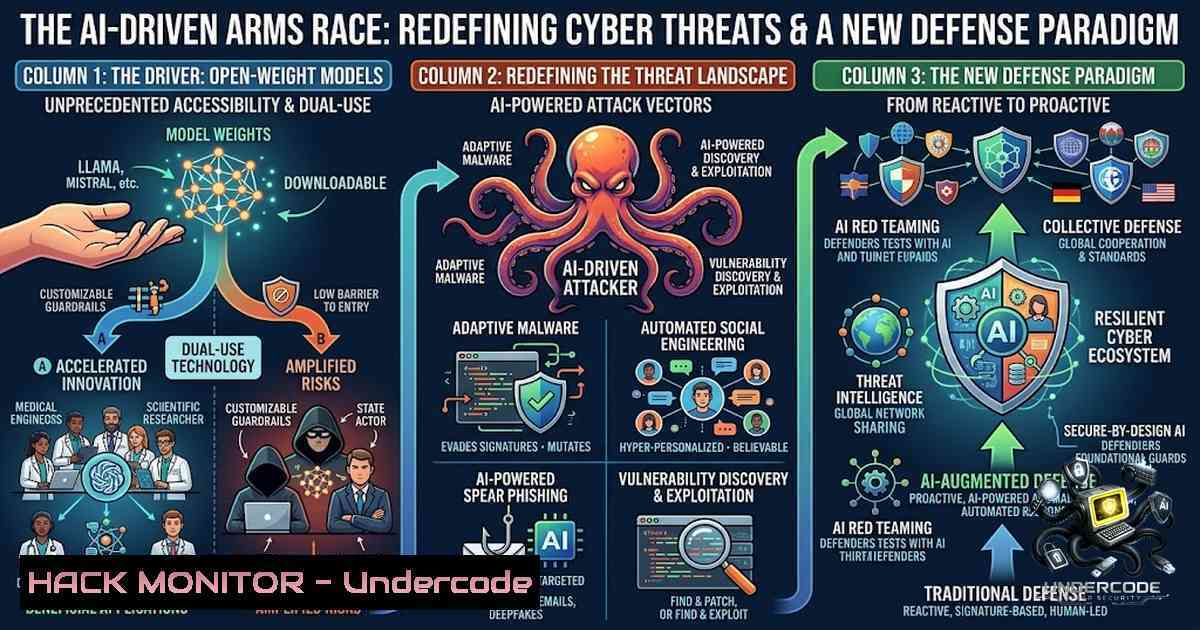
For the past year, technology leaders have congratulated themselves on implementing strict safety guardrails around closed frontier AI models. However, a massive flaw in that strategy now exists: threat actors are no longer trying to jailbreak closed LLMs—they have migrated to open-weight models, which they can run locally with zero oversight, no vendor logging, no cloud monitoring, and no safety guardrails preventing them from generating malicious code. This fundamental shift, highlighted by Accenture and Google Cloud researchers at the Black Hat USA conference, has accelerated an AI-driven arms race where traditional perimeter-based security is rendered obsolete.
Attackers now leverage open-weight models to rapidly develop zero-day exploits, automate identity theft, and maintain persistent access in corporate networks. Worse, they have fundamentally changed their entry tactics: instead of burning time trying to crack passwords, they use AI to steal session tokens, cookies, and OAuth IDs. They aren’t hacking past the perimeter—they are authenticating as legitimate users.
Learning Objectives
- Understand the threat landscape shift from closed to open-weight AI models and the implications for enterprise security
- Learn to detect and mitigate session token theft and AI-assisted identity-based attacks
- Implement defensive AI strategies and Zero Trust architectures to counter AI-powered threats
You Should Know
- The Open-Weight Model Threat: Why Traditional Guardrails Fail
Open-weight LLMs—including LLaMA, Mistral, and DeepSeek-R1—have triggered a “Cambrian explosion” of innovation, but they have also democratized offensive cyber capabilities. Recent evaluations, such as MITRE’s OCCULT framework, show that publicly available models can now achieve greater than 90% success rates on offensive cyber knowledge tests, enabling targeted phishing, malware polymorphism, and vulnerability discovery at scale.
The technical reality is that once a model is downloaded, safety filters can be trivially fine-tuned away. Uncensored fine-tunes of open-source LLMs, including WormGPT and FraudGPT, have already been operationalized as malicious services. In one documented case, an attacker trained the open-source Qwen 2.5 model for three months at a cost of less than $1,600 to write malware capable of evading Microsoft Defender. This demonstrates the dangerously low barrier to entry for adversaries.
What This Means for Defenders: Traditional security models that rely on centralized control—API gating, monitoring, and rate limiting—vanish the moment model weights are published. Organizations must assume that attackers have access to the same AI capabilities as defenders and plan accordingly.
- Session Token Theft: The New Attack Vector Bypassing MFA
Instead of stealing passwords, hackers have turned to stealing tokens, cookies, or session IDs, which allow them to bypass traditional security protocols. This represents a paradigm shift: adversaries no longer need to crack credentials when they can simply hijack active authenticated sessions.
The scope of this threat is substantial. Researchers recently decoded 315,320 reasoning blocks from 6,708 public agent trajectories and extracted 62 API keys, 33 passwords, and seven private keys—with one session in twenty leaking something real. A separate vulnerability report detailed how weaker AI models can decrypt hidden reasoning chains used by OpenAI, Anthropic, and Google, exposing API keys, passwords, and tokens.
Detection and Prevention Commands:
For Windows environments, security teams can use the following PowerShell commands to audit active sessions and detect anomalous token activity:
 List all active user sessions with token information
Get-WmiObject -Class Win32_LogonSession | Where-Object {$<em>.LogonType -eq 2 -or $</em>.LogonType -eq 10}

Check for unusual token privileges
whoami /priv

Audit Kerberos ticket activity
klist

Monitor for suspicious token creation events (Event ID 4624)
Get-WinEvent -FilterHashtable @{LogName='Security'; ID=4624} -MaxEvents 50 |
Select-Object TimeCreated, @{N='User';E={$<em>.Properties[bash].Value}},
@{N='LogonType';E={$</em>.Properties[bash].Value}},
@{N='SourceIP';E={$_.Properties[bash].Value}}
For Linux environments, use these commands to detect session anomalies:
 List all active user sessions
who -a

Check for unusual login patterns in auth logs
sudo grep "Accepted" /var/log/auth.log | tail -20

Monitor active SSH sessions
ss -tnp | grep ssh

Audit current user tokens and environment variables
env | grep -E "SESSION|TOKEN|AUTH"

Check for unusual process activity that might indicate token theft
ps aux --sort=-%mem | head -20
Step-by-Step Guide to Detecting Token Theft:
- Enable Comprehensive Logging: Configure Windows Event Logging (Security log) and Linux auditd to capture all authentication events, including success and failure logs.
- Implement Behavioral Analytics: Deploy tools that monitor post-authentication activity patterns, detecting subtle deviations that indicate account takeover even when credentials authenticate successfully.
- Deploy Session Monitoring: Use Okta’s Identity Threat Protection or similar solutions that can automatically purge compromised browser cookies and terminate hijacked sessions in near real-time.
- Configure Impossible Travel Detection: Implement geographic anomaly detection that flags when a session token is reused from geographically impossible locations within a short timeframe.
3. AI-Generated Malware and Polymorphic Threats
IBM’s X-Force threat intelligence team recently discovered an autonomously coded backdoor called Slopoly, which, while “relatively unspectacular,” signals a “fundamental shift of dynamics” in the threat environment. The malware enabled a hacker group to maintain access to a hacked server for more than a week, with the hackers’ instructions having “successfully circumvented” whatever security restrictions the AI model possessed.
LLM-generated malware alone is projected to account for 50% of detected threats in 2025. The concern is that AI’s increasing code-writing power might encourage hackers to generate new malware for every attack rather than repeatedly relying on the same carefully developed code—making it significantly more difficult to attribute attacks to specific actors.
Linux Command for Malware Detection and Analysis:
 Scan for recently modified suspicious files
find / -type f -mtime -7 -1ame ".sh" -o -1ame ".py" -o -1ame ".bin" 2>/dev/null

Check for unusual network connections
sudo netstat -tunap | grep ESTABLISHED

Monitor for unexpected cron jobs (common persistence mechanism)
crontab -l
sudo cat /etc/crontab
ls -la /etc/cron.

Analyze suspicious processes with VirusTotal integration (using clamscan)
sudo clamscan -r --bell -i /

Monitor file integrity with AIDE (Advanced Intrusion Detection Environment)
sudo aide --check
- The Zero Trust Imperative in an AI-Driven World
When adversaries use AI to compress attack cycles from weeks to minutes, manual incident response is equivalent to bringing a knife to a gunfight. Defensive AI is no longer optional—it is a necessity. The perimeter firewall is useless against stolen session tokens; if an adversary uses an open-source AI model to harvest active tokens, they bypass multi-factor authentication instantly.
Zero Trust principles must extend beyond network access control to email, collaboration platforms, and mobile communications. This means:
- Continuous Verification: Never trust, always verify—even for authenticated sessions
- Least Privilege Access: Limit token scope and lifetime aggressively
- Micro-segmentation: Isolate critical systems to limit lateral movement
- Real-time Behavioral Analysis: Use AI to detect anomalies in user and system behavior
Windows Group Policy Configuration for Zero Trust Session Management:
 Configure Kerberos ticket lifetime (maximum 10 hours)
Set-ADDefaultDomainPasswordPolicy -MaxServiceAge 10:00:00

Enforce smart card authentication for sensitive systems
 Configure via Group Policy: Computer Configuration > Windows Settings > Security Settings > Local Policies > Security Options

Enable verbose logging for all authentication events
auditpol /set /subcategory:"Logon" /success:enable /failure:enable
auditpol /set /subcategory:"Special Logon" /success:enable /failure:enable
auditpol /set /subcategory:"Other Logon/Logoff Events" /success:enable /failure:enable
5. Defensive AI: Building Autonomous Security Operations
Current cyber defense systems are mostly reactive—they only address threats after an initial compromise occurs. The solution lies in proactive defense frameworks that combine Large Language Models with Deep Reinforcement Learning to help predict and prevent threats.
AI-powered defense should incorporate:
- Behavior-based detection that moves from pattern matching to contextual analysis
- Automated alert triage that accelerates threat detection by analyzing and prioritizing alerts, reducing manual SOC workload
- Incident timeline generation that processes multi-source logs to create coherent attack timelines and map attacker actions to MITRE ATT&CK techniques
Linux Command for Automated Threat Hunting:
 Set up automated log analysis with fail2ban for real-time threat response
sudo apt-get install fail2ban
sudo systemctl enable fail2ban
sudo systemctl start fail2ban

Configure custom fail2ban jail for SSH brute force protection
sudo nano /etc/fail2ban/jail.local
 Add: [bash]
 enabled = true
 maxretry = 3
 bantime = 3600

Deploy OSSEC for comprehensive intrusion detection
 Monitor for file integrity changes, rootkit detection, and real-time alerting
What Undercode Say
- Key Takeaway 1: The shift from closed to open-weight AI models represents a fundamental threat vector change. Attackers now operate with zero oversight, running models locally to generate malware, discover vulnerabilities, and automate attacks at scale. Organizations must assume their adversaries have access to the same—or better—AI capabilities than their own security teams.
-
Key Takeaway 2: Session token theft has rendered traditional MFA and perimeter defenses obsolete. Attackers aren’t breaking in; they’re logging in as legitimate users. Defensive strategies must shift from preventing initial access to detecting and responding to post-authentication anomalous behavior through behavioral AI and continuous verification.
Analysis: The AI-driven arms race is not a future concern—it is happening now. The democratization of offensive AI capabilities through open-weight models has lowered the barrier to entry for threat actors to an unprecedented degree. The Slopoly malware discovery and the documented use of AI to develop working zero-day exploits demonstrate that we have crossed a critical threshold.
Organizations must urgently adopt defensive AI capabilities to match the speed and sophistication of AI-powered attacks. This means investing in autonomous security operations centers (SOCs), behavioral analytics, and Zero Trust architectures that continuously verify every access request. The traditional approach of relying on perimeter defenses and manual incident response is no longer viable when attackers can compress attack cycles from weeks to minutes.
The good news is that defensive AI is rapidly evolving. Frameworks combining LLMs with deep reinforcement learning, AI-powered threat detection for critical infrastructure, and autonomous cyber defense agents are emerging as viable countermeasures. However, these must be deployed with urgency. As IBM researchers noted, “the adversarial use of AI is accelerating—and it’s poised to significantly reshape the threat landscape, forcing defenders to fundamentally rethink today’s security paradigms”.
Prediction
+N The AI arms race will accelerate security innovation, forcing the development of more sophisticated defensive AI systems that can predict and prevent attacks before they occur—potentially leading to fully autonomous security operations within 3-5 years.
-1 The democratization of offensive AI capabilities through open-weight models will lead to a surge in AI-generated malware and zero-day exploits, overwhelming traditional security teams and creating a sustained period of heightened cyber risk.
+N Zero Trust architectures will become the de facto standard, with AI-driven continuous verification replacing traditional perimeter-based security models, creating more resilient enterprise security postures.
-1 The speed advantage AI gives attackers will outpace most organizations’ ability to adapt, particularly for small and medium-sized businesses lacking resources for advanced defensive AI, widening the cybersecurity gap.
-1 Regulatory responses, such as the EU AI Act, risk imposing compliance burdens on open-source developers without effectively preventing misuse, potentially stifling innovation while failing to address the core threat.
+N The security community’s response—including initiatives like MITRE’s OCCULT framework for evaluating offensive AI capabilities and NIST’s critical infrastructure AI security sprint—will create new standards and best practices that ultimately strengthen global cybersecurity resilience.
▶️ Related Video (74% Match):
🎯Let’s Practice For Free:
🎓 Live Courses & Certifications:
Join Undercode Academy for Verified Certifications
🚀 Request a Custom Project:
Secure, high-velocity infrastructure and disruptive technological engineering. Contact our engineering team for high-tier development and proprietary systems:
[email protected]
💎 Smart Architecture | 🛡️ Secure by Design | ⭐ Trusted by Thousands
IT/Security Reporter URL:
Reported By: https://lnkd.in/p/eksE-Qb9 – Hackers Feeds
Extra Hub: Undercode MoN
Basic Verification: Pass ✅


