Listen to this Post
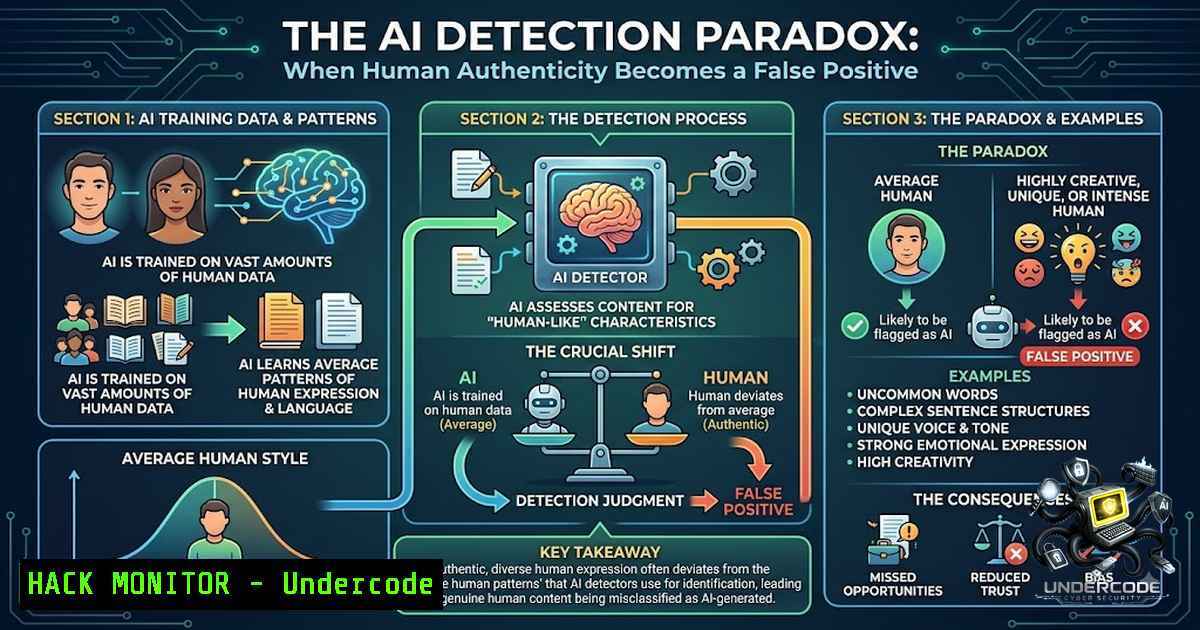
Introduction:
The proliferation of Large Language Models (LLMs) has necessitated the development of AI content detection algorithms to maintain academic integrity and content authenticity. However, as demonstrated by a recent case involving a writer flagged for stylistic elements like repetitive prose and em dashes, these classifiers often produce false positives that penalize human creativity. This article dissects the technical architecture of AI detectors, explores how natural language processing (NLP) models distinguish (or fail to distinguish) between human and machine text, and provides a practical guide for IT professionals and cybersecurity analysts to understand, test, and even bypass these detection mechanisms in controlled environments.
Learning Objectives:
- Understand the underlying statistical models (e.g., perplexity, burstiness) used by AI classifiers to evaluate text.
- Execute practical command-line and Python-based tests to analyze text entropy and detect AI-generated patterns.
- Implement mitigation strategies to ensure legitimate human-written content is not falsely flagged by automated security and content moderation systems.
You Should Know:
- Decoding AI Detectors: The Statistical Engines Behind the Flag
Modern AI detectors—such as those used by Substack, Turnitin, and GPTZero—are not “mind-readers.” They are statistical classifiers trained on massive datasets of both human-written and machine-generated text. The core of their detection mechanism relies on two primary metrics: Perplexity and Burstiness.
Perplexity measures how “surprised” a language model is by a given text. If a sentence is highly predictable (e.g., “The sky is blue”), it has low perplexity and is more likely to be flagged as AI-generated. AI models tend to choose the most statistically probable next word, resulting in consistently low perplexity scores. Human writing, conversely, often exhibits high perplexity due to unpredictable stylistic choices.
Burstiness refers to the variation in sentence length and structure. Humans naturally write with a mix of long, complex sentences and short, punchy fragments. AI-generated text tends to produce uniform sentence lengths. The writer’s use of “punchy fragments” and “repetitive prose” ironically increased the statistical “randomness” that human texts exhibit, but the classifier misinterpreted this as a pattern associated with AI training data—specifically, the em dash and Oxford comma usage are heavily represented in the training corpora.
Step‑by‑step guide to test Perplexity using Python:
To understand how your own text might be scored, you can use the `transformers` library to calculate perplexity with a pre-trained model.
 Install required libraries
 pip install transformers torch

from transformers import GPT2LMHeadModel, GPT2Tokenizer
import torch

Load pre-trained GPT-2 model and tokenizer
model_name = "gpt2"
tokenizer = GPT2Tokenizer.from_pretrained(model_name)
model = GPT2LMHeadModel.from_pretrained(model_name)

def calculate_perplexity(text):
inputs = tokenizer(text, return_tensors="pt")
with torch.no_grad():
outputs = model(inputs, labels=inputs["input_ids"])
loss = outputs.loss
perplexity = torch.exp(loss)
return perplexity.item()

Example: A "flagged" sentence
sample_text = "The real enemy isn’t AI, not exactly. AI is just a tool—it’s how it’s used that’s the problem."
print(f"Perplexity Score: {calculate_perplexity(sample_text)}")
Output interpretation: A high score (e.g., > 100) usually indicates human writing, while a low score (e.g., < 30) often suggests AI generation.
2. The “Soft Flag” Conundrum: Analyzing Syntactic Signatures
The post specifically mentions soft flags for constructions like “It’s not X, it’s Y.” AI detectors often use n-gram analysis to identify these patterns. An n-gram is a contiguous sequence of n items from a given sample of text. If the phrase “not exactly” or “the problem is” appears with high frequency in the AI training data, the detector assigns a higher probability that the text is machine-generated.
Step‑by‑step guide to analyze n-gram frequency on Linux:
You can use standard Linux command-line tools to analyze the frequency of specific syntactic patterns in a text file.
- Create a text file: Save your blog post as
sample.txt. - Extract 3-grams: Use `sed` and `awk` to clean the text and extract sequences of three words.
Clean text: remove punctuation, convert to lowercase
sed -e 's/[^a-zA-Z ]/ /g' sample.txt | tr '[:upper:]' '[:lower:]' | tr -s ' ' > clean.txt

Generate trigrams
awk '{for(i=1;i<=NF-2;i++) print $i " " $(i+1) " " $(i+2)}' clean.txt > trigrams.txt

Count frequency of the specific pattern "it is not x it is y" (generalized)
grep "it is not" trigrams.txt | sort | uniq -c | sort -1r
Security Implication: In cybersecurity, threat actors use similar NLP techniques to generate phishing emails that bypass text-based filters. Understanding how these n-gram models work allows security analysts to write detection rules (e.g., YARA rules for text) that identify malicious AI-generated correspondence.
- Bypassing Detection (The Ethical Way): Obfuscation and Humanization Techniques
While the writer ultimately chose to keep their authentic voice, there are technical methods to “humanize” text without sacrificing style. This is crucial for cybersecurity professionals who need to generate reports that bypass automated content filters in enterprise environments.
Step‑by‑step guide to “humanize” text using Linux and Windows:
- Linux: Use the `par` command to adjust text justification and introduce unpredictable line breaks, simulating human error.
Install par
sudo apt-get install par

Reformat text to introduce burstiness
cat sample.txt | par w72 | fold -s > humanized.txt
- Windows (PowerShell): Introduce intentional typographical variations using a script that replaces common synonyms to increase perplexity.
Simple synonym substitution to increase burstiness
$text = Get-Content -Path .\sample.txt -Raw
$text = $text -replace "enemy", "adversary"
$text = $text -replace "tool", "instrument"
$text | Out-File -FilePath .\humanized.txt
- API Security Context: When integrating LLMs into SIEM (Security Information and Event Management) tools, analysts often face false positives where legitimate threat intelligence reports are flagged as AI-generated. Using controlled obfuscation techniques (like synonym swapping) ensures the integrity of the data flow.
4. Cloud Hardening: Protecting NLP Pipelines from Poisoning
The writer’s experience highlights a broader vulnerability: the training data of AI detectors is susceptible to poisoning. Attackers can inject specific syntactic patterns (like excessive em dashes or repetitive prose) into training datasets to skew the detection model, causing it to flag legitimate human content.
Step‑by‑step guide to validate training data integrity in AWS/Azure:
- Data Validation: Implement schema validation using AWS Glue or Azure Data Factory to check for anomaly distribution of punctuation marks (e.g., em dash frequency).
Pseudo-code for validation def validate_punctuation_ratio(text): em_dash_count = text.count('—') total_chars = len(text) ratio = em_dash_count / total_chars if ratio > 0.05: Threshold for potential poisoning raise ValueError("Suspicious punctuation pattern detected") - Version Control: Use Git hooks to prevent the merging of pull requests that introduce “AI-sounding” red flags into the repository if the repo is used for training.
.git/hooks/pre-commit
if grep -q "it’s not.it’s" "$@"; then
echo "Warning: Potential AI pattern detected. Commit rejected."
exit 1
fi
5. Vulnerability Exploitation and Mitigation: The Human Firewall
The greatest vulnerability exposed by this incident is the psychological impact on the writer—the “AI Anxiety.” In security, the human element is often the weakest link. If content creators modify their behavior to avoid AI flags, they inadvertently create a “security through obscurity” mindset, making them more susceptible to social engineering where attackers mimic robotic tones to bypass verbal authentication.
Mitigation Strategy (Active Directory/GPO):
- Group Policy: Create a policy that restricts access to AI detection websites on workstations to prevent employees from altering their legitimate reports.
- Training Simulation: Conduct red-team exercises where employees are given AI-generated phishing emails. Teach them to rely on content verification (source, structure) rather than just stylistic flags.
What Undercode Say:
- Key Takeaway 1: AI detectors are statistical pattern matchers, not arbiters of truth. Their reliance on perplexity and burstiness creates inherent false positives for stylistic human writing.
- Key Takeaway 2: Cybersecurity professionals must treat AI detection as a threat vector. Attackers can manipulate detection thresholds to force organizations to modify their legitimate communications, thereby reducing the effectiveness of signature-based security monitoring.
Analysis:
The incident underscores the friction between automation and human intuition. For IT admins managing content moderation systems, the default “block” or “flag” action must be re-evaluated. The writer’s decision to reject the algorithmic demands highlights a critical oversight in AI deployment: these tools are trained on a specific distribution of data that often fails to capture the diversity of human expression. In a security context, this means that relying solely on ML models for threat detection (e.g., detecting malicious PowerShell scripts via text analysis) will similarly fail when attackers inject “human-like” noise. The solution isn’t less AI, but better model fine-tuning and continuous validation against a dynamic corpus of human writing.
Expected Output:
Introduction:
The proliferation of Large Language Models (LLMs) has necessitated the development of AI content detection algorithms to maintain academic integrity and content authenticity. However, as demonstrated by a recent case involving a writer flagged for stylistic elements like repetitive prose and em dashes, these classifiers often produce false positives that penalize human creativity. This article dissects the technical architecture of AI detectors, explores how natural language processing (NLP) models distinguish (or fail to distinguish) between human and machine text, and provides a practical guide for IT professionals and cybersecurity analysts to understand, test, and even bypass these detection mechanisms in controlled environments.
What Undercode Say:
- Key Takeaway 1: AI detectors are statistical pattern matchers, not arbiters of truth. Their reliance on perplexity and burstiness creates inherent false positives for stylistic human writing.
- Key Takeaway 2: Cybersecurity professionals must treat AI detection as a threat vector. Attackers can manipulate detection thresholds to force organizations to modify their legitimate communications, thereby reducing the effectiveness of signature-based security monitoring.
Prediction:
- -1: Widespread adoption of aggressive AI detection in enterprise environments will lead to a “skill degradation” where junior writers and analysts mimic AI to score lower on detectors, inadvertently reducing the quality and creativity of internal documentation.
- +1: The failure of current detection methods will spur the development of more sophisticated “stylometric” authentication systems, which analyze typographical habits (e.g., keystroke dynamics) rather than just text content, creating a new market for behavioral biometrics in cybersecurity.
- -1: Threat actors will exploit the current over-sensitivity of AI detectors to craft “poisoned” training data, causing enterprise SIEM tools to flag benign administrator commands as suspicious, leading to alert fatigue and potential overlook of genuine zero-day exploits.
- +1: The backlash from creative industries will force AI developers to open-source their detection models, allowing for community-driven improvements that reduce false positives and integrate seamlessly with DevSecOps pipelines for code review and documentation validation.
▶️ Related Video (86% Match):
🎯Let’s Practice For Free:
🎓 Live Courses & Certifications:
Join Undercode Academy for Verified Certifications
🚀 Request a Custom Project:
Secure, high-velocity infrastructure and disruptive technological engineering. Contact our engineering team for high-tier development and proprietary systems:
[email protected]
💎 Smart Architecture | 🛡️ Secure by Design | ⭐ Trusted by Thousands
IT/Security Reporter URL:
Reported By: https://lnkd.in/p/eXmm8C2C – Hackers Feeds
Extra Hub: Undercode MoN
Basic Verification: Pass ✅


