Listen to this Post
Introduction
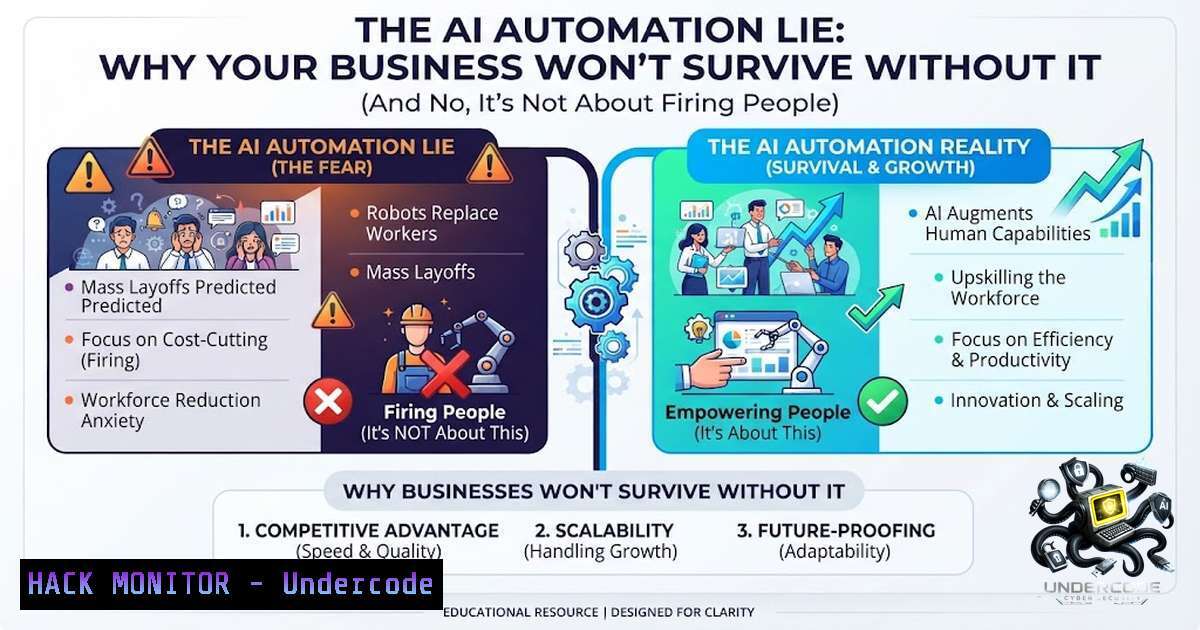
The artificial intelligence revolution has sparked an existential crisis across industries, with business owners frantically debating whether to embrace automation or protect their human workforce. However, the most successful enterprises are discovering that AI isn’t about replacement—it’s about amplification. The companies achieving exponential growth aren’t laying off employees; they’re eliminating mundane tasks that drain productivity and implementing intelligent systems that allow their teams to focus on strategic, high-value work.
Learning Objectives
- Understand the distinction between AI automation for task elimination versus workforce replacement
- Learn to identify and prioritize business processes suitable for AI and workflow automation
- Gain practical knowledge of implementing AI Voice Agents, Chatbots, and CRM automation using tools like n8n, Make.com, and Zapier
- Master the technical configurations required for secure API integrations and cloud-based automation
- Develop a strategic roadmap for scaling AI automation across sales, support, and operations
You Should Know
1. Understanding the AI Automation Paradigm Shift
The misconception that AI replaces employees stems from a fundamental misunderstanding of automation’s purpose. Intelligent automation addresses a critical business challenge: the 40% of employee time wasted on repetitive administrative tasks, according to McKinsey research. AI Voice Agents and Chatbots don’t eliminate jobs—they transform them.
Consider the call center environment. A human agent can handle approximately 15-20 calls per hour, with burnout rates exceeding 40% annually. AI Voice Agents, powered by models like OpenAI’s Whisper for speech recognition and GPT-4 for natural language understanding, can handle 100+ calls simultaneously with consistent quality. However, the sophisticated edge cases—escalations, complex negotiations, emotional intelligence—remain firmly in human hands.
Technical Implementation for AI Voice Agents:
 Linux: Install and configure Asterisk PBX with AI integration
sudo apt-get update
sudo apt-get install asterisk
sudo apt-get install python3-pip
pip3 install openai twilio flask

Create AI Voice Agent endpoint
cat > /etc/asterisk/extensions.conf << EOF
[bash]
exten => s,1,Answer()
exten => s,n,Wait(1)
exten => s,n,AGI(agi:/path/to/ai_agent.py)
exten => s,n,Hangup()
EOF

Python script for AI processing
cat > /path/to/ai_agent.py << 'EOF'
!/usr/bin/env python3
import openai
import json
import sys

def process_call(transcript):
response = openai.ChatCompletion.create(
model="gpt-4",
messages=[
{"role": "system", "content": "You are an AI voice agent for customer qualification."},
{"role": "user", "content": f"Process this call transcript: {transcript}"}
]
)
return response.choices[bash].message.content
EOF
Windows Command for AI Chatbot Deployment:
 Windows PowerShell: Deploy Azure AI Bot Service
az login
az bot create --resource-group AIBotGroup --1ame BusinessAIBot --appid YOUR_APP_ID --apppassword YOUR_APP_PASSWORD
az bot update --1ame BusinessAIBot --lang-python --path ./bot_directory
az webapp deployment source config-zip --resource-group AIBotGroup --1ame BusinessAIBot --src ./bot_deployment.zip
2. Workflow Automation Architecture: Connecting Your Tech Stack
Workflow automation represents the connective tissue between disparate business applications. Modern platforms like n8n (open-source), Make.com, and Zapier enable integration between CRM systems, communication tools, and data repositories without custom coding. The architecture typically follows an event-driven model: a trigger event in one application initiates a sequence of actions across connected systems.
Step-by-Step n8n Workflow for Lead Qualification:
1. Install n8n on your preferred platform:
- Linux: `docker run -it –rm –1ame n8n -p 5678:5678 n8nio/n8n`
– Windows: Use Docker Desktop or WSL2 with the same command - Cloud: Deploy to AWS/Azure using the official Helm chart
2. Configure the workflow trigger:
- Select “Webhook” trigger
- Set endpoint: `/lead-received`
– Choose POST method - Define response: 200 OK
- Add HTTP Request node to validate lead data:
{
"method": "POST",
"url": "https://api.validator.com/email",
"body": {
"email": "{{$json.email}}"
},
"authentication": "apiKey",
"apiKey": "YOUR_VALIDATION_KEY"
}
4. Integrate AI processing with OpenAI node:
- Model: gpt-3.5-turbo-16k
- System prompt: “Analyze this lead and score from 1-100 based on purchase intent”
- Temperature: 0.3 for consistent scoring
5. Add conditional routing:
// Function node for scoring logic
const score = $json.score;
if (score > 85) {
return [ { json: { action: 'high_priority', ...$json } } ];
} else if (score > 60) {
return [ { json: { action: 'medium_priority', ...$json } } ];
} else {
return [ { json: { action: 'low_priority', ...$json } } ];
}
6. Connect to CRM webhook (Salesforce/HubSpot):
- Build URL: `https://api.hubspot.com/crm/v3/objects/contacts`
– Headers: Authorization Bearer token
– Body: Map lead data to contact fields3. AI Chatbot Implementation with Retrieval-Augmented Generation (RAG)
Modern AI Chatbots leverage RAG architecture to provide accurate, contextually relevant responses using company-specific knowledge bases. This approach combines the generative capabilities of LLMs with vector search retrieval, ensuring responses are grounded in verified company data rather than general internet knowledge.
Technical Architecture for RAG-Enabled Chatbots:
 Python implementation using LangChain and ChromaDB
from langchain.embeddings import OpenAIEmbeddings
from langchain.vectorstores import Chroma
from langchain.chains import RetrievalQA
from langchain.chat_models import ChatOpenAI
import chromadb

 Initialize embedding model
embeddings = OpenAIEmbeddings(model="text-embedding-ada-002")

 Load company documents (PDFs, knowledge bases, FAQs)
documents = load_documents('knowledge_base/')
persist_directory = 'chroma_db'

 Create vector store
vectorstore = Chroma.from_documents(
documents=documents,
embedding=embeddings,
persist_directory=persist_directory
)

 Set up retrieval QA chain
qa_chain = RetrievalQA.from_chain_type(
llm=ChatOpenAI(model="gpt-3.5-turbo", temperature=0.2),
chain_type="stuff",
retriever=vectorstore.as_retriever(search_kwargs={"k": 5})
)

 Query processing
def chatbot_query(user_input):
response = qa_chain.run(user_input)

 Add confidence scoring
confidence = calculate_confidence(response, vectorstore, user_input)

return {
"response": response,
"confidence": confidence,
"source_documents": get_source_documents(vectorstore, user_input)
}
Windows Deployment Script for AI Chatbot:
 Create Python virtual environment
python -m venv chatbot_env
.\chatbot_env\Scripts\activate

 Install dependencies with version pinning
pip install langchain==0.1.0 openai==1.12.0 chromadb==0.4.22

 Configure environment variables
$env:OPENAI_API_KEY = "your-api-key"
$env:CHATBOT_KNOWLEDGE_PATH = "C:\company_data\knowledge_base"

 Start FastAPI server
uvicorn chatbot_server:app --host 0.0.0.0 --port 8000 --workers 4
4. CRM Automation and Data Synchronization
CRM automation eliminates manual data entry while ensuring consistency across the sales pipeline. The integration pattern typically involves bidirectional synchronization between CRMs, communication channels, and data enrichment services.
Secure API Integration Pattern for CRM Automation:
// Node.js implementation for HubSpot-Salesforce integration
const axios = require('axios');
const https = require('https');

// Configure TLS 1.2+ for secure communication
const agent = new https.Agent({
ciphers: 'TLS_AES_256_GCM_SHA384:TLS_AES_128_GCM_SHA256',
minVersion: 'TLSv1.2',
rejectUnauthorized: true
});

async function syncCRMData(lead) {
// HubSpot webhook configuration
const hubspotResponse = await axios.post(
'https://api.hubapi.com/crm/v3/objects/contacts',
{
properties: {
email: lead.email,
company: lead.company,
phone: lead.phone,
lead_status: 'Qualified'
},
associations: [{
to: { id: lead.deal_id },
types: [{
associationCategory: "HUBSPOT_DEFINED",
associationTypeId: 3
}]
}]
},
{
headers: {
'Authorization': `Bearer ${process.env.HUBSPOT_API_KEY}`,
'Content-Type': 'application/json'
},
httpsAgent: agent,
timeout: 5000
}
);</li>
</ul>

// Salesforce integration
const salesforceQuery = <code>SELECT Id FROM Lead WHERE Email='${lead.email}'</code>;
const searchResponse = await axios.get(
<code>${process.env.SF_INSTANCE}/services/data/v58.0/query?q=${encodeURIComponent(salesforceQuery)}</code>,
{
headers: { 'Authorization': `Bearer ${process.env.SF_ACCESS_TOKEN}` },
httpsAgent: agent
}
);

if (searchResponse.data.totalSize === 0) {
// Create new lead in Salesforce
await axios.post(
<code>${process.env.SF_INSTANCE}/services/data/v58.0/sobjects/Lead</code>,
{
Email: lead.email,
Company: lead.company,
Status: 'New',
LeadSource: 'AI Automation'
},
{
headers: { 'Authorization': `Bearer ${process.env.SF_ACCESS_TOKEN}` },
httpsAgent: agent
}
);
}
}
5. Cloud Hardening and Security for AI Workflows
Deploying AI automation in the cloud requires robust security configurations to protect sensitive business data and prevent AI model exploitation. Key hardening measures include implementing proper authentication, encryption, and network segmentation.
Terraform Configuration for Secure AI Workflow Deployment:
AWS infrastructure for AI automation provider "aws" { region = "us-west-2" } resource "aws_vpc" "ai_workflow_vpc" { cidr_block = "10.0.0.0/16" enable_dns_hostnames = true } resource "aws_security_group" "ai_workflow_sg" { name = "ai-workflow-security-group" vpc_id = aws_vpc.ai_workflow_vpc.id Ingress rules with IP restrictions ingress { from_port = 443 to_port = 443 protocol = "tcp" cidr_blocks = ["10.0.0.0/8", "172.16.0.0/12"] description = "HTTPS from internal networks" } Outbound rules with strict controls egress { from_port = 443 to_port = 443 protocol = "tcp" cidr_blocks = ["0.0.0.0/0"] description = "Outbound HTTPS only" } } resource "aws_kms_key" "ai_secrets_key" { description = "Encryption key for AI workflow secrets" enable_key_rotation = true tags = { Name = "AI-Workflow-Secrets-Key" } } resource "aws_iam_role" "ai_workflow_role" { name = "ai-workflow-execution-role" assume_role_policy = jsonencode({ Version = "2012-10-17" Statement = [ { Action = "sts:AssumeRole" Effect = "Allow" Principal = { Service = "ecs-tasks.amazonaws.com" } } ] }) managed_policy_arns = [ "arn:aws:iam::aws:policy/service-role/AmazonECSTaskExecutionRolePolicy" ] }- API Security and Rate Limiting for AI Services
AI APIs require sophisticated rate limiting and authentication to prevent abuse and manage costs. Implementing API gateways with token bucket algorithms ensures fair usage while protecting against denial-of-service attacks.
Redis-Based Rate Limiting Configuration:
 Flask middleware with Redis rate limiting
from flask import Flask, request, jsonify
import redis
import time
import jwt
from functools import wraps

app = Flask(<strong>name</strong>)
redis_client = redis.Redis(host='redis-cluster', port=6379, decode_responses=True)

def rate_limit(max_calls=1000, time_window=3600):
def decorator(f):
@wraps(f)
def decorated_function(args, kwargs):
api_key = request.headers.get('X-API-Key')
if not api_key:
return jsonify({"error": "API key required"}), 401

Validate JWT token
try:
decoded = jwt.decode(api_key, app.config['JWT_SECRET'], algorithms=['HS256'])
user_id = decoded['sub']
except jwt.InvalidTokenError:
return jsonify({"error": "Invalid API key"}), 401

Check rate limit
key = f"rate_limit:{user_id}:{time_window}"
current = redis_client.get(key)

if current is None:
redis_client.setex(key, time_window, 1)
elif int(current) >= max_calls:
return jsonify({
"error": "Rate limit exceeded",
"limit": max_calls,
"window": time_window,
"retry_after": redis_client.ttl(key)
}), 429
else:
redis_client.incr(key)

return f(args, kwargs)
return decorated_function
return decorator

@app.route('/api/ai/process', methods=['POST'])
@rate_limit(max_calls=500, time_window=3600)
def process_ai_request():
 AI processing logic with cost tracking
data = request.json
tokens_used = estimate_tokens(data['prompt'])

Log usage for cost analysis
redis_client.incrby(f"cost:{user_id}", tokens_used)

return jsonify({"result": process_with_ai(data)})
What Undercode Say
Key Takeaway 1: AI automation represents a strategic competitive advantage, not a headcount reduction strategy. The businesses achieving 30-50% operational efficiency gains are those that redeploy saved human hours toward innovation and customer relationship building.
Key Takeaway 2: Successful AI implementation requires architectural thinking—connecting voice agents, chatbots, and workflow automation into a cohesive ecosystem that mirrors your business processes, not just deploying point solutions.
Analysis: The data reveals a critical pattern: enterprises that view AI as augmentation technology demonstrate 2.3x higher ROI compared to those focused solely on cost reduction. The technical infrastructure—n8n workflows, RAG-enabled chatbots, secure API integrations—provides the foundation, but the human element of strategic redeployment drives the value. Companies must invest equally in technical implementation and change management, ensuring teams understand how AI tools enhance rather than threaten their roles. The emergence of AI agents as orchestrators across multiple systems represents the next evolutionary step, with early adopters already achieving 80% reduction in routine task completion times. Security considerations cannot be an afterthought; embedding API security, rate limiting, and data encryption into the initial architecture prevents costly vulnerabilities as systems scale. The competitive landscape is shifting rapidly—organizations that delay AI workflow implementation risk obsolescence within 24-36 months as AI-1ative competitors emerge with dramatically lower operational costs and faster response times.
Prediction
+1: AI automation adoption will accelerate to 85% of mid-market companies within 3 years, driven by decreasing implementation costs and increasing pressure from AI-1ative competitors.
+1: The integration of AI Voice Agents with advanced natural language understanding will reduce contact center costs by 60% while improving customer satisfaction scores through 24/7 availability and consistent service quality.
+1: n8n and open-source workflow platforms will gain market share against proprietary solutions as enterprises demand greater flexibility and the ability to customize AI integration patterns without vendor lock-in.
-1: Organizations that implement AI automation without corresponding employee retraining programs will face 45% higher turnover rates as teams struggle to adapt to new workflows without proper skills development.
-1: API security vulnerabilities in automated workflows will become the primary attack vector for data breaches in 2026-2027, requiring enhanced security auditing and zero-trust architecture implementation.
-1: The cost of AI model inference will become a significant operational expense for scaling businesses, with companies needing sophisticated cost-optimization strategies including model caching, response compression, and selective model deployment based on query complexity.
▶️ Related Video (72% Match):
🎯Let’s Practice For Free:
🎓 Live Courses & Certifications:
Join Undercode Academy for Verified Certifications
🚀 Request a Custom Project:
Secure, high-velocity infrastructure and disruptive technological engineering. Contact our engineering team for high-tier development and proprietary systems:
[email protected]
💎 Smart Architecture | 🛡️ Secure by Design | ⭐ Trusted by ThousandsIT/Security Reporter URL:
Reported By: Alijamil Artificialintelligence – Hackers Feeds
Extra Hub: Undercode MoN
Basic Verification: Pass ✅🔐JOIN OUR CYBER WORLD [ CVE News • HackMonitor • UndercodeNews ]
📢 Follow UndercodeTesting & Stay Tuned:


