Listen to this Post
Introduction:
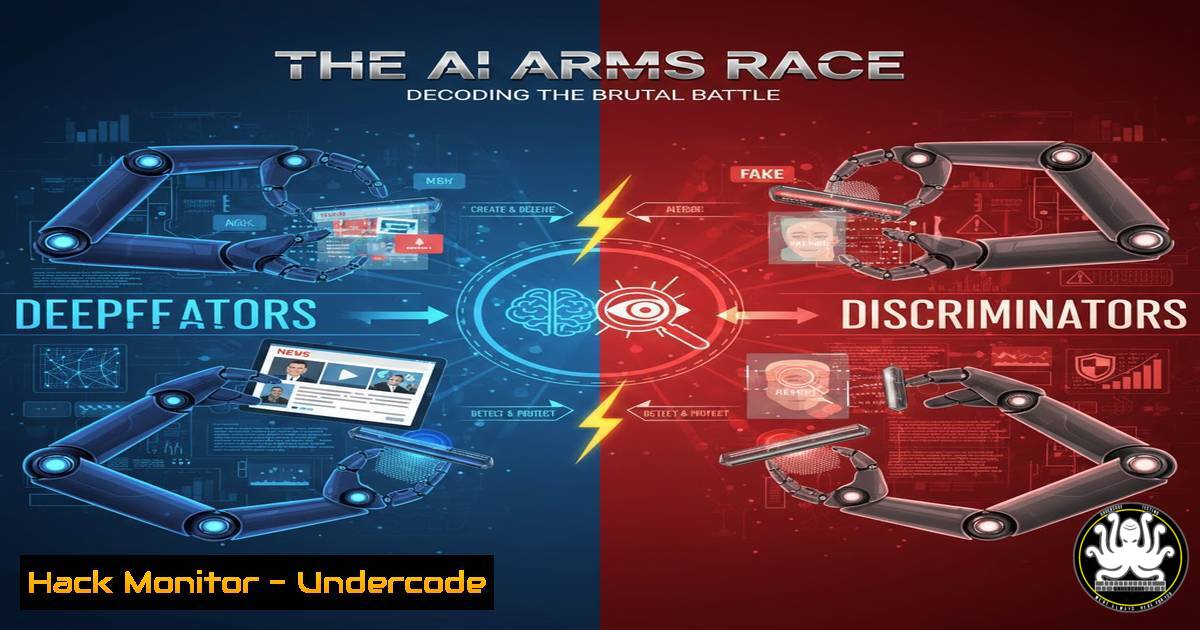
The digital landscape is now a battleground where generative AI models create hyper-realistic forgeries and discriminators fight to expose them. This adversarial competition, rooted in Generative Adversarial Networks (GANs), is escalating the threat of deepfakes in cybercrime, misinformation, and fraud. Understanding this core mechanism is no longer optional for cybersecurity professionals tasked with defending digital integrity.
Learning Objectives:
- Understand the fundamental GAN architecture powering the deepfake arms race and its security implications.
- Learn to implement and use open-source detection tools and commands for forensic analysis.
- Apply cryptographic verification standards as a proactive mitigation strategy against synthetic media.
You Should Know:
- The Adversarial Core: How GANs Fuel the Deepfake Engine
The deepfake creation process is an automated AI duel. A Generator neural network creates synthetic images or video frames, while a Discriminator network attempts to classify them as real or fake. They are trained simultaneously: the generator learns to produce more convincing outputs to fool the discriminator, and the discriminator becomes better at detection based on its mistakes. This adversarial loop rapidly improves the quality of forgeries.
Step-by-Step Guide to a Basic GAN Framework:
While creating deepfakes is unethical, understanding the code illustrates the threat. Here is a simplified TensorFlow/Keras snippet for educational purposes:
 Import core libraries
import tensorflow as tf
from tensorflow import keras
from tensorflow.keras import layers
import numpy as np

Define the Generator model
def build_generator(latent_dim):
model = keras.Sequential([
layers.Dense(128, input_dim=latent_dim),
layers.LeakyReLU(alpha=0.2),
layers.Dense(256),
layers.LeakyReLU(alpha=0.2),
layers.Dense(784, activation='tanh'),  Output image pixels
layers.Reshape((28, 28))  Output shape
])
return model

Define the Discriminator model
def build_discriminator(img_shape):
model = keras.Sequential([
layers.Flatten(input_shape=img_shape),
layers.Dense(256),
layers.LeakyReLU(alpha=0.2),
layers.Dense(128),
layers.LeakyReLU(alpha=0.2),
layers.Dense(1, activation='sigmoid')  Real/Fake probability
])
return model

Compile the combined GAN
latent_dim = 100
img_shape = (28, 28)
discriminator = build_discriminator(img_shape)
discriminator.compile(loss='binary_crossentropy', optimizer='adam', metrics=['accuracy'])
generator = build_generator(latent_dim)
discriminator.trainable = False  Freeze discriminator during generator training
gan_input = keras.Input(shape=(latent_dim,))
gan_output = discriminator(generator(gan_input))
gan = keras.Model(gan_input, gan_output)
gan.compile(loss='binary_crossentropy', optimizer='adam')
This framework shows the competing loss functions that drive the improvement of both networks, mirroring the ongoing arms race in the wild.
2. Operational Detection: Deploying Open-Source Deepfake Forensic Tools
Security teams must move beyond manual inspection. Tools like Microsoft’s Video Authenticator or Facebook’s DeepFaceLab detection fork analyze digital “fingerprints” left by AI models, such as inconsistent lighting reflections, unnatural blinking patterns, or spectral artifacts in the frequency domain.
Step-by-Step Guide to Using `deepface` Analysis:
The `deepface` Python library offers accessible detection models.
 Install the library
pip install deepface
from deepface import DeepFace
 Analyze a video or image for deepfake indicators
analysis = DeepFace.analyze(
img_path = "suspect_video_frame.jpg",
actions = ['emotion', 'age', 'race'],  Detector checks for inconsistencies
detector_backend = 'opencv',
enforce_detection = False
)
 Use the DeepFace verification function to compare against a known real source
verification = DeepFace.verify(
img1_path = "known_real.jpg",
img2_path = "suspect_frame.jpg",
model_name = "VGG-Face",
distance_metric = "cosine"
)
print(f"Is it the same person? {verification['verified']}")
print(f"Detection score details: {verification}")
On Linux, use FFmpeg to extract frames for batch analysis:
 Extract frames from a video at 1 frame per second
ffmpeg -i suspect_video.mp4 -vf fps=1 output_frames/frame_%04d.jpg
 Run a Python script to iterate through frames with deepface
for file in output_frames/.jpg; do python3 analyze_frame.py "$file"; done
- Metadata & Hash Verification: The First Line of Defense
Before deploying complex AI, conduct basic digital forensics. Generative models often strip or create inconsistent metadata. Use command-line tools to inspect file integrity.
Step-by-Step Guide for File Forensic Analysis:
On Windows (PowerShell):
 Get detailed file hash using PowerShell
Get-FileHash -Path "C:\Evidence\video.mp4" -Algorithm SHA256
 Inspect basic file metadata
Get-ItemProperty -Path "C:\Evidence\video.mp4" | Select-Object
 Use ExifTool (requires installation) for deep metadata
exiftool "C:\Evidence\video.mp4" | findstr "CreateDate|Software|History"
On Linux:
 Generate SHA256 hash
sha256sum suspect_video.mp4
 Use ExifTool to view all metadata
exiftool suspect_video.mp4
 Look for inconsistencies in creation/modification times
stat suspect_video.mp4
 Check for embedded thumbnails or unusual byte patterns
strings suspect_video.mp4 | head -100
4. API-Based Detection Services for Enterprise Scaling
For organizations, integrating detection APIs into security pipelines automates scanning. Services like Sensity AI (now part of Meta), Truepic, or Microsoft Azure’s Video Indexer offer REST APIs.
Step-by-Step Guide to Integrating a Detection API:
import requests
import json

api_key = "YOUR_API_KEY"
api_endpoint = "https://api.sensity.ai/v2/detect"

headers = {
"Authorization": f"Bearer {api_key}",
"Content-Type": "application/json"
}
 For a video URL
payload = {
"media_url": "https://yourdomain.com/media/suspect_video.mp4",
"mode": "deepfake"
}

response = requests.post(api_endpoint, headers=headers, data=json.dumps(payload))
result = response.json()

if result['status'] == 'completed':
confidence = result['deepfake_score']  e.g., 0.95 = 95% likely synthetic
print(f"Deepfake probability: {confidence}")
 Integrate with SIEM or ticketing system
if confidence > 0.8:
print("ALERT: High-confidence deepfake detected.")
Automate this check in a corporate email security gateway or document upload portal.
5. Cryptographic Attestation: The “Evergreen” Proactive Solution
As highlighted in the source post, reactive detection is a losing game. The sustainable solution is implementing cryptographic content provenance at the point of creation, akin to digital certificates for SSL/TLS that secured online banking. Standards like the Coalition for Content Provenance and Authenticity (C2PA) allow for signing media with a tamper-evident certificate.
Step-by-Step Guide to Verifying C2PA Metadata:
While creation requires specialized software, verification can be built into browsers and OS.
 Using the 'c2patool' (hypothetical example - tools emerging)
 To verify a signed image
c2patool verify image.jpg --public-key https://keys.camera-maker.com/key.pub
 Expected output includes:
 - Provenance: Created by Camera Model XYZ
 - Timestamp: 2024-01-15T10:30:00Z
 - Edits: None / Cropped (specified)
 - Signature: VALID
Windows users could right-click a file > Properties > Digital Signatures to see C2PA attestation in the future.
What Undercode Say:
- The Defender’s Dilemma is Unsustainable: Relying solely on AI discriminators creates a reactive, resource-intensive cat-and-mouse game. The generator only needs to succeed once, while the detector must be right every time.
- Shift Left to Cryptographic Provenance: The long-term mitigation lies in “shifting left” in the security lifecycle. Integrating hardware- and software-based signing at the capture device (cameras, phones) creates an unbroken chain of trust, making authenticity a default feature rather than a forensic challenge.
Analysis: The post correctly identifies the core adversarial dynamic and astutely points to pre-1990s cryptography as the conceptual blueprint for a solution. However, the transition period will be perilous. Legacy unsigned media will persist for decades, forcing a hybrid approach: advanced AI detection for older content and ubiquitous cryptographic verification for new media. Regulations will eventually mandate provenance for news, political ads, and financial communications, creating a new market for trusted hardware and PKI (Public Key Infrastructure) for consumer devices. The organizations that start integrating verification requirements into their procurement and development lifecycles today will be ahead of both the threat and the coming compliance curve.
Prediction:
Within 3-5 years, we will see mandated C2PA-style signing for all media from major news and social platforms, creating a two-tiered internet: “verified” and “unverified” content streams. Deepfake technology will simultaneously become commoditized in criminal-as-a-service markets, leading to an explosion of personalized phishing and extortion campaigns. The decisive factor won’t be the superiority of one AI model over another, but the widespread adoption of the cryptographic trust layer that makes the discriminator’s job obsolete for officially sourced media.
▶️ Related Video (76% Match):
🎯Let’s Practice For Free:
IT/Security Reporter URL:
Reported By: Juneklein Everybody – Hackers Feeds
Extra Hub: Undercode MoN
Basic Verification: Pass ✅


