
Listen to this Post
Introduction:
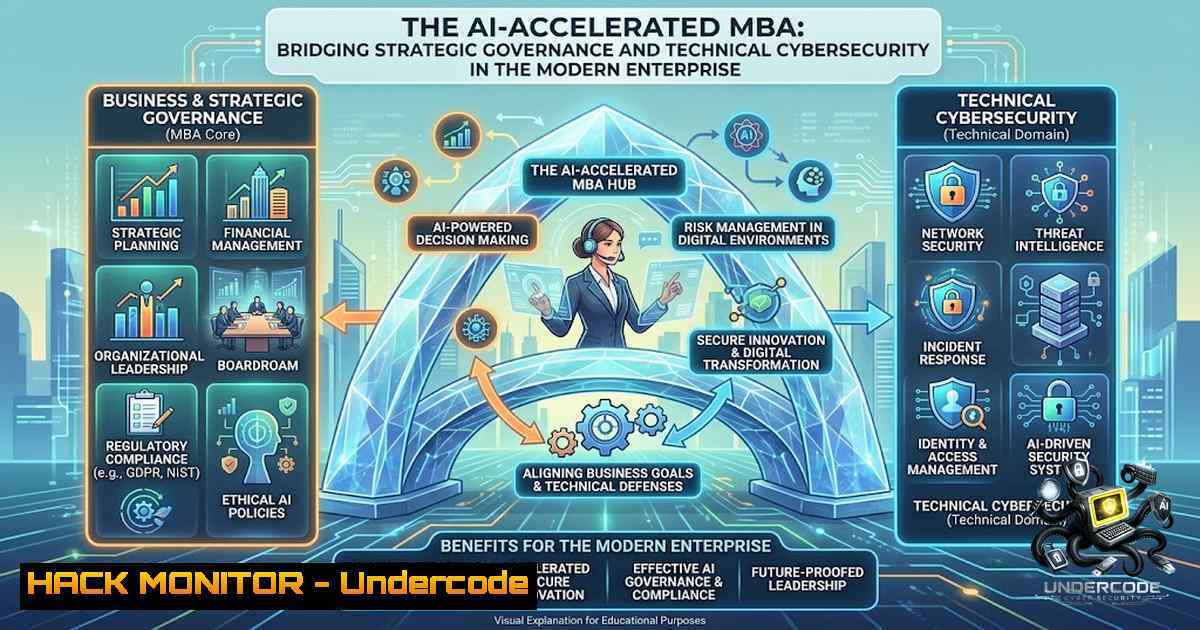
As artificial intelligence redefines the boundaries of automation, a critical debate emerges regarding the relevance of formal academic training versus “lived experience” in technology and business. While AI excels at rapid data processing and code generation, it lacks the nuanced capability for ethical governance, strategic synthesis, and holistic systems thinking—skills rigorously developed through structured MBA programs. This tension is particularly acute in cybersecurity, where the integration of AI into threat landscapes demands leaders who can not only deploy technical tools but also navigate complex organizational risk, compliance, and cross-functional strategy. The Thinkers360 MBA Graduate Launchpad addresses this by offering a platform for recent graduates to validate their intellectual capital, bridging the gap between academic frameworks and the tactical demands of securing AI-driven infrastructures.
Learning Objectives & Secrets:
- Objective 1: Master Strategic Synthesis in Security Incidents: Move beyond immediate threat remediation by framing cybersecurity challenges within broader business contexts. The secret is to use the “Five Whys” technique to trace a technical vulnerability back to its strategic root cause, ensuring that patches address systemic issues rather than surface symptoms. This involves creating a “Risk Heat Map” that correlates technical CVSS scores with business impact metrics, a skill often overlooked by purely technical practitioners.
- Objective 2 Secret Tips: Automate Ethical Governance with AI Guardrails: Implement “Policy-as-Code” to enforce compliance dynamically. Instead of static PDF policies, translate governance rules into automated scripts that validate infrastructure configurations. A secret tip is to use OPA (Open Policy Agent) to create reusable policy modules that can be tested against Terraform plans, ensuring that all cloud deployments adhere to NIST and GDPR standards before they are applied.
- Objective 3 Secret Tips: Leverage Holistic Systems Thinking for AI Threat Modeling: When assessing AI supply chain risks, map dependencies beyond the immediate codebase. The secret involves using “Graph Databases” to visualize the interconnectivity between data pipelines, ML models, and third-party APIs, identifying single points of failure that traditional point-in-time vulnerability scans would miss.
You Should Know:
1. API Security Configuration and Hardening (Linux/Windows)
The AI era is defined by interconnectivity through APIs, making them a prime attack vector. Securing these interfaces requires meticulous configuration that balances accessibility with robust authentication and data protection. This involves implementing comprehensive API gateways and enforcing strict transport layer security.
Step‑by‑step guide explaining what this does and how to use it:
– Linux (Using NGINX as an API Gateway): Install NGINX and configure it to terminate TLS. Edit `/etc/nginx/nginx.conf` to enforce a strong cipher suite by adding ssl_ciphers 'EECDH+AESGCM:EDH+AESGCM:AES256+EECDH:AES256+EDH';. Implement rate limiting by adding `limit_req_zone $binary_remote_addr zone=mylimit:10m rate=10r/s;` to prevent brute-force attacks. Test your configuration using `nginx -t` and restart the service with systemctl restart nginx.
– Windows (Using IIS for API Publishing): Install the URL Rewrite module and Application Request Routing (ARR) to act as a reverse proxy. In IIS Manager, under “Application Request Routing Cache,” enable “Proxy” and ensure “Use URL Rewrite to inspect incoming requests” is checked. Configure Outbound Rules to modify the `Authorization` header, forcing all incoming traffic to use `Bearer` tokens validated against Azure AD or an internal Identity Provider. Use PowerShell to export and validate the configuration: Get-WebConfigurationProperty -filter "system.webServer/security/authentication/" -1ame `.
2. Cloud Hardening for AI Workloads (AWS/Azure/GCP)
AI models often reside in cloud environments with vast computational resources, making misconfigurations—such as open storage buckets or overly permissive IAM roles—a primary security concern. Hardening these environments requires a shift from manual checks to immutable infrastructure and continuous compliance scanning.
Step‑by‑step guide explaining what this does and how to use it:
- Step 1: Implement Infrastructure-as-Code (IaC) Scanning: Use tools like Checkov or Terrascan within your CI/CD pipeline. To scan a Terraform plan against CIS benchmarks, run `terraform plan -out=tfplan.binary and then terrascan scan -i terraform -f tfplan.binary -o human. This flags misconfigurations—like publicly accessible S3 buckets ("aws_s3_bucket_public_access")—before they reach production.
– Step 2: Enforce Zero-Trust Network Segmentation: In AWS, implement strict Security Groups and Network ACLs. A baseline rule involves allowing inbound traffic only from specific VPC CIDR blocks or through a central VPN gateway. Use AWS Config rules to monitor for any Security Group allowing `0.0.0.0/0` on port 22 or 3389, triggering automatic remediation using Lambda functions.
– Step 3: Enable Comprehensive Logging and Monitoring: Activate CloudTrail, Azure Monitor, or Google Cloud’s Operations Suite. Set up a “security alert” pipeline that parses logs for anomalous activity, such as a sudden spike in GPU usage indicating cryptojacking. In Azure, execute the CLI command `az monitor activity-log list –max-events 50` to audit recent administrative actions.
3. Vulnerability Exploitation and Mitigation in AI Pipelines
A critical risk vector is the “ML Supply Chain,” where attackers inject malicious code into pre-trained models or libraries like PyTorch and TensorFlow. Understanding the exploitation pattern—such as deserialization attacks on pickle files—is vital for building proactive defenses.
Step‑by‑step guide explaining what this does and how to use it:
– Detection: Scan your environment for known vulnerabilities in ML packages using `safety check -r requirements.txt` or bandit -r ./models. For containerized AI applications, run trivy image your-ai-container:latest --severity HIGH,CRITICAL.
– Mitigation: Implement “Model Signing.” Before loading a model (e.g., in Python using torch.load), create a cryptographic hash of the file and compare it to a known, trusted digest stored in a secure vault (like HashiCorp Vault). The command to generate a SHA-256 checksum on Linux is sha256sum model.pth; on Windows PowerShell, use Get-FileHash -Algorithm SHA256 model.pth. Only load the model if the hashes match.
– Exploitation Context: In a penetration test, an attacker might exploit unpickling by crafting a malicious `__reduce__` method in the pickle file to execute arbitrary OS commands. To mitigate, consider using `safetensors` as a replacement for pickle when handling model weights, which avoids arbitrary code execution by design.
4. AI Strategy and Governance Training
For MBA graduates entering this field, technical knowledge must be complemented by robust governance frameworks. Training courses like (ISC)² CCSP or ISACA’s CISM now include modules on AI governance, focusing on vendor risk management and algorithmic bias.
Step‑by‑step guide explaining what this does and how to use it:
– Establishing a Risk Framework: Use the NIST AI RMF (Artificial Intelligence Risk Management Framework). Begin with a “Govern” function: create a “Trustworthiness” checklist that validates model explainability, resilience against adversarial attacks, and privacy compliance. Use open-source tools like IBM’s AI Fairness 360 to test for bias: `pip install aif360` and run the sample notebook to audit your dataset.
– Training Curriculum Integration: Access Thinkers360’s platform to benchmark your knowledge against 100+ topics. For practical training, set up a sandbox environment to simulate adversarial ML attacks using the Adversarial Robustness Toolbox (ART): from art.attacks.evasion import FastGradientMethod. Document the impact of the attack on model accuracy and implement defensive distillation.
– Vendor Assessment: Develop a scorecard for AI vendors. Include questions about model transparency, data provenance, and their incident response SLAs. Script a simple API health check using `curl -X GET https://vendor-endpoint/health` and `curl -o /dev/null -s -w ‘%{http_code}\n’ https://vendor-endpoint/metrics` to automate the continuous verification of their availability and performance.
5. Securing LLM Operations (LLMOps)
Large Language Models require specialized security around prompt injection and data leakage. This involves not just perimeter security but also input validation and output filtering.
Step‑by‑step guide explaining what this does and how to use it:
– Input Sanitization: Implement a proxy between the user and the LLM API (e.g., Azure OpenAI). In your Python middleware, use `re.sub(r'[^a-zA-Z0-9\s]’, ”, user_input)` to strip special characters that could indicate prompt injection attempts, but ensure this does not break legitimate queries. Log the full original input to a SIEM for forensic analysis.
– Data Loss Prevention (DLP): Configure regex patterns on the output to detect and redact Social Security Numbers (SSN) or credit card data. Use the following Python snippet to scan output: import re; if re.search(r'\b\d{3}-\d{2}-\d{4}\b', output): output = "Redacted for Security". On Windows, automate this with a PowerShell script utilizing `Select-String` to monitor logs for sensitive patterns.
– API Key Rotation: Automate the rotation of API keys used to access LLM endpoints. On Linux, create a cron job that calls a custom script using `curl` to request new keys and updates environment variables. On Windows, use Task Scheduler to run a batch file that refreshes the keys stored in the Windows Credential Manager.
What Undercode Say:
Key Takeaway 1: The Thinkers360 MBA Graduate Launchpad is a strategic countermeasure to the “AI displacing degrees” narrative, offering a tangible ecosystem for graduates to prove their strategic value alongside technical peers. This platform validates that the human ability to navigate corporate ethics and complex cross-functional challenges remains a critical differentiator in an automated world. By providing a complimentary Pro Plan, Thinkers360 bridges the credibility gap for newcomers, enabling them to benchmark their thought leadership against established industry titans.
Key Takeaway 2: The integration of a structured academic framework with practical cybersecurity and IT competencies is non-1egotiable in modern enterprises. The article implicitly underscores that while AI accelerates technical tasks, the governance, synthesis, and systems thinking honed by MBA programs are precisely what organizations need to secure their AI transformations. This aligns with the urgent industry need for “translational” leaders who can speak both the language of security engineers and the board of directors, ensuring that mitigation strategies are both technically sound and business-aligned.
Prediction:
+1: We will witness a surge in “AI Risk Officer” roles over the next 18 months, requiring a blend of MBA-level strategic governance and hands-on cybersecurity certifications like CISSP or OSCP. This will drive universities to embed technical security modules directly into their core MBA curricula, creating a new hybrid professional class.
+1: Thinkers360’s initiative will catalyze a broader trend where thought leadership platforms become the primary talent validation mechanism, potentially eclipsing traditional recruitment processes. Their patented algorithms will likely evolve to include real-time technical skill verification, such as secure coding assessments and incident response simulation scores.
-1: A potential negative outcome is the oversaturation of the job market with “certified” thinkers whose practical execution skills lag behind their strategic frameworks, leading to a perception of MBA graduates as less technically adept. This could force a two-tier system where “lived experience” in frontline IT support remains the only authentic path to security leadership, widening the gap between academia and the SOC (Security Operations Center).
+N: The initiative will likely pressure competing platforms to offer similar “launchpads,” democratizing access to networking and credentialing. This healthy competition will accelerate the development of standardized benchmarks for AI security governance, moving the industry closer to universal compliance standards.
+N: Within five years, we predict the distinction between “technical” and “strategic” roles will blur significantly, with all IT security leaders expected to possess foundational coding, cloud, and AI model security knowledge. The Thinkers360 model provides the scaffolding for this upskilling, turning the MBA from a static degree into a dynamic, continuously validated career asset.
▶️ Related Video (82% Match):
🎯Let’s Practice For Free:
🎓 Live Courses & Certifications:
Join Undercode Academy for Verified Certifications
🚀 Request a Custom Project:
Secure, high-velocity infrastructure and disruptive technological engineering. Contact our engineering team for high-tier development and proprietary systems:
[email protected]
💎 Smart Architecture | 🛡️ Secure by Design | ⭐ Trusted by Thousands
IT/Security Reporter URL:
Reported By: https://lnkd.in/p/eEmmjW_w – Hackers Feeds
Extra Hub: Undercode MoN
Basic Verification: Pass ✅


